Search This Blog

Sunday, October 7, 2018

Blackberry has healthcare apps for Spark platform, blockchain ledger


  • BlackBerry is looking to leverage its new Spark “enterprise of things” platform to improve patient care with partnerships and customer-driven projects.
  • The company will use its network operation center to power a blockchain ledger to securely store and share medical data. The digital ledger was developed by Cape Town, South Africa, biotech incubator ONEBIO.
  • The mobile device pioneer has also developed a real-time operating system for developing robotic surgical instruments, patient monitoring systems, infusion pumps and other connected medical devices. QNX OS for Medical 2.0 is certified to international safety standard IEC 62304, the company said.

With Thursday’s announcement, BlackBerry boosts its stake in healthcare. The company, which has struggled in recent years with declining mobile phone sales, acquired a minority interest in NantHealth in 2014, with plans to help the tech firm build a platform connecting medical devices at hospitals in India. However, its healthcare activity has been nowhere as visible companies like Google, Apple and IBM.
Still, blockchain, data security and IoT are all garnering lots of attention, so it will be interesting to see how BlackBerry fares against the competition. Providers have signaled their willingness to invest in these types of services, though barriers to widescale adoption remain, such as identifying clinical use cases.
“We are applying out expertise in security, data privacy, and communication work in regulated industries such as automotive, financial services, and government to tackle one of the biggest challenges in the healthcare industry: leveraging healthcare endpoints to improve patient outcomes while ensuring security and data privacy,” John Chen, executive chairman and CEO of Blackberry, said in a statement.
The blockchain ledger will initially be used by the Global Commission to End the Diagnostic Odyssey for Children with a Rare Disease, which was created by Shire Pharmaceuticals, Microsoft and EURORDIS-Rare Diseases Europe. BlackBerry said one of the group’s technology pilots will explore the blockchain’s ability to provide real-time, actionable analysis to shorten time to diagnosis.
BlackBerry is also partnering with the Mackenzie Innovation Institute, part of Ontario-based Mackenzie Health, to explore security and connectivity between its new Spark platform and Mi2’s “smart” healthcare technology efforts.

CMS to post more hospital accrediting information online


  • CMS said Thursday it will make some changes to its oversight of hospital accrediting organizations, including making more information publicly available and piloting direct observation of surveys.
  • Data on evaluation of the organizations will be posted online, along with annual reports, in an effort “to increase transparency for patients on the organizations’ performance,” the agency said in a press release.
  • In the pilot program, CMS will replace state validation surveys with direct observation during original AO assessments “to evaluate AO performance more effectively” and “suggest improvements and address concerns with AOs immediately.” The agency touted the new method as cutting back on duplicative regulation by allowing providers to forgo follow-up assessments.

This isn’t the first time CMS has attempted to make the hospital accreditation process more public. Late last year the agency rolled back plans to make public reports from accrediting organizations, saying it could be construed as an attempt to circumvent federal law barring release of third-party audit results.
The American Hospital Association didn’t outright oppose the proposal at the time, but did question whether details of inspections should be public. AHA said Friday it was reviewing the latest announcement and did not have an immediate comment.
The Wall Street Journal reported in September 2017 on the rarity of revoked or altered accreditation despite identified safety violations. About 350 hospitals maintained their status with the Joint Commission (which evaluates 80% of hospitals) in 2014 despite such problems, according to the investigation.
Congress has stepped in to question CMS and the accrediting organizations over their rigor. The House Energy and Commerce Committee announced in March it “is conducting oversight to ensure that patient safety is being provided for, and that federal standards are being adhered to, in hospitals participating in the Medicare and Medicaid programs.”
The committee sent questions to CMS, The Joint Commission, the Bureau of Healthcare Facilities Accreditation, the Center for Improvement in Heatlhcare Quality and DNV GL Healthcare.
CMS said the accrediting information it will begin posting online will include the care quality deficiency findings from complaint surveys, a list of providers the agency determines to be out of compliance and those providers’ AOs and overall performance data for the AOs themselves.
View image on Twitter
Administrator Seema Verma
✔@SeemaCMS
“Today we are taking action to improve our oversight of Accrediting Organizations, including increasing transparency for patients on the organizations’ performance.” https://go.cms.gov/2zS3bTw

CMS tweaks local coverage policy to speed access to medical devices


  • Medicare Administrative Contractors (MAC) tasked with deciding what medical technologies qualify for Medicare coverage in local geographical areas will now be required to publish a summary of clinical evidence supporting their decisions, include a beneficiary representative and non-physician healthcare workers on advisory committees, and ensure that Contractor Advisory Committee meetings are open to the public.
  • The changes, promulgated by CMS on Wednesday, come in response to Section 4009 of the 21st Century Cures Act. Separately, the House passed legislation in September aiming to change how Local Coverage Determinations are made, with strong backing from the medical device industry.
  • CMS Administrator Seema Verma says that the changes will help speed new medical technologies to patients, but AdvaMed and key Republican lawmakers say more should be done.

Local Coverage Determinations are made by MACs when a national coverage determination has not yet been made or when a national policy needs to be clarified to address local differences in the practice of medicine.
“Coverage decisions will be made more transparently with an explanation of the clinical evidence that supports them, and with input from beneficiaries who are affected,” Verma said in a statement.
AdvaMed praised CMS for implementing the changes, saying they would “improve transparency and consistency.”
“Having a more open LCD meeting process for MACs and requiring them to provide rationales for their decisions will help allow for greater stakeholder engagement and a fairer process, and ensure that no Medicare beneficiaries are denied access to life-changing innovations because of bureaucratic impediments,” Don May, AdvaMed EVP of payment and healthcare delivery policy, told MedTech Dive in a statement.
The recently passed House bill, the Local Coverage Determination Clarification Act of 2018, would require local private insurers to undertake feedback processes before issuing a determination and post a rationale for a final determination online.
Companion legislation in the Senate, sponsored by Sen. Jonny Isakson, R-Ga., has yet to gain traction in the Finance Committee. It appears Isakson is not satisfied with the changes CMS is undertaking.
“Senator Isakson feels there is more work to be done in this space, and the bill he introduced is still needed to create a fair and transparent process for the issuing of Local Coverage Determinations (LCDs). We were pleased to see the U.S. House move on their version of the bill, and we are working closely with the Senate Finance Committee on a path forward for Senator Isakson’s legislation,” Isakson’s communications director Amanda Maddox told MedTech Dive in a statement.
Finance Committee Chairman Orrin Hatch, R-Utah, will work with Isakson and other lawmakers to consider if the CMS policy may affect the legislation and solicit stakeholder feedback on the CMS policy changes, committee spokesperson Nicole Hager told MedTech Dive.
AdvaMed CEO Scott Whitaker said that while the CMS actions are commendable, more should be done.
Scott Whitaker@ScottWMedTech
CMS’s actions today are a solid step toward addressing concerns from the MedTech industry regarding the local coverage process (LCD). @SeemaCMS@CMSGov
Scott Whitaker@ScottWMedTech
The MedTech community has been hopeful to see even more in this space to unleash the power of breakthrough technologies. We are ready to work with CMS to find additional solutions to ensure America’s seniors have improved access to new innovations. @SeemaCMS @CMSGov
Industry is lobbying CMS to quickly speed Medicare coverage of breakthrough devices that are cleared by FDA. CMS and the Office of Management and Budget both appear to be open to the idea, but a concrete timeline for a pilot program or other action remains unclear.

Sarepta, Nationwide Childrens Hospital Agree on Gene Therapy Plan Rights


Sarepta Therapeutics, Inc. (NASDAQ:SRPT), a commercial-stage biopharmaceutical company focused on the discovery and development of precision genetic medicine to treat rare neuromuscular diseases, announced today it has signed an agreement with Nationwide Childrens Hospital (Nationwide Childrens) giving Sarepta the exclusive option to a Nationwide Childrens gene therapy candidate, neurotrophin 3 (NT-3), to treat Charcot-Marie-Tooth (CMT) neuropathies, including CMT type 1A. CMT is a group of hereditary, degenerative nerve diseases that can affect motor skills, resulting in muscle weakness, and limiting patients ability to walk or use their hands. CMT is the most common inherited neuromuscular disorder, affecting over 2.8 million people worldwide. CMT type 1A is most often caused by an extra copy of the PMP22 gene, and affects approximately 50,000 patients in the U.S. alone. Currently, there are no available treatment options.
The clinical trial to test NT-3 gene therapy is planned to commence dosing in 2019 for CMT type 1A. The delivery of the NT-3 gene may have applicability to other sub-types of CMT in addition to other muscle-wasting diseases. Pre-clinical research has shown the ability of the NT-3 gene construct to regenerate nerves. Further research is under way to explore its potential.
Dr. Zarife Sahenk, M.D., Ph.D. is the founder of the NT-3 program at Nationwide Childrens. Over the past 15 years, Dr. Sahenk has accumulated a large body of evidence to support the efficacy of neurotrophin NT-3 to improve nerve regeneration and myelination, associated with increased Schwann Cell (SC) survival and differentiation along with the normalization of axonal neurofilament (NF) cytoskeleton.
Dr. Sahenk is an attending neurologist at Nationwide Children`s, Director of Clinical and Experimental Neuromuscular Pathology at The Research Institute at Nationwide Children`s and Professor of Pediatrics, Pathology and Neurology at The Ohio State University College of Medicine, and a lead researcher in the anatomical and molecular basis of nerve degeneration and impaired regeneration in hereditary peripheral neuropathies.

Should FDA Treat Rare Disease Drugs Differently?


Drugmakers and other experts in the rare disease space urged senators to pressure the FDA to adopt a more flexible approach to the approval process for drugs intended for patients with rare or orphan diseases.
Orphan diseases are those that affect fewer than 200,000 patients. Most of these illnesses are “serious or life-threatening” and most have no FDA-approved treatment, said Sen. Rand Paul, MD (R-Ky.), during a subcommittee hearing of the Senate Health, Education, Labor and Pensions (HELP) Committee on Wednesday.
“The standard for approval for orphan drugs is similar, if not the same, as those for more common conditions. It can take upwards of a decade, sometimes, for a drug to make it from the bench to bedside, and costs can be upwards of $2 billion,” Paul said.
Because families with terminal patients can’t afford to wait for drugs to be approved, they may import drugs from other countries, take medicines off-label, or procure chemical-grade products that may be unsafe for pharmaceutical use, Paul said.
Congress has provided the FDA with “numerous tools” to speed approvals and continually increased the agency’s funding, but review times haven’t grown shorter, Paul said.
At Wednesday’s hearing, physicians, advocates and industry experts shared the barriers they face in bringing new drugs to treat rare diseases to market and proposed solutions.
“The bottom line is that we need more effective methods and pathways for drug approval for rare and ultra-rare diseases,” said Marc Patterson, MD, a professor of neurology, pediatrics, and medical genetics for the Mayo Clinic in Rochester, Minn., who advocated sweeping changes in legislation.
“What we hope to get is legislation that enables and directs the FDA to adopt specific approaches to dealing with rare diseases. To recognize they’re different. To recognize the rules that apply for common diseases don’t work,” he told MedPage Today after the hearing, when asked about his goals.
Rare Diseases are Different
Lincoln Tsang, PharmD, JD, a London-based partner at law firm Arnold & Porter Kaye Scholer, told MedPage Today the FDA needs to appreciate the context in which drugs for rare disease are being tested — which is that “there’s no drug available,” he said. “Those patients will die eventually.”
One challenge Mark Dant, chair of the EveryLife Foundation for Rare Diseases in Louisville, Kentucky, noted is that trial designs are often too narrow for patients to participate and the clinical endpoints are often very precise.
Patterson said challenges also include the already small potential pool of participants, the wide variations of symptoms, and the difficulty in measuring the effect of a drug, since traditional measures aren’t always appropriate.
Assembling a well-matched cohort of patients for controlled trials is “well nigh impossible,” Patterson said.
One solution is legislating a “menu” of options for alternative and adaptive trial designs specifically for rare diseases, Patterson said, with a smaller number of patients, perhaps 50 to 100.
Borrowing Trial Data
A second strategy Patterson urged is to have the FDA leverage data from well-controlled clinical trials “wherever they’re conducted” instead of “wasting time” duplicating the same studies state-side.
Michael Strupp, MD, professor of Neurology for the University of Munich, agreed.
If a drug is approved by the FDA, the European Medicines Agency (EMA) should approve it and vice versa, he told MedPage Today.
“That saves a lot of money, a lot of resources and there’s also much faster approval,” Strupp said.
Due to his own legislative efforts, Paul said in his opening remarks, the FDA already has the authority to accept data from other countries, but “duplicative testing and trials are still required in order to bring most drugs to market.”
“It’s still my belief that whether it’s an orphan drug or any drug… the modern civilized world is an enormous world of medicine and science now and we’re crazy to stop it at the border and say you have to Americanize all of the studies,” Paul added later.
A third recommendation Patterson put forward is to require the FDA to work with families, academic medicine, industry and other international regulatory agencies to create disease registries, containing secure patient data.
The registries can be used to enhance researchers understanding of the natural history of a disease, to develop outcome measures, and to support clinical trials.
Tsang noted that FDA regulations already include certain flexibilities, the question is whether they will test them, and be “a bit bolder.”
Reward Drugmakers
Dant, whose son Ryan was born with mucopolysaccharidosis I, advocated for Congress to pass legislation to provide incentive payments to drug companies for testing already approved products in rare diseases.
A bill known as The Open Act would achieve such an aim by extending the exclusivity period for a drug or biologic if the drug is also approved to prevent, diagnose or treat a rare or orphan disease.
Already many patients, including his son, are taking these medications off-label without the appropriate safety, efficacy and dosing information, and many pay out-of-pocket because their treatments aren’t covered by insurers.
Dant also pressed congress to pass bills to ensure coverage of genomic sequencing.
Previous Efforts
The Orphan Drug Act of 1983, the first federal move effort to promote research for rare diseases, provided grants to help offset the costs of research and development, and granted drugmakers 7 years of exclusivity, noted Sen. Bob Casey (D-Pa.)
More recently, he and other senators helped to establish the Rare Pediatric Disease Priority Review Voucher, which rewards drug development in the rare disease space by providing drug companies with vouchers that can be used to shorten the review time of another drug. The vouchers can also be sold and the money then reinvested in the company, Casey explained.
And in 2016, the Senate passed the 21st Century Cures Act that required the FDA to publish guidance on how to use adaptive trial designs and Bayesian methods for clinical trials. Draft guidance was released last month, Casey said.
The agency also recently published produced a “master protocol” allowing the use of use a single clinical trial to evaluate multiple drug candidates, multiple disease types and more than one patient population in the same clinical trial.
“I really want to get a result,” Paul said at the close of the hearing, suggesting the collaboration with witnesses continue. He also voiced the possibility of updating the Orphan Drug Act with a “separate track” or a “different design.”

Saturday, October 6, 2018

Discounting Future Cash Flows: The Buffett/Munger Approach


Over the years, Warren Buffett and Charlie Munger have articulated an approach to discounting at odds with academic finance.
Buffett and Munger eschew complicated math and spreadsheets in favor of simple mental models.
Buffett says that he frequently uses the risk-free rate to discount future cash flows, not some abstract cost of equity.
Everything comes back to opportunity costs, but not in the way the academic finance supposes.
Occasionally I get questions and comments on my use of the risk-free rate (i.e. the interest rate on U.S. Treasury securities) to discount future cash flows. Such inquiries are definitely justified, seeing as my method runs counter to the discounted cash flow (NYSE:DCF) models typically taught in business programs all over the country. The standard approach specifies a “cost of capital,” which ostensibly includes a “risk premium.” Why, then, would I be satisfied using an opportunity cost equivalent to a low-yield government bond – which, of course, results in a much higher present value?
Not to appeal to authority, but this position has already been articulated by none other than the Oracle of Omaha himself. Just how exactly does Warren Buffett discount future cash flows – a key component of stock valuation? Surprisingly, this wonky topic is rarely brought up in interviews, but Buffett and Charlie Munger have sprinkled around some nuggets of wisdom over the years. Here I will review some of their comments and explain the approach in context.

False Sense of Precision

Buffett and Munger have been vocal in their criticism of academic finance. To quote one of Munger’s many famous zingers:
Munger: Some of the worst business decisions I’ve seen came with detailed analysis. The higher math was false precision. They do that in business schools, because they’ve got to do something.
Buffett followed up with a reference to Aesop, whom he frequently quotes as a font of basic investment advice.
Buffett: The priesthood has to look like they know more than “a bird in the hand.” You won’t get tenure if you say “a bird in the hand.” False precision is totally crazy. The markets saw it in the Long-Term Capital Management [hedge fund] in 1998. It only happens to people with high IQs.
While Buffett accepts the principle of discounting cash flows, Charlie Munger says that he has never seen him perform a formal DCF analysis.
Munger: Warren often talks about these discounted cash flows, but I’ve never seen him do one. If it isn’t perfectly obvious that it’s going to work out well if you do the calculation, then he tends to go on to the next idea.
Buffett: It’s true. If [the value of a company] doesn’t just scream out at you, it’s too close.
Source: Buffett FAQ
The value investor Joel Tillinghast advocates the use of a simple perpetual annuity formula, which shows the present value of a cash flow that stays constant forever, as a quick way of valuing a security. The equation merely consists of earnings divided by an interest rate.
The math behind discounting is not terribly complicated. The real trick is judging whether or not those cash flows will actually materialize, which is more of a qualitative exercise. This is where the science and art of investing blend together, and many high-IQ people probably find it easier to simply ignore the creative element.

Using the Risk-Free Rate

In Buffett’s view, it is foolish to account for risk by fiddling with the discount rate. For one, it only makes sense to “deal with things about which we are quite certain.” Buffett is only interested in opportunities where the probability of actually getting those future cash flows is as close to 100 percent as possible. In that case, it is appropriate to discount the cash flow using a risk-free rate.
Buffett: In a world of 7% long-term bond rates, we’d certainly want to think we were discounting the after-tax stream of cash at a rate of at least 10%. But that will depend on the certainty that we feel about the business. The more certain we feel about the business, the closer we’re willing to play. We have to feel pretty certain about anything before we’re even interested at all. But there are still degrees of certainty. If we thought we were getting a stream of cash over the thirty years that we felt extremely certain about, we’d use a discount rate that would be somewhat less than if it were one where we expected surprises or where we thought there were a greater possibility of surprises.
Moreover, using a single discount rate allows Buffett to compare the innumerable investing opportunities that cross his desk every day.
Buffett: In order to calculate intrinsic value, you take those cash flows that you expect to be generated and you discount them back to their present value – in our case, at the long-term Treasury rate. And that discount rate doesn’t pay you as high a rate as it needs to. But you can use the resulting present value figure that you get by discounting your cash flows back at the long-term Treasury rate as a common yardstick just to have a standard of measurement across all businesses.
Rather than include a “risk premium” in his discount rate, he simply buys businesses at a large discount from calculated intrinsic value.
Shareholder: Following up on that other question – if you don’t adjust for risk by using higher discount rates, how do you adjust for risk – or do you?
Buffett: Well, we adjust by simply trying to buy it at a big discount from the present value calculated using the risk-free interest rate. So if interest rates are 7% and we discount it back at 7% (which Charlie says I never do anyway — which is correct), then we’d require a substantial discount from that present value figure in order to warrant buying it.

Opportunity Cost

In any case, Buffett and Munger are pretty dismissive of the idea that one can even ascertain the cost of capital. Munger, in particular, has made no secret of his disdain for academia’s thoughts on the matter. Here he explains why it makes no sense to evaluate assets in total isolation:
Munger: In the real world, you uncover an opportunity, and then you compare other opportunities with that. And you only invest in the most attractive opportunities. That’s your opportunity cost. That’s what you learn in freshman economics. The game hasn’t changed at all. That’s why Modern Portfolio Theory is so asinine.
Munger: The trouble isn’t that we don’t have one [a hurdle rate] – we sort of do – but it interferes with logical comparison. If I know I have something that yields 8% for sure, and something else came along at 7%, I’d reject it instantly. It’s like the mail-order-bride firm offering a bride who has AIDS – I don’t need to waste a moment considering it. Everything is a function of opportunity cost.
Or, even more succinctly:
Munger: I’ve never heard an intelligent discussion on cost of capital.
One of Buffett’s great strengths is his ability to say “no,” even to otherwise attractive business opportunities. He refuses to jump into something new unless he thinks he can get even better return than what he judges as the best investment at the moment. When investors employ drastically different discount rates for different businesses, it is difficult to compare each company and ascertain which is the best buy.

Case Study: Copart, Inc.

Applying the Buffett/Munger method served me well when I looked at Copart (CPRT) last year. At the time, the company was on track to earn more than $1.60 per share for FY 2017. Copart’s business model revolves around auctioning salvage vehicles wrecked in collisions and natural disasters, so its earnings are solid in both good times and bad. Therefore, the company passed the “certainty” filter with flying colors.
Shares traded at around $30 for less than 19 times earnings, which looked inexpensive for a company generating a return on equity of 30 percent. The annual report clearly explained a growth plan that revolves around infilling the U.S. market and expanding internationally. Copart also simply buys up smaller competitors and folds them into the company’s existing online platform, adding instant value to the acquired firm through network effects. Using the perpetual annuity formula with a 4 percent discount rate, I quickly computed a value of $41 a share.
Once I estimated earnings 10 years out, it was clear that Copart was trading for a very low multiple of the present value of its future cash flow. Indeed, that multiple was lower than every other stock that I was considering at the time. Even though I saw other attractive opportunities in the market, I thought back to Munger’s admonition to “instantly” dismiss them. Rather than dilute a great opportunity with so-so opportunities, as I had done in the past, I just kept buying Copart.
Using a higher discount rate (say, 7 percent) for Copart to account for risk also would have been a terrible mistake. The company’s business risk is much lower than the average firm, so it deserves a much lower rate. Indeed, 7 percent would have given me a present value far below what the shares were changing hands for at the time.
In my first article on the company, I opined that shares were 25 – 50 percent undervalued. Since then, Copart stock is up more than 50 percent to $47 a share after the company smashed expectations for the most recent quarter.

A Few Caveats

Although Buffett has always remained modest and self-deprecating about his investing prowess, there is no question that he is a man of exceptional intelligence. In her biography The Snowball, Alice Schroeder writes how Buffett would often perform obnoxious feats of memory during his college years, frequently annoying professors by quoting long passages of their own work verbatim.
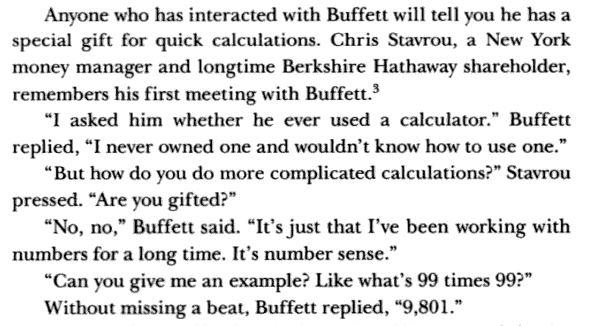
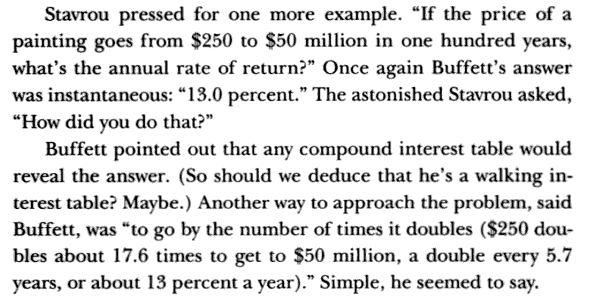
His mathematical ability is also said to be extraordinary. Robert Hagstrom describes a few choice examples of Buffett’s facility with numbers in The Warren Buffett Portfolio.
Despite what Buffett and Munger say about not needing a calculator, I do not think that most investors could be faulted for using simple spreadsheets to compute present value. The two men possess the advantage of being able to intuitively evaluate businesses based on experience, which few people can do. Not everyone can be Warren Buffett – otherwise, we would all be billionaires. Nevertheless, there is a lot to be said for eschewing the complex models and esoteric concepts that are common in academia and professional investment analysis.
So to conclude, I feel very comfortable sticking with a 4 percent discount rate. Even though the 10-year Treasury currently yields 3 percent, I hedge my bets by going with a rate that is closer to the long term average.
However, as former Fed chair Janet Yellen explained, there is a growing consensus among economists that the long run normal rate of interest may be closer to 3 percent. If that is the case, then the stock market is very cheapindeed. As long as investors plan to stay in the market and ride out any turmoil, it would be a terrible mistake to throw away fantastic opportunities by employing an arbitrarily high discount rate.
Of course, a 4 percent rate would not be appropriate for low-quality businesses. As Buffett cautions, he needs to be highly certain about earnings prospects before he is even interested in the first place. In my own investing, I try to minimize risk by identifying businesses with large moats, solid growth prospects, and strong balance sheets.

Mexican president-elect pressures drugmakers to contain prices


Mexican President-elect Andres Manuel Lopez Obrador on Saturday urged pharmaceutical companies in the country to keep prices down or face losing out on government business to competitors abroad.

During a speech in the western city of Morelia, Lopez Obrador said the government was paying too much for medicine. For the budget to be able to provide the public with free medicine, this “corruption” would have to end, he added.
Lopez Obrador, a leftist who takes office on Dec. 1, said he wanted to support the national pharmaceutical industry.
But he warned the industry his government would seek cheaper medicine elsewhere if firms overcharged and acted as “accomplices to corruption.”
“We’ll open the bidding tenders to buy medicine anywhere in the world that they offer better prices,” he added, estimating that the government spent about 100 billion pesos ($5.31 billion) on medicine each year.
Lopez Obrador, 64, won office by a landslide victory in July, and has pledged to slash public waste and corruption.
Separately, the incoming president reiterated that his government would guarantee prices for certain food products, including milk, beans and corn, in order to support farmers.
Milk would be guaranteed at 8.20 pesos per liter, beans at 14,500 pesos per tonne and corn for 5,610 pesos per tonne, he said. “We’re going to pay the producers well,” he added.
($1 = 18.8165 Mexican pesos)