Search This Blog

Thursday, June 13, 2019

Hong Kong IPO will make one of the world’s richest biopharma families

China’s Hansoh Pharmaceutical is slated to go public in Hong Kong on Friday. The HK$7.86 billion ($1 billion) raise puts it among the largest IPOs on the exchange this year. But perhaps what’s more interesting is how the market value will create one of the world’s wealthiest biopharma families.
The IPO values Hansoh at $10.4 billion, and with a 68% stake, its founder, chairwoman and CEO, Zhong Huijuan, will be worth $7.9 billion, according to Bloomberg. But her husband’s company, Jiangsu Hengrui Medicine, is perhaps better known in the Western world. The Shanghai-listed anticancer drugmaker has given Zhong’s husband Sun Piaoyang, who holds about one-fourth of equity interest, a $9.3 billion stake.
Combined, they sit among the world’s richest biopharma families, beating out the Sacklers of Purdue Pharma, whose fortune in 2016 totaled around $14 billion by Forbes’ estimate before their opioid fallout.
Both Hansoh and Hengrui have benefited from China’s fast-growing drug industry. Healthcare expenditure in China increased to 5.87 trillion yuan in 2018 ($848 billion) from 3.53 trillion yuan ($510 billion) in 2014, and it’s expected to reach 9.35 trillion yuan ($1.35 trillion) in 2023, Hansoh said in its prospectus, citing data from the Chinese government.
For Hansoh, revenue has jumped to 7.72 billion yuan ($1.12 billion) in 2018 from 5.43 billion yuan ($785 million) in 2016, with net profit increasing to 1.9 billion yuan ($274 million) from 1.48 billion yuan ($214 million) in the same period.

While Hengrui is more focused on anticancer therapies, fellow Jiangsu Province-based company Hansoh has a more rounded portfolio, with about half of its revenues coming from oncology and CNS disease drugs.
Based on Frost & Sullivan data, Hansoh ranked as China’s largest psychotropic pharma company by sales for five consecutive years up to 2018, and as the country’s fifth-largest oncology drugmaker by 2018 sales. Other than those, it sells drugs in the anti-infective, diabetes, gastrointestinal and cardiovascular spaces.
It has also marketed more than 30 first generics in China. In the recent “4+7” bulk procurement program the Chinese government is piloting to drive down drug costs, Hansoh’s copycats of Eli Lilly’s mental disorder therapy Zyprexa (olanzapine) and Novartis’ leukemia drug Gleevec (imatinib) beat out their foreign originators to win public hospital supply contracts in 11 major cities.
Exactly how large are those purchases? According to Hansoh’s prospectus, it will supply a minimum of 19.39 million tablets of olanzapine and 2.54 million tablets of imatinib for those cities.

First-to-market generics make up a large proportion of Hansoh’s business—and will continue to do so—but the company is also eyeing the innovative market. The Chinese branded drug market looks more appealing these days, as drug regulators have streamlined the approval process. In comparison, the generics side is under more pricing pressure.
For example, Hansoh slashed over 25% off its knockoffs to win those two “4+7” tenders, even though that was far less than the 50%-plus average for all 25 drugs included in the first wave.
The company now boasts an R&D team of about 1,000 staffers. And within its nearly 100-candidate-strong pipeline, six are new medicinal entities that have entered phase 2 or further clinical trials. In its prospectus, Hansoh laid out its ambition to launch nearly 30 drugs from 2019 to 2020, including four innovative drugs. Among them are EGFR TKI HS-10296, for which it has already completed a new drug application submission to Chinese regulators for non-small cell lung cancer; and HS-10234 for hepatitis B, a disease that’s highly prevalent in China.
Right before the IPO, in May, the company’s self-developed polyethylene glycol loxenatide became the first domestically made long-acting diabetes med to win a go-ahead. As a weekly dosed GLP-1, it will go up against AstraZeneca’s Bydureon, sold through local partner 3SBio, and Eli Lilly’s Trulicity, which just won its own Chinese nod, as well as Novo Nordisk’s once-daily Victoza.

How Alex Trebek is Managing Grim Cancer Diagnosis

In a recent People article, Jeopardy! host Alex Trebek shared some good news. Diagnosed with stage 4 pancreatic cancer in March, Trebek said he was told that he has been responding very well to his chemotherapy regimen, and that he’s in “near remission.”
He went on to say, “It’s kind of mind-boggling. … The doctors said they hadn’t seen this kind of positive result in their memory … some of the tumors have already shrunk by more than 50%.”
In an interview with Good Morning America’s Robin Roberts (also a cancer survivor), Trebek admits that the chemotherapy has left him tired and occasionally depressed: “My oncologist tells me I’m doing well, even though I don’t always feel it. I’ve had kidney stones; I’ve had ruptured discs, so I’m used to dealing with pain, but what I’m not used to dealing with is these surges that come on suddenly of deep, deep sadness, and it brings tears to my eyes.”
Trebek, who will turn 79 on July 22, has another round of chemotherapy coming up and then will undergo a review of where things stand. He still plans to return to host the show’s 36th season in September, but he’s glad to have some time off this summer: “Now, I have the summer months to recuperate and get strong again. I just have to get strong because, as you know, the chemo takes it out of you. I mean I feel so weak all the time, and that’s not a good place to be.”
And Trebek says there is another factor that may be key to his recovery: “People all over America have been sharing their good thoughts, their advice, their prayers, and I feel it is making a difference in my well-being,”
We consulted an expert on pancreatic cancer, Richard Frank, MD, Director of Clinical Cancer Research at the Western Connecticut Health Network, to ask about Trebek’s reported near remission and to tell us about any new treatments on the horizon and prospects for early detection.
According to Frank: “In general, about 1/2 of patients benefit from chemotherapy and 1/3 have a reduction in the size of their tumor(s) but complete eradication of the cancer is rare.” He went on to say that “pancreatic cancer patients feel really sick and treatment reduces the burden of cancer on the body, reduces pain, and increases their quality of life.”
Regarding new treatments, Frank told us that he had just attended the annual meeting of the American Society of Clinical Oncology where some exciting new work was presented. “We now know that about 5% of people with pancreatic cancer have genetic changes that are similar to those in hereditary breast and ovarian cancers and therefore a class of drugs known as PARP inhibitors may benefit this group of patients.”
Frank added that, given what we now know about the genetics of pancreatic cancer, “every patient should consult a genetic counselor to see if it may run in their families.”
Although a method to detect pancreatic cancer at an earlier, more curable stage would be welcome, one does not yet exist, Frank said. He noted that he is working on the problem as leader of a research study to investigate a known link with new-onset diabetes. “About 1 out of 100 people over the age of 50 with new-onset diabetes will develop pancreatic cancer. We are looking for participants for our study who will undergo annual magnetic resonance imaging (MRI) of their pancreases for three years and who will also donate a blood sample every six months.” This “biobank” of blood samples will be used by researchers to discover potential new biomarkers for the early detection of pancreatic cancer.

China leads world in digital health adoption: Philips survey

  • China and other emerging markets lead the world in the use of digital health technologies, according to a survey commissioned by Philips.
  • Healthcare professionals in China are more likely to recommend patients use technologies to self-track blood pressure and other health indicators than their peers in the West.
  • The Chinese healthcare sector’s embrace of self-monitoring has contributed to the country becoming the biggest wearables market. Similar trends in other countries Philips classes as digital forerunners, such as India and Saudi Arabia, are supporting above-average growth.

Philips has identified ways in which emerging economies lead the West in adoption and use of digital health technologies since it began publishing its annual Future Health Index report. Back in 2016, the report noted that emerging markets led the world in data sharing. In China and the UAE, 58% and 46% of patients, respectively, had shared data from connected devices with healthcare professionals. In the U.K., Sweden and Germany, the figures were 26%, 17% and 12%, respectively.
That data point and other findings led Philips to identify the potential for emerging countries to leap ahead of established economies and become the forerunners in digital health technologies. Philips’ latest survey of 15,000 patients and more than 3,000 healthcare professionals across 15 countries suggests that has now happened.
“In 2019, we see that some [countries] have already leapfrogged and these technologies are increasingly part of the everyday healthcare experience for both healthcare professionals and patients,” Philips wrote in its latest Future Health Index report.
The conclusion is backed up by multiple findings. In Russia, Saudi Arabia, India and China, the proportion of healthcare professionals who use a digital health technology or mobile health app ranges from 81% to 94%. In Germany, the U.K., Australia and the U.S., the range spans 64% to 76%.
There are signs this is reshaping healthcare in the emerging economies. In China, 60% of healthcare professionals always or often advise patients to use digital health technologies to monitor their blood pressure. The average across all 15 surveyed countries is 44%.
Chinese patients are far more likely to act on self-collected information, too, with 80% of citizens who use digital technologies or mobile health apps contacting healthcare professionals on the basis of their data. The 15-country average is 47%. Citizens of Saudi Arabia and India are the next most proactive, with 74% and 70%, respectively, taking action as a result of self-tracked data.
The findings map onto forecasts of wearables market growth. Sales of the technologies in India and Saudi Arabia are tipped to grow at 5.8% and 5.6%, respectively, compared to a 4.5% average across all 15 countries.
Citizens of China, India and Saudi Arabia are more likely to have positive perceptions of the use of AI in healthcare. The countries, particularly China, have embraced telehealth to a greater extent, too, potentially because the low physician density makes remote consultations more attractive.
Philips thinks the forerunner countries can serve as examples for other countries and help spread the perceived benefits of technologies, such as the suggestion in the survey that patients who share data think they receive better quality care. However, the adoption of technology is creating new barriers to use. In Asia, healthcare professionals are far more likely than their European counterparts to have access to data sharing systems, but they are also more concerned about data privacy.

Insulet target raised to $130 from $110 by UBS

Maintain Buy

Kezar up 2% after hours on encouraging KZR-616 data

Thinly traded micro cap Kezar Life Sciences (NASDAQ:KZR) is up 2% after hours on the heels of positive data from the Phase 1b open-label dose-escalation portion of its Phase 1/2 study of KZR-616 in patients with systemic lupus erythematosus (SLE). The results were presented at EULAR in Madrid.
The immunoproteasome inhibitor was well-tolerated while demonstrating encouraging immunomodulatory activity across multiple measures.
The Phase 2 portion should launch shortly. Phase 2 studies in  dermatomyositis, polymyositis, autoimmune hemolytic anemia and immune thrombocytopenia will commence in H2.

U.S. healthcare stocks shielded from political pressures prove profitable

U.S. healthcare investors have found success this year buying stocks of companies whose products improve eyesight, treat pets and fix crooked teeth, all viewed as unlikely to fall victim to political and regulatory issues pressuring a wide swath of the sector.
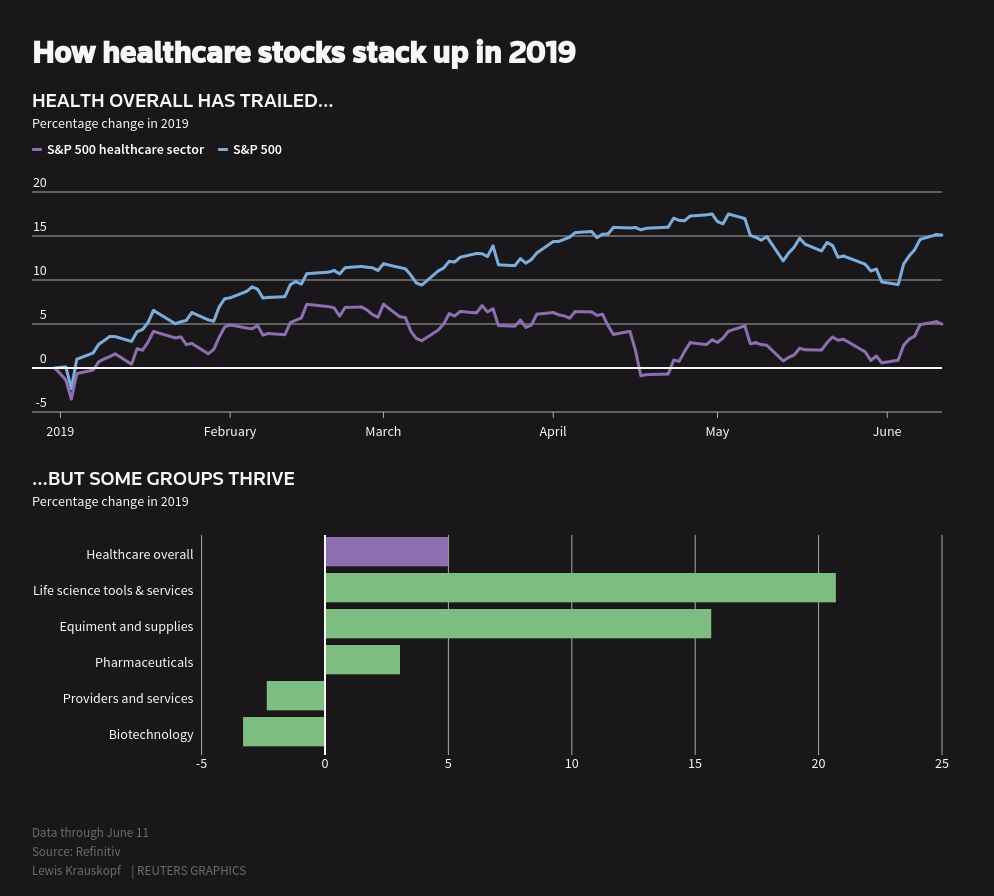
The S&P 500 healthcare sector overall has underperformed the broader stock market this year. But a number of companies have posted standout returns even as healthcare reform and prescription drug pricing loom as hot topics with the 2020 presidential election campaign heating up.
“The reason that people have been gravitating toward names like these is they feel more comfortable that they are less susceptible,” said Teresa McRoberts, a portfolio manager who focuses on healthcare at Fred Alger Management in New York.
“People are trying to stay away from anything that is viewed as susceptible to headline risk.”
The healthcare sector, which accounts for 14% of the S&P 500 benchmark stock index, is due for another test later this month, when the Democratic Party holds its first presidential debates.
Healthcare is poised to be a prominent issue, with left-leaning candidates embracing government-run Medicare for All plans. At the same time, the high cost of medicines has drawn attention from Democrats as well as President Donald Trump and his Republican party.
So far this year, the S&P 500 healthcare sector has climbed 5.5%, well below the roughly 15% return for the overall S&P 500.
Graphic: How healthcare stocks stack up in 2019
Reuters Graphic
Shares of many health insurers, pharmaceutical and biotechnology companies, and pharmacy services companies have lagged.

But a number of large-cap healthcare stocks have thrived in 2019, generally benefiting from factors specific to their businesses as well as from their place away from the political glare afflicting others in the sector.
For example, shares of Mettler-Toledo International and Thermo Fisher Scientific, which specialize in equipment used for drug development and research laboratories, are up 43% and 27.5%, respectively. Shares of animal health company Zoetis Inc have climbed 30%, while contact lens company Cooper Cos Inc has seen its stock price jump 29%.
Graphic: Healthcare stock winners and losers in 2019
Reuters Graphic
In general, life-science tool makers, medical device companies and animal health firms are “all higher growth and they all have low healthcare reform risk,” said Martin Jarzebowski, sector head of healthcare for Federated Investors.
“Those two things in combination mean that those best-performing names are safe havens amid both economic and regulatory uncertainty,” Jarzebowski said. “That’s the glue behind all of them.”
Earnings for S&P 500 healthcare companies are expected to rise by 6.2% in 2019, according to IBES data from Refinitiv, more than twice the 2.7% earnings growth expected for the S&P 500 overall, despite the market’s strong performance this year.
Graphic: Putting up profits in healthcare link

Reuters Graphic
Two of the three top-performing S&P 500 healthcare stocks so far in 2019 are in the dental space. Shares of Dentsply Sirona Inc and Align Technology Inc have jumped 53% and 49%, respectively in 2019. Shares of biotechnology company Celgene are up about 51% this year because it is being acquired by drugmaker Bristol-Myers Squibb. Bristol, by comparison, is down 9% this year.
Dentsply Sirona, which makes an array of products found in the dentist’s office, is a “turnaround story” after a rough 2018 for the shares, said William Blair analyst John Kreger. New products and a solid first-quarter report have helped the stock, he said.
Align Technology, which specializes in clear aligners that straighten teeth, saw its shares sell off late last year with tech and growth stocks as the market swooned. Along with those other stocks, shares of Align are rebounding as they also benefit from lessening concerns about competitive price pressures, Kreger said.
“No one is really talking about reforming dental and how dental is provided,” Kreger said. “The idea is you can get the growth potential without the regulatory uncertainty or the political uncertainty.”
Healthcare’s overall sluggishness this year means the sector looks relatively cheap. It now trades at 14.8 times forward earnings estimates compared to 16.2 times for the S&P 500, according to Refinitiv data. The sector and the broader market began the year with similar valuations.
Graphic: Healthcare stock valuations link
Reuters Graphic
Healthcare, a topic that helped Democrats regain control of the House of Representatives in the 2018 elections, is likely to come into the spotlight when a crowded field of Democratic candidates meet on June 26 and 27 for the party’s first presidential debates.
Former Vice President Joe Biden, who tallied the most support in a Reuters/Ipsos poll released earlier this month, is seen by investors as likely to back more moderate healthcare reform efforts than left-leaning candidates, such as U.S. Senator Bernie Sanders of Vermont.

Should Sanders, who advocates Medicare for All, or other candidates with similar views gain more prominence, the healthcare sector could face increased pressure.
“I think there’s more potential downside to the debates,” McRoberts said.

Amgen, Biogen, Gilead, Novo Nordisk ‘very high’ capacity for M&A: Moody’s

M&A activity is set to rise, and biopharmaceutical giants Amgen Inc., Biogen Inc., Gilead Inc. and Novo Nordisk A/S are in the best position to strike deals, Moody’s Investors Service said in a report published Thursday.
Moody’s said factors like reduced pricing flexibility, upcoming patent expirations and regulatory threats that could further erode pricing would likely drive an increase in acquisitions in the biopharmaceutical industry.
“Companies use acquisitions to bring new growth drivers into the product portfolio or the pipeline, and to diversify away from blockbuster drugs that face patent expirations,” Moody’s senior vice president Michael Levesque wrote.
The four biopharmaceutical companies are especially well-positioned as potential acquirers, thanks to generous cash stores and “moderate” debt-to-earnings ratios, according to the report. Shares of Amgen AMGN, +0.63%  gained 0.3% in afternoon trading, Biogen BIIB, +0.36% tacked on 0.3% and Gilead GILD, +1.27% rose 0.9%, while Novo Nordisk NVO, -1.47%  fell 1.4%.
Bristol-Myers Squibb Co. BMY, -0.63%  also has a “very high” capacity for M&A as a stand-alone company, but that will change following its acquisition of Celgene Corp. CELG, -0.12%  , Moody’s said.
Other potential buyers with more limited M&A capacity include Allergan PlcAGN, -1.03%  , AstraZeneca Plc AZN, -0.03%  , GlaxoSmithKline Plc GSK, -0.42%  , Mylan N.V. MYL, +1.28%  and Takeda Pharmaceutical Company TAK, -1.48%   — companies with lower cash levels and higher debt-to-earnings ratios, the report said.
Moody thinks any acquisitions will remain in the oncology and gene therapy space, mirroring recent moves like Eli Lilly & Co’s LLY, -3.09%  acquisition of Loxo Oncology and Biogen’s  acquisition of Nightstar Therapeutics. Roche Holding AGRHHBY, +0.20%  said in February it would acquire Spark Therapeutics, and Merck & Co Inc. MRK, -0.93%  said earlier this week that it would buy cancer-treatment biotech Tilos Therapeutics in a deal that could be valued at up to $773 million.
But current biotech valuations could stand in the way of further acquisitions. Many potential buyers view biotech valuations as much too high, especially considering the R&D risks associated with pipeline-stage drugs, Moody’s said. One example: In 2016, AbbVie ABBV, +0.50%  acquired Stemcentrx Inc. for $5.8 billion. A succession of trial failures cast doubt on the companies’ ability to get Stemcentrx’s lead drug and other pipeline drugs approved. In 2018, AbbVie ended up booking an impairment charge of $5.1 billion.
Biotech valuations have more than doubled in the past five years, far outpacing the S&P 500. But a recent dip could push some acquisitions forward — the S&P 500 SPX, +0.41%  has fallen 22% from a peak in mid-2015, and is down 15% from a second peak in the third quarter of 2018, Moody’s noted.