Search This Blog

Tuesday, October 15, 2019

FDA OKs Hisamitsu Pharma’s asenapine patch for schizophrenia

Hisamitsu Pharmaceutical Co. (OTCPK:HTSUF) subsidiary Noven Pharmaceuticals announces the FDA nod for SECUADO (asenapine) transdermal patch for the treatment of adults with schizophrenia.
Market launch will commence shortly.
Asenapine is marketed in the U.S. as a sublingual tablet under the brand name Saphris by Allergan (NYSE:AGN) under a license from Merck (NYSE:MRK).
https://seekingalpha.com/news/3505759-fda-oks-hisamitsu-pharmas-asenapine-patch-schizophrenia

Sanofi Opens Its First Digital Manufacturing Facility in Massachusetts

Paris-based Sanofi announced it has inaugurated the opening of its first new digital manufacturing facility for biologics production in Framingham, Massachusetts. The digital-enabled aspect of the manufacturing plant is designed to leverage better use of data to optimize manufacturing processes and increase efficiencies.
The company indicates that the factory will speed up the company’s recent transformation of its Industrial Affairs organization, focusing on biologics. The facility will be paperless and is expected to decrease the time it takes for products to transfer from development laboratories to the manufacturing plant and then to the marketplace.
“We have been investing for some years to prepare for Sanofi’s future,” said Philippe Luscan, executive vice president, Global Industrial Affairs at Sanofi. “Our Framingham facility leads the way in delivering the next generation of biologics manufacturing, leveraging intensified, continuous processing in a fully integrated digitally powered facility. This opening demonstrates we are at the leading edge of innovation and manufacturing excellence, helping us to shape the future of both our company and the industry.”
Sanofi indicates that it has several pilot programs across its network of facilities, but Framingham is “the first ‘digitally born’ facility.” Similar digital changes have been made in legacy plants. The company indicates it plans to move forward with digital transformation initiatives in Toronto, Canada; Suzano, Brazil; Waterford, Ireland; Sisteron, France; and Geel, Belgium.
The announcement comes about a month after Paul Hudson took over the company’s chief executive officer position. Hudson came from Novartis, replacing Olivier Brandicourt, who retired on September 1. Hudson was chief executive officer of Novartis Pharmaceuticals and member of the company’s executive committee. Before Novartis, Hudson had roles with Schering Plough and AstraZeneca.
Hudson is currently on a “listening tour,” visiting all of its sites around the world. The plan is to develop a strategy to reveal at a special investors event later this year.
There is speculation that one of the areas Hudson will make changes is the company’s diabetes program. Sanofi is paying Lexicon Pharmaceuticals $260 million to end a deal for diabetes drug Zynquista. This deal was inked in 2015, with Sanofi paying $300 million upfront and up to $1.4 billion in milestones. However, the drug hasn’t met expectations.
Competition in the diabetes market is fierce, with major market share held by Eli Lilly, Novo Nordisk and AstraZeneca. Lilly’s Trulicity is expected to double by 2024 to more than $7 billion and Novo Nordisk’s Ozempic is projected to bring in $5.25 billion by 2024. But Sanofi’s Lantus is projected to lose about 50% of sales from 2018’s $4.21 billion to a projected $2.19 billion in 2024.
Although that may not happen, the company is clearly focusing on improving and streamlining its manufacturing base for biologics. The hub in Framingham has been central to the company’s manufacturing strategy for 30 years and the company’s pipeline is dominated by biologics. The most promising is its Dupixent (dupilumab) for asthma and eczema.
The company generally gains most of its biologics from its U.S.-based Genzyme division.
https://www.biospace.com/article/sanofi-opens-first-digital-manufacturing-facility-in-massachusetts/

Health Insurers May Have Bottomed as Investors Tire of Politics

The worst may be past for managed-care stocks this year, barring any major surprises, as investors are growing fed up with the political rhetoric in Washington, according to Wall Street analysts.
UnitedHealth Group Inc.’s solid third-quarter earnings on Tuesday sparked the sector’s biggest rally in a decade as it helped ease concerns about rising medical costs. While expectations were low heading into the report, the magnitude of the move illustrates just how negative sentiment has gotten. Also roiled by fears of a single-payer system, health insurers appear to have found their footing as investors turned more optimistic about the industry’s business outlook, according to BMO analyst Matthew Borsch.
“Until something significantly new happens, I think we’re sort of stabilized for the moment,” he said in a telephone interview. “Investors are kind of fatigued with the political side of this.”
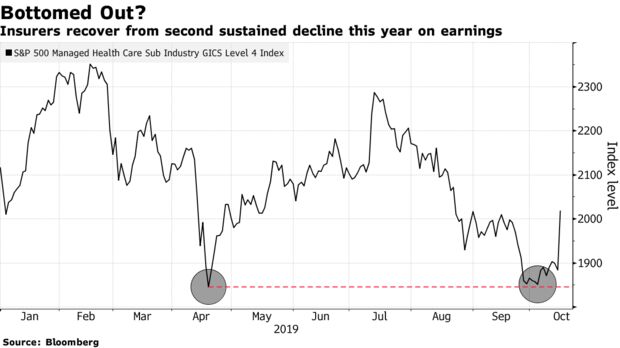
Insurers recover from second sustained decline this year on earnings
The S&P 500 Managed Care Index, which has plunged into two corrections this year, has rebounded to its highest level since August. The gauge jumped as much as 7.5% on Tuesday, the most since November 2009. It’s still trading down 4.7% for the year.
Tuesday’s Democratic presidential primary debate will serve as a key test for investors’ renewed optimism. Observers are looking to see whether Senator Elizabeth Warren, who polls show is tied for the lead with former Vice President Joe Biden, will elaborate on her plans for health care. She supports “Medicare-for-All” and has blasted insurers in previous debates, but has remained notably vague on the specifics.
It would be difficult to see a reversal of the rally following the debate as investors are familiar with Democrats’ health-care proposals, according to Borsch. Warren could get pushed for more specifics on her plans, but it’s unlikely that will impact investors’ views, he said. “We know what we know at this point.”
Other analysts are less sanguine. Bloomberg Intelligence’s Glen Losev said he wouldn’t be surprised to see health insurance stocks pull back from Tuesday’s gains after the debates and stay range-bound in the near term. “The Washington overhang remains and will continue” to be there until a Democratic nominee emerges, he said by telephone.
Scott Fidel of Stephens agrees that the sector is not clear of the political uncertainties, saying Tuesday’s rally just reflects investors’ increased comfort with fundamentals.
“The market is still pricing in a lot of uncertainty with these stocks, just not at the extreme levels that we had” heading into UnitedHealth’s earnings, Fidel said.
https://www.bloomberg.com//news/articles/2019-10-15/health-insurers-may-have-bottomed-as-investors-tire-of-politics?srnd=markets-vp

ProQR’s sepofarsen nabs Rare Pediatric Disease status in U.S. for LCA10

The FDA grants Rare Pediatric Disease designation for ProQR Therapeutics’ (NASDAQ:PRQR) sepofarsen for the treatment of Leber congenital amaurosis type 10 (LCA10).
Rare Pediatric Disease designation provides for the issuance of a rare pediatric disease priority review voucher following FDA approval. The voucher can be use for accelerated approval of a future application or it can be sold to a third party.
Shares are down 12% after hours in response to its $50M equity offering. Price, volume and terms have yet to be announced.
https://seekingalpha.com/news/3505929-proqrs-sepofarsen-nabs-rare-pediatric-disease-status-u-s-lca10

Drug wholesalers perk up on talks to settle opioid suits for $18B

Drug distributors McKesson (NYSE:MCK), AmerisourceBergen (NYSE:ABC) and Cardinal Health (NYSE:CAH) are up after hours in reaction to the news that they are in talks to settle over 2,000 lawsuits brought by state and local governments over their role in the opioid epidemic. The offer allegedly on the table is $18B over 18 years.
https://seekingalpha.com/news/3505955-drug-wholesalers-perk-talks-settle-opioid-suits-18b

Akebia sues feds over dropped Auryxia coverage

Akebia Therapeutics (NASDAQ:AKBA) has filed a complaint in a district court against the U.S. Department of Medicare & Medicaid Services (CMS) and the U.S. Department of Health and Human Services (HHS) challenging CMS’s decision about a year ago to rescind Medicare Part D coverage of Auryxia (ferric citrate) for the treatment of iron deficiency anemia in adult patients with chronic kidney disease not on dialysis.
The company also seeks a reversal of a related decision by CMS requiring prior authorization for Auryxia when used to control serum phosphorus levels in adult patients with CKD on dialysis.
The FDA first approved the product in September 2014 for the hyperphosphatemia indication followed by the IDA indication in November 2017.
https://seekingalpha.com/news/3505969-akebia-sues-feds-dropped-auryxia-coverage

Reata looks to outsmart Abbvie again

Fresh from buying omaveloxolone and bardoxolone rights back from Abbvie, Reata sees the first part of the puzzle fall into place.
Note to Abbvie management: the next time a biotech partner offers you $330m out of the blue to buy back rights to some minor shared assets, consider that it might be on to something.
Yesterday’s unexpectedly positive readout for Reata’s omaveloxolone in Moxie, a Friedreich’s ataxia study, came just four days after the biotech had struck a deal to reacquire the project from Abbvie. While it might seem inconceivable that the junior partner did not have at least some inkling that the study was about to read out positively, Reata today denied that this was the case.
“Neither Abbvie nor us had access to the results” before last week’s deal was done, Reata’s chief executive, Warren Huff, told analysts on a call today. The question yet to be answered is whether $330m was money well spent; however smart the buyback might have been omaveloxolone alone might not justify it.
Stifel analysts reckon the global market for Friedreich’s ataxia, a notoriously hard indication to crack, is worth over $3bn, but sellside consensus collected by EvaluatePharma sees omaveloxolone revenue forecasts translating to only $27m of NPV.
The much bigger test of the buyback is bardoxolone, Reata’s lead, for which a phase III study in Alport syndrome, reading out by the end of 2019, is a crucial binary outcome. Reata this morning traded up 45%.
Surprise
This likely reflects the surprising nature of omaveloxolone’s Friedreich’s win in Moxie. The study’s first part had been a bust, but Reata seized on an activity signal in a secondary endpoint.
That endpoint was the modified Friedreich’s ataxia rating scale (mFARS), and Reata redesigned Moxie to increase its chances of success: mFARS replaced peak work during maximal exercise as the primary endpoint, the treatment period was increased from 12 to 48 weeks, and only the 80% of the subjects without pes cavus entered into the primary analysis.
Pes cavus is a foot deformity that occurs in some Friedreich’s patients, and was blamed for the failure in Moxie’s first part. Part two hit on mFARS in the 82 subjects without pes cavus and – perhaps surprisingly – in the 103 all-comers too.
Two obvious questions are whether omaveloxolone’s potential label could be limited to subjects without pes cavus, and whether mFARS is an approvable metric. On an analyst call today Reata stated that the FDA had indicated in writing that mFARS was an “approval primary endpoint” in Friedreich’s, but that the breadth of any approval would be up to the agency.
Omaveloxolone’s safety profile will also raise questions, especially its effect on elevating the liver enzymes alanine transaminase and aspartate transaminase. Reata argues that increases in aminotransferases are a pharmacological effect of omaveloxolone, and that the elevations in Moxie were not associated with liver injury.
Summary of Reata’s Moxie trial (NCT02255435)
  Omaveloxolone 150mg/day Placebo
Subjects without pes cavus (n) 40 42
PRIMARY: 48wk mFARS* 2.40-point net improvement (p=0.014)
SECONDARY: PGIC** improvement No benefit (p=0.125)
SECONDARY: change in peak workload during exercise No meaningful improvement


All-comers (n) 51 52
SECONDARY: 48wk mFARS* 1.93-point net improvement (p=0.034)
SECONDARY: PGIC** improvement Favoured omaveloxolone (p=0.028)


Safety analysis (n) 51 52
ALT increases 19 (37%) 1 (2%)
AST increases 11 (22%) 1 (2%)
Discontinuation due to AE 4 (8%) 2 (4%)


*Friedreich’s ataxia scale, vs baseline; higher is worse; **patient global impression of change.
Abbvie had licensed bardoxolone and omaveloxolone for a remarkable $850m up front, but in 2012 the former bombed in chronic kidney disease after a heart failure signal. Reata then seemed to outfox its partner by repositioning bardoxolone for rare forms of kidney disease, thanks partly to money Abbvie had irreversibly pledged.
The big pharma group held data and rights to opt back in, but likely saw $330m as a way to recoup from Reata some of its sunk cost, given that the rare diseases where the two assets now held promise were of little interest to it. Whether Abbvie might have decided differently had it seen the Moxie data will remain a mystery.
https://www.evaluate.com/vantage/articles/news/trial-results/reata-looks-outsmart-abbvie-again