The Lower Drug Costs Now Act (H.R. 3) would impose federal price controls on prescription medicines. The bill would limit Americans’ access to lifesaving therapies, impede the development of new treatments for deadly and debilitating diseases, and inflict harm that vastly exceeds the budgetary savings it promises. Congress should reject the policies of H.R. 3 and pursue drug-pricing reforms that encourage innovation. Specifically, Congress should reform Medicare prescription drug payment programs and practices that prevent affordable generic medicines from coming to market.
KEY TAKEAWAYS
To combat rising prescription drug costs, Congress should address flawed government policies and provide relief for patients and taxpayers.
Congress can start by rejecting H.R. 3, which would limit access to life-saving medicines, impede development of new cures, and inflict harm on Americans.
Congress should reform Medicare prescription drug programs and ban anti-competitive practices that prevent affordable generic medicines from coming to market.
The House of Representatives is scheduled to vote this week on H.R. 3, the Lower Drug Costs Now Act, which would impose federal price controls on prescription medicines. The bill would limit Americans’ access to lifesaving therapies, impede the development of new treatments for deadly and debilitating diseases, and inflict harm that vastly exceeds the budgetary savings it promises.
Congress should reject the policies of H.R. 3 and pursue drug-pricing reforms that encourage innovation. Specifically, Congress should reform Medicare prescription drug payment programs and practices that prevent affordable generic medicines from coming to market. Such reforms include restructuring the Medicare Part D program to protect seniors from high out-of-pocket drug spending and refining federal laws that brand-name manufacturers are exploiting to prevent competition from generics.
These proposals enjoy overwhelming support among both parties in the House and Senate and could be signed into law by the President. All proposals are included in an alternative bill (H.R. 19) released by House Republicans on December 6.1
H.R. 19, The Lower Costs, More Cures Act, section-by-section summary released by House Republicans, December 6, 2019. H.R. 19, as outlined in this document, contains many proposals approved with bipartisan votes by the Senate HELP Committee (S. 1895, The Lower Health Care Costs Act) and the Senate Finance Committee (S. 2543, The Prescription Drug Pricing Reduction Act).
Acting on these reforms would provide relief from high prescription drug prices, while fostering continued medical innovation that will cure diseases, lengthen life expectancy, and improve quality of life.
H.R. 3: The Wrong Path
The Lower Drug Costs Now Act would reduce drug prices by government fiat, jeopardizing the quality of health care that Americans deserve.
What is worse is that H.R. 3 will not reduce drug prices at all because it will not become law. The House vote on the measure is expected to split largely along party lines, the bill lacks support in the Senate, and it is expected to face a veto threat from President Donald Trump. If Congress cannot move beyond the flawed and divisive H.R. 3 and toward effective reforms, it will adjourn next year having done nothing about drug prices.
Drug-pricing reform need not fall victim to partisan squabbling. There is broad bipartisan support for proposals to reduce prescription drug prices. Democrats and Republicans have reached a rare consensus on this contentious issue, backing reforms to Medicare prescription drug coverage and supporting a ban on practices that impede the entry of affordable generic drugs into the marketplace.
By shunning these broad-based reforms in favor of a vote on H.R. 3, House leaders have chosen partisan posturing over bipartisan progress on drug prices.
A better path is needed.
How Congress Can Make Real Progress
Making Medicines Affordable for Seniors: Reforms to Medicare Payment Practices. The federal government, through Medicare, helps seniors and people with disabilities to access prescription drugs via two programs: Medicare Part D and Medicare Part B. Both programs need reform in order to address policies that provide flawed financial incentives to drug makers and insurance companies that are driving up prescription drug costs.
Part D Restructuring. There is broad consensus on the need to reform Medicare prescription drug coverage. Members of both parties agree that the Medicare Part D benefit, which was created in 2003, requires restructuring.
Under Medicare Part D, drug prices are set through negotiations between private pharmacy benefit managers and drug manufacturers without government involvement. Competing prescription drug plans sponsor insurance policies that cover drugs and set their premiums. The government subsidizes these premiums at fixed rates. Prescription drug plans compete for seniors’ business based on quality and price. Seniors can choose the plan that provides them the best value, covering the medicines they take at the most affordable prices.
Consumer choice and competition have made Part D the rarest of government programs: one in which spending has not spiraled out of control. In fact, government actuaries report that federal general revenue spending on the program was $67.8 billion in 2018. That is less than the amount that the government spent on Part D in 2015 ($68.4 billion).2
Annual Report of the Boards of Trustees of the Federal Hospital Insurance and Federal Supplemental Medical Insurance Trust Funds, The Boards of Trustees, Federal Hospital Insurance and Federal Supplemental Medical Insurance Trust Funds, April 22, 2019, Table III.D3, p. 103.
Over that same period, government spending on Medicare Part A (hospital inpatient benefits) increased by 10.5 percent (from $279 billion to $308 billion),3
Ibid., Table III.B4, p. 52.
while general revenue spending on Part B (physician and other outpatient benefits) grew by 24.2 percent (from $203.9 billion to $253.2 billion).4
Ibid., Table III.C4, p. 85.
The Part D program has also resulted in reduced spending elsewhere in the Medicare program by making drug therapies broadly accessible to seniors. Multiple studies have found that these therapies help to keep beneficiaries out of hospital beds and emergency rooms, reducing Medicare spending on hospitals and doctors.
For example, the Congressional Budget Office (CBO) estimates that a 1 percent increase in prescriptions filled by Medicare beneficiaries reduces spending on medical services by 0.2 percent.5
Congressional Budget Office, “Offsetting Effects of Prescription Drug Use on Medicare’s Spending for Medical Services,” November 2012, p. 1, https://www.cbo.gov/sites/default/files/112th-congress-2011-2012/reports/MedicalOffsets_One-col.pdf (accessed December 9, 2019).
Applying the CBO methodology, Chris Pope of the Manhattan Institute estimated that an extra $100 in prescription drug use by Medicare beneficiaries can be expected to reduce the program’s spending on other medical services by $95, while delivering better outcomes.6
Chris Pope, “Issues 2020: Drug Spending Is Reducing Health Care Costs,” Manhattan Institute, November 6, 2019, p. 3, https://www.manhattan-institute.org/issues-2020-drug-prices-account-for-minimal-healthcare-spending (accessed December 9, 2019).
Relying on different economic assumptions, a December 2016 study by economist Robert J. Shapiro found that the Part D program had produced net Medicare savings of $679.3 billion between 2006 and 2014.7
Robert J. Shapiro, “The Value of the Medicare Part D Program for its Beneficiaries and the Medicare System,” Progressive Policy Institute, December 2016, p. 5, https://www.progressivepolicy.org/wp-content/uploads/2016/12/The-Value-of-the-Medicare-Part-D-Program.pdf (accessed December 9, 2019).
The Part D program has achieved these results through competition among prescription drug plans and through a standard drug benefit that apportions costs among beneficiaries, plans, manufacturers, and the government.
The program’s complex benefit structure could nonetheless be improved. While drug plans and beneficiaries finance prescription drug spending for the vast majority of seniors, the taxpayers shoulder 80 percent of the burden of the small minority of seniors whose annual drug spending falls into the program’s catastrophic tier (annual spending that exceeds $8,140).
Although overall Part D spending growth has been quite modest, the Medicare Payment Advisory Commission (MedPAC), an advisory arm of Congress, has noted that spending in the catastrophic tier grew from 25 percent of Part D costs in 2007 to 54 percent in 2017.8
Medicare Payment Advisory Commission, “Report to the Congress: Medicare Payment Policy,” March 2019, p. xxv, http://www.medpac.gov/docs/default-source/reports/mar19_medpac_entirereport_sec.pdf (accessed December 9, 2019).
MedPAC attributes this in part to the program’s benefit structure.There is broad congressional support for restructuring the Part D benefit. Several proposals have emerged. While they differ in detail, they share two important features: They cap the amount that seniors spend annually on prescription drugs, and they shift financing in the catastrophic tier from taxpayers to Part D plans and drug manufacturers.9
For a detailed analysis of these various options, see Tara O’Neill Hayes, “Competing Proposals to Medicare Part D,” American Action Forum, September 23, 2019, https://www.americanactionforum.org/insight/competing-proposals-to-reform-medicare-part-d/ (accessed December 9, 2019).
Table 1 compares the proposals with current law.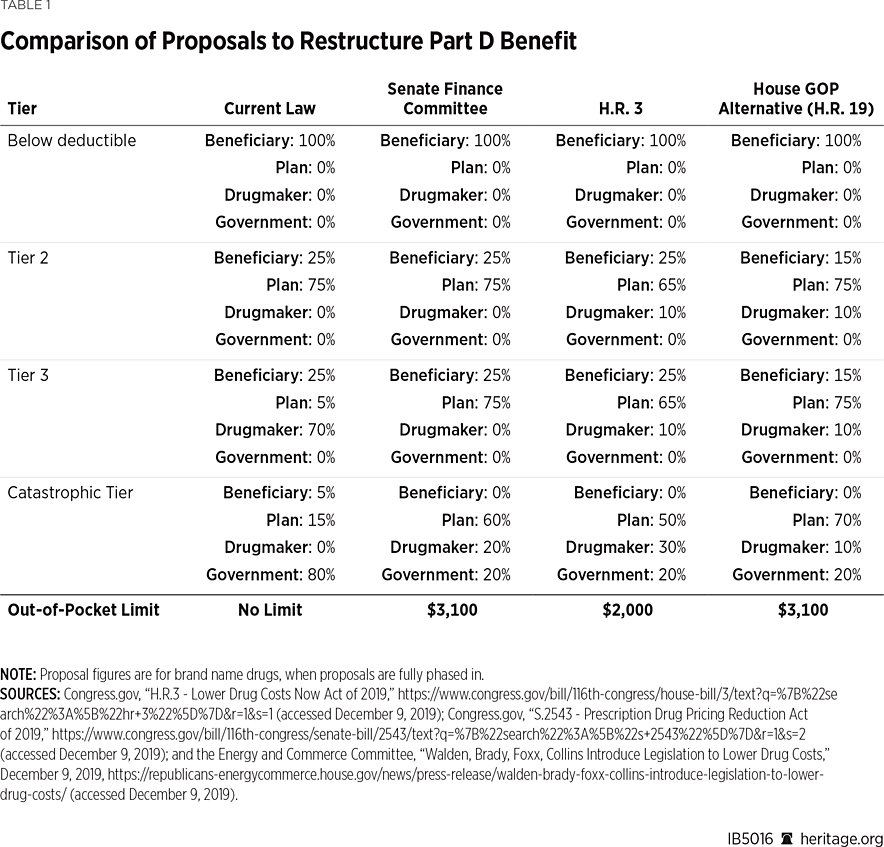
Under current law, beneficiaries are responsible for meeting a deductible, set at $415 in 2019 (Tier 1). In Tier 2, which ranges from $416 to $3,820 in drug spending, the beneficiary share drops to 25 percent, with the plan bearing 75 percent of the cost. In Tier 3, commonly known as the “donut hole” or “coverage gap,” current law requires drug manufacturers to assume 70 percent of the costs. The remaining 30 percent is split between the beneficiary (25 percent) and the plan (5 percent). Finally, in the catastrophic tier, the government bears 80 percent of the costs, the plan 15 percent, while beneficiaries pay 5 percent. There is no limit on out-of-pocket expenditures.
This benefit structure incentivizes plans and manufacturers to push high-cost patients as quickly as possible into the catastrophic tier, where taxpayers finance 80 percent of the costs. Plans have powerful motivation to manage costs aggressively in Tier 2, but very little in Tier 3 or the catastrophic tier. Manufacturers have every motivation to hustle people through Tier 3 and into the catastrophic tier. This may help explain why manufacturers do not provide big rebates for the most expensive drugs: Plans have little reason to seek them, and drug makers have little incentive to grant them.
The most consequential feature of all three restructuring plans (as described in Table 1) is that they attack these perverse incentives in roughly the same way. All reduce the share of costs that government bears in the catastrophic tier; and all place additional costs in that tier on Part D plans and pharmaceutical manufacturers. The proposals, despite their differences, have other commonalities as well. They all:
- Eliminate the coverage gap by requiring the beneficiary to pay a constant share between the deductible and the catastrophic threshold. This share is 25 percent in all but the House Ways and Means Republican plan, which reduces the beneficiary share of costs to 15 percent in Tiers 2 and 3.
- Reduce the government share in the catastrophic tier from 80 percent to 20 percent.
- Require the manufacturer and plan to bear larger shares of the cost in the catastrophic tier, although the percentages differ among the plans.
- Establish a limit on the amount a beneficiary spends out of pocket for prescription medicines. The limit differs among the proposals but, unlike current law, all put a limit into place.
These commonalities are far more significant than the differences among the proposed benefit designs. All would benefit seniors, especially by capping their annual drug expenses. All require manufacturers and plans to shoulder more of the burden of this catastrophic coverage. And all relieve taxpayers of much of the cost of high prescription drug expenses.
A preliminary CBO analysis of the Senate Finance Committee proposal estimated that the Part D benefit restructuring would reduce federal spending by $34.6 billion over 10 years.10
Congressional Budget Office, “The Prescription Drug Pricing Reduction Act,” July 24, 2019. https://www.cbo.gov/system/files/2019-07/PDPRA_preliminary_estimate.pdf (accessed December 9, 2019).
Key details remain unresolved, and those details will greatly affect how well these promising reforms will work in practice. Congress should work through these critical details and refine these proposals, taking advantage of the broad bipartisan consensus in favor of restructuring the Part D program in ways that benefit seniors and taxpayers.
Other Proposals to Make Medicines Affordable for Seniors
Restructuring the Medicare Part D program would be a boon both to taxpayers and to Medicare beneficiaries. And, there are other changes that can be made in the Part D program that would benefit seniors who take prescription medicines. These include:
- Requiring Part D plan sponsors to provide prescribing physicians with real-time benefit information. This provision would require Part D insurers to implement real-time benefit tools that would electronically transmit eligibility, formulary, and benefit information to each enrollee’s prescribing physician. While insurers already provide this information to pharmacies, consumers would benefit if real-time information was provided to their prescribing physician. This reform would allow doctors to tell the patient of any clinically appropriate alternatives, what the patient would have to pay at the counter, and of pharmacy options, including the option to have prescriptions filled through the mail. This information would empower patients to save on prescription medicines.11Section 125 of S. 2543 and section 116 of H.R. 19.
- Incentivizing Part D plans to provide Part D rebates at the point of sale.12Section 132 of H.R. 19.Part D drug plans generally enter into rebate arrangements with drug manufacturers. Unlike price discounts, which are generally made at the point of sale, rebate transactions take place after the fact. They thus are paid directly from the manufacturer to the drug plan, bypassing the consumer. Although rebates indirectly benefit seniors by reducing premiums for their coverage, they do not provide savings at the pharmacy counter. An example is a medicine with a list price of $150 on which the manufacturer pays a $50 rebate to the drug plan. A senior whose cost sharing on the medicine is 10 percent will pay $15 at the counter—10 percent of the gross price—rather than $10, which is 10 percent of the price, net of rebate. Earlier, the Trump Administration withdrew a rule that would have required plans to pass on rebates at the counter after studies showed that the requirement would increase premiums for Part D coverage.13Debra A. McCurdy, “HHS Scraps Pending Rule to Remove Anti-Kickback Safe Harbor Protection for Drug Rebates to Health Plans, PBMs,” ReedSmith, July 12, 2019, https://www.healthindustrywashingtonwatch.com/2019/07/articles/other-health-policy-developments/other-oig-developments/hhs-scraps-pending-rule-to-remove-anti-kickback-safe-harbor-protection-for-drug-rebates-to-health-plans-pbms/ (accessed December 9, 2019).Congress should enact a law that would allow plan sponsors to pass at least some portion of the rebate to the beneficiary at the counter.
- Allowing beneficiaries to spread out their cost sharing over time.14Section 133 of H.R. 19, and section 116 of S. 2543.Seniors who are prescribed very expensive drugs can face daunting cost-sharing requirements. This is especially true in the early part of the year, when beneficiaries have yet to meet their plan’s deductible. These costs can be daunting. A recent survey found that nearly half of seniors have abandoned a medicine prescribed by their doctor because of its high price.15Jeff Lagasse, “Nearly Half of Physicians Abandoned a Prescription at the Pharmacy Because It Was Too Expensive,” Healthcare Finance, October 30, 2018, https://www.healthcarefinancenews.com/news/nearly-half-consumers-abandoned-prescription-pharmacy-because-it-was-too-expensive (accessed December 9, 2019).Congress should address this by requiring plans to allow enrollees who must pay large sums in a 30-day period to spread those payments out over the course of multiple months. While this provision would not reduce what the senior pays for drugs, it would provide welcome relief to those on fixed incomes who struggle to meet their cost-sharing obligations all at once.
- Changes to Part Medicare B. While Medicare Part D covers drugs that patients typically obtain at pharmacies, Medicare Part B covers physician-administered drugs, including injected and infused medicines, such as chemotherapy. Unlike Part D, where competing plans negotiate rates with manufacturers without government intervention, the government sets prices for Part B drugs. The law specifies that Medicare is to reimburse for physician-administered drugs based on their average sales price, net of discounts, rebates, and other price concessions.16Under the ASP payment system, Medicare pays providers ASP+6 percent for the drug. ASP reflects the average price realized by the manufacturer for its sales broadly across different types of purchasers and for patients with different types of insurance coverage. It is based on manufacturers’ sales to all purchasers’ net of manufacturer rebates, discounts, and price concessions (with certain exceptions). Manufacturers report ASP data to the Centers for Medicare and Medicaid Services on a quarterly basis, and the agency updates the payments quarterly. “Part B Drugs Payment Systems,” Medicare Payment Advisory Commission, October 2017, http://www.medpac.gov/docs/default-source/payment-basics/medpac_payment_basics_17_partb_final.pdf?sfvrsn=0 (accessed December 9, 2019).Physicians are paid six percentage points above the average sales price (ASP+6). That six-percentage-point add-on is intended to cover provider costs associated with handling and storage of the drugs, as well as distributor markup. It also is meant to compensate for the fact that, by definition, some providers will pay prices that exceed the average.
Government spending on Part B drugs has multiplied. Between 2011 and 2016 that spending grew from $17.6 billion to $28.0 billion, an average annual growth rate of nearly 10 percent. Beneficiaries have shared the burden of growing Part B drug costs, since they are required to pay a coinsurance rate of 20 percent.
Critics of the Part B methodology have noted that physician reimbursement rises with a drug’s cost. The add-on payment for a $100 drug is $6. The add-on payment for a $100,000 drug is $6,000. The payment system thus rewards the use of the most expensive medications.
There is a growing congressional agreement in favor of reforming the Part B drug reimbursement system to benefit taxpayers and beneficiaries. Some policy proposals offer a platform for reforms. These include:
- Capping add-on payments.17S. 2543, section 110; H.R. 19, section 104. H.R. 19 would cap the add-on payment at $2,000 for certain immunotherapies.While there is some rationale for letting add-on payments grow with a product’s price, Congress should impose a limit. The Finance Committee bill, for example would cap add-on payments at $1,000.18H.R. 19 would also vary the add-on payment based on a drug’s price. Products with prices below the median would be reimbursed at ASP+10, while reimbursement for drugs whose prices were at the 85th percentile or higher would be reimbursed at ASP+4. H.R. 19, section 103.
- Providing beneficiaries with more price transparency.19S. 2543, section 106; H.R. 19, section 101.Medicare requires seniors to pay 20 percent of the cost of outpatient services. What seniors may not know is that Medicare pays higher rates for the same service, based on where it is provided. For example, Medicare generally pays more for a service provided in a hospital outpatient department than in an ambulatory surgical center or doctor’s office. Beneficiaries really have no way of knowing this, even though they are responsible for 20 percent of the costs. The Administration has taken a first step toward correcting this. Beginning in 2018, the Secretary created an online tool to enable beneficiaries to compare prices between hospital outpatient departments and ambulatory surgical centers. This provision would add price information for services provided in physician offices, enabling beneficiaries to compare prices for a service across all three sites of care.
- Exploring the possibility of moving coverage of certain Part B drugs to Part D.20S. 2543, section 147; H.R. 19, section 507.Part D uses private negotiation to set drug prices; the government sets Part B prices. The result is that spending on the Part D program has grown only moderately, while Part B drug spending has exploded. The Senate Finance Committee directs MedPAC, a panel of outside experts, to study moving some physician-administered drugs from the price-controlled Part B program to the market-based Part D program. Bringing market forces to bear on these drug prices would benefit seniors and taxpayers alike.
- Revisiting the Medicare Part B drug payment methodology.21S. 2543, section 112; H.R. 19, section 502.Congress enacted the ASP+6 methodology in 2003. There is bipartisan support for undertaking a comprehensive review of the methodology, beginning with an assessment by the Government Accountability Office (GAO).
- Reducing Drug Prices Through Choice and Competition. Restructuring the Medicare Part D benefit and reforming Medicare Part B reimbursement of physician-administered drugs would provide welcome relief on drug prices to 60 million Medicare beneficiaries. There is also bipartisan support in Congress for measures that will make prescription drugs more affordable for the 270 million Americans who are not on Medicare.
These policies would encourage market competition by preventing brand-name drug manufacturers from squelching or impeding competition from generic manufacturers.
Federal law incentivizes the search for new cures by granting innovators market exclusivity—a period of time during which their product is shielded from competing generic versions.22
For an overview on market exclusivity, see Kevin J. Hickey, Erin H. Ward, and Wen S. Shen, “Drug Pricing and Intellectual Property Law: A Legal Overview for the 116th Congress,” Congressional Research Service, April 4, 2019, https://crsreports.congress.gov/product/pdf/R/R45666 (accessed December 9, 2019).
Once that period expires, other companies can produce and sell medicines that are identical or equivalent to the innovator product.23
This discussion does not emphasize the distinction between bioequivalent active ingredients, which are commonly called generics, and biosimilars, which are not identical to the reference product, although they could be interchangeable. For a more complete discussion, see Agata Dabrowska, “Biologics and Biosimilars: Background and Key Issues,” Congressional Research Service, June 6, 2019, https://crsreports.congress.gov/product/pdf/R/R44620 (accessed December 9, 2019).
Because generics generally cost far less than brand-name drugs, consumers begin saving money as soon as a generic product comes on market. The Association for Accessible Medicines (AAM), an association representing generic drug manufacturers, estimates that 90 percent of prescriptions filled by Americans in 2017 were for generic medicines and they account for only 23 percent of drug spending.24
Association for Accessible Medicines, “Generic Drug Access and Savings in the U.S., 2018: Access in Jeopardy,” p. 10, https://accessiblemeds.org/sites/default/files/2018_aam_generic_drug_access_and_savings_report.pdf (accessed December 9, 2019).
Ibid., p. 8.
Those savings add up. According to the AAM, Americans saved more than $265 billion in 2017 alone by using generic medicines instead of their brand-name competitors.26
Ibid., p. 11.
Ibid., p. 11, based on author calculation.
The savings would be even higher under proposals that prevent brand-name manufacturers from slowing down or impeding the entrance of generic products into the marketplace. Those reform proposals enjoy bipartisan support and include:
- Allowing the U.S. Food and Drug Administration (FDA) to prevent “blocking” a generic drug from coming to market.28S. 1895, section 205 and H.R. 19, section 321.In addition to providing market exclusivity for innovator products, federal law entitles the first generic substitute for a brand-name drug to a 180-day period of market exclusivity.29U.S. Code 355(j), https://www.govinfo.gov/content/pkg/USCODE-2010-title21/html/USCODE-2010-title21-chap9-subchapV-partA-sec355.htm (accessed December 9, 2019).That is, the first generic to win FDA approval cannot have any generic competitors for a six-month period. That 180-day clock starts to run when the FDA grants final marketing approval. Some generic companies have “parked” their applications—not filing their application for final marketing approval even when the FDA is prepared to approve it.30Scott Gottlieb, “The HELP Committee’s Fix For 180-Day Generic Marketing Exclusivity: Does It Solve the Problem?” Health Affairs Blog, May 30, 2019, https://www.healthaffairs.org/do/10.1377/hblog20190529.223594/full/ (accessed December 9, 2019).In some cases, the brand-name company makes payments to the generic manufacturer in exchange for not seeking final marketing approval from the FDA.31Ibid.By not launching, the generic company retains its 180-day exclusivity. That prevents another generic company from bringing its drug to market. Congress should end this practice by allowing the FDA to grant marketing approval to any generic company if no other company has obtained final marketing approval.
- Creating legal remedies for generic companies to obtain samples of brand-name products.32S. 1895, section 203, and H.R. 19, sections 301–303.A generic company must verify that it has tested its product to demonstrate that it has met FDA approval criteria. As part of this testing, the company must use reference samples of brand-name drugs. Manufacturers of brand-name drugs sometimes use a loophole in current law to block potential generic competitors from buying samples of their products. Without the samples, a generic company cannot meet the FDA approval criteria and therefore cannot bring a product to market that competes with the brand-name drug. Congress should grant developers of generic drugs and biosimilars the right to seek judicial remedies in cases where a manufacturer refuses to supply samples of its products. The courts can make a judgment as to whether the refusal to provide samples is appropriate on a case-by-case basis.
- Allowing the FDA to reject efforts by manufacturers to delay approval of a generic product.33Ibid.The law permits manufacturers to file “citizen petitions” with the FDA to protect their intellectual property rights. The petition process has sometimes been used for purely dilatory purposes. Congress should give the FDA authority to summarily deny any petition whose primary purpose is to delay approval of a generic product or which does not raise valid scientific or regulatory issues.34Under current law, the FDA cannot summarily dismiss a petition unless both criteria are met. The proposal would give them authority to dismiss if either is met.
Each of these provisions is aimed at closing loopholes in federal law that impede market competition between makers of innovative medicines and their generic competitors. The overall result would be more robust competition and lower prices for medicines. According to the CBO, these provisions collectively would save consumers between $27 billion and $30 billion on drug spending over the next decade.35
Author’s calculation based on estimates included in Congressional Budget Office, “S. 1895, Lower Health Care Costs Act,” July 16, 2019, pp. 8–10, https://www.cbo.gov/system/files/2019-07/s1895_0.pdf (accessed December 9, 2019).
Unlike government rate-setting proposals, these savings would derive from ending certain anticompetitive practices, and thus reducing prices by enhancing market competition. Unlike those rate-setting regimes, these changes, like others discussed in this paper, can become law now.
The Wrong Way to Reduce Drug Prices: H.R. 3
While the committees of jurisdiction have already approved H.R. 3, the Lower Drug Care Costs Now Act, congressional leaders have indicated that they may revise the text before the scheduled December 12 votes. Changes are likely to include the use of savings from the bill to enhance Medicare benefits. As of this writing, the revised version of the bill is not available. The analysis in this Issue Brief is based on committee-approved legislative text.
would institute an unprecedented intervention by the federal government into the regulation of prescription drug prices. Legal analysts at the Congressional Research Service, a nonpartisan arm of Congress, note that it raises constitutional concerns.37
Congressional Research Service, “Legal Analysis of Title I of H.R. 3, the Lower Drug Costs Now Act of 2019,” October 21, 2019.
Many economists, including the President’s Council of Economic Advisers (CEA), believe that H.R. 3 would dramatically reduce the number of new treatments for diseases, and that the economic impact of these consequences would dwarf projected federal savings. While H.R. 3 purports to dramatically reduce drug costs, H.R. 3 would not reduce them at all. It is a partisan vehicle that will preserve the status quo because it will not become law.The bill would establish a system in which the U.S. government bases prices for cutting-edge drug treatments on those set by foreign governments. The measure would set an upper price limit at 1.2 times a drug’s average price in six other countries (Australia, Canada, France, Germany, Japan, and the United Kingdom).
The Secretary of Health and Human Services then would seek to “negotiate” prices below that upper limit for at least 25—and as many as 250—drugs each year.
The prices resulting from these “negotiations” would be applied throughout the U.S. market. The government would require manufacturers to offer that price to private, as well as public, payers or face massive fines.
A manufacturer that declines to negotiate the price of any of its products would incur an excise tax of up to 95 percent of the revenues it derived from that product in the preceding year.
How H.R. 3 Affects Access to Care
Proponents of H.R. 3 claim that it would have no adverse effect on innovation or on access to pharmaceuticals. But aggressive government price-setting has damaged innovation and limited access to new treatments in all six of the countries whose price controls the bill would import.
If the U.S. adopts price controls, it risks the same results here. Access to new drugs is much greater in the U.S. than in countries with price controls, in part because of having shunned price controls.
Of new active substances introduced between 2011 and 2018, 89 percent are available to Americans, compared with 62 percent in Germany and 60 percent in the United Kingdom.38
Doug Badger, “Examination of International Drug Pricing Policies in Selected Countries Shows Prevalent Government Control Over Pricing and Restrictions on Access,” Galen Institute, March 2019, Appendix 2, p. 20, https://galen.org/assets/Badger-Report-March-2019.pdf (accessed December 9, 2019).
One-half or more of these new therapies are unavailable to Australian, Canadian, French, and Japanese patients.This lack of access can have damaging effects. A study by IHS Markit examined outcomes for non-small-cell lung cancer, the leading cause of cancer mortality in the U.S. and the world.39
Wayne Su, “Comparing Health Outcome Differences Due to Drug Access: A Model in Non-Small Cell Lung Cancer,” IHS Markit, December 13, 2018, https://heatinformatics.com/sites/default/files/images-videosFileContent/IHSM_NSCLC%20HTA%20model%20white%20paper_18Jan2019r.pdf (accessed December 9, 2019).
The report compared how Americans with that disease fared, to how citizens of other highly developed countries, including Australia, Canada, France, and the U.K., fared.The study concluded that Americans gained 201,700 life years as a result of faster access to new medicines. Half those gains would have been wiped out, the study found, if Americans had the same limited access to those treatments as patients in other countries.
Patients will be worse off if Washington emulates the price-control regimes of foreign governments.
H.R. 3’s Impact on Innovation
A December 2019 analysis by the President’s Council on Economic Advisers estimates that 100 fewer drugs would be introduced—one-third fewer than the 300 projected to enter the market—over the next decade.40
Council of Economic Advisers, “House Drug Pricing Bill Could Keep 100 Lifesaving Drugs from American Patients,” December 3, 2019, https://www.whitehouse.gov/articles/house-drug-pricing-bill-keep-100-lifesaving-drugs-american-patients/ (accessed December 9, 2019).
In developing that estimate, the CEA study relied on a preliminary analysis by the CBO, which estimated that H.R. 3 would reduce pharmaceutical company revenues by $500 billion to $1 trillion over the next decade.41
“Effects of Drug Price Negotiation Stemming from Title I of H.R. 3, the Lower Drug Costs Now Act, on Spending and Revenues Related to Part D of Medicare,” letter from Congressional Budget Office Director Phillip Swagel to the Honorable Frank Pallone, October 11, 2019, https://www.cbo.gov/system/files/2019-10/hr3ltr.pdf (accessed December 9, 2019).
Noting that pharmaceutical companies typically spend between 15 percent and 20 percent of revenue on research and development, the CEA study estimated that pharmaceutical companies would spend between $75 billion and $200 billion less on research and development if H.R. 3 gained enactment. Assuming that it costs roughly $2 billion to develop a new drug, the CEA concluded that H.R. 3 could result in as many as 100 fewer drugs entering the market over the next decade.42
The report notes that the $2 billion estimate of the costs of developing a new drug is on the low end, citing a 2016 study which estimated that those costs average nearly $2.6 billion in 2013 dollars. See Joseph A. DiMasi, Henry G. Grabowski, and Ronald W. Hansen, “Innovation in the Pharmaceutical Industry: New Estimates of R&D Costs,” Journal of Health Economics, Vol. 47 (2016), pp. 20–33, https://dukespace.lib.duke.edu/dspace/bitstream/handle/10161/12742/DiMasi-Grabowski-Hansen-RnD-JHE-2016.pdf;sequence=1 (accessed December 9, 2019).
The annual savings to the federal government, which the CBO preliminarily estimated at $34.5 billion, would be dwarfed by the economic costs the measure would impose.43
“Effects of Drug Price Negotiation,” letter from CBO Director.
Fewer new medicines mean shorter life expectancies (a four-month reduction, according to the CEA study) and lower productivity. In all, the CEA put the annual economic price tag at $375 billion to $1 trillion, a figure that is more than ten times higher than H.R. 3’s projected federal savings.
Conclusion
Amid a climate of partisan discord, Congress has arrived in an unfamiliar place: a bipartisan consensus on policies to rein in drug prices through increased choice and competition. Legislation that would provide relief to seniors from high drug costs and spur competition that will reduce drug prices for all Americans is within the grasp of Congress. The contours of these policies are contained in H.R. 19, a proposal assembled by congressional Republicans based on provisions that have demonstrated bipartisan backing. Congress should examine and refine these proposals to ensure that they all meet their intended goals, including the restructuring of the Medicare Part D benefit, and enacting them into law.44
As discussed in this Issue Brief, there are several proposals to restructure the Medicare Part D benefit. Each has merit and there are many commonalities among them. Before settling on a final plan, Congress should carefully examine the effect of each proposal on premiums and access to medicines, in an effort to reduce the risk of adverse unintended consequences.
It appears, however, that the House will vote on H.R. 3, a bill that would do great damage to the health of Americans, particularly those whose lives may depend on the development of new cures. Because it will not become law, H.R. 3 will preserve the status quo of high drug prices.
Americans need relief from high drug prices. Congress should deliver it.
Doug Badger is Visiting Fellow in Domestic Policy Studies, of the Institute for Family, Community, and Opportunity, at The Heritage Foundation, and a Senior Fellow at the Galen Institute.
