The number of confirmed cases of coronavirus across New York state
rose Wednesday to 212, while the five boroughs have now tallied 48
positive diagnoses, according to Gov. Andrew Cuomo.
Those totals represent a statewide increase of 39 and a city spike of
12 from Tuesday, as the potentially deadly disease continues to surge
in the Empire State, home to more cases than any state in the nation
except Washington.
New York’s hardest-hit county remains Westchester, which has 13 new cases for a total of 121.
Starting Thursday, the National Guard will begin enforcing a one-mile-radius
“containment area” in the city of New Rochelle, forcing the two-week
closure of large gathering areas including schools and houses of
worship.
Cases continued to rise on Long Island, where Nassau County now has
28, an increase of nine, and Suffolk County has six, an increase of
five.
Tallies in Rockland, Saratoga and Ulster counties stayed static, meanwhile, at six, two and one, respectively.
Still, Cuomo urged calm.
“The facts here do not justify the amount of fear,” he said. “The
facts here actually reduced the anxiety. We have 212 cases in the state
of New York. [Just] 32 are hospitalized.” https://nypost.com/2020/03/11/coronavirus-in-ny-212-cases-now-in-new-york-state-48-across-nyc/
A few patients recover after getting Gilead’s remdesivir
Vaccine developers Inovio, Moderna among top biotech gainers
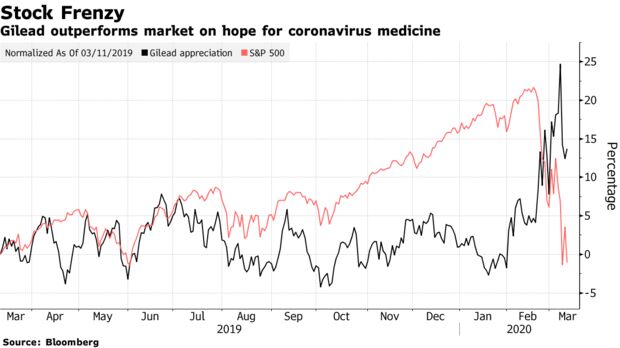
Gilead Sciences Inc. gained the most among the trio of advancers
in the S&P 500 Index Wednesday, climbing despite a market rout as
investors focus on reports of patients getting the biotech company’s
antiviral medicine for the novel coronavirus.
The stock rose 1.6%, paring a 4.2% jump after a doctor went on CNBC to discuss already known
results from the first U.S. patient to be treated with remdesivir. In
two more case reports out of France, one person who received the drug
died while another recovered after 22 days, an RBC analyst said.
“It is difficult to ascribe this recovery definitively to
remdesivir,” RBC’s Brian Abrahams wrote in a note. He called the results
“mixed.”
The analyst said the drug has at most a 50/50 shot of succeeding
against Covid-19, the disease caused by the virus. Investors are
looking for an update on remdesivir by April. The World Health
Organization declared the spread of the disease a pandemic on Wednesday.
Some good news from the Internal Revenue Service.
Until further notice is given, health insurers’ high-deductible plans
may foot the bill on novel coronavirus-testing and treatment before
their customers reach their steep deductible, the IRS said Wednesday.
The IRS said these health-insurance plans — which have less expensive
monthly premiums than traditional health-insurance plans — will not lose
their tax status if they pay for COVID-19 care before they would
typically start paying for medical services.
Approximately 50 million people use these types of health-insurance
plans, according to the Employee Benefit Research Institute, a think
tank focused on health, savings and retirement benefits. These plans
have lower monthly premiums than traditional plans, but users have to spend more money before the insurance plan starts covering the bill.
Any plan with an individual deductible of at least $1,400 or $2,800
for a family qualifies as a high deductible plan, according to the IRS.
People using high-deductible plan can use pretax income to pay for their
care in health-savings accounts, the IRS said. The 2020 contribution
limits are $3,550 for individuals and $7,100 for families.
The IRS announcement came the same day the World Health Organization said the coronavirus outbreak was formally a “pandemic”
now that human-to-human transmission of the virus occurred on several
continents. Worldwide, there were 121,977 COVID-19 cases and 4,386
deaths as of Wednesday afternoon; about 66,702 people have recovered.
The health plans already pay for certain preventative care before
users reach their deductible, such as physicals and cancer screening.
The IRS announcement adds coronavirus testing and care to the list. The
U.S. had 1,101 cases of the coronavirus, and 31 deaths, and has spread
to over 100 countries in just over three months.
The IRS said it was trying to clear any “potential administrative and financial barriers” so health plans could address “the unprecedented public health emergency posed
by COVID-19.” Treasury Department officials are also reportedly
considering pushing back the April 15 income tax filing deadline, according to the Wall Street Journal. No final decision has been made, the outlet said. https://www.marketwatch.com/story/guid/b2e09b8e-63c5-11ea-bbaf-956fcc553ce3
Wall Street stocks plunged on Wednesday, with the Dow .DJI
confirming a bear market for the first time since the financial crisis
after the World Health Organization called the coronavirus outbreak a
pandemic.
All three major U.S. stock averages ended the session sharply lower, with the benchmark S&P 500 .SPX and Nasdaq composite index .IXIC both about 19% below their Feb. 19 record closing highs.
A bear market is confirmed when an index closes 20% or more below its most recent closing high.
Market participants were further rattled following a Reuters report
that the White House had ordered top-level coronavirus meetings to be
classified.
“There’s just a plethora of bad news today, a growing number of
people with the disease, there are different points of view in how
stimulus should work, and the market is acting accordingly,” said Peter
Tuz, president of Chase Investment Counsel in Charlottesville, Virginia.
“You call this thing a pandemic and all hell breaks loose.”
A lack of details from the Trump administration regarding its plans
for fiscal stimulus, and partisan wrangling in Washington, added further
unknowns to the mix.
“Fiscal help may be slow in coming, because of differences between
the president and Congress on what form it should take,” added Tuz.
Boeing Co (BA.N)
was the biggest drag on the blue-chip Dow, sinking 18.2% after
announcing plans for a full drawdown of an existing $13.8 billion loan
as early as Friday. The planemaker suffered its biggest ever three-day
fall, surpassing the aftermath of the Sept. 11, 2001 attacks.
Stocks worldwide lost ground despite global stimulus efforts to
soften the economic blow of the virus, named COVID-19, with Britain and
Italy announcing war chests to contend with the growing crisis.
Concerns over the fast-spreading virus have ravaged markets and
hobbled supply chains as countries around the world grapple with how to
contain both the virus and its economic impact.
As part of those efforts, the U.S. Federal Reserve is widely expected
to cut interest rates for a second time this month at the conclusion of
a two-day monetary policy meeting next week.
The Dow Jones Industrial Average .DJI fell 1,464.94 points, or 5.86%, to 23,553.22, the S&P 500 .SPX lost 140.85 points, or 4.89%, to 2,741.38 and the Nasdaq Composite .IXIC dropped 392.20 points, or 4.7%, to 7,952.05.
All 11 major sectors in the S&P 500 ended the session sharply lower.
Rate-sensitive banking stocks .SPXBK were down 5.9% as U.S. Treasury yields dropped.
Nike Inc (NKE.N) fell 4.9% on fears of virus-related sales slump in China.
Declining issues outnumbered advancing ones on the NYSE by a 13.61-to-1 ratio. On Nasdaq, a 8.24-to-1 ratio favored decliners.
The S&P 500 posted no new 52-week highs, and 131 new lows; the Nasdaq Composite recorded six new highs and 816 new lows.
Volume on U.S. exchanges was 15.10 billion shares, compared with the 11.92 billion average over the last 20 trading days. https://www.reuters.com/article/us-usa-stocks/wall-street-tumbles-dow-confirms-bear-market-idUSKBN20Y1FR
Emergent BioSolutions (NYSE:EBS) initiates two new programs aimed at treating and preventing coronavirus infection based on its hyperimmune platforms.
Human polyclonal hyperimmune with antibodies to
SARS-CoV-2 (COVID-HIG) for the potential treatment of severely ill
hospitalized patients and protection for at-risk people.
Equine-derived polyclonal hyperimmune with
antibodies to SARS-CoV-2 (COVID-EIG) for the potential treatment of
severely ill hospitalized patients.
Both candidates will be derived from plasma,
humans with anti-SARS-CoV-2 antibodies and horses immunized with
anti-SARS-CoV-2 antibodies.
The company has launched plasma collections with a
goal of manufacturing clinical material within the next four or five
months. A clinical trial may start as early as Q3.
Shionogi has expanded its partnership with its Alzheimer’s
drug development partner Tetra Therapeutics, giving an option for a
buyout of the US biotech ahead of a key trial milestone.
The two companies will work together to develop and market BPN14770 for Alzheimer’s disease, Fragile X syndrome and other indications marked by cognitive and memory deficits. Shionogi
has increased its equity investment in Tetra to 50% and has the option
to complete a structured buyout of the remaining equity if certain
conditions are met.
The option hinges on results of the phase 2 PICASSO AD trial in
patients with early Alzheimer’s disease expected to read out later this
month.
Shionogi’s move comes at a time when there are major question marks
about the treatment approaches from mainstream pharma companies for Alzheimer’s, which have mainly focused on the amyloid plaques that build up in those affected by the disease.
After a string of trial failures, the so-called “amyloid hypothesis”
will likely receive its definitive test soon when Biogen files results
of two phase 3 trials with the FDA in the coming weeks or months.
Although these trials also failed Biogen thinks it has the data to show the drug aducanumab is effective at higher doses.
While Biogen tries to revive aducanumab pharma companies and biotechs are looking for alternatives.
Tetra’s BPN14770 selectively inhibits phosphodiesterase-4D (PDE4D) to enhance memory formation in children and older adults.
Tetra is developing BPN14770 for brain disorders marked by cognitive
and memory impairment including Alzheimer’s disease and Fragile X
syndrome.
Michigan-based Tetra has completed enrolment in a phase 2 study of
BPN14770 in adults with Fragile X syndrome, an indication for which
BPN14770 has received Orphan Drug Designation from the FDA.
Tetra says the mechanism of action could improve cognitive and memory
function in devastating CNS disorders, including Fragile X syndrome,
Alzheimer’s disease and other dementias, learning/developmental
disabilities and schizophrenia.
Preclinical animal models show that BPN14770 may promote the
maturation of connections between neurons, which is impaired in patients
with Fragile X Syndrome, and to protect connections between neurons
which otherwise are lost in patients with Alzheimer’s disease.
Tetra has completed phase 1 double blind, placebo-controlled,
dose-ranging studies of the safety and pharmacokinetics of BPN14770 in
healthy volunteers.
The company said evidence of cognitive benefit was found in elderly subjects.
Sabra Health Care REIT (SBRA-12.2%) slumps on over 50% higher volume in apparent response to a COVID-19 outbreak at one of its facilities, reported by Mizuho.
Update: The facility in question
is the Issaquah Nursing Home and Rehabilitation Center in the greater
Seattle area, owned by Sabra but operated by North American Healthcare.
Several patients have tested positive for COVID-19 and one has died.