Search This Blog

Tuesday, August 25, 2020

Medtronic up on Q2 beat; strong margins tops expectations

Medtronic (MDT) Q2 results:

Revenues: $6,507M (-13.2%).

Cardiac & Vascular Group revenues of $2.433B (-12.8%), compared to estimate $1.81B.

Minimally Invasive Therapies Group revenues are $1.8B (-14.2%), vs. consensus of $1.76.

Restorative Therapies Group: $1.712B (-14.9%) compared to expectations of $1.33B; Diabetes Group: $562M (-5.1%).

Adjusted gross margin of 62.1% vs. estimate of 60.5%; Adjusted operating margin 16.5%, consensus 7.2%.

Net Income: $487M (-43.6%); EPS: $0.36 (-43.8%); non-GAAP Net Income: $836M (-50.9%); non-GAAP EPS: $0.62 (-50.8%).

CF Ops: $278M (-81.6%).

Citing COVID-19 uncertainties, the company is not providing formal annual or quarterly financial guidance at this time.

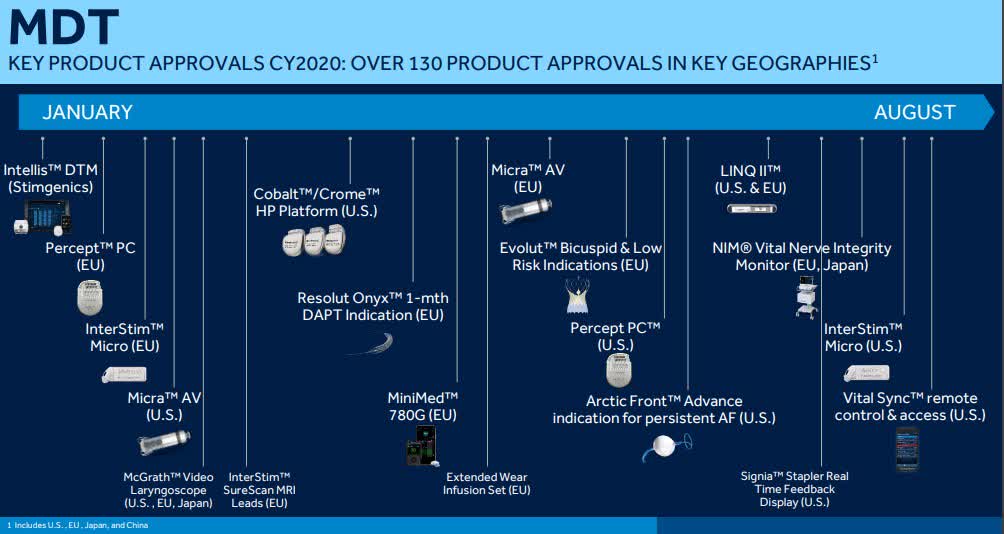
Below is the timeline of the company’s key product approvals in CY2020 till date in key geographies:


AbbVie opts in to develop fibrotic disease candidates with Morphic

Morphic Therapeutic (NASDAQ:MORF) announces that collaboration partner and licensee AbbVie (NYSE:ABBV) has exercised its option to develop its αvβ6 integrin inhibitors for the treatment of fibrotic diseases, including idiopathic pulmonary fibrosis (IPF) and additional indications.

The license covers αvβ6 integrin specific inhibitors discovered from Morphic’s proprietary MInT Platform, including the compounds MORF-720 and MORF-627.

AbbVie’s decision triggers a $20M license fee to Morphic, which will also be eligible for future development milestones and royalties on net sales of commercialized products.

Morphic received $100M upfront under the terms of their original agreement.


Bristol-Myers’ enasidenib fails to extend survival in late-stage leukemia study

A Phase 3 clinical trial, IDHENTIFY, evaluating Bristol-Myers Squibb (NYSE:BMY) unit Celgene’s IDHIFA (enasidenib) plus best supportive care (BSC) compared to conventional care regimens in patients with relapsed/refractory acute myeloid leukemia (AML) with an isocitrate dehydrogenase-2 (IDH2) mutation failed to achieve the primary endpoint of overall survival (OS).

“While we are disappointed by the outcome of the IDHENTIFY study, we remain confident in IDHIFA’s established role as a treatment option for patients with relapsed or refractory AML with an IDH2 mutation and are grateful to all those who participated in the study,” said Noah Berkowitz, M.D., Ph.D., senior vice president, Global Clinical Development, Hematology, Bristol-Myers Squibb. “AML is one of the most difficult-to-treat blood cancers, and we’re committed to furthering our research and improving on the standards of care for patients living with this aggressive disease.”

Complete results will be submitted for presentation at a future medical conference.

A Phase 3 clinical trial, IDHENTIFY, evaluating Bristol-Myers Squibb (NYSE:BMY) unit Celgene’s IDHIFA (enasidenib) plus best supportive care (BSC) compared to conventional care regimens in patients with relapsed/refractory acute myeloid leukemia (AML) with an isocitrate dehydrogenase-2 (IDH2) mutation failed to achieve the primary endpoint of overall survival (OS).

“While we are disappointed by the outcome of the IDHENTIFY study, we remain confident in IDHIFA’s established role as a treatment option for patients with relapsed or refractory AML with an IDH2 mutation and are grateful to all those who participated in the study,” said Noah Berkowitz, M.D., Ph.D., senior vice president, Global Clinical Development, Hematology, Bristol-Myers Squibb. “AML is one of the most difficult-to-treat blood cancers, and we’re committed to furthering our research and improving on the standards of care for patients living with this aggressive disease.”

Complete results will be submitted for presentation at a future medical conference.

The FDA approved the IDH2 inhibitor three years ago for IDH2 mutation-positive AML patients.

Monday, August 24, 2020

Mayo Clinic ends convalescent plasma program after FDA OK

The Mayo Clinic says it has discontinued its program for convalescent plasma after the FDA announced authorization of emergency use of the treatment Sunday.

For five months, the Mayo Clinic used its Expanded Access Program to investigate and evaluate the safety of the experimental COVID-19 therapy. Mayo says the treatment “demonstrated improvement in health and mortality rates” in “some cases” of COVID-19.

2,780 hospital and acute care facilities, 14,000 physicians and 101,000 patients were enrolled in the Mayo Clinic’s program. 71,000 were infused with the treatment. 

“While the program was never intended to be a randomized clinical trial, in the course of our work, Mayo Clinic and our collaborators observed potential signals of efficacy among a diverse population and chose to share those data,” says Michael Joyner, a lead researcher for the Mayo-led program.

Dr. R. Scott Wright, a Mayo cardiologist, said the program enabled “possibly the largest study ever on the safety of convalescent plasma as a therapeutic option.”

Mayo’s EAP program also saw success in enrolling racial and ethnic minority participants and women, who are all historically underrepresented in clinical trials, Wright added.


UNC-Chapel Hill: 31% of Students Tested Have COVID—And Probably More

UNC-Chapel Hill just released its latest COVID-19 testing numbers and it isn’t pretty.

The school reported that 31.3% percent of students tested for coronavirus last week returned positive results. This was after the university announced they shut down campus and transition to remote-only instruction.

There have been 835 cases—784 students and 51 staff members—since February 2020. The vast majority, 646 cases, were reported after the first day of in-person classes.

These numbers only reflect tests that were performed at campus health or self-reported by students and staff. Many student sources have told the INDY that they’re aware of students deferring to local urgent care clinics to be tested, only to use their home address. Those cases aren’t being reported to the university. 

On Monday, the INDY also learned of off-campus cases at The Carolina Inn. A worker at the hotel said there had been at least five cases at the inn, all from students that were staying there due to construction on one of the Granville Towers buildings and the Alpha Phi sorority house.

The Carolina Inn has told its staff that none of their employees had tested positive and that the students “sought medical attention and there are not currently any cases on property.” It is unclear if they have gone back to their hometowns or been sent to isolation housing on campus.


Amedisys in agreement with BrightStar Care

Amedisys (NASDAQ:AMED) signed a Care Coordination Agreement with BrightStar Care in order to add its agencies to the Amedisys Personal Care Network and facilitate the coordination of care between the former’s hospice and home health care centers and personal care partners network.

BrightStar Care’s 340 personal care locations in 38 states covers ~75% of the U.S. population and largely overlaps Amedisys’ hospice and home health footprints; expands network to 1,211+ partner agencies in 39 states.

The new partnership will pilot with BrightStar care centers in Pennsylvania and Texas, with expansion plans later.


Fla. judge rules order for brick-and-mortar schools to reopen unconstitutional

August 24, 2020

As many Central Florida students headed back to class on Monday, a judge sided with educators who were fighting the state’s mandate to reopen brick-and-mortar schools.
Florida’s largest teacher’s union is calling this a victory for teachers and students, specifically considering so many schools have already started back with face-to-face education.
One of the major parts of the ruling is that school boards, not the commissioner of education, have control over local schools and how they operate.
Commissioner of Education Richard Corcoran had drawn criticism over threats that the state would withhold funding if schools did not open for face-to-face education by the end of August.
The judge agreed, saying the decisions made by Corcoran in the Department of Education are arbitrary.
The Florida Department of Education has already filed an appeal, which would stay this ruling.
This is another reason why many schools are going to stay the course and continue moving forward with in-person education.
The Florida Education Association said it should be up to each individual district to decide how to safely restart school this year.
Orange County CTA President, Wendy Doromal, released a statement Monday saying “The Education Commissioner made a reckless decision and now our district needs to reverse their reckless decision that was based on the threat of the loss of funding. We should reopen schools when it is safe to do so to protect the health of every student, teacher, employee and all our community members.”
The union is pushing to nullify sections of Gov. Ron DeSantis’ executive order to reopen schools.
The state made its final argument against the FEA on Friday.
Attorneys for the state said not returning to the classroom would be harmful.
Seminole County Public Schools said it’s unknown if this will affect its schools because they’ve already opened.