Search This Blog

Tuesday, May 4, 2021

Cocrystal Pharma Lays Out Plans To Launch Another COVID-19 Antiviral Candidate


  • Cocrystal Pharma Inc (NASDAQ: COCP) has announced progress on its COVID-19 antiviral drug candidates that target coronaviruses, including SARS-CoV-2, and it also plans to launch a second COVID-19 program with additional antiviral compounds for development, apart from CDI-45205.

  • The company said that it had designed new chemical scaffolds to improve in vitro potency and pharmacokinetic properties. Lead discovery and optimization are ongoing.

  • Identification of another SARS-CoV-2 preclinical lead for oral administration is anticipated this year.

  • Additionally, the company is also developing novel SARS-CoV-2 inhibitors that block viral replication and transcription.

  • In December last year, Cocrystal selected CDI-45205 as its lead coronavirus development candidate, obtained under an exclusive license agreement with Kansas State University Research Foundation (KSURF).

  • CDI-45205 showed good bioavailability in mouse and rat pharmacokinetic studies via intraperitoneal injection and no cytotoxicity against various human cell lines. The company recently demonstrated a strong synergistic effect with the FDA-approved COVID-19 medicine remdesivir.

  • Additionally, a proof-of-concept animal study demonstrated that daily injection of CDI-45205 exhibited favorable in vivo efficacy in MERS-CoV-2 infected mice.

Vaxart Oral Vaccine Phase I Study Suggests Broad Cross-Reactivity v. Other Coronaviruses

 Vaxart oral vaccine induced higher CD8+ T-Cell responses than those seen with Moderna or Pfizer vaccines in comparative experiment conducted by the Company

IgA antibodies triggered in the mucosa, show broad cross-reactivity

Vaxart, Inc. (Nasdaq: VXRT), a clinical-stage biotechnology company developing oral recombinant vaccines that are administered by tablet rather than by injection, announced today at Vaxart’s key opinion leader event that new data obtained from its Phase I COVID-19 trial added to the evidence suggesting that VXA-CoV2-1, the company’s first COVID-19 oral vaccine construct that triggers mucosal immunity and includes both the S and the N SARS-Cov-2 proteins, has broad cross-coronavirus activity.

“We have previously announced study data showing that our oral vaccine could be as protective as the leading injectable against flu, and that it does so by triggering a very different immune response. Data obtained from the Phase I study were compared to data from volunteers subsequently vaccinated with the Moderna or Pfizer mRNA vaccine distributed under emergency use authorizations (EUAs) and suggest that the same may be true against coronavirus. Our vaccine’s immune response appears very different that that seen from the leading injectables: mucosal antibodies rather than serum antibodies, and more potent T-cell responses,” said Andrei Floroiu, Vaxart’s chief executive officer. “For our first oral COVID-19 vaccine candidate, we believe that these differences in immunogenicity profile may have a benefit in cross-reactive protection.”

https://finance.yahoo.com/news/data-vaxart-oral-covid-19-210600367.html

Monday, May 3, 2021

Patients Stricken By Vaccine Blood Clots Seek Payout From Government Fund

 Though they represent a tiny fraction of all patients who receive the various COVID-19 vaccines, those who have severe, even life-threatening, reactions to the J&J COVID-19 jab face a difficult path to compensation since US law shields producers of the various COVID-19 vaccines from lawsuits. Instead, as Bloomberg explains in a story published Monday, patients are left to file claim with an obscure federal fund that - as BBG explains - "a program with a history of rejecting claims and a relatively high bar for recovering costs."

The Countermeasures Injury Compensation Program, run by an obscure office within the Department of Health and Human Services, covers medical costs and lost wages not paid by insurance. Some 445 claims had been filed for Covid-related adverse reactions as of April 26, according to the Health Resources and Services Administration, which runs the program. However, only a small number of those claims are related to vaccines.

Bloomberg also offered some insight into what happens to patients who experience severe reactions to vaccines. It starts with the story of Emma Burkey, who was hosptialized after having a seizure caused by blood clots in her brain. An ambulance took Burkey to the local southern Nevada hospital, where doctors realized her reaction was similar to others reported from the J&J shot. Having grasped the severity of the situation, she was airlifted to a neural treatment unit at Loma Linda Hospital in San Bernardino, California. The family is counting on most costs to be covered by insurance, but they learned of the compensation program during a call from Sen. Catherine Cortez Masto’s office, one of the two senators from their home state of Nevada. Members of the senators staff are ensuring the family "gets the support they deserve.”

High school senior Emma Burkey received her “one and done” Johnson & Johnson coronavirus vaccine on March 20, and within two weeks was in an induced coma following seizures and clotting in her brain.

She’s making a slow recovery, having recently been transfered from the hospital to a rehabilitation center, and the first round of bills totaled $513,000. The 18-year-old’s family friends in the Las Vegas area started a GoFundMe account to help with medical expenses from the very rare vaccine reaction.

“We don’t know what’s going to happen with Emma, how long it will it take for her to return to a normal life,” said Bret Johnson, the family’s minister, who’s acting as spokesman for the Burkeys. He said the family believes her condition is linked to the vaccine but hasn’t yet been contacted by the company or U.S. health regulators, and that a connection hasn’t been independently confirmed.

So far, of the roughly 450 claims filed with the compensation program, only about 25% of the COVID-linked reactions have been linked to vaccines, while more than half were from various other treatments, according to HRSA. These include ventilators, convalescent plasma, and hydroxychloroquine. In total, the claims include more than 50 deaths from insufficient care.

Unfortunately for those who have filed, there have been no payouts so far in COVID cases, which the HRSA says is because it hasn’t received all the information it needs to make disbursements. Required medical records still haven’t been received from the applicant in the first claim, which was filed in September over an adverse reaction to convalescent plasma, the agency said.

Some critics say the countermeasures program isn’t the best way to handle the vaccine claims. Even once processing of the claims begins, historically, the fund has been pretty stingy. Only 39 of almost 500 claims have been found to be eligible for compensation (mostly for reactions to the H1N1 vaccine) and the fund has paid out only about $6 million in 29 cases.

Instead, these critics believe compensation requests should go through a decades-old program within the same agency called the Vaccine Injury Compensation Program, known informally as the “vaccine court.” However, the CDC insists that COVID-19 vaccinations aren't eligible to be heard by the court - though Congress might move to change this. The vaccine court was created in the late 1980s, when vaccine-makers threatened to pull out of the market over the high costs of litigation.

Fortunately for Burkey, her health-care costs - which will likely mount into the millions of dollars - will be borne by her health insurer. But one shouldn't assume that every one of the women who suffered blood clots due to the J&J jab will be so lucky.

https://www.zerohedge.com/covid-19/patients-stricken-vaccine-blood-clots-seek-payout-government-fund

31% of dogs and 40% of cats tested positive to COVID-19 after owners' diagnoses

  • Published: April 28, 2021
  • https://doi.org/10.1371/journal.pone.0250853  
  • PDF: https://journals.plos.org/plosone/article/file?id=10.1371/journal.pone.0250853&type=printable


  • Abstract

    Background

    Infection by SARS-CoV-2 in domestic animals has been related to close contact with humans diagnosed with COVID-19. Objectives: To assess the exposure, infection, and persistence by SARS-CoV-2 of dogs and cats living in the same households of humans that tested positive for SARS-CoV-2, and to investigate clinical and laboratory alterations associated with animal infection.

    Methods

    Animals living with COVID-19 patients were longitudinally followed and had nasopharyngeal/oropharyngeal and rectal swabs collected and tested for SARS-CoV-2. Additionally, blood samples were collected for laboratory analysis, and plaque reduction neutralization test (PRNT90) to investigate specific SARS-CoV-2 antibodies.

    Results

    Between May and October 2020, 39 pets (29 dogs and 10 cats) of 21 patients were investigated. Nine dogs (31%) and four cats (40%) from 10 (47.6%) households were infected with or seropositive for SARS-CoV-2. Animals tested positive from 11 to 51 days after the human index COVID-19 case onset of symptoms. Three dogs tested positive twice within 14, 30, and 31 days apart. SARS-CoV-2 neutralizing antibodies were detected in one dog (3.4%) and two cats (20%). In this study, six out of thirteen animals either infected with or seropositive for SARS-CoV-2 have developed mild but reversible signs of the disease. Using logistic regression analysis, neutering, and sharing bed with the ill owner were associated with pet infection.

    Conclusions

    The presence and persistence of SARS-CoV-2 infection have been identified in dogs and cats from households with human COVID-19 cases in Rio de Janeiro, Brazil. People with COVID-19 should avoid close contact with their pets during the time of their illness.
  • https://journals.plos.org/plosone/article?id=10.1371/journal.pone.0250853                                                                                  


States Offer Beer, Cash Incentives As Vaccine Demand Softens

 Just as more states project that they have reached peak levels of vaccine demand, and governors like Michigan's Gretchen Whitmer come up with subtle ways to encourage reluctant adults to acquiesce, multiple states are experimenting with offering carrots, even a monetary reward.

Maryland Gov. Larry Hogan on Monday offered a $100 financial incentive to state employees who receive the vaccine.

To receive the incentive, employees must provide their HR office with proof of vaccination, and agree to receive all subsequent CDC recommended booster vaccinations within 18 months of being fully vaccinated. The incentive is retroactive, so that all state employees who have already been fully vaccinated will also receive the $100 incentive payment.

"With this incentive program, we are further encouraging state employees to get vaccinated to help keep themselves, their families, and their communities healthy and safe," said Governor Hogan. "Incentives like this are another way to reinforce the importance of getting vaccinated, and we strongly encourage businesses across the state to consider offering incentives to their workers as well. These vaccines are safe and effective, they’re free, and they’re readily available with or without an appointment."

To receive the incentive, employees must provide their HR office with proof of vaccination, and agree to receive all subsequent CDC recommended booster vaccinations within 18 months of being fully vaccinated. The incentive is retroactive, so that all state employees who have already been fully vaccinated will also receive the $100 incentive payment.

And in order to ensure those who participate in the program follow through with all subsequent appointments, the state will require anyone who doesn't receive their booster or any future doses required to fend off mutant strains to repay the $100.

To Maryland's northern flank, New Jersey has offered its own take on enticements by offering adults who are 21+ a free beer (at any participating brewery) by displaying proof that they had been vaccinated.

the cash incentive for state employees isn't the only strategy being used in Maryland. The city of Baltimore elicited laughter nationwide when it unveiled a new advertising campaign intended to encourage young adults to get the vaccine.

The message, that adults should be vaccinated before they start socializing again, was mocked because the ad resembles a poster for a woman’s refuge, as if the "Debra" character in the ad was embroiled in a domestic abuse situation with her boyfriend.

Others slammed the ad as idiotic.

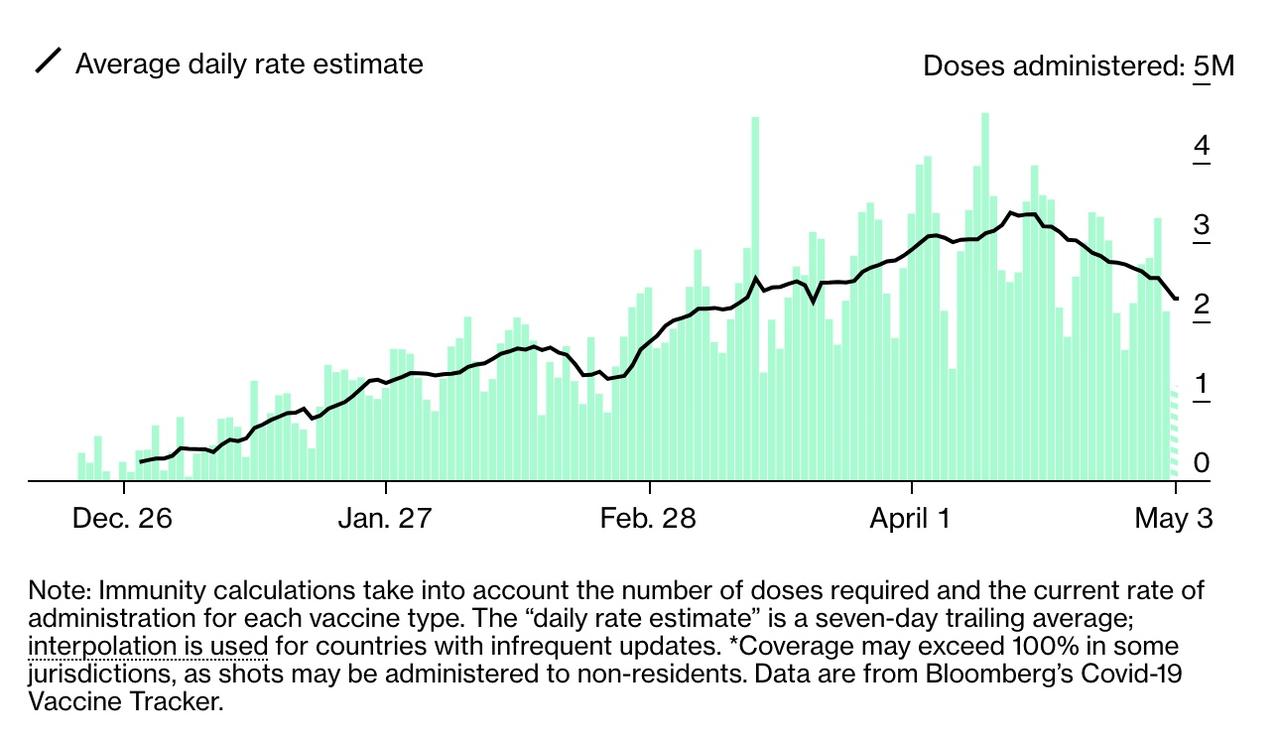
After peaking north of 4 million a day in early April, the number of doses being administered per day has fallen by almost half, to just north of 2 million per day as of early May.

Source: Bloomberg

As we wait to see whether more states will follow in Maryland's footsteps, we would like to know whether this will apply retroactively to state employees who have already been fully vaccinated?

https://www.zerohedge.com/covid-19/states-offer-beer-cash-incentives-vaccine-demand-softens

3D 'lung-on-a-chip' model developed to test new therapies for COVID, other lung conditions

 Globally, lung failure is one of the leading causes of death. Many conditions can affect and damage the lungs, including asthma, chronic obstructive pulmonary disease, influenza, pneumonia, and, most recently, COVID-19. To better understand respiratory diseases and develop new drugs faster, investigators from Brigham and Women's Hospital designed a 3D "lung-on-a-chip" model of the distal lung and alveolar structures, the tiny air sacs that take in oxygen as you breathe. With this innovation, researchers are actively studying how COVID-19 viral particles travel through airways and impact pulmonary cells. Notably, this technology enables scientists to investigate how various COVID-19 therapies, such as remdesivir, impact the replication of the virus. Their results are published in Proceedings of the National Academy of Sciences.

"We believe that it is a true innovation," said Y. Shrike Zhang, Ph.D., associate bioengineer in the Brigham's Department of Medicine and Division of Engineering in Medicine. "This is a first-of-its-kind in vitro model of the human lower lung that can be used to test many of the biological mechanisms and therapeutic agents, including anti-viral drugs for COVID-19 research."

Understanding and developing treatments for COVID-19 requires , which are time- and resource-intensive. With better laboratory models, such as the lung-on-a-chip, researchers may be able to evaluate drugs much faster and help select the drug candidates most likely to succeed in clinical trials.

Zhang and colleagues developed this technology to mirror the biological characteristics of the human distal lung. Previous models have been based on flat surfaces and oftentimes made with plastic materials, which do not incorporate the curvature of the alveoli and are much stiffer than the human tissue. Researchers created this new model with materials more representative of human alveolar tissue and stimulated  within these 3D spaces.

In testing the model's effectiveness, researchers found that the 3D alveolar lung effectively grew cells over multiple days and that these cells adequately populated airway surfaces. Through genome sequencing, scientists observed that the alveolar lung model more closely resembled the human distal lung than previous 2D models have. Additionally, the lung-on-a-chip model successfully stimulated breaths of air at the normal frequency for humans.

Beyond COVID-19, Zhang's research team intends to use this technology to study a broad range of pulmonary conditions, including various lung cancers. To replicate smoking's impact on the lungs, scientists allowed smoke to seep into the model's air chambers then simulated a breathing event, moving smoke deeper into the lungs. From there, they measured the smoke's impact and cell damage it caused.

While this innovation holds the potential to vastly expand the possibilities of studying and treating pulmonary diseases, this model is still in its early stages, said Zhang. Currently, the alveolar lung-on-a-chip only incorporates two out of the 42 cell types existing in the . In the future, researchers hope to incorporate more cell types into the model to make it more clinically representative of human lungs.

Going forward, Zhang also hopes to study how COVID-19 variants may travel through airways and impact pulmonary cells and COVID-19 therapies. He believes that using this  in tandem with other 3D organs, such as the intestines, could enable researchers to study how oral drugs impact  in the lower lungs. Zhang also hopes that in the future, this technology could be implemented to urgently understand and develop treatments for emerging contagious diseases.

"In terms of COVID-19, we've had very minimal timelines for developing therapies. In the future, if we have these models ready in hand, we can easily use them to study and test therapeutics in urgent situations where clinical trials are limited," said Zhang.


Explore further

New research may explain severe virus attacks on the lungs

More information: Di Huang el al., "Reversed-engineered human alveolar lung-on-a-chip model," PNAS (2021). www.pnas.org/cgi/doi/10.1073/pnas.2016146118
https://medicalxpress.com/news/2021-05-3d-lung-on-a-chip-therapies-covid-lung.html

Research with neutrons for better mRNA medicines

 If not before, then certainly since the first messenger RNA (mRNA) vaccines to combat the SARS CoV2 virus were approved in Germany, mRNA has become a recognized term even outside scientific circles. What is less well known is that mRNA can be used to produce much more than just vaccines. Around 50 different procedures for the treatment of diseases including cancer are already being studied in clinical trials. Scientists from the pharmaceutical company AstraZeneca, with the support of neutron researchers from Forschungszentrum JĂŒlich, have now discovered how the subcutaneous administration of mRNA can be improved. The goal is for chronically ill patients to be able to self-administer the medication on a regular basis.

mRNA serves as a blueprint in our cells for the production of protein molecules. mRNA drugs could therefore create proteins directly in the patient's body, targeted at the site where they are needed. Besides cancer, many other diseases are potentially treatable: haemophilia, for example, where the formation of a clotting factor is disrupted, can be treated by administering the blueprint for this very factor. After heart attacks or strokes, injecting mRNA could enable the formation of proteins that allow new blood vessels to grow.

Compared to current therapeutics, producing mRNA is faster and more flexible, as mRNA can be easily manufactured and the process is independent of the mRNA sequence. In addition, the technology enables personalized drugs to be developed quickly and proteins can be produced in the body over an extended period of time and with modifications otherwise difficult to achieve.

mRNA is rapidly degraded in the body by ubiquitous enzymes. It is important to prevent this from happening before the mRNA reaches the cells where the protein synthesis takes place. In addition, it must be ensured that the messenger reaches the right cells and in sufficient quantities. Even though there are procedures in which the "naked" mRNA is administered, using secure packaging and some kind of "address label" is far more efficient.

An advanced packaging system is exemplified in so-called lipid nanoparticles (LNP), tiny vesicles made of a mixture of fat-like substances. Each of them fulfils a specific task, such as stabilising the construct or delivering it into the cell.

When administered intravenously or intramuscularly, the LNPs already fulfil their objectives sufficiently, but when administered subcutaneously, the LNP trigger significant inflammation. Subcutaneous application would be essential to enable patients to inject themselves with the drug, just as diabetes patients do with insulin. Particularly in chronic diseases that require regular doses of a drug, this would offer a great advantage.

So far, only small, insufficient quantities can be safely injected subcutaneously. Current studies from researchers at AstraZeneca and the JĂŒlich Centre for Neutron Science (JCNS) show how this problem can be solved. The scientists supplemented the mRNA packaging with precursors of anti-inflammatory substances from the class of steroids. The body's own enzymes can convert these precursors into effective steroids at the site of injection.

Steroids have a strong anti-inflammatory effect, but can however have considerable side effects, especially if taken regularly. These side effects can be minimised by incorporating a steroid-precursor within the LNP so it is delivered and activated only at the site where it is needed i.e. the site where the LNPs are injected.

However, it is important to ensure that the steroid precursors are accessible to the enzymes. Therefore, they must be localised in the exterior of the lipid nanoparticles.

The researchers tried to ensure this by adding shorter or longer "fat-loving" extensions to the active substances. The idea is that the fat-loving areas would be inserted between the fatty substances of the LNP envelope in such a way that the steroid precursors would end up positioned on the outside. The scientists were able to prove that this is indeed the case with the help of neutron scattering studies at the small-angle scattering instrument KWS-2, operated by the JCNS at its outstation in the Heinz Maier-Leibnitz Zentrum in Garching.

"The KWS-2 instrument allows us to study fine structures, right down to nanostructures, using the contrast variation method," explains JCNS instrument scientist Dr. Aurel Radulescu. "In this process, the hydrogen atoms of individual components are exchanged for heavy hydrogen. This does not change the physical chemistry of the sample, but it does change the visibility for the neutrons. The neutrons can differentiate between the two isotopes and thus recognise which hydrogen atoms belong to which molecule." In this way, the different components of the lipid nanoparticles can be selectively labelled and differentiated from each other. And sure enough, the researchers found the steroid precursors on the outside of the particles, at least in the longer extensions.

"Understanding what the LNP surface looks like is fundamental to other challenges affecting LNP development," adds Dr. Marianna Yanez Arteta, Associate Principal Scientist in Advanced Drug Delivery at AstraZeneca. "Neutron scattering combined with selective isotope contrast is, to my knowledge, the only available technique that allows us to probe the lipid distribution and resolve the surface."

Further studies in AstraZeneca's laboratory confirmed the anti-inflammatory effect of the new LNP variants. The scientists also studied what length the fat-loving stem should be to ensure an optimal balance between efficient mRNA delivery and inflammatory response. "Incorporating an anti-inflammatory component into LNP greatly simplifies the therapy and may open it up to other treatments," predicts Dr. Yanez Arteta. If the anti-inflammatory LNPs now also prove their worth when used in humans, they could indeed unlock new therapeutic options for a wide range of diseases.


Story Source:

Materials provided by Forschungszentrum JuelichNote: Content may be edited for style and length.


Journal Reference:

  1. Nigel Davies, Daniel Hovdal, Nicholas Edmunds, Peter Nordberg, Anders DahlĂ©n, Aleksandra Dabkowska, Marianna Yanez Arteta, Aurel Radulescu, Tomas Kjellman, Andreas Höijer, Frank Seeliger, Elin Holmedal, Elisabeth Andihn, Nils Bergenhem, Ann-Sofie Sandinge, Camilla Johansson, Leif Hultin, Marie Johansson, Johnny Lindqvist, Liselotte Björsson, Yujia Jing, Stefano Bartesaghi, Lennart Lindfors, Shalini Andersson. Functionalized lipid nanoparticles for subcutaneous administration of mRNA to achieve systemic exposures of a therapeutic proteinMolecular Therapy - Nucleic Acids, 2021; 24: 369 DOI: 10.1016/j.omtn.2021.03.008