Search This Blog

Sunday, July 18, 2021

WHO: 'HIV Independently Tied to More Severe COVID-19'

 HIV was independently associated with a higher risk for severe or critical COVID-19, according to a World Health Organization (WHO) analysis.

In a study of people living with HIV in Asia, Europe, Africa, and South America who also were hospitalized for COVID-19, HIV infection was linked with an increased risk of severe or critical COVID-19 presentation (OR 1.13, 95% CI 1.09-1.17), after adjusting for age, sex and comorbidity burden, reported Silvia Bertagnolio, MD, of WHO in Geneva, Switzerland.

In addition, HIV infection was tied to a higher risk of inhospital mortality (adjusted HR 1.30, 95% CI 1.24-1.36), she said during a press conference at the International AIDS Society (IAS) virtual meeting.

"This 30% increase risk of dying in the hospital among persons living with HIV is independent of age, gender, severity of disease at admission, and of comorbidity," Bertagnolio explained.

IAS President Adeeba Kamarulzaman, MBBS, the press conference moderator, called the inhospital mortality rate "astonishing...this study underscores the importance of countries including all people living with HIV in the list of priority populations for national COVID-19 vaccine programs."

"It is also critical that health systems maintain HIV services during the COVID-19 pandemic, particularly in countries with high HIV prevalence," stressed Kamarulzaman, who is a member of the WHO Science Council. "Unfortunately, as we know, countries in sub-Saharan Africa with the highest burden of HIV are not currently receiving much COVID-19 vaccine coverage, and this needs to change."

"The global community must also do much more to bring COVID-19 vaccines to countries around the world with high prevalence of HIV and other diseases," Kamarulzaman said in a statement. "It is unacceptable that as of today, less than 3% of the entire African continent has received a single dose of the vaccine and less than 1.5% have received both doses."

Bertagnolio said that previous evidence regarding the impact of HIV infection on the severity and mortality of COVID-19 has been limited and sometimes conflicting, and most analyses have been based on relatively small cohorts of individuals in specific settings.

Her group looked at patients hospitalized for COVID-19 between January 2020 and April 2021 (n=168,649; 37 countries), and identified those (n=15,522; 24/37 countries) who also had HIV. Patient age was about 45 and 37.1% were men; 91.8% of those with HIV were on antiretroviral therapy. Bivariate and regression analyses were conducted to determine whether HIV status was a risk factor for severity at admission and in-hospital mortality. The models were adjusted for potential correlation for clustering at the country level.

At presentation, 36.2% of those with HIV had severe or critical COVID-19 symptoms. Of those patients with a known outcome, 23.1% died from COVID-19, the authors reported. Among the patients with HIV infection who died inhospital, other associated significant risk factors for higher mortality were age >65 (OR 1.82, 95% CI 1.62-2.04), being male (OR 1.21, 95%CI 1.15-1.28), having diabetes (OR 1.50, 95% CI 1.39-1.62), and having a hypertension diagnosis (OR 1.26, 95% CI 1.19-1.34).

Data for the analysis came from the WHO Global Clinical Platform for COVID-19. Bertagnolio said that, based on the study results, WHO intends to add HIV infection as a risk factor in its clinical guidelines for COVID-19. She called the data "a living analysis," that will be updated routinely.

Biotech week ahead, July 19

 Biotech stocks were down for a second week in a row, as they retreated along with the broader market amid macro concerns. Consumer price inflation data released during the week stoked rate hike fears, and exerted negative pressure on stocks.

There were very few stock-specific catalysts, barring a few preannouncements, stock offerings, and a slew of initial public offerings.

The biggest disappointment of the week was FibroGen, Inc. FGEN 42.23%, which lost roughly 50% of its market cap following an adverse AdCom verdict on its roxadustat, which is evaluated for treating anemia in chronic kidney disease patients.

Vaccine maker Moderna, Inc. 

MRNA 10.3% was a standout this week, as its shares ended the week with a gain of about 22%, closing at an all-time high. In the process, the stock hit a key milestone of $100 billion in market cap.
Eli Lilly and Company LLY 0.46% announced the acquisition of privately-held Promoter Technologies for over $1 billion, including potential milestone payments. Promoter's portfolio is expected to add value to Lilly's diabetes franchise.

Here are the key catalytic events for the unfolding week:

Conferences

Mucopolysaccharides 2021, the 16th Annual International Symposium of MPS and Related Diseases: July 23-25


PDUFA Dates

The Food and Drug Administration is expected to rule on Albireo Pharma, Inc.'s ALBO 4.29% new drug application for odevixibat for the treatment of pruritus in patients with progressive familial intrahepatic cholestasis, a rare inherited progressive liver disease.
Bylvay has been approved as the brand name for odevixibat. The PDUFA goal date is Tuesday, July 20.


Earnings

Intuitive Surgical, Inc. ISRG 0.37% (Tuesday, after the close)
Johnson & Johnson JNJ 0.15% (Wednesday, before the market open)
Abbott Laboratories ABT 0.69% (Thursday, before the market open)
Biogen Inc. BIIB 1.08% (Thursday, before the market open)
Quest Diagnostics Incorporated DGX 0.36% (Thursday, before the market open)
NeuroMetrix, Inc. NURO 0.31% (Thursday, before the market open)

IPOs

IPO Pricing

AbSci Corp is proposing to offer 12.5 million shares in an initial public offering at an estimated price range of $15-$17. The company's AI-powered Integrated drug creation platform enables the creation of novel biologics by unifying biologic drug discovery and cell line development into one simultaneous process. The company has applied for listing its shares on the Nasdaq under the ticker symbol ABSI.

Candel Therapeutics, Inc., a late clinical stage biopharma focused on helping patients fight cancer with oncolytic viral immunotherapies, has filed to offer 6.072 million shares in an IPO. The company expects to price the offering between $13 and $15 and has applied for listing its shares on the Nasdaq under the ticker symbol CADL.

Elicio Therapeutics, Inc., an oncology-focused clinical-stage biopharma, will offer 3.077 million shares in an IPO, with the price range estimated to be $12 and $14. The company has applied for listing its shares on the Nasdaq under the ticker symbol ELTX.

Ocean Biomedical, Inc. has filed to offer 3.2258 million shares in an IPO. The company expects to price the offering in the range of $14-$17. The biopharma focuses on licensing tech and innovations and developing them into products. It has applied for listing its shares on the Nasdaq under the ticker symbol OCEA.

IPO Quiet Period Expiry

Monte Rosa Therapeutics, Inc. GLUE 0.89%
Miromatrix Medical Inc. MIRO 1.52%
Elevation Oncology, Inc. ELEV 5.65%
Acurx Pharmaceuticals, Inc. ACXP 1.47%
Graphite Bio, Inc. GRPH 4.07%
G Medical Innovations Holdings Ltd GMVD 5.7%

Israel's Bennett: ‘Vaccines on their own won’t solve the problem’

At a situational assessment in Tel Aviv Friday, Prime Minister Naftali Bennett said protection afforded by COVID-19 vaccines was “weaker than we’d hoped” against the surging Delta variant.

“Anyone who hoped that vaccines on their own would solve the problem — they won’t,” Bennett said at the meeting attended by ministers, health officials, national security council members, police and the military.

“Delta is surging” all over the world, he said. “On the one hand the vaccines are effective against the virus, and so we are making sure we have the necessary stocks. But vaccines alone are not enough.”

He added: “We don’t know exactly to what extent the vaccine helps, but it is significantly less” against Delta than previous strains. “We all hope to see a slowdown, but the facts at the moment are that there isn’t a slowdown — not here and not around the world.”

Still, the premier said, “Our goal is to allow routine life to continue with adjustments to the coronavirus.”

Bennett said the government’s aim was to provide the public with clear directives with enough advance warning to prepare, “without surprises, without panic and mainly through forward planning.”

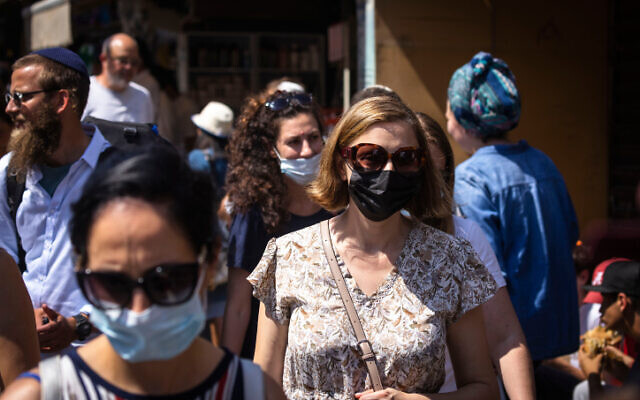
People shop at the Mahane Yehuda market in Jerusalem on June 15, 2021 (Olivier Fitoussi/Flash90)

At the meeting, officials decided to move to quickly approve the use of home testing kits, increase enforcement, particularly of the “Revelry Pass” set to take effect next week for weddings, parties and other celebratory indoor gatherings, and conduct a review of travel policies at Ben Gurion Airport.

Meanwhile a top health official said Friday said the Health Ministry was not considering lockdowns at this stage.

“I don’t know how we’ve come to talk of lockdowns,” Sharon Alroy-Preis, head of public health at the ministry, told Channel 12 news. “We are not at a place of [considering] a lockdown during the holiday period [in September].”

She said that instead, health officials were pushing for broad use of the Green Pass system to only allow vaccinated and recovered individuals or those with negative tests to enter various venues.

Her comments seemed to contradict those made Thursday by Nachman Ash, the new director-general of the Health Ministry, who said closures remained a possibility for the High Holiday period that begins with Rosh Hashana and stretches for much of September.

Dr. Sharon Alroy-Preis, head of public health services in the Health Ministry, at a press conference in Jerusalem on June 23, 2021. (Yonatan Sindel/Flash90)

“I think that it could be that we’ll get to the point where we’ll say ‘we need a lockdown,’” Ash told Channel 13 news. “I’m worried we might get there… in a few weeks, it’s possible we’ll get there.”

Starting Friday, all travelers, including those who are vaccinated or have recovered from COVID-19, were required to self-isolate for 24 hours upon arrival to Israel, or for a shorter period if they receive a negative test result.

Meanwhile, those returning from 15 countries deemed to have high infection rates will be required to quarantine for seven days with a negative test result, according to the ministry’s updated guidelines. The full quarantine period was recently shortened from the previous 10-14 days.

The countries considered to have high infection rates as of Friday are the United Arab Emirates, Seychelles, Ecuador, Ethiopia, Bolivia, Guatemala, Honduras, Zimbabwe, Zambia, Namibia, Paraguay, Chile, Colombia, Costa Rica and Tunisia.

Starting next Friday, July 23, the following countries will be added to the list: the United Kingdom, Cyprus, Turkey, Georgia, Uganda, Myanmar, Fiji, Panama, Cambodia, Kenya and Liberia.

The Health Ministry also said that next Friday, Spain and Kyrgyzstan will be added to the list of countries with extreme rates of infection to which Israelis are barred from flying, provided that a government committee approves the ministry’s request.

People are seen at the Ben Gurion Airport on July 15, 2021 (Flash90)

The countries that are currently off-limits for Israelis are Uzbekistan, Argentina, Belarus, Brazil, South Africa, India, Mexico and Russia.

Health Ministry figures showed 855 new cases were confirmed on Thursday, the highest figure since March 22. That came after daily infections topped 750 on each of the previous three days. Of the 65,125 tests performed Thursday, 1.52 percent came back positive — a rate slightly higher than in recent days.

There are 5,817 active virus cases in the country, Health Ministry data showed, while the death toll stood at 6,443.

Health officials have linked the recent spike in infections in Israel to travelers who brought back new variants of the virus from abroad and did not properly quarantine after arriving.

The resurgence of coronavirus in Israel has been largely attributed to the spread of the Delta variant, which was first detected in India and is believed to be twice as contagious as the original COVID strain.

https://www.timesofisrael.com/bennett-protection-afforded-by-vaccines-weaker-than-wed-hoped-against-delta/

UAE among 1st nations to receive, use Glaxo-Vir COVID-19 med Sotrovimab

 The Ministry of Health and Prevention (MoHAP), in collaboration with the Department of Health - Abu Dhabi (DoH) and Dubai Health Authority (DHA), has announced the treatment results for anti-viral medicine Sotrovimab in treating mild to moderate COVID-19 cases among high-risk patients including adults, pregnant women and children aged 12 and above who are at risk of progressing to severe symptoms and meet other relevant criteria.

The MoHAP has approved the use of Sotrovimab, which is produced by global biopharmaceutical company GlaxoSmithKline (GSK), after conducting local evaluation. It has also been approved for emergency use by the US Food and Drug Administration.

Between 30 June and 13 July, Sotrovimab was administered to 6,175 patients with COVID-19 in Abu Dhabi. About 52 per cent of the patients were aged 50 or above, and almost all recipients had multiple comorbidities including obesity, cancer, cardiovascular disease and diabetes.

97 percent of recipients fully recovered within 14 days. The medication also resulted in 100 percent prevention of death among recipients and 99 percent prevention of admission to ICU.

Sotrovimab is a monoclonal antibody treatment delivered through intravenous therapy in accordance with protocols developed by the National Scientific Committee.

The UAE was one of the first countries in the world to receive a shipment of Sotrovimab in mid-June, following an agreement between the Department of Health - Abu Dhabi, Rafed, a leading group purchasing organisation, GSK and Etihad Cargo.

https://wam.ae/en/details/1395302953635

Only 1 in 4 nursing homes confident they will stay open a year: survey

 ​Only a quarter of nursing homes and assisted living communities are confident they can remain open for another year or more, reports The American Health Care Association and National Center for Assisted Living.

The findings come from the organization's most recent survey of U.S. skilled nursing centers, assisted living communities, and sub-acute centers and homes.

Four key survey findings:

1. More than half of nursing homes and close to half of assisted living communities said their organization is operating at a loss.  

2. The top three costs facilities have incurred due to the pandemic are additional pay for staff, hiring additional staff and personal protective equipment. 

3. In total, 92 percent of nursing homes and 62 percent of assisted living facilities said the Provider Relief Fund has been helpful amid the pandemic. 

4. Overall, 143 closures or mergers occurred in 2020, with 1,670 projected in 2021.  

"Even though COVID cases in long term care are at historic lows, providers are struggling to recover from the economic crisis the pandemic has induced," said Mark Parkinson, president and CEO of AHCA/NCAL. "Too many facilities are operating under shoestring budgets simply because policymakers have failed to dedicate the proper resources, and this can have devastating consequences."

https://www.beckershospitalreview.com/post-acute/percentage-of-nursing-home-staff-fully-vaccinated-against-covid-19-by-state-louisiana-is-last.html

Percentage of nursing home staff fully vaccinated against COVID-19, by state

 Nationwide, an average of 56.4 percent of nursing home staff are fully vaccinated, reports AARP.

The AARP Public Policy Institute, in collaboration with the Scripps Gerontology Center at Miami University in Ohio, created the AARP Nursing Home COVID-19 Dashboard to collect COVID-19 data from the nation's nursing homes. The data below is a four-week snapshot ending June 20, the most recent data available.

States are listed in order of highest percentage vaccinated.

All states, ranked by percentage of nursing home staff fully vaccinated: 

Hawaii: 83.9 percent  

Vermont: 76.6 percent

California: 76.3 percent 

New Hampshire: 73.9 percent 

Rhode Island: 71.6 percent

Massachusetts: 71.3 percent 

Alaska: 69.9 percent 

Maryland: 69.1 percent 

Maine: 67.6 percent 

Oregon: 67.6 percent 

Utah: 66.8 percent 

Colorado: 65.1 percent 

District of Columbia: 64.6 percent 

West Virginia: 64.6 percent 

Virginia: 64.5 percent

Nebraska: 63.4 percent

North Dakota: 62.8 percent

Minnesota: 62.7 percent

Washington: 62.2 percent

New Jersey: 61.9 percent

New York: 60.4 percent

Iowa: 60 percent

New Mexico: 59.9 percent

South Dakota: 59.7 percent

Montana: 59.3 percent

Delaware: 58.6 percent

Wisconsin: 57.5 percent

Pennsylvania: 56.9 percent

Illinois: 56.4 percent

Arkansas: 55.8 percent

Nevada: 55.6 percent

Kansas: 53.6 percent

Texas: 52.8 percent

North Carolina: 51.3 percent

Idaho: 51.1 percent

Arizona: 50.8 percent

Connecticut: 50 percent

South Carolina: 49 percent

Wyoming: 48.2 percent

Indiana: 47.9 percent

Alabama: 47.8 percent

Ohio: 47.7 percent

Michigan: 46.9 percent

Tennessee: 46.8 percent

Kentucky: 46.4 percent

Oklahoma: 44.7 percent

Georgia: 44 percent

Missouri: 43.2 percent

Mississippi: 42.2 percent

Florida: 41.8 percent

Louisiana: 41.1 percent

https://www.beckershospitalreview.com/post-acute/percentage-of-nursing-home-staff-fully-vaccinated-against-covid-19-by-state-louisiana-is-last.html

US government to send 100 people to Nevada for vaccine efforts amid surge

 At the request of Nevada Gov. Steve Sisolak, the federal government is deploying more than 100 people to help enhance vaccine access and vaccine outreach efforts, Jeff Zients, the White House's COVID-19 response coordinator, said during a July 16 news briefing.

"Surge response teams are working with governors and local public health officials to provide specific federal health resources and capabilities to fight outbreaks due to spread of the delta variant," Mr. Zients said. "We're already helping many states identify and address specific needs, including testing, therapeutics and vaccination."

Case numbers are climbing across most of the U.S., with The New York Times reporting sharp rises in both cases and hospitalizations in Arkansas, Missouri, Florida and Nevada — states with relatively low vaccination rates. As of July 15, cases in Nevada have increased 44 percent over the last two weeks, while hospitalizations have risen 85 percent, reports the Times. 

The White House is also providing Missouri with CDC technical expertise, including a genetics sequencing data analysis outbreak response, said Mr. Zients. 

https://www.beckershospitalreview.com/quality/us-government-to-send-100-people-to-nevada-for-vaccine-efforts-amid-surge.html