Search This Blog

Wednesday, July 28, 2021

SARS-CoV-2 Lambda variant exhibits higher infectivity and immune resistance

 Izumi Kimura, Yusuke Kosugi, Jiaqi Wu, Daichi Yamasoba, Erika P Butlertanaka, Yuri L Tanaka, Yafei Liu, Kotaro Shirakawa, Yasuhiro Kazuma, Ryosuke Nomura, Yoshihito Horisawa, 

Kenzo TokunagaAkifumi Takaori-KondoHisashi AraseThe Genotype to Phenotype Japan (G2P-Japan) ConsortiumAkatsuki SaitoSo NakagawaKei Sato

HUMAN RHINOVIRUS INFECTION BLOCKS SARS-COV-2 REPLICATION

 The common cold virus could offer some level of protection against COVID-19 infection, according to a new study led by Centre for Virus Research (CVR) scientists.

The research, published in the Journal of Infectious Diseases, found that human rhinovirus - the virus that causes the common cold - triggers an innate immune response that seems to block SARS-CoV-2 replication in cells of the respiratory tract.

In further studies, mathematical simulations by the research team showed that this virus-virus interaction might have a population-wide effect, and that an increasing prevalence of rhinovirus could reduce the number of new COVID-19 cases.

Human rhinoviruses cause the common cold and are the most widespread respiratory viruses found in people. Previous research has shown that interactions between rhinoviruses and other respiratory viruses can affect the type and severity of infections in individuals, and the way in which they infect and circulate around groups of people (patterns of infection).

Viruses only infect a small number of cell types within the body, and respiratory viruses typically infect cells within the respiratory tract.

In the study, the researchers first infected human respiratory cells with SARS-CoV-2 in the lab, recreating the cellular environment in which infections normally occur. They then studied the replication of SARS-CoV-2 in these cells, both in the presence and absence of rhinovirus.

The CVR's Professor Pablo Murcia explained: “Our research shows that human rhinovirus triggers an innate immune response in human respiratory epithelial cells which blocks the replication of the COVID-19 virus, SARS-CoV-2.

"This means that the immune response caused by mild, common cold virus infections could provide some level of transient protection against SARS-CoV-2, potentially blocking transmission and reducing the severity of COVID-19.

“The next stage will be to study what is happening at the molecular level during these virus-virus interactions, to understand more about their impact on disease transmission.

"We can then use this knowledge to our advantage, hopefully developing strategies and control measures for COVID-19 infections. In the meantime, vaccination is our best method of protection against COVID-19.”


The front cover of the Journal of Infectious Diseases for March 2021

Human rhinovirus infection blocks SARS-CoV-2 replication within the respiratory epithelium: implications for COVID-19 epidemiology

  • Kieran Dee, Daniel M Goldfarb, Joanne Haney, Julien A R Amat, Vanessa Herder, Meredith Stewart, Agnieszka M Szemiel, Marc Baguelin, Pablo R Murcia.
  • The Journal of Infectious Diseases, jiab147, Published 23 March 2021. https://doi.org/10.1093/infdis/jiab147.

Funding: The study was funded by the Medical Research Council (MRC).

https://www.gla.ac.uk/researchinstitutes/iii/newsevents/headline_783026_en.html

Traveling with unvaccinated kids? 6 questions answered on how to manage the risks

 Across the U.S., COVID-19 cases are rising again, primarily in unvaccinated populations. Most of these cases are due to the highly infectious delta variant of SARS-Cov-2, the coronavirus that causes COVID-19. Many children are among those who aren't vaccinated, simply because no vaccines have been authorized for children under 12. About a quarter of children aged 12-15 years have been vaccinated. Given the rise in cases and the inability to vaccinate young children, many parents are concerned about the safety of traveling this summer.

The risk of COVID-19 associated with travel is largely determined by how you will travel, where you're going, who will be there and what you will do there. By assessing these variables, parents can make informed decisions about their travel plans.

1. How much risk does COVID-19 pose for kids?

When thinking about COVID-19 and unvaccinated , two types of risk should be considered—both the direct risk for the child and the risk of transmission to others. Children develop severe disease from COVID-19 far less commonly than adults, and they die much less often. But children do die from COVID-19. COVID-19 has caused nearly 500 deaths in children 17 years of age and younger in the U.S. And some children also suffer from long COVID-19—the lingering effects of COVID-19 that are still not well understood.

To put that in perspective, the number of deaths due to influenza in a typical flu season is about 150 to 200 children in the U.S. But only one child is known to have died from the flu in the 2020-2021 influenza season. In the past year, COVID-19 has been one of the most common infectious disease-related causes of death in children.

But even when children do not get seriously ill with COVID-19 or show symptoms, they can still transmit the virus to other children and adults. The rate of child-to-adult transmission of SARS-CoV-2 is roughly half the rate of adult-to-child transmission. So even when the risk is low for children, transmission to other unvaccinated kids and adults is still a serious concern.

2. Are road trips safer than air travel?

People can encounter others more often when they are traveling than in their daily lives, which automatically increases the possibility of being exposed to someone with COVID-19.

With , families need to consider the number of people they're exposed to in airports, as well as on the airplane. In airports, travelers are exposed indoors to many people, potentially from different parts of the country and world. But risk is reduced by the requirement to wear masks indoors at all times in U.S. airports.

On an airplane, travelers may sit near several people outside of their own family for a few hours, and some of these people may not comply with mask requirements consistently. Although outbreaks have been associated with air travel, fortunately these reported outbreaks have been rare.

In general, traveling by car is likely to be safer, with exposures limited to infrequent rest stops and short meal breaks.

3. How does the destination affect the risk?

Whether in one's own community or when traveling afar, a serious risk factor to consider is the rate of COVID-19 cases, including the incidence of delta variant in that community. When COVID-19 rates rise in a community, that destination becomes less safe, generally, than a community with low, stable rates.

In recent weeks, the highest COVID-19 infection rates have been seen in communities with the lowest vaccination rates. One way to assess the risk of a particular destination is to compare recent COVID-19 and vaccination rates in your destination to the rates in your own community using the CDC website.

4. What kinds of gatherings are safe right now?

When people travel, they come into contact with strangers, friends and extended family whom they would not encounter at home. These interactions, what epidemiologists call "mixing," increase the chances for people to be exposed to SARS-CoV-2.

The added risk from that mixing depends on the vaccination status of the people encountered, the number of people encountered, the nature of that encounter and the duration of the encounter. If you are near many people for several hours, the risk is greater than if you are near a few people for a short time. If almost everyone you'll come into contact with is vaccinated, the risk will be very low. But as the number of unvaccinated people goes up, the risk will go up as well.

5. What types of activities are safe?

An important rule of thumb is that being outdoors is safer than being indoors. Indoors, the virus can hang in the air for some time, increasing potential exposure. Outdoors, the virus disperses quickly, greatly reducing the chances you're exposed to virus shed by someone infected with the coronavirus.

The primary concern outdoors is when people are close to one another for extended periods. Sitting near other people for several hours outdoors, like at a baseball game or a music festival, could carry some risk, especially if people aren't wearing masks and the vaccination rate in the community is low. For kids playing together, an activity like wrestling in the grass is going to be less safe than playing soccer or tossing a Frisbee.

6. What steps can lower the risk of infection?

No decision is going to be right for everyone. Every parent will need to weigh the risks and make their own decisions. Traveling will inevitably lead to exposures to unvaccinated kids and adults. But the risk will be determined by the extent of that exposure.

It's important to remember that vaccination is only one of the tools that can be used to reduce risk. Consider using masks indoors whenever possible. Masks reduce transmission and have been proven to be an effective complement to vaccination. Wearing a mask indoors and in public spaces part of the time—even if not all of the time—further cuts down on risk.

Before traveling, families should talk through expectations and concerns, both within their own family and with others they will be meeting up with. These conversations can be difficult. People should talk openly, honestly and without judgment about who has been vaccinated and who hasn't and agree up front on a set of rules.

And then do your best to enjoy your vacation.

https://medicalxpress.com/news/2021-07-unvaccinated-kids.html

Inhaled dry powder formulation of broad-spectrum antiviral against COVID-19 and influenza

 The collaborative research team formed by the Department of Pharmacology and Pharmacy and Department of Microbiology, LKS Faculty of Medicine, The University of Hong Kong (HKUMed), has developed an inhalable dry powder formulation of tamibarotene, a repurposed drug that exhibits broad-spectrum antiviral activity against SARS-CoV-2, MERS-CoV and influenza A H1N1 virus following pulmonary delivery. The work has been published online in Advanced Therapeutics in June 2021.

In response to the unpredictable epidemic and pandemic outbreaks of influenza and coronavirus, early administration of a broad-spectrum antiviral agent could be an effective strategy to control the spread of respiratory infections. The HKUMed research team has previously reported that a retinoid derivative, AM580, demonstrated broad-spectrum  against coronaviruses (MERS-CoV, SARS-CoV and SARS-CoV-2) and influenza virus.

An analog of AM580, tamibarotene, is an orally active retinoid derivative for the treatment of acute promyelocytic leukemia currently marketed in Japan. With an antiviral activity comparable to AM580, tamibarotene has an established safety profile in human with milder adverse effects than other retinoid derivatives. Tamibarotene is available as an oral tablet, which is difficult to achieve robust antiviral activity in the respiratory tract due to inadequate lung distribution following oral administration. When high dose is administered to compensate the insufficient lung distribution, toxic side effects are expected because of the extensive systemic exposure.

Inhaled dry powder formulation of broad-spectrum antiviral against COVID-19 and influenza
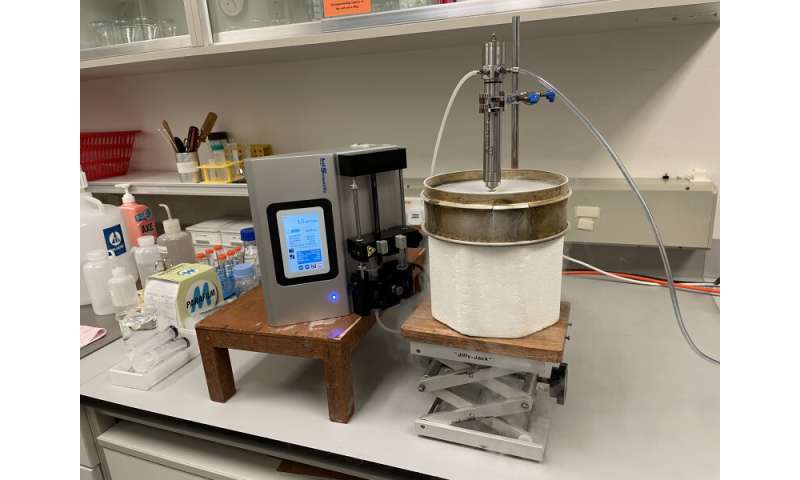
Photos of spray-freezing step in spray freeze drying process. Liquid is fed into a nozzle and atomised into fine droplets. Those droplets fall into liquid nitrogen (inside the white styrofoam container) and become frozen. Credit: The University of Hong Kong

By contrast, pulmonary delivery is a non-invasive administration route that can maximize local concentration in the lung and reduce systemic exposure, thereby reducing the risk of adverse effects and improving therapeutic efficacy. Inhaled  formulation of broad-spectrum antiviral drug can be used on outpatient basis due to the ease of (self-)administration as prophylaxis and treatment for respiratory viral infections.

Inhaled dry powder formulation of tamibarotene was prepared by spray freeze drying, a particle engineering technique that combines spray freezing and freeze drying to produce particles with excellent aerosol properties for inhalation. The HKUMed research team found that a prophylactic dose of tamibarotene powder delivered by intratracheal administration significantly reduced virus titer and viral RNA load of SARS-CoV-2 in the hamsters' lungs, and the antiviral efficacy was comparable to intratracheally administered remdesivir. The broad-spectrum anti-coronavirus activity of inhaled tamibarotene powder was also demonstrated in MERS-CoV-infected mice model as pre-challenge prophylaxis. Moreover, remarkable anti-influenza activity of tamibarotene powder formulation was demonstrated by the improved survival rate of mice and alleviated disease severity when administered either intratracheally as prophylaxis or intranasally as treatment.

"Currently, there is no inhaled powder formulation of antiviral available on the market for COVID-19 treatment. Tamibarotene dry powder with broad-spectrum antiviral activity presents a new strategy for COVID-19 management, especially as prophylaxis and treatment for outpatients when in-patient healthcare cannot be provided," said Dr. Jenny Lam, associate professor, Department of Pharmacology and Pharmacy, HKUMed, who initiated the study. "With the favorable safety profile of tamibarotene and based on the findings in the present study,  evaluating inhaled tamibarotene for its safety and as at-home treatment for COVID-19 could be considered."

Since tamibarotene exerts its antiviral activity by targeting lipid metabolism in the host cells, it is advantageous in responding to mutated or drug-resistant virus strains. More importantly, by demonstrating antiviral efficacy against SARS-CoV-2 and H1N1 virus in respective animal models, inhaled tamibarotene presents a possible solution for COVID-19 and influenza co-infection.


Explore further

Scientists uncover potential antiviral treatment for COVID-19

More information: Qiuying Liao et al, Inhaled Dry Powder Formulation of Tamibarotene, a Broad‐Spectrum Antiviral against Respiratory Viruses Including SARS‐CoV‐2 and Influenza Virus, Advanced Therapeutics (2021). DOI: 10.1002/adtp.202100059
https://medicalxpress.com/news/2021-07-inhaled-powder-broad-spectrum-antiviral-covid-.html

Highly potent, stable nanobodies stop SARS-CoV-2

 Göttingen researchers have developed mini-antibodies that efficiently block the coronavirus SARS-CoV-2 and its dangerous new variants. These so-called nanobodies bind and neutralize the virus up to 1,000 times better than previously developed mini-antibodies. In addition, the scientists optimized their mini-antibodies for stability and resistance to extreme heat. This unique combination makes them promising agents to treat COVID-19. Since nanobodies can be produced at low costs in large quantities, they could meet the global demand for COVID-19 therapeutics. The new nanobodies are currently in preparation for clinical trials.

Antibodies help our  system to fend off pathogens. For example, the molecules attach to viruses and neutralize them so that they can no longer infect cells. Antibodies can also be produced industrially and administered to acutely ill patients. They then act like drugs, relieving symptoms and shortening recovery from the disease. This is established practice for treating hepatitis B and rabies. Antibodies are also used for treating COVID-19 patients. However, producing these molecules on an industrial scale is too complex and expensive to meet worldwide demand. Nanobodies could solve this problem.

Scientists at the Max Planck Institute (MPI) for Biophysical Chemistry in Göttingen (Germany) and the University Medical Center Göttingen (UMG) have now developed mini-antibodies (also known as VHH antibodies or nanobodies) that unite all the properties required for a potent drug against COVID-19. "For the first time, they combine extreme stability and outstanding efficacy against the  and its Alpha, Beta, Gamma, and Delta mutants," emphasizes Dirk Görlich, director at the MPI for Biophysical Chemistry.

At first glance, the new nanobodies hardly differ from anti-SARS-CoV-2 nanobodies developed by other labs. They are all directed against a crucial part of the coronavirus spikes, the receptor-binding domain that the virus deploys for invading host cells. The nanobodies block this binding domain and thereby prevent the virus from infecting cells.

"Our nanobodies can withstand temperatures of up to 95 °C without losing their function or forming aggregates," explains Matthias Dobbelstein, professor and director of the UMG's Institute of Molecular Oncology. "For one thing, this tells us that they might remain active in the body long enough to be effective. For another, heat-resistant nanobodies are easier to produce, process, and store."

Single, double, and triple nanobodies

The simplest mini-antibodies developed by the Göttingen team already bind up to 1,000 times more strongly to the spike protein than previously reported nanobodies. They also bind very well to the mutated receptor-binding domains of the Alpha, Beta, Gamma, and Delta strains. "Our single nanobodies are potentially suitable for inhalation and thus for direct virus neutralization in the respiratory tract," Dobbelstein says. "In addition, because they are very small, they could readily penetrate tissues and prevent the virus from spreading further at the site of infection."

A 'nanobody triad' further improves binding: The researchers bundled three identical nanobodies according to the symmetry of the spike protein, which is comprised of three identical building blocks with three binding domains. "With the nanobody triad, we literally join forces: In an ideal scenario, each of the three nanobodies attaches to one of the three binding domains," reports Thomas Güttler, a scientist in Görlich's team. "This creates a virtually irreversible bond. The triple will not let release the spike protein and neutralizes the virus even up to 30,000-fold better than the single nanobodies." Another advantage: The larger size of the nanobody triad expectedly delays renal excretion. This keeps them in the body for longer and promises a longer-lasting therapeutic effect.

As a third design, the scientists produced tandems. These combine two nanobodies that target different parts of the receptor-binding domain and together can bind the spike protein. "Such tandems are extremely resistant to virus mutations and the resulting 'immune escape' because they bind the viral spike so strongly," explains Metin Aksu, a researcher in Görlich's team.

For all nanobody variants—monomeric, double as well as triple—the researchers found that very small amounts are sufficient to stop the pathogen. If used as a drug, this would allow for a low dosage and thus for fewer side effects and lower production costs.

Alpacas provide blueprints for mini-antibodies

"Our nanobodies originate from alpacas and are smaller and simpler than conventional antibodies," Görlich says. To generate the nanobodies against SARS-CoV-2, the researchers immunized three alpacas—Britta, Nora, and Xenia from the herd at the MPI for Biophysical Chemistry—with parts of the coronavirus spike protein. The mares then produced antibodies, and the scientists drew a small blood sample from the animals. For the alpacas, the mission was then complete, as all further steps were carried out with the help of enzymes, bacteria, so-called bacteriophages, and yeast. "The overall burden on our animals is very low, comparable to vaccination and blood testing in humans," Görlich explains.

Görlich's team extracted around one billion blueprints for nanobodies from the alpacas' blood. What then followed was a laboratory routine perfected over many years: The biochemists used bacteriophages to select the very best nanobodies from the initially vast pool of candidates. These were then tested for their efficacy against SARS-CoV-2 and further improved in successive rounds of optimization.

Not every antibody is 'neutralizing.' Researchers of Dobbelstein's group therefore determined if and how well the nanobodies prevent the viruses from replicating in cultured cells in the lab. "By testing a wide range of nanobody dilutions, we find out which quantity suffices to achieve this effect," explains Antje Dickmanns from Dobbelstein's team. Her colleague Kim Stegmann adds, "Some of the nanobodies were really impressive. Less than a millionth of a gram per liter of medium was enough to completely prevent infection. In the case of the nanobody triads, even another twenty-fold dilution was sufficient."

Also effective against current coronavirus variants

Over the course of the coronavirus pandemic, new virus variants have emerged and rapidly became dominant. These variants are often more infectious than the strain that first appeared in Wuhan (China). Their mutated spike protein can also 'escape' neutralization by some originally effective antibodies of infected, recovered, or vaccinated persons. This makes it more difficult even for an already trained immune system to eliminate the virus. This problem also affects previously developed therapeutic antibodies and nanobodies.

This is where the new nanobodies show their full potential, as they are also effective against the major coronavirus variants of concern. The researchers had inoculated their alpacas with part of the spike protein of the first known SARS-CoV-2 virus, but remarkably, the animals' immune system also produced antibodies that are active against the different virus variants. "Should our nanobodies prove ineffective against a future variant, we can reimmunize the alpacas. Since they have already been vaccinated against the virus, they would very quickly produce antibodies against the new ," Güttler asserts confidently.

Therapeutic application in view

The Göttingen team is currently preparing the nanobodies for therapeutic use. Dobbelstein emphasizes, "We want to test the nanobodies as soon as possible for safe use as a drug so that they can be of benefit to those seriously ill with COVID-19 and those who have not been vaccinated or cannot build up an effective immunity." The team is supported by experts in technology transfer: Dieter Link (Max Planck Innovation), Johannes Bange (Lead Discovery Center, Dortmund, Germany), and Holm Keller (kENUP Foundation).

The receptor-binding domain of SARS-CoV-2 is known to be a good candidate for a protein vaccine but so far difficult to manufacture economically on a large scale and in a form, which activates the immune system against the virus. Bacteria programmed accordingly produce incorrectly folded material. The Göttingen researchers discovered a solution for this problem: They identified special nanobodies that enforce correct folding in bacterial cells, without obstructing the crucial neutralizing part of the receptor-binding domain. This might allow for vaccines that can be produced inexpensively, can be quickly adapted to new virus variants, and can be distributed with simple logistics even in countries with little infrastructure. "The fact that nanobodies can help with protein folding was previously not known and is extremely interesting for research and pharmaceutical applications," Görlich says.


Explore further

Nanobodies inhibit SARS-CoV-2 infection, including emergent variants

More information: Thomas Güttler et al, Neutralization of SARS‐CoV‐2 by highly potent, hyperthermostable, and mutation‐tolerant nanobodies, The EMBO Journal (2021). DOI: 10.15252/embj.2021107985
https://medicalxpress.com/news/2021-07-highly-potent-stable-nanobodies-sars-cov-.html

T cell response 'not critical' for immune memory to SARS-CoV-2 or recovery from COVID-19

 New research conducted in monkeys reveals that T cells are not critical for the recovery of primates from acute COVID-19 infections. T cell depletion does not induce severe disease, and T cells do not account for the natural resistance of rhesus macaques to severe COVID-19. Furthermore, strongly T cell-depleted macaques still develop potent memory responses to a second infection.

The findings, published in the mBio, an open-access journal of the American Society for Microbiology, have implications for the development of second-generation vaccines and therapeutics.

"We started this study early in the pandemic, trying to figure out how to make a good model to study the disease in humans using animals. The monkeys turned out to be more resistant to the disease than we expected, so we wanted to try to figure out why that was and try to gain some insights into the disease in humans as well," said lead study author Kim Hasenkrug, PhD, senior investigator in the Laboratory of Persistent Viral Diseases, Rocky Mountain Laboratories, National Institute of Allergy and Infectious Diseases, National Institutes of Health, in Hamilton, Montana. "We now know that the antibody response is the most critical response for protection by vaccination, not the T cell response."

In the new study, the researchers used classic reagents known to deplete CD4+ and CD8+ T cells in rhesus macaques. While CD8+ T cells directly attack infected cells and kill them, CD4+ T cells are helper T cells that trigger the immune response by recognizing pathogens and secreting cytokines, small proteins, that signal other immune cells to act, including CD8+ T cells and antibody-producing B cells.

One week after depleting the macaques of CD4+ T cells, CD8+ T cells, or both at the same time, the researchers infected the animals with SARS-CoV-2. "We depleted, we infected them and then we continued the depletions during the first week of infection to make sure the animals were well depleted. Then we studied their blood to see how they were responding in terms of their T cells and B cells," said Hasenkrug. For six weeks, the researchers studied nasal swabs and bronchoalveolar lavages to measure virus in the nose, mouth and lungs, and rectal swabs to see if the gut was shedding virus. After six weeks, the researchers re-challenged the monkeys with SARS-CoV-2 and they repeated their collection of virus and blood samples, which allowed the researchers to evaluate immune memory responses. "If there is a memory response, you get a much quicker immune response and control of the virus. That is how vaccinations work. Once your body has seen a viral pathogen, the next time it sees it, you can get a much faster and stronger immune response," said Dr. Hasenkrug.

The researchers found that the monkeys were able to mount a good memory response against the virus regardless of T cell depletion. "We found we got really good memory responses regardless of whether we depleted T cells or not. Basically, we found very strong virus neutralizing antibodies, and they are the most important antibodies in controlling the infection. That was unexpected by most immunologists, virologists and vaccinologists," said Hasenkrug.

"The other thing that happens during a memory response is that antibodies mature, becoming, stronger and more potent at binding the viral pathogen. We saw indications of this through what's called "class switching,," said Hasenkrug.

"Class switching" was also unexpected in these monkeys with depleted T cells. "We don't have a firm explanation as to why that happened, but we think it involves some sort of compensatory response, which you can see in our study. For example, when we depleted CD8+ T cells, we saw stronger CD4+ T cell or B cells responses in some animals. When the animals are missing something, they will try to make up for it by making more of something else."

Hasenkrug doesn't know why the T cells didn't turn out to be more important, but it is probably a good thing that they are not required, because then, people who fail to mount sufficient T cell responses still have opportunities to recover.

"This implies that the innate immune response is critical for initial control of the virus, rather than the adaptive immune responses we studied," said Hasenkrug.


Story Source:

Materials provided by American Society for MicrobiologyNote: Content may be edited for style and length.


Journal Reference:

  1. Kim J. Hasenkrug, Friederike Feldmann, Lara Myers, Mario L. Santiago, Kejun Guo, Bradley S. Barrett, Kaylee L. Mickens, Aaron Carmody, Atsushi Okumura, Deepashri Rao, Madison M. Collins, Ronald J. Messer, Jamie Lovaglio, Carl Shaia, Rebecca Rosenke, Neeltje van Doremalen, Chad Clancy, Greg Saturday, Patrick Hanley, Brian J. Smith, Kimberly Meade-White, W. Lesley Shupert, David W. Hawman, Heinz Feldmann. Recovery from Acute SARS-CoV-2 Infection and Development of Anamnestic Immune Responses in T Cell-Depleted Rhesus MacaquesmBio, 2021; DOI: 10.1128/mBio.01503-21

Blood clots in severe COVID-19 may be related to abnormal antibody response

 Inflammation and blood clotting seen in very severe cases of Covid-19 may be caused by the antibodies sent to fight the disease activating unnecessary platelet activity in the lungs.

A new paper published in the journal Blood reveals how antibodies produced by our bodies to protect against Covid-19 are triggering increased function of platelets, which may be causing fatal blood clots in patients with severe disease. Platelets are small cells found in blood which form clots to stop or prevent bleeding, but where platelets don't function properly this can lead to serious health concerns such as strokes and heart attacks.

The study took antibodies produced to fight the coronavirus's spike protein, from people with severe Covid-19 infections, and cloned them in a lab to study. The team found that the small sugars found on the surface of these antibodies were different to antibodies from healthy individuals, and when those cloned antibodies were introduced in a lab to blood cells taken from healthy donors, there was an observed increase in platelet activity.

The study team also found that it was possible to reduce or stop platelets from responding in this way in the laboratory by treating blood with active ingredients from different medication which is known to either inhibit platelet function or immune responses. The findings suggest that it may be possible for drugs that are currently used to treat immune system problems to reduce or stop the cells from producing an exaggerated platelet response.

A trial led by Imperial College London and Imperial College Healthcare NHS Trust -- called MATIS -- is already testing these drugs in clinical trials with patients at hospital sites across the UK to see whether they will reduce serious clotting for hospitalised Covid-19 patients.

The lab-based study of human cells provides key evidence to support the scientific basis for the MATIS trial and, while there are yet to be any results reported from this clinical trial, the two teams will continue to work closely together as the clinical trial develops.

Professor Jon Gibbins, Director of the Institute for Cardiovascular and Metabolic Research at the University of Reading said:

"Until now, we have only had assumptions about why platelets involved in clotting were being activated during Covid-19 infection.

"One way to think of what is happens is that the immune response that is designed to protect you from the infection in some cases, particularly in severely ill patients, actually causes more damage. In this case, the antibodies that are produced to stop Covid-19 from spreading trigger infected cells to induce platelet activity which causes clotting even though there is no wound that needs healing.

"We are particularly excited because our studies of platelets in the laboratory establishes important mechanisms that explain how and why dangerous blood clots may occur in severely ill Covid-19 patients, and importantly, also provides clues as to how this may be prevented."

Co-author Nichola Cooper, reader at Imperial College London and consultant haematologist at Imperial College Healthcare NHS Trust, who also designed and leads the MATIS trial said: "Early on in the Covid-19 pandemic it was clear that the infection was causing an overwhelming immune response, including blood clotting, and that many of the more severe cases and deaths were related to this.

"Having been involved in early research around blood clotting related to inflammation, it occurred to me that the drugs we already use for other disorders could be easily accessible treatments for Covid-19. We are yet to see results from the MATIS trial so we do not yet know how these drugs will work in patients, but our hope is that we can both inhibit the inflammatory response and prevent severe disease and blood clots. It is exciting to see our collaboration with Reading backing our theory already and providing a solid scientific basis for clinical trials."


Story Source:

Materials provided by University of ReadingNote: Content may be edited for style and length.


Journal Reference:

  1. Alexander P Bye, Willianne Hoepel, Joanne L Mitchell, Sophie Mélanie Jégouic, Silvia Loureiro, Tanya Sage, Gestur Vidarsson, Jan Nouta, Manfred Wuhrer, Steven W. de Taeye, Marit van Gils, Neline Kriek, Nichola Cooper, Ian Jones, Jeroen den Dunnen, Jonathan M Gibbins. Aberrant glycosylation of anti-SARS-CoV-2 IgG is a pro-thrombotic stimulus for plateletsBlood, 2021; DOI: 10.1182/blood.2021011871