Search This Blog

Thursday, July 29, 2021

Makary To Fauci: 'Time To Stop Fearmongering' Amid Widespread Natural Immunity

 It is not the first time Dr. Marty Makary has dared to speak out against the establishment's doom narrative.

In February, he slammed Fauci's forecasts of a return to normalcy not occurring before 2022, saying that we would see herd immunity well before that, urging that:

"Experts should level with the public about the good news..."

In March, Makary continued to bring the public's atention to herd immunity, saying Fauci "needs to put up or shut up" on his fearmongering.

"Anthony Fauci has been saying that the country needs to vaccinate 70% to 85% of the population to reach herd immunity from Covid-19. But he inexplicably ignores natural immunity. If you account for previous infections, herd immunity is likely close at hand.

In May, the professor disputed CDC Director Dr. Rochelle Walensky's contention that COVID-19 variants could set back the march to herd immunity, adding that:

"Don’t buy the fearmongering: The COVID-19 threat is waning," adding “please, ignore the CDC guidance,” he urged, suggesting “Live a normal life, unless you are unvaccinated and did not have the infection, in which case you need to be careful.”

“We’ve got to start respecting people who choose not to get the vaccine instead of demonizing them,” Makary further asserted.

As a reminder, Makary is a professor at the Johns Hopkins School of Medicine, Bloomberg School of Public Health and Carey Business School... so he knows "the science" which as Pelosi said, is key to everything.

Here's the scary chart that has Fauci and The CDC and Pelosi and her cronies all demanding masks (or worse)...
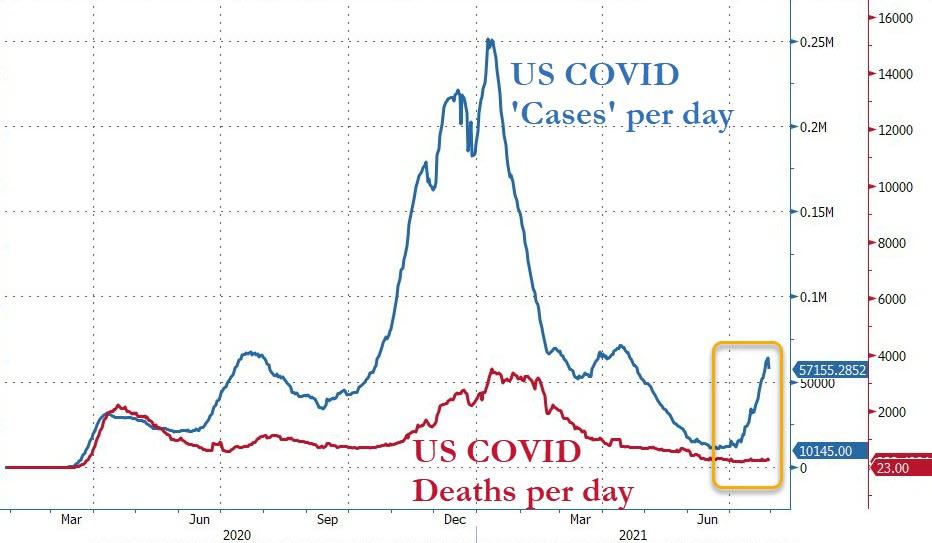
Source: Bloomberg

Notice anything different this time? No one is dying!!!!

Which leads us to today's new Wall Street Journal op-ed from Dr. Makary, where he describes real science on the power of natural immunity...

The news about the U.S. Covid pandemic is even better than you’ve heard. Some 80% to 85% of American adults are immune to the virus: More than 64% have received at least one vaccine dose and, of those who haven’t, roughly half have natural immunity from prior infection. There’s ample scientific evidence that natural immunity is effective and durable, and public-health leaders should pay it heed.

...

Without accounting for natural immunity, we are far from Anthony Fauci’s stated target of 70% to 85% of the population becoming immune through full vaccination. But the effect of natural immunity is all around us. The plummeting case numbers in late April and May weren’t the result of vaccination alone, and they came amid a loosening of both restrictions and behavior.

...

Natural immunity is durable. Researchers from Washington University in St. Louis reported last month that 11 months after a mild infection immune cells were still capable of producing protective antibodies. The authors concluded that prior Covid infection induces a “robust” and “long-lived humoral immune response,” leading some scientists to suggest that natural immunity is probably lifelong. Because infection began months earlier than vaccination, we have more follow-up data on the duration of natural immunity than on vaccinated immunity.

...

Researchers from the Cleveland Clinic published a study this week of 1,359 people previously infected with Covid who were unvaccinated. None of the subjects subsequently became infected, leading the researchers to conclude that “individuals who have had SARS-CoV-2 infection are unlikely to benefit from COVID-19 vaccination.”

What’s the harm of underestimating or disregarding the protection afforded by natural immunity? It almost certainly cost American lives by misallocating vaccine doses earlier this year, and is still doing so in countries where Covid is prevalent and shots are scarce. It continues to delay full reopening and prolongs the state of fear that has many people wearing masks even when there’s no mandate, or reason, to do so.

Dr. Fauci said last Aug. 13 that when you have fewer than 10 cases per 100,000, “you should be able to open up safely and clearly.” The U.S. reached that point in mid-May. It’s time to stop the fear mongering and level with the public about the incredible capabilities of both modern medical research and the human body’s immune system.

Read more here...

As we are once again bombarded with accusations of "ignoring the science" - when even the head of CDC cannot show the "science" she is using to back her decision to make America mask-up again - and suggesting that natural immunity is not enough (you must still get the jab) as policymakers appear to be heading towards the tyrannical control required to achieve "ZeroCOVID" - an impossible dream (that enables trillions more in stimmies and more and more dependence on government handouts.

https://www.zerohedge.com/political/makary-fauci-its-time-stop-fearmongering-amid-widespread-natural-immunity

Recap: DexCom Q2 Earnings

 Shares of DexCom (NASDAQ:DXCM) rose 3.7% in after-market trading after the company reported Q2 results.

Quarterly Results

Earnings per share were down 3.80% year over year to $0.76, which beat the estimate of $0.45.

Revenue of $595,100,000 rose by 31.72% from the same period last year, which beat the estimate of $551,270,000.

Looking Ahead

DexCom hasn't issued any earnings guidance for the time being.

The upcoming fiscal year's revenue expected to be between $2,350,000,000 and $2,400,000,000.

Details Of The Call

Date: Jul 29, 2021

Time: 04:30 PM

ET Webcast URL: https://edge.media-server.com/mmc/p/uawkk73o

Recent Stock Performance

52-week high: $463.22

Company's 52-week low was at $305.63

Price action over last quarter: Up 23.54%

https://www.benzinga.com/news/earnings/21/07/22236211/recap-dexcom-q2-earnings

CRISPR Therapeutics Business Update and Second Quarter Report

 More than 45 patients have been dosed with CTX001™ across CLIMB-Thal-111 and CLIMB-SCD-121 to date; completion of enrollment in both trials is expected in 2021-

-Received Orphan Drug Designation (ODD) for Phase 1 clinical trial of CTX130™ for the treatment of T-cell lymphoma-

-Enrollment ongoing in CTX110™, CTX120™ and CTX130 clinical trials-

CRISPR Therapeutics (Nasdaq: CRSP), a biopharmaceutical company focused on creating transformative gene-based medicines for serious diseases, today reported financial results for the second quarter ended June 30, 2021.

“We concluded an important quarter in which we reported notable data from our hemoglobinopathies program while rapidly advancing our entire clinical and pre-clinical portfolio and our capabilities,” said Samarth Kulkarni, Ph.D., Chief Executive Officer of CRISPR Therapeutics. “Updated clinical data on CTX001 presented at EHA demonstrate consistency and durability, further validating the promise of a functional cure for sickle cell disease and beta thalassemia. We expect to report clinical data from our immuno-oncology programs later this year, and to file multiple INDs for our regenerative medicine and in vivo programs in the next 18 to 24 months. In addition, we continue to expand our portfolio and access best-in-class capabilities through collaborations, such as those recently announced with Capsida Biotherapeutics and Nkarta Therapeutics.”

Recent Highlights and Outlook

  • Beta Thalassemia and Sickle Cell Disease

    • In April, CRISPR Therapeutics and Vertex announced an amendment to their collaboration for CTX001. In connection with the completion of the transaction in June, Vertex made a $900 million upfront payment to CRISPR Therapeutics.

    • Data from 22 patients with at least three months of follow-up after CTX001 infusion were presented at the Annual European Hematology Association Virtual Congress (EHA) in June and continued to build the profile of a functional cure for patients with transfusion-dependent beta thalassemia (TDT) and severe sickle cell disease (SCD), showing consistent and durable benefit with longer term data from a larger population of patients.

    • Enrollment and dosing are ongoing in the clinical studies for CTX001 and more than 45 patients have been dosed across the programs to date. The companies anticipate achieving target enrollment in both studies in the third quarter of 2021, with regulatory filings possible in the next 18 to 24 months.

  • Immuno-Oncology

    • The Company expects to report additional clinical data in 2021 from its ongoing Phase 1 CARBON trial assessing the safety and efficacy of several dose levels of CTX110, its wholly-owned allogeneic chimeric antigen receptor T cell (CAR-T) investigational therapy targeting CD19, for the treatment of relapsed or refractory B-cell malignancies.

    • CRISPR Therapeutics’ Phase 1 clinical trial assessing the safety and efficacy of several dose levels of CTX120, its wholly-owned allogeneic CAR-T investigational therapy targeting B-cell maturation antigen for the treatment of relapsed or refractory multiple myeloma, is ongoing. The Company expects to report top-line data from this trial in 2021.

    • CRISPR Therapeutics received Orphan Drug Designation (ODD) from the U.S. Food and Drug Administration (FDA) for CTX130, its wholly-owned allogeneic CAR-T investigational therapy targeting CD70, for the treatment of T-cell lymphoma. CRISPR Therapeutics’ two independent Phase 1 clinical trials assessing the safety and efficacy of several dose levels of CTX130, for the treatment of both solid tumors and certain hematologic malignancies, are ongoing. The Company expects to report top-line data from these trials in 2021.

    • In May, CRISPR Therapeutics and Nkarta Therapeutics announced a research and development collaboration to co-develop and co-commercialize two chimeric antigen receptor (CAR) NK cell product candidates, one targeting CD70, and a product candidate combining NK and T cells (NK+T), each enhanced with genome engineering.

  • Regenerative Medicine and In Vivo Programs:

    • CRISPR Therapeutics and its partner ViaCyte remain on track to initiate a Phase 1/2 trial of their allogeneic stem cell-derived therapy for the treatment of Type 1 diabetes in 2021. The combination of ViaCyte’s stem cell capabilities and CRISPR’s gene editing capabilities has the potential to enable a beta-cell replacement product that may deliver durable benefit to patients without requiring immune suppression.

    • The Company continues to make progress with its in vivo approaches for liver gene editing. Additionally, earlier this month, Nature Communications published an independently peer-reviewed article entitled “Improved CRISPR genome editing using small highly active and specific engineered RNA-guided nucleases.” The publication includes information on the Company’s development of proprietary small Cas9 variants which may allow for more efficient delivery in vivo using viral delivery vehicles. The Company expects to move multiple programs utilizing in vivo approaches into the clinic in the next 18 to 24 months.

    • In June, CRISPR Therapeutics and Capsida Biotherapeutics announced a strategic partnership to research, develop, manufacture and commercialize in vivo gene editing therapies delivered with engineered AAV vectors for the treatment of familial amyotrophic lateral sclerosis (ALS) and Friedreich’s ataxia.

  • Second Quarter 2021 Financial Results

    • Cash Position: Cash, cash equivalents and marketable securities were $2,589.4 million as of June 30, 2021, compared to $1,806.2 million as of March 31, 2021. The increase in cash of $783.2 million was primarily driven by an upfront payment of $900.0 million in connection with the Amended and Restated Joint Development and Commercialization Agreement with Vertex, offset by continuing operating expenses.

    • Revenue: Total collaboration revenue was $900.2 million for the second quarter of 2021, compared to less than $0.1 million for the second quarter of 2020. Collaboration revenue primarily consisted of the $900.0 million upfront payment from Vertex, as well as charges to partners for research activities.

    • R&D Expenses: R&D expenses were $108.3 million for the second quarter of 2021, compared to $59.4 million for the second quarter of 2020. The increase in expense was driven by development activities supporting the advancement of the hemoglobinopathies program and wholly-owned immuno-oncology programs, as well as increased headcount and supporting facilities related expenses.

    • G&A Expenses: General and administrative expenses were $29.8 million for the second quarter of 2021, compared to $21.4 million for the second quarter of 2020. The increase in general and administrative expenses for the year was primarily driven by headcount-related expense.

    • Net Income (loss): Net income was $759.2 million for the second quarter of 2021, compared to a net loss of $79.7 million for the second quarter of 2020.

Vertex Reports Second-Quarter 2021 Financial Results

 - Product revenues of $1.79 billion, an 18% increase compared to Q2 2020 -

- Company raises full-year 2021 guidance for product revenues to $7.2 to $7.4B - 

- Phase 3 study of next-in-class triple combination for CF to begin in the second half of 2021; multiple additional clinical milestones across the pipeline expected in the next 6 to 9 months -

https://www.businesswire.com/news/home/20210729006087/en/Vertex-Reports-Second-Quarter-2021-Financial-Results

Gilead Earnings Top Views; Biotech Giant Narrows Guidance

Gilead stock edged lower late Thursday after the biotech company reported adjusted earnings of $1.87 per share on $6.217 billion in second-quarter sales.

On average, analysts polled by FactSet expected Gilead Sciences (GILD) to earn $1.74 a share on $6.08 billion in sales.

In the year-earlier period, Gilead earned $1.11 per share and reported $5.14 billion in sales.

For the year, Gilead narrowed its EPS range to $6.90-$7.25 from $6.75-7.45, with the midpoingt slightly lower.
Analysts called for adjusted profit of $7.11 per share and $24.67 billion in sales.

In after-hours trading on the stock market today, Gilead stock fell 0.5%. GILD stock is forming a flat base with a buy point at 70.21, according to MarketSmith.com. Gilead stock narrowly topped that entry during the regular session before pulling back to close down 0.3% 69.83.

https://www.investors.com/news/technology/gilead-stock-gilead-earnings-q2-2021/

Lilly donanemab data show link between amyloid plaque, cognitive decline

 Today at the Alzheimer's Association International Conference© (AAIC© 2021), Eli Lilly and Company (NYSE: LLY) presented two new exploratory analyses of data from the Phase 2 TRAILBLAZER-ALZ study. In the first, greater amyloid plaque changes following donanemab treatment was highly associated with less cognitive decline and participants with greater plaque clearance at 24 weeks of treatment showed less tau progression. In the second, Lilly shared data showing that treatment with donanemab drives a rapid reduction of a biomarker reflecting Alzheimer's disease pathology, plasma P-tau217, which was detected within 12 weeks.

Donanemab is an investigational antibody that targets a modified form of beta amyloid plaque called N3pG. In June 2021, Lilly announced the U.S. Food and Drug Administration (FDA) had granted Breakthrough Therapy designation for donanemab based on the Phase 2 data. No additional safety analyses were performed related to the presentations; for information on donanemab's safety profile, reference the previous publication.

"We are excited by these promising results, which provide further evidence on the potential for donanemab to slow disease progression for people with early symptomatic Alzheimer's disease," said Mark Mintun, M.D., vice president of pain and neurodegeneration, Lilly. "Importantly, these data link the mechanism of action of donanemab, plaque clearance, with positive effects on both clinical outcomes and brain tau pathology."

In the first oral presentation, donanemab induced rapid amyloid plaque reduction at 24 weeks in participants with early symptomatic AD, with the most rapid clearance in subjects with the most severe plaque burden at baseline. The subset of participants who reached complete amyloid plaque clearance at 24 weeks (defined as an amyloid level of <24.1CL) were able to stop or reduce dosing of donanemab earlier than other patients. Among those who achieved complete amyloid plaque clearance at 24 weeks and had a blinded switch to placebo, an exposure-response model showed minimal amyloid re-accumulation over the next year.

Additionally, among those who reached early complete amyloid plaque clearance status at 24 weeks, a flortaucipir positron emission tomography (PET) scan at 76 weeks showed a significant decrease of tau spread – a predictive biomarker for AD progression – over 76 weeks in frontal, parietal and temporal brain regions compared to placebo.

Greater amyloid plaque change at 24 weeks was also associated with improved Integrated Alzheimer's Disease Rating Scale (iADRS) score, a validated, composite measure that combines two well-established instruments used to assess cognition and daily function in AD clinical trials. Additionally, pharmacokinetic/pharmacodynamic modeling showed that greater relative amyloid plaque clearance was correlated with greater clinical benefit.

A second oral presentation focused on plasma P-tau217 (tau phosphorylated at threonine 217), a research blood-biomarker developed by Lilly, associated with amyloid and tau pathology and diagnosis of Alzheimer's disease. Planned analyses showed that treatment with donanemab resulted in early reduction of P-tau217 (LS mean log10 change -0.04) and showed significant reduction (p<0.01) by the 3-month timepoint compared to placebo (LS mean log10 change 0). Decreased P-tau217 correlated significantly with amyloid change at all timepoints, at 24 weeks (R = 0.394, p<0.0001) and 76 weeks (R = 0.492, p<0.0001).

https://www.shelbynews.com/news/state/lilly-releases-donanemab-data-that-demonstrated-relationship-between-reduction-of-amyloid-plaque-and-slowing-of/article_0d2784ed-d7af-5886-a47e-301e86fbcedd.html

Improved learning processes tied to reduced symptoms of depression

 Virginia Tech scientists with the Fralin Biomedical Research Institute at VTC have identified neural learning processes to be associated with symptoms of depression and linked improvements in these processes to improved symptoms in research participants being treated for depression.

The findings, described in a study published July 28, 2021 in the Journal of the American Medical Association (JAMA) Psychiatry, suggest distinct paths to depression symptoms and new mathematically guided approaches for treating clinical depression.

Major depression is one of the most common mental disorders in the United States and can cause severe impairment, according to the National Institute of Mental Health. An estimated 7.1% of all U.S. adults have had at least one major depressive episode.

"Current medications and behavioral therapies are helpful, but for many people struggling with depression, existing treatments don't work well," said Pearl Chiu, an associate professor at the Fralin Biomedical Research Institute Computational Psychiatry Unit and the study's corresponding author. "We need to consider other possible paths to depression. These paths, or mechanisms, could point to new treatment targets to explore."

The scientists used computational models of brain functioning as a new way to consider mechanisms of depression. In a key discovery, the researchers found that the symptom improvements that followed cognitive behavioral therapy were related to improvements in reinforcement learning components that were disrupted prior to therapy.

"Depression is a very serious illness and a leading cause of disability in the world. We hope that our work can be a bridge between behavioral clinicians and computational scientists to more precisely identify what causes depression and new ways to treat the illness," said first author Vanessa Brown, a former doctoral student with Chiu in Virginia Tech's Department of Psychology and who is now an assistant professor of psychiatry at the University of Pittsburgh.

The research team began studying a baseline group of 101 adults with and without clinical depression. A subset of the participants with depression were treated with up to 12 weeks of cognitive behavioral therapy -- a treatment that involves learning how to identify and correct negative thought patterns.

Participants with depression played a learning game during functional MRI brain scanning before and after cognitive behavioral therapy, and participants without depression played the same game at time points matched to participants who took part in cognitive behavioral therapy. The scientists used computational modeling to identify different processes that contribute to learning. They found that distinct components of learning about rewards and losses -- known as reinforcement learning -- were connected to certain symptoms of depression.

"Two of the most exciting parts of the findings are that people with depression learn in different ways and that these learning processes changed when depression symptoms improved after cognitive behavioral therapy. The link between the learning components and symptoms is critical," said Brooks King-Casas, co-author of the study and an associate professor with the Fralin Biomedical Research Institute and in the Department of Psychology in Virginia Tech's College of Science.

The researchers say using computational models has potential to help other investigators and mental health professionals precisely identify new contributors to depression, which in turn could be new targets for therapies.

"An example is that for someone with depression, losing a few cents in the game could feel like losing several hundred dollars or the loss could be very hard to forget. These processes are different, but both affect how we learn and the choices we make," King-Casas said.

"We quantified some of these learning processes with computational modeling and show that they relate to depression in very different ways," said Chiu, who is also an associate professor of psychology in Virginia Tech's College of Science. "The idea is similar to how stress or too much sodium can both contribute to high blood pressure, but what contributes to a particular person's hypertension could suggest whether they focus on decreasing stress or reducing salt consumption as part of treatment. Similarly, for depression, the parts of learning that contribute to a person's depression could call for different approaches to treatment."

Chiu says forming a computational understanding of how cognitive processes align with symptoms of depression is a promising approach.

"Now that we've linked specific components of learning to depression and show that they change with specific depression symptoms, perhaps we can develop new therapies that focus on adjusting these learning components as a way to reduce depression," she said.

Additional former students and postdoctoral associates who contributed to the study include Lusha Zhu, Alec Solway, John Wang, and Katherine McCurry.

The study was funded in part by the National Institute of Mental Health, part of the National Institutes of Health.


Story Source:

Materials provided by Virginia Tech. Original written by John Pastor. Note: Content may be edited for style and length.


Journal Reference:

  1. Vanessa M. Brown, Lusha Zhu, Alec Solway, John M. Wang, Katherine L. McCurry, Brooks King-Casas, Pearl H. Chiu. Reinforcement Learning Disruptions in Individuals With Depression and Sensitivity to Symptom Change Following Cognitive Behavioral TherapyJAMA Psychiatry, 2021; DOI: 10.1001/jamapsychiatry.2021.1844