Search This Blog

Thursday, August 12, 2021

37% of voters say CDC moving too slow on delta variant: Poll

 Thirty-seven percent of voters say the Centers for Disease Control and Prevention (CDC) is moving too slow in its response to the delta variant of the coronavirus, a new Hill-HarrisX poll finds.

Forty-three percent of registered voters in the Aug. 4-5 survey said the CDC is moving at just the right speed and 20 percent said it's moving too fast.

Fifty-one percent of Democrats said the health agency is moving at the right speed in addressing the delta variant, while 38 percent said it's too slow and 11 percent said it's too fast.

A plurality of independents voters, 47 percent, said the CDC is acting at just the right speed, while 30 percent said too slow and 23 percent said too fast.

Thirty-nine percent of Republicans said the agency is too slow while 33 percent said it's acting at the right speed and 28 percent said too fast.

The survey also found 59 percent of registered voters said they approve of the way the CDC has been handling the spread of the delta variant throughout the country, while 41 percent said they disapprove.

The high contagious delta variant has led to spikes in COVID-19 cases and hospitalizations across the U.S., particularly among the unvaccinated.

The Hill-HarrisX poll was conducted online among 1,103 registered voters. It has a margin of error of plus or minus 2.95 percentage points.

Gabriela Schulte

https://thehill.com/hilltv/what-americas-thinking/567645-poll-37-percent-of-voters-say-the-cdc-is-moving-too-slow-in

Inflation pressure 'never seen before' across entire food chain: former Heinz CEO

 Former Heinz CEO Bill Johnson told "Cavuto: Coast to Coast" on Thursday he is "very" worried about inflation, noting that "we're seeing pressures that we've never seen before even across the entire food chain."

Johnson noted that inflation is having a "huge impact" on "simple things, like container costs coming out of Europe or China." 

He pointed out that costs have increased for freight and fuel, "which everyone just sees as a gasoline price, but ultimately dictates the price we pay for packaging, particularly plastic packaging." 

Johnson made the comments one day after the Labor Department reported that its consumer price index rose 5.4% year over year in July, matching the prior month's gain as the fastest since August 2008.  

Prices increased 0.5% last month, slowing from June’s 0.9% increase. Analysts surveyed by Refinitiv were expecting a 0.5% gain. 

The department said prices for shelter, food, energy as well as new and used vehicles all increased in July. The energy index rose 1.6%, buoyed by a 2.4% gain in gasoline prices. 


The Labor Department reported that the price of gas increased 41.8% from the year before and that the price of food increased by 3.4%. 

Gas prices have been increasing at the pump for the past few weeks, reaching a national average of $3.19 a gallon as of Thursday, which is the most expensive gas price average of the year and $1.01 higher than the same time in 2020, according to AAA

Johnson pointed out that on consumer packaged goods (CPG) companies, "when one or two start pricing, the whole group recognizes the need and takes the opportunity to start pricing."

He also noted that "the industry itself and most consumer industries have lacked pricing power over the last two or three decades," however, currently "pricing power is returning, at least in the short-term." 

Supply-chain disruptions and labor shortages slowed the pace of economic activity while the country reopened from its COVID-19 lockdowns. 

Many companies are raising prices to offset the higher costs for materials such as aluminum and lumber, in addition to rising prices for gas and vehicles. 

General Mills, which produces brands including Cheerios and Betty Crocker, expects total input cost inflation of about 7% during the current fiscal year. The company also sees higher costs associated with securing incremental capacity and logistics. 

Constellation Brands, whose brands include Corona beer, Svedka vodka and other alcoholic beverages, is also raising prices, according to CFO Garth Hankinson.

Chipotle Mexican Grill is raising its menu prices by as much as 4% in order to offset the cost of increased employee wages instituted in June, the fast-casual restaurant chain said. In May, the company announced that it was offering increased wages across the board, resulting in a $15 average hourly wage by the end of June as part of its ongoing hiring push.

Johnson argued that even though food prices have been increasing, consumers have not yet reached the point where rising prices will prevent them from buying products. 

He said he believes that consumers are "appropriately" in the "complaining stage." However, he doesn’t think "they are in the stage yet where they are ready to revolt, primarily because they have been cooped up so long in the last 12 to 18 months, that they are seeing an opportunity to get out and they’re willing to spend the money."

Johnson also noted that consumers understand and recognize that currently labor shortages exist, which is contributing to rising costs. 


The Federal Reserve has insisted the recent price gains are "transitory" and that those increases will mitigate once production issues are resolved. 

Fed Chairman Jerome Powell has admitted that timing is uncertain.

Johnson disagreed with the Fed on Thursday, noting that while inflation "may be transitory to the Fed and to the administration," it "certainly is not transitory to people going to the grocery store."

https://www.foxbusiness.com/business-leaders/inflation-pressure-never-seen-before-across-entire-food-chain-former-heinz-ceo

JPMorgan: Delta Cases About To Turn Lower; Kolanovic Calls Bottom For Yields, Cyclicals

 It has been nearly two years since JPMorgan's Marko Kolanovic first called the rotation out of growth and into value stocks that was triggered by the repo crash in Sept 2019, a "once in a decade" event, and which he boldly predicted would continue for long time. Alas, it did not, with value stocks imploding during the covid crash of March 2020 (energy and bank stocks disintegrated for much of 2020) wiping out trillions in value (no pun intended); And while value stocks did rebound modestly courtesy of the great reflation rotation of late 2020 early 2021, growth has once again taken the baton as the best performing strategy in a time when concerns are spreading that the world is destined to live between covid lockdowns for the indefinite future, benefiting the well-known secular stagnation theme and boosting growth names.

However, even as value stocks resumed their P&L crushing ways, JPMorgan's Kolanovic doubled, tripled, and quadrupled down on his conviction call that value is set to surge and trounce growth (see "Kolanovic: Most Are Unprepared For The Coming Inflation Shock") as the market is grossly exaggerating the impact of the Delta variant (see "JPM's Kolanovic: The Delta Variant Does Not Pose A Risk For Markets") while betting his credibility on the advent of a commodity supercycle which is looking quite shaky in recent days (Kolanovic: A New Commodity Supercycle Has Begun).

Yet while markets stubbornly refuse to comply with the Croat's views, with energy stocks disconnected from underlying commodities by the most on record, that has not prevented Kolanovic from pushing on with this value thesis and despite all recent setbacks, the JPM quant is still convinced that value stocks is the place to be, telling client in a note published today that "yields and cyclicals likely bottomed last week and are now on an upward trajectory for the rest of the year" to wit:

Over the past weeks, clients have asked us about various market risks and the possibility of a near-term correction. In this note we assess some of these risks and provide our views. Given the strong earnings season, market positioning, signs of receding COVID-19 Delta variant in the US, and normalization of bond-equity correlation, we remain constructive.  In particular we like cyclical and reflation-linked market segments, and are cautious on beneficiaries of lockdowns and low bond yields. In fact, we believe that bond yields and cyclicals bottomed last week and are now on an upward trajectory for the rest of the year.

Addressing the first question, namely investor positioning, Kolanovic responds as he always does - namely that no matter how high stocks are positioning is always average at best, even though both major bank prime brokers show record gross exposure among hedge funds, which retail investors are by now clearly "all-in" stocks.
Facts aside, Kolanovic writes that while his estimates of equity positioning have been rising, they "are currently around historically average levels when compared with a 10-year history. Figure 1 shows percentile equity beta for broad hedge funds, equity long/short hedge funds and volatility targeting funds (such as insurance companies, risk parity, etc.)."
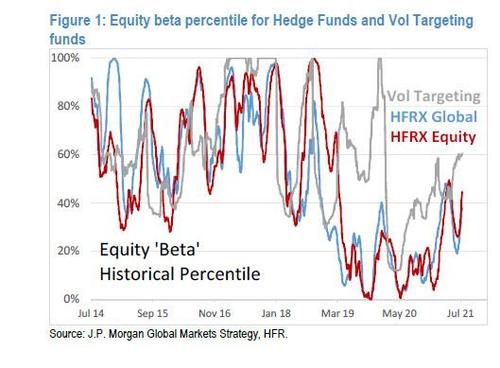
At least the Croat concedes that "increased exposure of these funds has certainly helped equity markets this year" however where the JPMorganite takes creative liberty is estimating that "these measures are near historical average levels (~50th percentile on average, with systematic higher than discretionary)" which matters because according to him "most corrections historically happen when these measures are above ~80th percentile, but we note there were cases when the exposure can stay at 100th percentile for a year without a significant correction." In other words, everyone is all in and can be even more all in, and nothing will happen... which is of course correct in a market where broad investor positioning is completely irrelevant and just one investor's positioning - the Fed - matters.

So if investor positioning is not a risk, what is? Well, according to Kolanovic, the next risk factor is a potential sharp rise in yields (e.g., related to tapering, inflation, etc.): This matters considering JPM's view "that yields have bottomed last week and that various market segments significantly benefited from the decline in yields since April." The beta of various market sectors to the price of 10-year bonds is shown below.
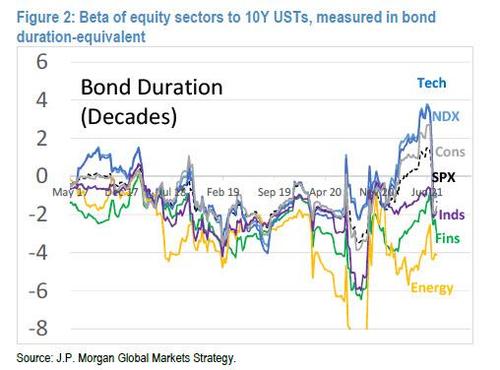
Discussing the chart above, Marko writes that during July, the Tech sector had a bond beta of +4, while financials had a beta of -3. "In other words for a 1% increase in 10- year bond prices, tech rallied 4% and financials sold off 3%, on average. Post earnings season this correlation eased, and now all equity sectors have the typical negative correlation to bond prices. Over the past month, Nasdaq sectors (i.e., tech, discretionary, communications) drove the beta of the S&P 500 to bonds higher, from negative territory in Q2 up to ~1."

The obvious risk here - for those for whom it is not obvious as the JPM quant explains - is that a quick reversal of this correlation during the bond sell-off that could result in a var shock (bond and equity sell-off). This is what happened in February 2018 (volmagedon) and October 2018 (hawkish Fed sell-off). In both of those instances, JPM's estimate for 1-day vol targeting selling was over $50bn (and a multiple of that with the contribution of derivative convexity, CTAs, fundamental selling, etc.) and led to an avalanche effect starting in bonds and propagating across stocks. 

Not surprisingly, here too Kolanovic - who in the past 4 years has never seen a market all time high he didn't like, in dramatic reversal from his earlier, more skeptical self -  finds little risk and writes that "looking at the current level of positioning, volatility and other factors, we  assess that such an event would require a ~3% selloff in both equities and 10 year bonds in 1 day. This is quite unlikely given that correlations have eased and is mitigated by the contribution of cyclical sectors, recent increase in bond yields, and post earnings price action in growth stocks."

Still, while he assures clients that "this risk is currently not high", Kolanovic does note that "investors can hedge it by reducing duration in bonds and equities" but only inasmuch this leads to a shift away from growth names and to his favorite "value" sector, to wit he says that investors may reduce tech exposure and increase exposure to cyclical sectors like energy, financials, and industrials.

This is actually a notably point because as Kolanovic calculates, the bond beta of a tech vs energy ‘market neutral’ position in July was 8, which was equivalent to holding an 80-year bond – risk that is frequently overlooked in, for example, ESG portfolios or Long-Short HF pods.

Still, while the Croat does admit that yields will spike, he is confident this spike won't be fast enough to lead to a broader wipeout, to wit:

While we believe that bond yields will increase significantly, the risk of a broad market sell-off driven by tech-bond correlation is not high and can be mitigated. This is another a reason why we prefer cyclicals, international stocks, and value.

So if the risk from both positioning and rising yields (i.e. tapering) is contained, (something which both GoldmanBofA and Morgan Stanley vocally disagree with) is there anything at all to be worried about? According to Kolanovic, the main risk factor driving asset classes over the past few months (and certainly in July) was fear of the COVID-19 Delta variant while "narratives of peak growth, China slowdown, hawkish Fed, etc., were not helping, but did not resonate with the majority of investors."

As previously discussed, Kolanovic - unlike an army of virtue-signaling Wall Street liberals - is quite confident that despite high cases, "low mortality of the delta variant in vaccinated countries should help investors look through this – likely the last – COVID-19 wave."
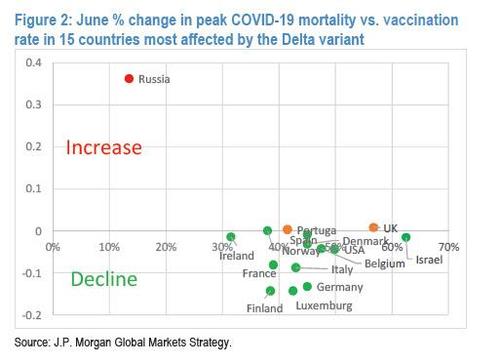
Echoing what he wrote at the end of June, Kolanovic notes that "constant Delta variant COVID-19 developments in India, the UK, the US, and China dominated sentiment. The UK Delta episode, where investors could see relatively low peak mortality and the fast timeline of a spike, was not enough to change the market sentiment, and it appears that investors are waiting for the inflection in US cases." This might be happening, he notes and - as we observed yesterday - adds that "there are strong signs the US is starting to turn the corner in the Delta variant COVID-19 infections. A significant signal of the upcoming peak in US COVID-19 infections is the effective reproduction number (Rt) that is now declining in 40 out of 50 US states (see here). For instance, in FL this indicator declined from ~1.4 to ~1 over the past few weeks, in a sign cases may start dropping soon. In fact, in several states with early Delta variant outbreaks, COVID-19 cases already started declining (Utah, Missouri, Alaska and possibly Nevada and Wisconsin)."

This, he concludes, "makes us believe that the US inflection is days away, and that bond yields and cyclicals bottomed last week."

So positioning is average, taper risk is contained, and delta is on its way out. Does Kolanovic sees any other risks to the market?

The answer is yes, a few, but nothing that is big enough to dent Kolanovic's permabullish outlook on stocks (where the only reason for the constant market upside has nothing to do with anything he has said and everything to do with the Fed's balance sheet). Among the secondary risks listed by the JPM quant include another leg lower in sectors that exhibited bubble-like behavior since the onset of the COVID-19 pandemic. Those include stocks related to COVID-19 lockdowns, renewable energy and EVs, crypto, hyper-growth and innovation stocks.

While these segments experienced a significant correction early in the year, we believe that there will be another leg lower. The final level of correction is likely determined by convergence of valuations between these and equivalent traditional sectors (e.g., EVs to autos, renewables to energy, hyper-growth to growth, etc.).

But while these rolling bubble bursts may continue, Kolanovic does not think that together they are powerful enough to crash the market: "As we saw earlier in the year, these segments are not significant enough to destabilize the whole market."

Finally, the Croat quant expect an increase and amplification of geopolitical and political risks next year: "these will be related to various interdependent issues such as geopolitical relationships with China, Russia, Iran, issues around energy security, inflation, and US political developments." However, we are confident that if and when these materialize, Kolanovic will remain bullish (and pitching value) as long as the Fed continue to inject billions of liquidity into markets every single month.

https://www.zerohedge.com/markets/jpmorgan-says-delta-cases-about-turn-lower-kolanovic-calls-bottom-yields-and-cyclicals

Half Of US Believes Vaccine Mandates, COVID Passports More Important Than 'Protecting Freedom': Poll

by Steve Watson via Summit News,

A Fox News poll contends that a majority of Americans are in SUPPORT of vaccine mandates and the introduction of COVID passports that tie freedoms to vaccination status.

The survey found that 50 percent of respondents are in favour of requiring proof of a coronavirus vaccine for “indoor activities such as restaurants, gyms and performances,” while 46% oppose the idea.

Fifty percent also agreed that “protecting the safety of Americans” by requiring vaccinations in order to engage in everyday activities trumps “protecting the freedom” of Americans to choose whether or not they are vaccinated.

In contrast, 47% of respondents said protecting freedom is more important.

The poll also found that 44% said they were more likely to frequent stores and establishments that require customers and workers to be vaccinated, or have a recent negative COVID-19 test.

Only 24% said they were less likely to do that.

Other interesting findings of the poll include 46% of Americans believing the federal government’s change in mask guidance has more to do with politics than science, with 42% saying the opposite.

In addition, 63% of parents agree schools should mandate masks for the unvaccinated, while 60% of respondents who said they had not taken the vaccine said they had no plans to do so.

The poll correlates with findings from April, when a Rasmussen poll revealed that almost half of Americans support the introduction of vaccine passports in order to get “back to normal.”

*  *  *

https://www.zerohedge.com/covid-19/half-america-believes-vaccine-mandates-covid-passports-more-important-protecting-freedom

Wakeup Call: Pfizer Vax Only 42% Effective Against Infection In July

 This week, Dr. Fauci confirmed that "at some time in the future" everyone will likely need a booster shot for the Covid-19 vaccine due to "fading efficacy."

Now, Axios reports that a new preprint study which has 'already grabbed the attention of top Biden administration officials' over the vaccines' effectiveness against new variants, with Pfizer's jab being of particular concern.

The study found the Pfizer vaccine was only 42% effective against infection in July, when the Delta variant was dominant. "If that's not a wakeup call, I don't know what is," a senior Biden official told Axios.

The study, conducted by nference and the Mayo Clinic, compared the effectiveness of the Pfizer and Moderna vaccines in the Mayo Clinic Health System over time from January to July. -Axios

The overall figures suggest that the vaccines provide robust (yet lower-than advertised) immunity early on, only to sharply drop in efficacy over time.

Between January and July, Moderna's vaccine was found to be 86% effective against infection over the study period, while Pfizer's was 76%. As far as hospitalization, Moderna's vaccine was 92% effective, while Pfizer's was 85%.

Bringing the averages down, of course, was the sharp drop in efficacy observed in July with Moderna proving just 72% effective against infection and Pfizer clocking in at 42%.

In other states such as Florida, the risk of infection in July among those who had taken the Moderna vaccine was around 60% lower than for people full vaccinated with Pfizer.

More via Axios:

Why it matters: Although it has yet to be peer-reviewed, the study raises serious questions about both vaccines' long-term effectiveness, particularly Pfizer's.

  • It's unclear whether the results signify a reduction in effectiveness over time, a reduced effectiveness against Delta, or a combination of both.
  • “Based on the data that we have so far, it is a combination of both factors," said Venky Soundararajan, a lead author of the study. "The Moderna vaccine is likely — very likely — more effective than the Pfizer vaccine in areas where Delta is the dominant strain, and the Pfizer vaccine appears to have a lower durability of effectiveness.”
  • He added that his team is working on a follow-up study that will try to differentiate between the durability of the two vaccines and their effectiveness against Delta.

Bring on the boosters.

https://www.zerohedge.com/covid-19/wakeup-call-pfizer-vax-only-42-effective-against-infection-july

Jazz: FDA OKs Xywav for Idiopathic Hypersomnia

 Jazz Pharmaceuticals plc (Nasdaq: JAZZ) today announced that the U.S. Food and Drug Administration (FDA) approved Xywav® (calcium, magnesium, potassium, and sodium oxybates) oral solution for the treatment of idiopathic hypersomnia in adults.1 The company plans to make Xywav available to patients with idiopathic hypersomnia later this year following Risk Evaluation and Mitigation Strategies (REMS) implementation.

"We are excited that with today's approval Xywav will become the first and only medicine indicated to treat idiopathic hypersomnia, a unique medical condition that can have significant effects on the lives of those diagnosed with the condition," said Bruce Cozadd, chairman and chief executive officer of Jazz Pharmaceuticals. "Xywav is a meaningful treatment for patients as demonstrated by the statistically significant results from the Phase 3 clinical trial. We are proud to build on our leadership in sleep medicine and, with this approval, are expanding beyond our Xywav narcolepsy indications to bring this treatment to adults living with idiopathic hypersomnia who currently have no FDA-approved options available. This milestone exemplifies our patient-focused R&D strategy and internal development capabilities, and underscores oxybate as a key growth opportunity for Jazz. With this launch we will have achieved our goal of five product launches in two years."

Idiopathic hypersomnia is a debilitating neurologic sleep disorder characterized by chronic excessive daytime sleepiness (the inability to stay awake and alert during the day resulting in the irrepressible need to sleep or unplanned lapses into sleep or drowsiness). In addition to excessive daytime sleepiness, symptoms may include severe sleep inertia or sleep drunkenness (prolonged difficulty waking with frequent reentries into sleep, confusion and irritability), a core symptom of idiopathic hypersomnia, as well as prolonged, non-restorative nighttime sleep, cognitive impairment, and long and unrefreshing naps.2,3,4,5 An estimated 37,000 people in the U.S. have been diagnosed with IH and are actively seeking healthcare.

https://finance.yahoo.com/news/jazz-pharmaceuticals-announces-u-fda-183000209.html

Is Delta Also More Severe in Kids?

 With recent increases in COVID-19 cases and hospitalizations in children, some experts are concerned that the Delta variant may cause more severe illness in kids than previous variants.

Though the data remain in short supply, some have suggested it would be reasonable to extrapolate mounting evidence of increased severity with Delta in adults to children.

The CDC stated that some data suggest Delta may cause more severe illness in the unvaccinated. The agency called attention to two studies -- one from Scotland, one from Canada -- that showed patients infected with Delta were more likely to be hospitalized than those infected with other variants.

David Kimberlin, MD, a pediatric infectious disease expert at the University of Alabama and a member of the American Academy of Pediatrics' (AAP) Committee on Infectious Diseases, said that "while we don't know if those data apply to children, the anecdotal information suggests it might."

"Across the South, where we have low vaccination rates, children's hospitals are experiencing many more cases than they did at the worst of the peak at the end of 2020 and the beginning of 2021, suggesting it's possible that Delta causes more severe disease in children," he told MedPage Today.

Even if the virus isn't more severe in kids, Kimberlin said, "we're still staring down the barrel of this gun because its hypertransmissibility is causing more pediatric infections than earlier versions did."

That's a particular concern as children in the South have returned or are starting to return to classrooms, he noted.

The latest AAP data show a sharp increase in COVID-19 cases in kids, totaling 94,000 in the week ending August 5 -- up from almost 72,000 cases the week prior, and 39,000 cases the week before that. Previously, the most recent nadir was approximately 8,500 cases for the week ending June 24.

The highest peak of pediatric COVID infections occurred during one week in mid-January -- 211,000 cases. So far, nearly 4.3 million kids in the U.S. have contracted COVID-19 since the start of the pandemic, and they account for 14.3% of all U.S. cases cumulatively. This past week, they accounted for 15% of cases.

As for hospitalizations, which the AAP tracks in 23 states and New York City, kids accounted for 1.5% to 3.5% of total cumulative hospitalizations, and 0.1% to 1.9% of all pediatric COVID cases resulted in hospitalization.

CDC's COVID Data Tracker shows a total of about 46,000 hospital admissions for kids under 18 since Aug. 1, 2020, with a current 7-day average of 203 pediatric hospitalizations daily -- close to the peak 7-day average of 217 during this past winter's surge (for the week ending Jan. 9, 2021). This week's figure is up from a 7-day average of 168 the week prior.

AAP collects mortality data from 43 states, New York City, Puerto Rico, and Guam, tallying 371 pediatric deaths since mid-May 2020.

Children accounted for 0% to 0.26% of all COVID deaths in those areas, and seven states reported no child deaths at all. Of all pediatric COVID cases in those areas, 0% to 0.03% resulted in death.

"At this time, it appears that severe illness due to COVID-19 is uncommon among children," the AAP report stated. "However, there is an urgent need to collect more data on longer-term impacts of the pandemic on children, including ways the virus may harm the long-term physical health of infected children, as well as its emotional and mental health effects."

During an Infectious Diseases Society of America (IDSA) press briefing last week, Ezekiel Emanuel, MD, PhD, of the University of Pennsylvania in Philadelphia, cautioned that it's difficult to tease apart severity data in general because increasing hospitalizations could just be the result of increasing cases due to Delta's greater transmissibility.

But Emanuel acknowledged anecdotal reports suggesting a more rapid progression of illness compared with the early days of the pandemic. And experts on the ground in hard-hit areas have described greater challenges now compared with previous waves.

Last week, Mark Kline, MD, chief physician at Children's Hospital New Orleans, told ABC News that the positivity rate in kids rose from 1% to about 20% over the last 30 days.

"We are hospitalizing record numbers of children," Kline said, adding that the majority are under 12 and can't yet be vaccinated.

In Alabama, Kimberlin noted that "our hospitals are close to complete capacity, and that includes children's hospitals in Mobile and Birmingham."

"We're deferring scheduled procedures," he said. "There are people who need cancer surgery that's being put off because there's no guarantee we'll have a bed available for them. People with heart attacks don't have beds. A child with vehicular trauma doesn't have a place to go because we're full."

"I think the rate of increase we see in pediatric cases is truly alarming," he added. "We've seen a skyrocketing of cases in a very short period of time. It's Delta. It's hypertransmissible. Combine that with the fact that two-thirds of our population [in Alabama] are not vaccinated -- that's not even touching on the kids under 12 who are not able to be vaccinated -- and you have a recipe for disaster."

https://www.medpagetoday.com/special-reports/exclusives/93979