Search This Blog

Saturday, August 14, 2021

Authorization of COVID-19 vaccine boosters not applicable to J&J shot: CDC

 The authorization of an extra COVID-19 vaccine dose for those with a compromised immune system does not apply to the Johnson & Johnson vaccine at this time, the U.S. Centers for Disease Control and Prevention said on Friday. 

  Data on the Johnson & Johnson vaccine was insufficient at this time, the CDC said in slides presented at a meeting of its advisory panel. 

https://finance.yahoo.com/news/cdc-says-authorization-covid-19-151033582.html

Friday, August 13, 2021

Thousands of fake COVID vaccine cards headed for New Orleans intercepted

 A shipment of fake COVID vaccine cards from China, headed to New Orleans, has been intercepted by U.S. Customs and Border Protection Officers in Memphis.

Officers say there were 15 such shipments of low-quality counterfeit vaccine cards. The cards had blank lines for names, birthdays, lot numbers, and even a CDC logo, but were riddled with typos, unfinished words, and some Spanish verbiage was misspelled.

Some of the shipments had packs of 20, 21, or 100, without any attempt to conceal them in books or paintings or anything.

Memphis has made 121 seizures totaling 3,017 of these cards.

Buying, selling, or using a counterfeit COVID-19 vaccination card is a crime, according to the FBI. It can be categorized as the unauthorized use of an official government agency seal. Violators face a fine and up to five years in prison.
“These vaccinations are free and available everywhere,” said Michael Neipert, Area Port Director of Memphis. “If you do not wish to receive a vaccine, that is your decision. But don’t order a counterfeit, waste my officer’s time, break the law, and misrepresent yourself. CBP Officers at the Area Port of Memphis remain committed to stopping counterfeit smuggling and helping to protect our communities. But just know that when you order a fake vaxx card, you are using my officers time as they also seize fentanyl and methamphetamines.”
https://www.fox8live.com/2021/08/13/thousands-fake-covid-vaccine-cards-headed-nola-intercepted/

Gottlieb: Expect coronavirus to become ‘endemic’ in U.S. after delta surge

 Dr. Scott Gottlieb told CNBC on Friday he expects the coronavirus to become an endemic virus in the U.S. and other Western countries after the recent surge in delta variant infections calms down.

“We’re transitioning from this being a pandemic to being more of an endemic virus, at least here in the United States and probably other Western markets,” Gottlieb said on “Squawk Box.” An endemic virus is one that remains in the American population at a relatively low frequency, like the seasonal flu, for example.

Gottlieb — commissioner of the Food and Drug Administration from 2017 to 2019 during the Trump administration, and now a board member at several companies including vaccine maker Pfizer — has previously said “true herd immunity” for Covid may actually be impossible with new infections occurring in the years ahead.

“It’s not a binary point in time, but I think after we get through this delta wave, this is going to become more of an endemic illness where you just see sort of a persistent infection through the winter ... but not at the levels that we’re experiencing certainly right now, and it’s not necessarily dependent upon the booster shots,” Gottlieb added Friday.

Gottlieb said he expects the spread of the highly transmissible delta variant to remain noteworthy in the weeks ahead.

“You’re going to see the delta wave course through probably between late September through October,” Gottlieb said. “Hopefully we’ll be on the other side of it or coming on the other side of it sometime in November, and we won’t see a big surge of infection after this on the other side of this delta wave.” 

The tri-state region of New York, New Jersey and Connecticut will begin to see an uptick in delta cases as rates slow down in the South, Gottlieb said. 

“This is a big country and the delta wave is going to sweep across the country in a regionalized fashion,” he said. “By September, hopefully you’ll see the other side of that curve in the South very clearly, but cases will be picking up in the Northeast, the Great Lakes region, maybe the Pacific Northwest. …  It’s probably going to coincide with a restart in school, some businesses returning if you look at last summer as well.”

Gottlieb’s comments Friday morning came before the Centers for Disease Control and Prevention gave final approval to begin distributing Covid vaccine booster shots to recipients of the Pfizer and Moderna vaccines who have weakened immune systems. The CDC’s approval followed a unanimous vote earlier Friday to recommend the booster shots from its Advisory Committee on Immunization Practices. It now allows the shots to reach vulnerable individuals such as organ transplant recipients, as well as cancer and HIV patients.

A day earlier, the FDA approved booster shots for people who have weakened immune systems. They represent about 2.7% of the U.S. adult population but make up about 44% of hospitalized Covid breakthrough cases in fully vaccinated individuals, according to recent data from the CDC. 

Gottlieb said being able to deliver booster shots to those Americans, helping fortify their immunity protection, will drive the U.S. further into the “endemic phase.”

“I think that this is a policy call as much as a public health call that U.S. officials want to continue trying to promote first vaccinations before they pivot to giving people booster shots,” Gottlieb said about the FDA’s Thursday announcement. 

Among those people Gottlieb believes should receive Covid booster shots soon are nursing home residents, who tend to be older and have underlying conditions that make them more vulnerable to Covid. That’s particularly worrisome as the delta variant moves into Northern states, and their initial round of vaccinations moves further in the rearview mirror, he said.

“I would be worried about nursing homes right now, the infection getting into those settings against the backdrop where you have a patient population that probably has declining immunity and is more vulnerable than they were certainly five months ago.”

Disclosure: Scott Gottlieb is a CNBC contributor and is a member of the boards of Pfizer, genetic testing start-up Tempus, health-care tech company Aetion and biotech company Illumina. He also serves as co-chair of Norwegian Cruise Line Holdings’ and Royal Caribbean’s “Healthy Sail Panel.”

https://www.cnbc.com/2021/08/13/dr-scott-gottlieb-expects-coronavirus-to-be-an-endemic-virus-in-us-after-delta-surge.html

Moderna stakes a claim against Covid-19’s Delta variant

 Just weeks after a huge UK dataset confirmed the real-world efficacy of Pfizer/Biontech's and Astrazeneca’s vaccines against hospitalisation due to the Covid-19 Delta variant, a US analysis of the Mayo Clinic’s health records has backed Moderna’s shot – and then some.

While repeated studies have supported all the major vaccines’ ability to cut hospitalisations, the Mayo Clinic data suggest that, purely in terms of breakthrough Delta variant infections, Moderna’s Spikevax is twice as effective as Pfizer/Biontech’s Comirnaty. This is a fact that many bulls will cling to as Moderna’s valuation continues to defy gravity.

It should be stressed that the Mayo Clinic data are not peer-reviewed, and have only been published on the Medrxiv preprint server. A separate analysis of health data from Qatar, also only in preprint form so far, also gives Spikevax an edge over Comirnaty against the Delta variant, though there are caveats here.

Delta dominance

The Mayo Clinic analysis concerns Minnesota in January to July, an important period in one key regard: the Alpha, or UK, Covid-19 variant was fairly dominant until the end of May, but by July it had almost completely been supplanted by Delta, also known as the India variant.

The researchers analysed several hundred thousand PCR-tested patients, and whittled these down to three groups of around 26,000 each, matched for crucial baseline characteristics. The three groups comprised unvaccinated individuals, those who had had two doses of Spikevax, and those who had been fully vaccinated with Comirnaty.

Across the seven-month period Spikevax slightly outperforms Comirnaty in straight vaccine efficacy and efficacy against hospitalisation. But the gap widens when comparing May against July, with Comirnaty’s efficacy against symptomatic Covid-19 falling from 83% to just 42%, while Spikevax’s drops less drastically, from 93% to 76%.

While this clearly seems to favour Spikevax, it should again be stressed that both vaccines retained significant protection against hospitalisation during July, at 75-81%, a decline from May of just 12-14 points. Likewise, in the earlier UK analysis Comirnaty and Astra’s Vaxzevria showed continuing efficacy against hospitalisation due to the Delta variant.

Still, the Mayo paper researchers separately compared other US states in their database, including Florida, which has seen a coronavirus surge. This found that the risk of breakthrough infection was cut by 50% in those fully immunised with Spikevax versus those double-vaccinated with Comirnaty.

Summary of Mayo Clinic data from Minnesota
   Variant prevalence
 SpikevaxComirnatyAlphaDelta
May 202185%1%
VE against symptomatic Covid-1993%83% 
VE against hospitalisation95%87%
July 202113%70%
VE against symptomatic Covid-1976%42% 
VE against hospitalisation81%75%
VE=vaccine efficacy. Source: Medrxiv.

The separate Qatar preprint concerns a matched March-July dataset of Spikevax or Comirnaty vaccinated individuals, 1,810 of whom developed Delta variant Covid-19, and 760,983 of whom remained Covid-19-free by PCR.

This, too, numerically backs Spikevax over Comirnaty, a fact that will please Moderna bulls. But a curious aspect is that Comirnaty’s efficacy appears to fall for double versus single-vaccinated individuals, from 64% to 54% in the unadjusted dataset, or from 66% to 60% adjusting for sex, age and other factors.

Spikevax’s efficacy rises from single to double vaccination, and the authors stress that Comirnaty’s effectiveness against the Delta variant is “statistically similar” comparing one against two doses. Instead, they suggest Comirnaty’s protective effect waning over time, something not seen with Spikevax in this analysis.

Still, there are caveats. Qatar, in common with Israel and the US, used a short dose interval, meaning that patients in the Qatar analysis had received their second Comirnaty dose longer ago than those in the UK and Canada, where efficacy is running at 75%. And the easing of restrictions has differed for vaccinated versus unvaccinated Qataris.

Either way, the two preprints suggest differences emerging between two mRNA-based vaccines that had until now been viewed as pretty similar. The Mayo analysis authors note that each Spikevax dose provides three times more Spike protein mRNA copies than Comirnaty, something they suggest could more effectively prime the immune response.

A third study of Covid-19 variants of concern, published yesterday in Science, found Spikevax to elicit antibodies persisting for six months. However, it is still unclear how important for ongoing protection antibody levels are versus T-cell responses, and yesterday the FDA authorised a third dose of Spikevax or Comirnaty for immunocompromised people.

Summary of Qatar data on confirmed Delta variant cases in March-July 2021
 ≥14 days after first dose, no second dose≥14 days after second dose
 SpikevaxComirnatySpikevaxComirnaty
VE against Covid-19 Delta variant infection80%66%86%60%
VE against severe, critical or fatal Covid-19 Delta variant infection100%100%100%97%
VE=vaccine efficacy. Note: adjusted for sex, age, nationality, reason for PCR testing, and calendar week in logistic regression analysis. Source: Medrxiv.

https://www.evaluate.com/vantage/articles/news/trial-results/moderna-stakes-claim-against-covid-19s-delta-variant

Pfizer and Moderna Go Head to Head Against Delta

 Moderna's COVID-19 vaccine appeared to have a higher effectiveness rate compared with the Pfizer vaccine during the period of time when the Delta variant first became predominant, researchers reported.

While both vaccines were highly protective against infection from January to July in Minnesota (Moderna 86%, Pfizer 76%), their effectiveness estimates declined during the month of July, with an estimate of 76% for Moderna (95% CI 69-81) and 42% for Pfizer (95% CI 13-62), reported Venky Soundararajan, PhD, of nference, a healthcare research company in Cambridge, Massachusetts, and colleagues.

Moreover, in a matched cohort from multiple states, a two-fold risk reduction against breakthrough infection was seen with Moderna's vaccine versus Pfizer's (incidence rate ratio [IRR] 0.50, 95% CI 0.39-0.64), the authors wrote in a study published on the preprint server medRxiv.

However, they found no significant differences in the rate of complications in breakthrough cases from either vaccine, with similar rates of 21-day hospitalizations, 21-day ICU admissions, and 28-day mortality.

An earlier report of a Cape Cod cluster of breakthrough infections published in Morbidity and Mortality Weekly Report late last month did not seem to find an imbalance between the percentage of breakthrough infections and the percentage of Massachusetts residents who received the vaccine (46% and 56% with Pfizer, and 38% and 38% with Moderna, respectively).

In the current study, Soundararajan and co-authors examined adults in the Mayo Clinic Health System or affiliated hospitals in Minnesota, Arizona, Florida, Iowa, and Wisconsin with at least one PCR test for SARS-CoV-2 who received at least one dose of Pfizer or Moderna vaccine after Dec. 1, 2020 but before July 29, 2021, and who did not test positive prior to receiving their first vaccine dose.

Overall, 119,463 patients met this criteria for the Pfizer vaccine, and 60,083 met this criteria for Moderna, the authors said.

Notably, the prevalence of Delta variant in Minnesota in July was 70% compared with a prevalence of 0.7% in January.

To determine vaccine effectiveness, they matched demographically and "clinically similar" unvaccinated, Moderna-vaccinated, and Pfizer-vaccinated individuals by sex, race, ethnicity, state of residence, SARS-CoV-2 PCR testing history, and date of vaccination, yielding 43,895 "matched triples."

Clinical outcomes of interest included SARS-CoV-2 infection, COVID-associated hospitalization, ICU admission, mortality, and breakthrough infection (defined as infection occurring at least 14 days after the second dose of mRNA vaccine).

From January to July in Minnesota, both the Moderna and Pfizer vaccines were effective at protecting against COVID-associated hospitalization (91.6% vs 85%, respectively) and ICU admission (93.3% vs 87%, respectively). There were no deaths in either cohort.

The Moderna and Pfizer cohorts also had similar rates of hospitalization in Minnesota, the authors noted (IRR 0.57, 95% CI 0.17-1.7, and IRR 0.53, 95% CI 0.0089-10, respectively).

When examining data from multiple states, breakthrough infections were less likely among the Moderna cohort versus the Pfizer cohort. The rate of hospitalization was lower among those vaccinated with Moderna compared with Pfizer (IRR 0.51, 95% CI 0.29-0.88), though the authors found that COVID-associated ICU admission rates were comparable.

When examining data from Florida only, the authors found that risk of infection in July -- when the state started to experience their Delta surge -- was lower in the Moderna cohort versus the Pfizer cohort (IRR 0.39, 95% CI 0.24-0.62).

"We observed a pronounced reduction in the effectiveness of BNT162b2 [Pfizer] coinciding with the surging prevalence of the Delta variant in the United States, but this temporal association does not imply causality," Soundararajan and colleagues wrote.

The cohorts were not geographically representative of the American population, which limits their generalizability. In addition, it was possible that the vaccine effectiveness estimates were impacted by unknown exposure risk variables that were missed in the matching procedure, the authors noted.

They called for further research, namely a head-to-head comparison study of the neutralizing antibody titers produced by both vaccines, as well as larger studies with more diverse populations to further investigate this issue.


Disclosures

Puranik, Soundararajan, and other co-authors are employed by nference, which is collaborating with Moderna, Pfizer, Janssen, and other bio-pharmaceutical companies on data science initiatives unrelated to this study.

Other co-authors disclosed support from Elsevier, Bates College, nference, National Institute of Allergy and Infectious Diseases, amfAR, Mayo Clinic, and various ties to industry.

Several co-authors are employees of the Mayo Clinic, which may stand to gain financially from the successful outcome of the research.

FDA Authorizes COVID Booster Shots for Certain Populations

 After weeks of speculation, the FDA amended the emergency use authorizations (EUAs) for Pfizer and Moderna's COVID-19 vaccines to include an additional booster dose for certain immunocompromised people, the agency said late Thursday.

These populations include solid-organ transplant recipients or others diagnosed with conditions "considered to have a similar level of immunocompromise" who previously received one of the two mRNA vaccines. The FDA kept the language purposely vague, as clinical considerations are set to be defined Friday during CDC's Advisory Committee on Immunization Practices (ACIP) meeting.

FDA merely added that individuals immunocompromised "in a manner similar" to those who underwent solid-organ transplantation have a reduced ability to fight disease and are vulnerable to infections, such as COVID-19.

The ACIP meeting agenda was updated to include a vote on additional doses of mRNA vaccines for immunocompromised people, and CDC staff are scheduled to present evidence for this practice on Friday morning.

In a statement on Friday, CMS said that booster doses will be available for immunocompromised Medicare recipients who qualify for an additional dose, and "they can receive it with no cost sharing."

"The FDA is especially cognizant that immunocompromised people are particularly at risk for severe disease," said acting FDA Commissioner Janet Woodcock, MD, in a statement. "After a thorough review of the available data, the FDA determined that this small, vulnerable group may benefit from a third dose of the Pfizer-BioNTech or Moderna vaccines."

According to the updated EUAs, support for the expanded authorizations came from two studies: a randomized trial of Moderna's vaccine in 120 solid-organ transplant recipients who failed to mount a sufficient antibody response after the standard two-shot series, and a single-arm study involving 101 consecutive transplant recipients treated in France with a third shot of Pfizer's vaccine after regulators there recommended a booster for these individuals.

In the randomized trial, a third dose of Moderna's shot 2 months after the second produced a serologic response shown to confer 50% virus neutralization or greater (anti-receptor-binding domain antibody level ≥100 U/mL) in 55% of patients after 4 months, as compared with 18% in a placebo group (P<0.001).

And in the French study, recipients demonstrating antibodies against SARS-CoV-2 increased from 40% before a third Pfizer vaccine dose to 68% a month after it. In individuals who were seronegative for antibodies before the booster, 44% became seropositive a month afterward.

Interestingly, there was no indication within FDA's statement that the two manufacturers applied for these amendments themselves. At a prior ACIP meeting in late July, FDA staff noted that the agency had yet to receive any data to support any regulatory mechanisms or actions regarding this population.

Pfizer has been vocal about needing vaccine boosters on a broader scale, but not for immunocompromised people specifically.

However, Woodcock was unequivocal in that this EUA only applied to immunocompromised people, and stated that other fully vaccinated individuals are "adequately protected" and do not need a booster dose at this time.

"The FDA is actively engaged in a science-based, rigorous process with our federal partners to consider whether an additional dose may be needed in the future," she said.

In addition to a booster dose of vaccine, FDA recommended that immunocompromised individuals discuss monoclonal antibody treatments with their providers, as this population would be at high risk of progressing to severe COVID-19.

They added that clinicians should counsel these patients to maintain "physical precautions" to protect themselves from the virus, and all close contacts should be fully vaccinated to provide this population further protection.

https://www.medpagetoday.com/infectiousdisease/covid19vaccine/94026

Morgan Stanley: The Delta Wave Will Peak In 1-2 Weeks

 In making his case for the bottom in yields and cyclical stocks, yesterday JPMorgan quant Marko Kolanovic yesterday echoed what we said earlier this week when we observed that the Delta wave may have just peaked, writing that "the US inflection is days away."

He's not the only one to piss into the Biden admin's hopes to extend the Delta crisis until the midterms, or maybe even until the next mail-in presidential election. As Morgan Stanley's resident in-house biotechnologist Matthew Harrison writes overnight, "with new cases in the US reaching ~120K/day, investor questions are centered around the timing of the new peak in cases. Based on the reproduction rate trajectory, US/UK hospitalization relationship, and previous peaks, we expect the next peak to occur in ~1-2 weeks."

As Harrison notes, the only question on investor minds is when will Delta be over?

To this his answer is that a peak would occur in late August / early September. Based on detailed data we now believe that US cases may be approaching a peak within the next 1-2 weeks (~August 15th-25th) for the following reasons:

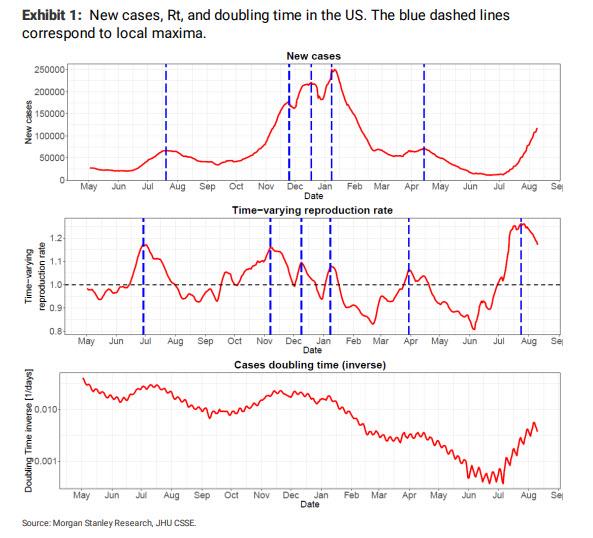
(1) During the 5 major prior peaks in cases over the past 1+ year  (Exhibit 1, blue dashed lines), the peak in reproduction rate (Rt)values
(Exhibit 1, middle panel) was consistently reached prior to the peak in new cases (Exhibit 1, top panel),and specifically ~9-21 days in advance (except from Jan 8th wherein new cases and Rt peaked on the same day). This may suggest that the next peak in cases could be predicted by the timing of the peak in Rt values and, therefore,given that the latest peak in Rt was on July 24th, the next peak in cases could be reached by ~Aug14th. Note that,unlike Rt, the doubling time (Exhibit 1, bottom panel) does not appear to be a leading factor of new cases

(2) By overlaying the hospitalization data in the UK over the US data, Harrison had previously illustrated that US hospitalizations lag UK by ~1 month. Given that the UK hospitalizations peaked on ~ July 25th, it could be expected that US hospitalizations may reach a peak on ~August 25th, while the cases may peak sometime around August 20th (assuming ~1 week lag between cases and hospitalizations);

(3) If the number of daily cases currently is adjusted for vaccination coverage in the US (assuming ~50% fully vaccinated people and ~85% vaccine efficacy), then the current number of new cases is similar to the highest peak in cases in January (~250K/day). Given that, and assuming that it is not very likely for the upcoming peak in the summer (with most activities being outdoor) to exceed the January peak, this is another reason why Morgan Stanley expects the cases currently to be approaching the next peak soon.

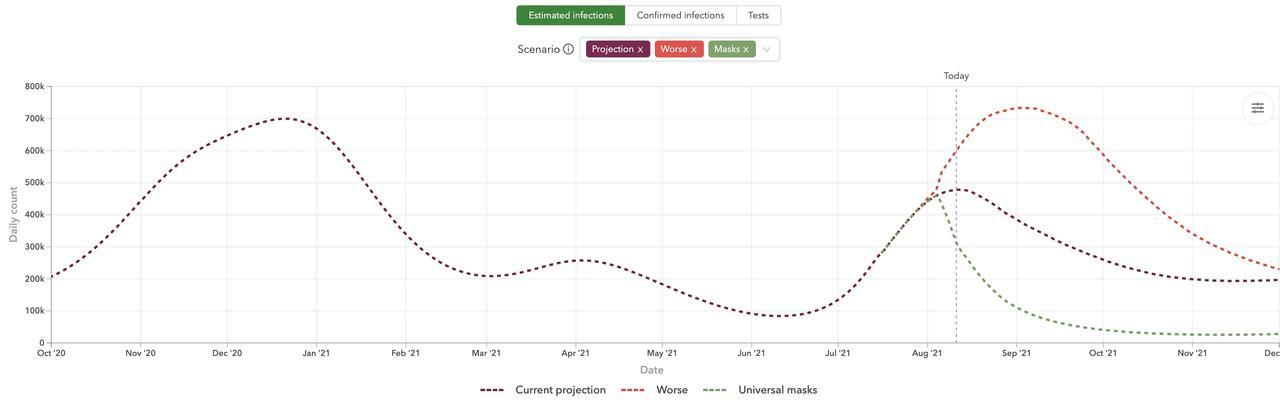
Taken together, Harrison writes that "the above reasons suggest that the next peak in cases may be reached within the next 1-2 weeks." He also references the same data from the Institute of Health Metrics and Evaluation (IHME) in WA which we presented earlier this week, and which he says projects that the peak in US cases is nearly reached...

... even if the CDC's average projection that aggregates forecasts from 25 major modeling groups (link) indicates that the peak in US cases won't be reached before September.

Bottom line: if the Biden admins hopes to use covid as the strawman for trillions more in stimmies and for mail-in voting in the next elections, it will need to dramatically ramp up the media panic over the next, lambda variant as delta is almost done.

https://www.zerohedge.com/covid-19/morgan-stanley-delta-wave-will-peak-1-2-weeks