Search This Blog

Monday, October 18, 2021

NY directs two cryptocurrency lending platforms to cease activity

 Two cryptocurrency lending platforms were asked to cease activities in New York by the state’s attorney general on Monday and three other platforms were directed to provide information about their business.

The move comes weeks after New York Attorney General Letitia James won a court order forcing the closure of cryptocurrency exchange Coinseed.

In a redacted version of a letter dated Monday, James said the Office of the Attorney General “was in possession of evidence of unlawfully selling or offering for sale securities and/or commodities”.

Regulators in the U.S. have been ratcheting up scrutiny of a world that has so far existed in a regulatory gray area, against the backdrop of rising tension between the crypto industry and regulators worldwide.

James filed a lawsuit in February to shut down Coinseed for allegedly defrauding thousands of investors, including by charging hidden trading fees and selling “worthless” digital tokens.

The state’s attorney general warned investors about “extreme risk” when investing in cryptocurrency and issued warnings to those facilitating in the trading of virtual currencies.

“Cryptocurrency platforms must follow the law, just like everyone else, which is why we are now directing two crypto companies to shut down and forcing three more to answer questions immediately,” James said on Monday.

https://www.reuters.com/article/crypto-currency-new-york/new-york-directs-two-cryptocurrency-lending-platforms-to-cease-activity-idUSL4N2RE3I7

Wyoming lawmakers plan anti-vaccine-mandate special session

 Wyoming lawmakers plan to hold a rare special session next week to counter President Joe Biden’s proposal to require COVID-19 vaccination for certain workers.

Whether the session Oct. 26-28 in Cheyenne, at a cost of $25,000 per day, proceeds to discussing legislation remains to be seen. Disagreement over rules could lead to adjournment at the outset, the Casper Star-Tribune reports.

One bill being drafted would ban vaccine passports. Another would impose a $500,000 fine for firing, demoting, promoting, compensating or refusing to hire employees based on vaccination status.

Both are sponsored by Republican Rep. Chuck Gray, of Casper. A bill sponsored by Republican Sen. Tom James, of Rock Springs, meanwhile, would provide for fines and jail for any public servant who tried to enforce federal vaccine mandates.

Even if approved and signed into law by Gov. Mark Gordon, such bills may lack legal force. The U.S. Constitution prohibits state statutes from superseding federal law.

How lawmakers will get to the point of considering legislation also remains to be seen.

Although a simple majority — 36 of 59 in the House and 18 of 30 in the Senate — voted last week to hold the special session, there’s a higher bar to approve rules for the session.

Two-thirds of each chamber would need to approve rules for the session to be proposed by legislative leadership. The leaders plan to seek to adjournment if legislators don’t approve their rules, according to a memo from Senate President Dan Dockstader, R-Afton, and House Speaker Eric Barlow, R-Gillette.

If lawmakers don’t vote to adjourn, they might default to the rules of the most recent session last winter. That could prolong the session by allowing bills outside the scope of vaccine mandates to be considered.

Lawmakers could also hash out a different set of rules requiring a two-thirds vote.

Biden has not yet revealed specifics of his plan to require vaccination for health care workers, federal employees and contractors, and workers at businesses with over 100 employees. Gordon and other Republican governors have vowed to challenge the mandate in court.

The Legislature held a short, virtual special session in 2020 to allocate emergency spending related to the coronavirus pandemic. The last special session before that was in 2004.

https://apnews.com/article/coronavirus-pandemic-joe-biden-health-wyoming-casper-43cd35743d2d8eb970e10ca950bac05b

Michigan business groups urge Biden to reconsider manda

 Michigan business groups on Monday urged President Joe Biden to reconsider a plan to require most workers to get vaccinated or regularly tested for COVID-19 but said, if it is enacted, Gov. Gretchen Whitmer should ensure related state rules are no stricter.

The Michigan Chamber of Commerce and six local chambers raised a host of concerns and questions over the pending federal mandate, which will apply to employers with at least 100 employees. They cited the cost, the logistical challenge of checking workers’ vaccination status and test results at a time human resources or other staffing is limited, and said the 100-employee threshold is arbitrary.

The organizations also asked how employees will be counted, whether the unvaccinated will be able to work while awaiting weekly test results and how long companies will have to comply with the Occupational Safety and Health Administration’s rule.

Rich Studley, president and CEO of the Michigan Chamber of Commerce, said the regulations may be announced later this week or next week. Michigan is among 27 states that operate and enforce workplace safety rules instead of the U.S. government. OSHA-approved state plans must be at least as effective as the federal program.

“Sometimes there’s been a tendency in the past that state officials look at a federal standard as a jumping off point to do more, to do differently, to enact substantially more stringent standards. That would be our concern,” Studley said.

A message seeking comment was left with the Michigan Occupational Safety and Health Administration.

Biden, who resisted vaccine requirements previously, has shifted to favoring them due to a stubborn slice of the public that has refused to be inoculated and has jeopardized the lives of others and the country’s economic recovery.

“The federal vaccine mandate is well-intentioned, but unfortunately it creates an entirely new level of private-sector responsibilities our member businesses, by and large, have neither the experience nor the resources to carry out at this time,” said Nikki Devitt, president of the Petoskey Regional Chamber of Commerce.

About 61.5% of people ages 12 and older are fully vaccinated in Michigan, 20th-highest among states but lower than the national rate of 66.7%.

https://apnews.com/article/coronavirus-pandemic-joe-biden-business-health-michigan-c80c5872cb4758f71bac5ef46bbab64a

Why COVID boosters weren’t tweaked to better match variants

 More COVID-19 booster shots may be on the way -- but when it’s your turn, you’ll get an extra dose of the original vaccine, not one updated to better match the extra-contagious delta variant.

And that has some experts wondering if the booster campaign is a bit of a missed opportunity to target delta and its likely descendants.

“Don’t we want to match the new strains that are most likely to circulate as closely as possible?” Dr. Cody Meissner of Tufts Medical Center, an adviser to the Food and Drug Administration, challenged Pfizer scientists recently.

“I don’t quite understand why this is not delta because that’s what we’re facing right now,” fellow adviser Dr. Patrick Moore of the University of Pittsburgh said last week as government experts debated whether it’s time for Moderna boosters. He wondered if such a switch would be particularly useful to block mild infection.

he simple answer: The FDA last month OK’d extra doses of Pfizer’s original recipe after studies showed it still works well enough against delta -- and those doses could be rolled out right away. Now the FDA is weighing evidence for boosters of the original Moderna and Johnson & Johnson vaccines.

“It’s less churn and burn on the manufacturing” to only switch formulas when it’s really necessary, said FDA vaccine chief Dr. Peter Marks.

But Pfizer and Moderna are hedging their bets. They’re already testing experimental doses customized to delta and another variant, learning how to rapidly tweak the formula in case a change eventually is needed -- for today’s mutants or a brand new one. The tougher question for regulators is how they’d decide if and when to ever order such a switch.

What we know so far:

CURRENT VACCINES ARE WORKING EVEN AGAINST DELTA

Vaccines used in the U.S. remain strongly effective against hospitalization and death from COVID-19, even after the delta variant took over, but authorities hope to shore up waning protection against less severe infection and for high-risk populations. Studies show an extra dose of the original formulas revs up virus-fighting antibodies that fend off infection, including antibodies that target delta.

MIGHT A DELTA-SPECIFIC BOOSTER WORK EVEN BETTER?

Vaccines target the spike protein that coats the coronavirus. Mutations in that protein made delta more contagious but to the immune system, it doesn’t look all that different, said virus expert Richard Webby of St. Jude Children’s Research Hospital.

That means there’s no guarantee a delta-specific booster would protect any better, said University of Pennsylvania immunologist John Wherry. Waiting for studies to settle that question -- and if necessary, brewing updated doses -- would have delayed rolling out boosters to people deemed to need them now.

Still, because delta is now the dominant version of the virus worldwide it almost certainly will be a common ancestor for whatever evolves next in a mostly unvaccinated world, said Trevor Bedford, a biologist and genetics expert at the Fred Hutchinson Cancer Research Center.

A delta-updated vaccine would “help to provide a buffer against those additional mutations,” he said. Bedford is paid by the Howard Hughes Medical Institute, which also supports The Associated Press Health and Science Department.

TWEAKING THE RECIPE

The Pfizer and Moderna vaccines are made with a piece of genetic code called messenger RNA that tells the body to make harmless copies of the spike protein so it’s trained to recognize the virus. Updating the formula merely requires swapping out the original genetic code with mRNA for a mutated spike protein.

Both companies first experimented with tweaked doses against a mutant that emerged in South Africa, the beta variant, that has been the most vaccine-resistant to date, more so than the delta variant. Lab tests showed the updated shots produced potent antibodies. But the beta variant didn’t spread widely.

Now the companies have studies underway of fully vaccinated people who agreed to test a booster dose tweaked to match delta. Moderna’s studies also include some shots that combine protection against more than one version of the coronavirus -- much like today’s flu vaccines work against multiple influenza strains.

The mRNA vaccines are considered the easiest kind to tweak but some other vaccine makers also are exploring how to change their recipes if necessary.

WHY STUDY UPDATED SHOTS IF THEY’RE NOT YET NEEDED?

Moderna’s Dr. Jacqueline Miller told an FDA advisory panel last week the company is studying variant-specific boosters now to learn if they offer advantages, and to be ready if they’re needed.

And Penn’s Wherry said it is critical to carefully analyze how the body reacts to updated shots because the immune system tends to “imprint” a stronger memory of the first virus strain it encounters. That raises questions about whether a subtly different booster would prompt a temporary jump in antibodies the body’s made before -- or the bigger goal, a broader and more durable response that might even be better positioned for the next mutations to come along.

NO RULES YET FOR MAKING A SWITCH

“What is the tripping point?” asked Webby, who is part of a World Health Organization network that tracks influenza evolution. “A lot of what is going to need to go into that decision making is just going to be learned by experience, unfortunately.”

Bedford said now is the time to decide what drop in vaccine effectiveness would trigger a formula change, just as is done with flu vaccines every year.

That’s important not just if a dramatically worse variant suddenly develops. Like many scientists, Bedford expects the coronavirus to eventually evolve from a global crisis into a regular threat every winter -- which might mean more regular boosters, maybe even yearly in combination with the flu shot.

Timing between shots matters, too, Wherry noted.

“Your boostability may actually improve with longer intervals between stimulation,” he said. While scientists have learned a lot about the coronavirus, “the story’s not finished yet and we don’t know what the last chapters say.”

https://apnews.com/article/coronavirus-pandemic-science-business-health-1810900835cdc9f58cb4384ca5fcf03e

Why MannKind fell

 Shares of MannKind (NASDAQ:MNKD), a company working to develop inhaled therapeutics, were down 18% as of 11:59 a.m. EDT on Monday after an inspection issue derailed its hopes of approval for Tyvaso DPI, a lung disease therapy it developed with United Therapeutics (NASDAQ:UTHR).

Tyvaso DPI is a potential treatment for pulmonary arterial hypertension (PAH), a condition where high blood pressure constricts or blocks blood vessels in the lungs. It's a rare disease with an occurrence rate that Johnson & Johnson estimates between 50 and 100 people per million. According to United Therapeutics' Securities and Exchange Commission filings, it owns two patents for treating PAH through inhalation that expire in 2024. That makes the delay especially impactful.

Despite the drop in shares, it isn't all bad news. The Food and Drug Administration's complete response letter didn't cite issues with MannKind's operations or even the clinical data submitted by the two companies. Instead, it was the inspection at a third-party facility that proved to be the fly in the ointment.


Prior to today's fall, MannKind stock had been up 12% in October. The stock now trades at levels from mid-August -- not that long ago. Perhaps that's because there is still a clear path to approval.

Management has expressed confidence that the issue raised by the FDA can be resolved quickly. The partners say approval of the drug candidate should still come by next summer. To that end, MannKind CEO Michael Castagna said it is stockpiling inventory in anticipation of the eventual green light.

For investors with a long-term horizon, today's drop should be seen as a temporary setback; the effectiveness of the treatment is not in question. That said, time is money. Waiting until next summer for approval is clearly something many shareholders were not anticipating.

https://www.fool.com/investing/2021/10/18/why-shares-of-mannkind-corporation-are-falling-thi/

Gottlieb: New 'Super Variant' Is Behind Latest COVID Comeback In UK

 The UK thought it had COVID mostly licked, but Dr. Scott Gottlieb (former head of the US FDA) warned Monday that a new "super-strain" evolved from the delta variant might be behind a recent upsurge in cases in the UK, just after PM Boris Johnson and his health secretary announced plans to loosen foreign travel restrictions.

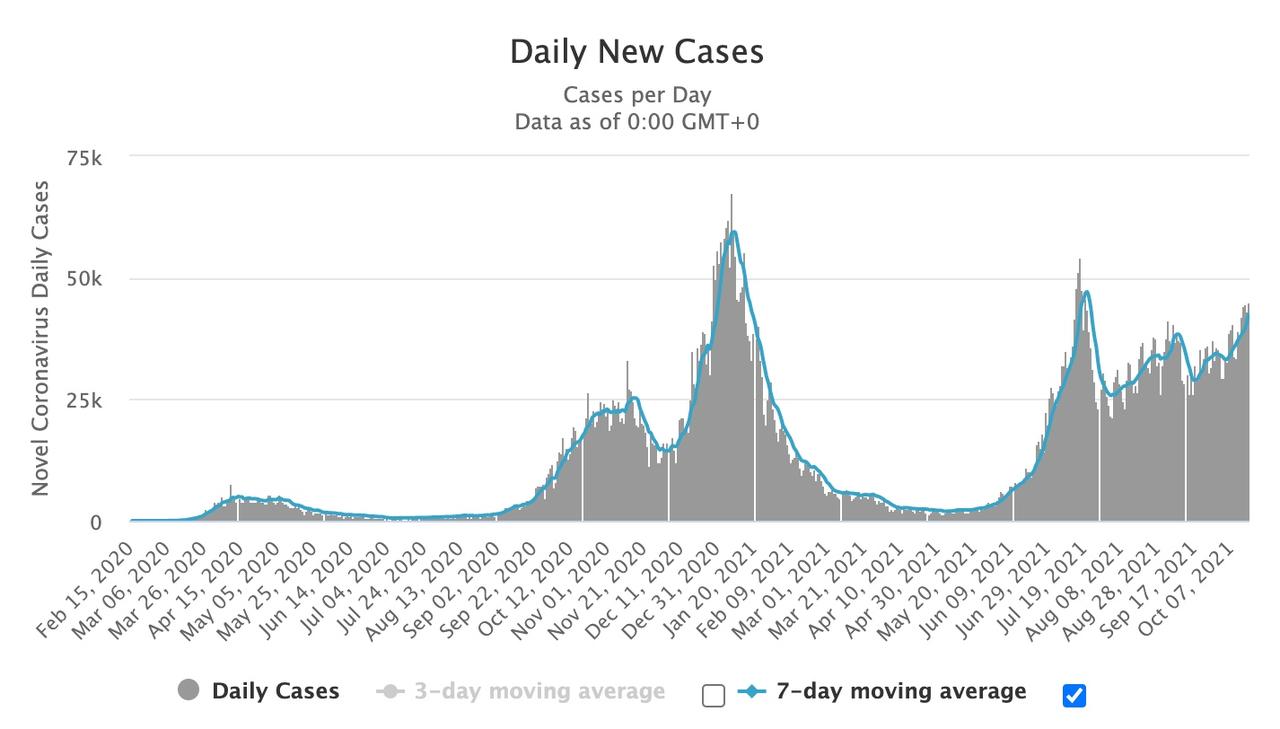
On Twitter, Dr. Gottlieb, pointed out that the UK recently recorded its biggest single-day jump in new COVD cases in 3 months. At the same time, Dr. Gottlieb notes, the new variant known as AY.4v with the S:Y145H mutation in the spike has spread quickly and presently comprises 8% of new cases being confirmed in the UK.

The UK reported 57 new deaths on Sunday, along with 45,140 more cases. The fact that this daily tally is the highest in three months is what's prompting the concerns raised by Dr. Gottlieb.

Dr. Gottlieb, a former head of the FDA who is frequently in the press, said the UK and other countries need to ramp up research on the new variant. Specifically there needs to be more research as to wether the new variant is more transmissible: "We need urgent research to figure out if this delta plus is more transmissible, has partial immune evasion,” he said. "There’s no clear indication that it’s considerably more transmissible, but we should work to more quickly characterize these and other new variants. We have the tools."

The mutation that Dr. Gottlieb is talking about has been spreading in the UK since about July.

As Dr. Gottlieb explains, this isn't a call for immediate action or a snap-back to the lockdown days. Instead, there needs to be a "coordinated global" response in terms of  research and other measures to keep an eye out for the next round of variants and "super variants".

Furthermore: how much longer until Dr. Anthony Fauci declares this new "super variant" an immediate threat.

https://www.zerohedge.com/covid-19/dr-gottlieb-warns-new-super-variant-behind-latest-covid-comeback-uk

Philips 3Q Sales Missed Market Views, Lowers Fiscal Year Guidance

 Koninklijke Philips NV reported on Monday a rise in net profit for the third quarter but sales declined and it lowered its full-year growth and margin guidance.

The Dutch medical-technology group said its results were hit by supply-chain issues, which led to longer lead times to convert its strong order book to revenue during the period. It expects the problems to continue in the fourth quarter.

Philips downgraded its full-year guidance to low single-digit growth from low-mid-single digit growth. It also said it now expects a "modest improvement" in margin, from an estimated 60 basis-points improvement previously, according to analysts.

Philips posted a net profit from continuing operations of 2.98 billion euros ($3.46 billion) compared with EUR340 million for the same period a year earlier. The company's net profit result was mainly driven by the sale of its Domestic Appliances business, it said.

"With this, we concluded our major divestments, allowing us to focus fully on extending our leadership in health technology and continuing our transformation into a solutions company," Chief Executive Frans van Houten said.

Quarterly sales decreased to EUR4.16 billion from EUR4.98 billion for the year earlier period, when they were expected to reach EUR4.18 billion, according to the company's compiled consensus. Comparable sales fell 7.6%, Philips said.

Adjusted earnings before interest, taxes, and amortization came to EUR512 million, down from EUR684 million the prior year. The adjusted EBITA margin for the third quarter was 12.3%, compared with 15.5% the prior year.

https://www.marketscreener.com/quote/stock/PHILIPS-NV-6289/news/Philips-3Q-Sales-Missed-Market-Views-Lowers-Fiscal-Year-Guidance-2nd-Update-36704875/