Search This Blog

Saturday, February 4, 2023

FTX FILING PULLS BACK CURTAIN ON BANKMAN-FRIED INFLUENCE-PEDDLING

 A FILING IN FTX’s bankruptcy proceedings is shedding light on the true extent of the crypto-trading powerhouse’s influence-peddling operation. Last week, FTX filed its creditor matrix, a document that lists former vendors and investors to the company.

The list includes nearly a dozen public relations experts — specialists who generate positive spin in the media on behalf of clients — as well as political consultants, think tanks, and trade groups.

Sometimes, the money went directly to political operations; Majority Forward, a dark-money group designed to elect Senate Democrats, received cash. In some cases, the hired guns, such as PR firms, were paid directly for their services. In others, the groups that received donations maintain that they are independent, but had interests aligned with FTX.

The filing, for instance, listed a donation to the Center for a New American Security, a prominent national security-focused think tank in Washington, D.C., that has worked to shape crypto regulations.

The filing offered a look under the hood of FTX’s intricate maze of influence. On the heels of its meteoric rise as a crypto exchange, FTX quickly began to spend extraordinary amounts of money to buy prestige and friends in high places. Now that the firm stands accused of siphoning off billions of its investors’ dollars — with its disgraced founder Sam Bankman-Fried charged with fraud in the matter — increased scrutiny is falling on powerbrokers’ dealings with FTX.

The relationships of many of the entities listed in the bankruptcy filing and FTX were already known — the company complied with lobbying disclosures for some of its consultants — but the creditor matrix shows the crypto giant also retained several previously undisclosed professional influence peddlers.

One seasoned political hand tied to FTX without any disclosures is former New York City Council Speaker Corey Johnson. His firm, Cojo Strategies, is featured in the FTX vendor list. Another is Susan McCue, a former aide to Sen. Harry Reid, D-Nev., who has advised many Senate Democrats and played a role in the leadership of several Democratic super PACs and dark-money outfits. Her firm, Message Global, is in the filing.

Other consulting firms with a finger on the pulse of power are sprawled through the creditor matrix, which runs over 116 pages. Another creditor, Patomak Global Partners, a firm that specializes in influencing financial regulators, is led by Paul Atkins, a former Securities and Exchange commissioner. Atkins’s company touts its roster of former government officials as providing “a telescope to anticipate trends on the horizon to help position our clients for long-term success.” (Neither Johnson, McCue, nor Patomak responded to requests for comment.)

Think Tank Crypto Regulations

The donation to CNAS — a powerful think tank with ties to both political parties but known for staffing national security roles in Democratic administrations — came at a time when the organization advocated for crypto regulations with a light touch.

“To compete in the digital-economy race with China, the United States must foster a more innovative fintech environment,” CNAS fellow Yaya J. Fanusie said in testimony to the Senate Finance Committee on July 14, 2021. “If U.S. securities regulation does not evolve to account for the new technical and entrepreneurial capabilities offered by blockchain technology and broadcast data transmission, the United States could be hamstrung in a data revolution that is only just beginning.”

CNAS also maintains a task force on crypto, on which FTX formerly served as a member. The task force corresponded with national security-focused government officials, offering policy advice that reflected the crypto industry’s contention that digital tokens on the blockchain pose a low risk for terror financing.

readout of a CNAS meeting with the Treasury Department’s Brian Nelson, the undersecretary for terrorism and financial intelligence, included a summary of the discussion and noted that the official “recognized the work of many in industry to engage in constructive dialogue and support government efforts to mitigate the misuse of virtual assets for money laundering.” The use of crypto for “illicit activities remains below the scale of traditional finance,” Nelson said.
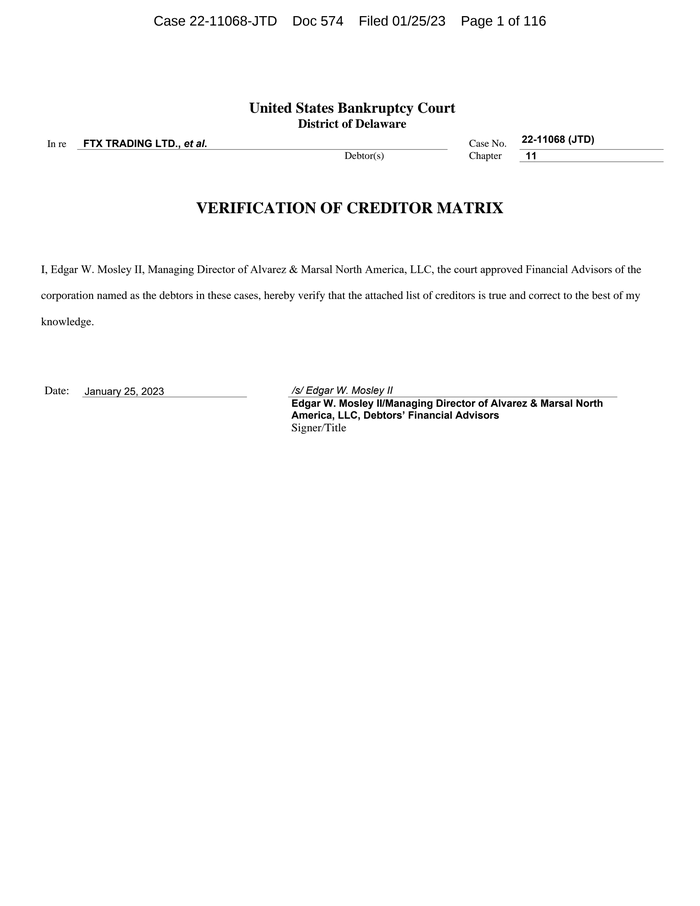
FTX Creditor Matrix Filed in Bankruptcy Proceedings116 pages

CNAS’s task force is co-chaired by Sigal Mandelker, who used to hold Nelson’s position at the Treasury before resigning in 2019 to enter the private sector. Mandelker now serves as general partner of Ribbit Capital, an investor in FTX. Mandelker spoke at SALT’s Crypto Bahamas conference last summer. The invite-only conference for “leading players in the crypto and traditional finance industry” also featured talks from Bankman-Fried, former President Bill Clinton, and ex-British Prime Minister Tony Blair.

Mandelker’s talk at Crypto Bahamas was on maintaining permissive crypto regulations.

“The instinct of government is often to focus on risk and not to put as much emphasis on opportunity,” she said. The true risk regulators should be wary of, Mandelker continued, was “shutting down [crypto] innovation.” (Mandelker did not respond to a request for comment.)

“CNAS received a $25,000 donation from FTX in 2022 in general support of CNAS’s independent research on national security,” Shai Korman, CNAS’s director of communications, told The Intercept. “FTX was also a member of the Task Force on Fintech, Crypto, and National Security. FTX is no longer a member of the task force, and CNAS has returned the donation in full.”

PR, Law Firms, and Video Games

FTX once enjoyed a near-mythical status in the media, with splashy cover stories and gushing news articles lauding the crypto powerhouse and Bankman-Fried, its youthful leader. Such coverage rarely emerges organically, and FTX hired an army of public relations firms to burnish its image.

Among them was M Group, a New York-based public relations powerhouse known for its Rolodex of elite journalists. Others under the employ of FTX included TSD Communications and Full Court Press Communications.

The creditor list includes Rational 360, a public relations firm led in part by former White House Press Secretary Joe Lockhart. Emails obtained by Matt Stoller, the director of research at the American Economic Liberties Project, show that Rational 360 pressured activists and political influencers to speak out in favor of a bill that would move crypto regulatory authority to the Commodity Futures Trading Commission. While the Securities and Exchange Commission handles many enforcement actions against crypto firms, the CFTC is seen as more friendly to crypto interests and has fewer disclosure requirements.

Powerhouse law firms also feature heavily in the most recent bankruptcy disclosure. One firm listed is Cleary Gottlieb Steen & Hamilton, which represented Russia in a $3 billion bond dispute against Ukraine before it shuttered its Moscow office last year. Buckley LLP, another large law firm based in Washington that appeared on the FTX creditor list, announced earlier this month that it would merge with the San Francisco-based Orrick to create a combined firm with a total of nearly $1.5 billion focused on “forward-looking regulatory and enforcement advice” in the fields of finance and tech.

Among FTX’s listed creditors were a handful of nations — though the contours of the financial relationships remain unknown. Nevertheless, the list of countries reads like a who’s who of nations with lax financial regulations: The British Virgin Islands, Bermuda, the Cayman Islands, Isle of Man, Liechtenstein, Luxembourg, the United Arab Emirates, Seychelles, and Switzerland all appear in the filing.

In addition to national banks and powerful firms in the corporate PR world, the creditor matrix also details luxury restaurants like Carbone in Miami and the luxury Margaritaville resort in Nassau.

The North America League of Legends Championship Series, a property of a premier video game event franchise, is also listed in the creditor matrix. Bankman-Fried, notorious for playing the video game “League of Legends” during pitch meetings with investors, arranged a $96 million sponsorship deal with Riot Games. In December, as the extent of FTX’s deception unfolded, Riot announced it would attempt to cut ties with Bankman-Fried.

The entertainment relationships provided, in some cases, an additional channel for political access. The creditor list includes the talent agency WME, with a memo mentioning actor Larry David, a celebrity endorser of FTX who appeared in a now-infamous Super Bowl commercial promoting the crypto exchange.

WME itself is owned by Endeavor, an investor in FTX that owns 38,000 shares of the company. Endeavor is also run by Ari Emanuel, the brother of Rahm Emanuel, President Joe Biden’s ambassador to Japan.

Editor’s Note: In September 2022, The Intercept received $500,000 from Sam Bankman-Fried’s foundation, Building a Stronger Future, as part of a $4 million grant to fund our pandemic prevention and biosafety coverage. That grant has been suspended. In keeping with our general practice, The Intercept disclosed the funding in subsequent reporting on Bankman-Fried’s political activities.

https://theintercept.com/2023/01/30/ftx-sam-bankman-fried-lobbying-pr/

$60 Billion In COVID Fraud? Try $4 Trillion

 s auditors and congressional investigators try to figure out just how much federal COVID relief went to fraudsters, they are missing the trillions of dollars in fraud committed by the federal government itself in a war that we had no chance of winning.

Last week, the Government Accountability Office reported that fraudsters took in about $60 billion in unemployment checks. That’s on top of the tens of billions in fraudulent claims made through the Paycheck Protection Program, the tens of billions handed out through a Small Business Administration program, and on and on.

This Wednesday, the House Committee on Oversight and Accountability will hold a hearing “to investigate rampant waste of taxpayer dollars in COVID relief programs.”

Rep. James Comer, R-Ky., the chairman of the committee, said “we owe it to Americans to identify how hundreds of billions of taxpayer dollars spent under the guise of pandemic relief were lost to waste, fraud, abuse, and mismanagement.”

That’s all well and good. But what we really need is an investigation into how the war against COVID wasted trillions of taxpayer dollars, imposed massive disruptions, handicapped millions of students, and probably didn’t save many, if any, lives.

That sort of investigation, if done honestly, would likely conclude that we would have been better off if we’d done nothing at all beyond asking people to wash their hands and stay home if they’re sick.

Shocking? Impossible to believe? Let’s review the evidence.

Start with the fact that since COVID-19 first landed on U.S. shores three years ago, 1.1 million have died from the virus, according to the Centers for Disease Control. Even now, deaths are averaging around 4,000 per week.

Way back in early March 2020, the CDC met with experts from around the world met to map out COVID-19 scenarios. “Between 160 million and 214 million people in the U.S. could be infected over the course of the epidemic,” reported the Yale School of Medicine. “As many as 200,000 to 1.7 million people could die.” That assumed the country did nothing to mitigate COVID’s spread.

So, the U.S. embarked on an unprecedented effort to slow the disease’s spread and develop vaccines in record time, spending trillions of dollars in the process. For months, the entire nation was locked down. People were ordered to stay at home. Businesses were forced to stay closed. Church services were suspended. Students were locked out of their schools. The elderly weren’t allowed to have outside visitors. In many areas, mask-wearing was mandatory, even outdoors.

The economic result was catastrophic. The nation’s GDP collapsed by 30% in the second quarter of 2020. Unemployment, which had just reached 3.5% – a 50-year low – shot up to 14.7% in April 2020.

The federal government rushed through trillions of dollars in relief legislation. In March 2020 alone, Congress approved three aid packages totaling $2.43 trillion. By the following March, COVID relief spending was close to $4 trillion.

All of this spending was with borrowed money, and paying off this monstrous debt is a burden future generations will have to bear. But the harm caused by these interventions goes beyond the explosion in the national debt.

Shutting down schools had a tragic impact on education. Reading and math scores plunged as schools struggled with remote learning. Reading scores saw their biggest drop in 30 years. Minorities suffered the most. Masking children for years will likely have long-term effects on their social development as well.

Meanwhile, depression, anxiety, and suicide all increased. A CDC study found that one in four people between 18 and 24 contemplated suicide during the shutdown.

Even car crash deaths, which had been trending downward for decades, started climbing again in 2020, and have continued to increase, most likely because reckless driving became more common thanks to prolonged shutdowns and more empty roads.

And what did we get for all this? Look at those fatality numbers again. At the start of COVID, experts said doing nothing would result in 1.7 million deaths. We did plenty, but the death count is steadily approaching that number anyway.

Researchers at Johns Hopkins University did a meta-analysis of studies done on the effectiveness of COVID mitigation efforts. Their stunning conclusion:

“We find no evidence that lockdowns, school closures, border closures, and limiting gatherings have had a noticeable effect on COVID-19 mortality.”

But the researchers found that all these interventions “have contributed to reducing economic activity, raising unemployment, reducing schooling, causing political unrest, contributing to domestic violence and undermining liberal democracy.”

We will concede that the rapid development of COVID tests, three different vaccines, and improved treatment regimens saved lives, although just how many is unknowable.

But what if we’d done nothing beyond that, other than follow standard guidelines when a disease is spreading? Stay home if you’re sick. Wash your hands. Avoid highly congested areas. What if, instead of spreading widespread fear, public health officials focused on the population most at risk: the sick and elderly?

Our guess is that just as many people would have died from COVID. But we wouldn’t be climbing out of the deep economic hole we dug. Our children wouldn’t have lost a year of education. Fewer would have died from suicide, overdoses, and other lockdown ills.

Few of us who’ve lived through the three years of nonstop warnings, mandates, and hysteria would be willing to admit that this war was all for nothing. But if we’re going to avoid repeating these mistakes in the future, we’d better learn from these mistakes now.

https://issuesinsights.com/2023/01/30/60-billion-in-covid-fraud-try-4-trillion/

Train derailment sparks massive fire in Ohio, prompts evacuations

 Part of the town of East Palestine, Ohio, is under an evacuation order after a train derailment caused a massive fire Friday night that was still burning into Saturday morning.

There is a shelter-in-place order for the rest of the community.

The Norfolk Southern train, which totaled around 50 cars, derailed around 9 p.m. Friday along the east-west tracks that run through East Palestine, on the outskirts of town near the Pennsylvania border. The fire is still burning Saturday morning, but said to be under control.

Several explosions were heard amid the blazes, and those explosions may continue as the train — which was comprised of tanker cars, box cars and a car hauling automobiles — continues to burn.

The fire stretched for a half-mile down the tracks, with smoke and flames visible for miles around. (Charity and William Peters)

There were no fatalities or significant injuries as a result of the accident, according to East Palestine Mayor Trent Conaway.

“The train crew was fine,” Mayor Conaway said.

As of Saturday morning, there was no indication of how the train derailed.

At a 6:30 a.m. press conference, officials announced a mandatory evacuation order for those living east of Market Street to Highland and Jimtown Roads, an area that affects about 1,500 to 2,000 residents.

Conaway declared a state of emergency just before 9:30 a.m. Saturday, allowing the Village of East Palestine to exercise all emergency authority for protection during the crisis.

“We have multiple HAZMAT teams on the scene,” said Mayor Conaway. “Norfolk Southern’s here with its HAZMAT team, too, to determine the possible chemicals that were involved.”

When speaking of which chemicals might be burning, Conaway said, “We don’t know 100% for sure.” 

A no-fly zone has also been established within a one-mile radius of the scene. Officials are asking the public to avoid the area.

“We are asking residents not to drive around,” Conaway said. “Fire trucks are flying up and down the road.  They’re tanker trucks. They’re full of water. They leak.” 

The mayor says 43 residents are currently in a shelter.

Drone video at the peak of the fire shows the flames stretching for around a half mile along the tracks. The plume of smoke could be seen 10 miles away and was easily picked up on weather radar.  

Fifty fire departments from three states responded to help fight the fire, including crews from virtually every fire department in the Columbiana and Mahoning counties of Ohio.

“The initial challenge was just not knowing what we were dealing with,” said Battalion Chief Brian Rutledge, who was part of the first fire crew on the scene.

One of the biggest issues facing firefighters were temperatures between 5-10 degrees Fahrenheit. Mayor Conaway said the hydrants were working fine, but the trucks pumping the water were freezing up. 

High school students Jacob Griffith and Cami Kridler had attended the basketball game and were headed out for something to eat when they saw the fire.

“We just looked to our left and a giant explosion, probably at least 200 feet, and we’re like, ‘Oh my God. What do we do?'”

“I was actually the one that dialed 911,” said Kridler. “We all saw the same thing. One of our friends said, ‘Hey something blew up.'”

https://thehill.com/homenews/3843787-train-derailment-sparks-massive-fire-in-ohio-prompts-evacuations/

Foreign states already using ChatGPT maliciously, UK IT leaders believe

Most UK IT leaders believe that foreign states are already using the ChatGPT chatbot for malicious purposes against other nations. That’s according to a new study from BlackBerry, which surveyed 500 UK IT decision makers revealing that, while 60% of respondents see ChatGPT as generally being used for “good” purposes, 72% are concerned by its potential to be used for malicious purposes when it comes to cybersecurity. In fact, almost half (48%) predicted that a successful cyberattack will be credited to the technology within the next 12 months. The findings follow recent research which showed how attackers can use ChatGPT to significantly enhance phishing and business email compromise (BEC) scams.

ChatGPT, OpenAI’s free chatbot based on GPT-3.5, was released on November 30, 2022, and racked up a million users in five days. It is capable of writing emails, essays, code, and phishing emails, if the user knows how to ask. Blackberry’s study found that attackers’ ability to use these capabilities to help craft more believable and legitimate sounding phishing emails is a top concern for 57% of the UK IT leaders surveyed. This was followed by the increase in sophistication of threat attacks (51%) and the ability to accelerate new social engineering attacks (49%).

Almost half of UK-based IT directors are concerned by ChatGPT’s potential to be used for spreading misinformation (49%), as well as its capabilities to enable less experienced hackers to improve their technical knowledge (47%). Furthermore, 88% of respondents said that governments have a responsibility to regulate advanced technologies such as ChatGPT.

“ChatGPT will likely increase its influence in the cyber industry over time,” commented Shishir Singh, CTO cybersecurity at BlackBerry. “We’ve all seen a lot of hype and scaremongering, but the pulse of the industry remains fairly pragmatic – and for good reason. There are a lot of benefits to be gained from this kind of advanced technology and we’re only beginning to scratch the surface, but we also can’t ignore the ramifications.”

In January, researchers with security firm WithSecure demonstrated how the GPT-3 natural language generation model can be used to make social engineering attacks such as phishing or business email compromise (BEC) scams harder to detect and easier to pull off. The study revealed that not only can attackers generate unique variations of the same phishing lure with grammatically correct and human-like written text, but they can build entire email chains to make their emails more convincing and can even generate messages using the writing style of real people based on provided samples of their communications.

“The generation of versatile natural-language text from a small amount of input will inevitably interest criminals, especially cybercriminals – if it hasn’t already,” the researchers said in their paper. “Likewise, anyone who uses the web to spread scams, fake news or misinformation in general may have an interest in a tool that creates credible, possibly even compelling, text at super-human speeds.”

https://www.csoonline.com/article/3687089/foreign-states-already-using-chatgpt-maliciously-uk-it-leaders-believe.html

Morgan Stanley sees another 25-bps Fed hike in March after strong jobs report


The Federal Reserve is likely to raise interest rates by another 25 basis points (bps) at the March policy meeting following a blockbuster U.S. non-farm payrolls report for January, according to Morgan Stanley's latest research note released on Friday.

The U.S. investment bank previously called for a pause in the rate-hiking cycle in March after the Fed increased the policy benchmark rate by 25 bps on Wednesday. The current benchmark rate stands in a range of 4.50% to 4.75%

Friday's robust payrolls number has changed that forecast, Morgan Stanley said.

"Even with more data outstanding ahead of the March FOMC, we think there is not enough time for the data to signal to the Fed that rates have moved sufficiently into restrictive territory," Morgan Stanley wrote in the research note.

Data showed that non-farm payrolls surged by 517,000 jobs last month, the most in six months. Economists in a Reuters poll had expected a gain of 185,000. Data for December was revised higher to show 260,000 jobs added instead of the previously reported 223,000.

The unemployment rate, on the other hand, hit more than a 53-1/2-year low of 3.4%.

Morgan Stanley also raised the peak fed funds rate to 4.875% from a previous estimate of 4.75%. However, it still sees the first rate cut in December 2023.

The rate futures market on Friday has priced in a terminal rate of 5.02% hitting in June. It has been under 5% for the last several weeks.

The Fed has projected it will raise its key policy rate to between 5% and 5.25% and keep it there at least until the end of the year.

https://www.marketscreener.com/news/latest/Morgan-Stanley-sees-another-25-bps-Fed-hike-in-March-after-strong-jobs-report--42893872/

DEFENSE SEC: BALLOON USED BY CHINA TO SURVEIL STRATEGIC SITES

 U.S. DEFENSE SECRETARY: BALLOON WAS BEING USED BY CHINA IN ATTEMPT TO SURVEIL STRATEGIC SITES IN THE CONTINENTAL UNITED STATES

https://www.marketscreener.com/news/latest/U-S-DEFENSE-SECRETARY-BALLOON-WAS-BEING-USED-BY-CHINA-IN-ATTEM-8230--42896988/

U.S. FAA SAYS FLIGHTS TO,FROM WILMINGTON, MYRTLE BEACH RESUME

 U.S. FAA SAYS FLIGHTS TO,FROM WILMINGTON, MYRTLE BEACH INTERNATIONAL AND CHARLESTON INTERNATIONAL AIRPORTS ARE RESUMING; OTHER AIRSPACE HAS BEEN REOPENED-TWEET

https://www.marketscreener.com/news/latest/U-S-FAA-SAYS-FLIGHTS-TO-FROM-WILMINGTON-MYRTLE-BEACH-INTERNATI-8230--42896990/