Search This Blog

Sunday, February 5, 2023

Treatment approach for prostate cancer could stop resistance in its tracks

 For the first time, researchers have discovered that prostate cancer can be killed by targeting a single enzyme, called PI5P4Kα. The findings, published recently in Science Advances, could help address the growing threat of treatment resistance in prostate cancer and could also lead to improved treatments for other cancers, such as those affecting the breast, skin, and pancreas.

"This is the first time this enzyme has been implicated in prostate , and we expect that it will prove relevant to other cancers as well," says co-senior author Brooke Emerling, Ph.D., an associate professor at Sanford Burnham Prebys. "An important element of improving precision medicine is using as many tools as possible to treat cancer while mitigating the risk of resistance."

Many cases of prostate cancer can be treated through treatments that lower testosterone and other , but about 10–20% of prostate cancer cases resist treatment within five years. This treatment-resistant prostate cancer can then spread to the rest of the body, where it becomes deadly.

"Understanding how prostate cancer develops resistance is critical for discovering  to delay or reverse the progression of prostate cancer," says Emerling.

The prostate gland requires male sex hormones, known as androgens, to grow. Prostate cancer hijacks the androgen signaling machinery of the prostate in order to grow rapidly, which is why treatments that disrupt these pathways are effective.

"What's remarkable is that we've found an enzyme that can be targeted against prostate cancer even in cases where treatments that lower hormones are ineffective or where resistance has developed," says Emerling. "This could give us a whole new weapon against prostate cancer and other cancers that rely on this enzyme."

The study was prompted by an observation made by Emerling's colleagues at the University of Bern, led by co-senior author Mark A. Rubin. They noticed that patients with treatment-resistant prostate cancer had high levels of PI5P4Kα, suggesting that this protein played a role in the cancer's ability to resist treatment and grow. Emerling's team was then able to show—using multiple  cancer model systems—that inhibiting this enzyme could kill treatment-resistant .

"It was that initial observation from the patient data that really got us excited," adds Emerling.

PI5P4Kα is part of a group of enzymes called PI5P4Ks that are involved in the metabolism of lipids, a type of molecule that includes fats, hormones, and many vitamins. While other areas of cancer metabolism have been extensively researched for decades,  has only recently emerged as a promising therapeutic avenue for cancer.

"Treatments that target lipid metabolism could be an unexplored treasure trove, and it's something researchers are very interested in right now," says Emerling. "We're working to develop drugs to target this , and there are several companies out there developing their own drugs as well."

Because of this interest, Emerling and her colleagues are optimistic about the future of this  approach.

She says, "There's no drug yet, but I have high hopes that in the near future, we'll have something in clinical trials. That would be amazing."

More information: Joanna Triscott et al, PI5P4Kα supports prostate cancer metabolism and exposes a survival vulnerability during androgen receptor inhibition, Science Advances (2023). DOI: 10.1126/sciadv.ade8641


https://medicalxpress.com/news/2023-02-treatment-approach-prostate-cancer-resistance.html

Cinnamon, memory and learning

 Cinnamon, the well-known aromatic spice that many of us use to bake cakes and cook savory dishes, is derived from the inner bark of Cinnamomum trees. These are evergreen trees found in the Himalayas and other mountain areas, as well as in rainforests and other forests in southern China, India and Southeast Asia.

In addition to its unique flavor,  could have other beneficial properties for humans. For instance, studies suggest that cinnamon has anti-inflammatory, antioxidant, and anticancer properties, and can also boost the immune system.

Some works also showed that its  could boost , particularly memory and learning. Yet the validity of these findings is yet to be established with certainty.

A team of researchers at Birjand University of Medical Sciences in Iran recently reviewed several past studies exploring the effects of cinnamon on cognitive functions. Their analysis, outlined in Nutritional Neuroscience, highlights the potential value of cinnamon for preventing or reducing memory or learning impairments.

"This study aimed to systematically review studies about the relationship between cinnamon and its key components in memory and learning," Samaneh Nakhaee, Alireza Kooshki and their colleagues wrote in their paper. "Two thousand six hundred five studies were collected from different databases in September 2021 and went under investigation for eligibility. Forty studies met our criteria and were included in this ."

Nakhaee, Kooshki and their colleagues reviewed hundreds of studies stored in several online research databases, including PubMed, Scopus, Google Scholar and Web of Science. They then narrowed down their analysis to 40 of these studies, those that were most pertinent to their topic of interest.

Among these 40 studies, 33 were carried out in vivo (i.e., examining real living organisms, such as humans, rodents, or other animals). Five of them were conducted in vitro (i.e., outside of living organisms, for instance by analyzing cells or post-mortem tissue), and two were  (i.e., with medical patients).

The researchers extracted data relevant to all these studies, including their author, year of publication, compound or type of cinnamon used, the study population and sample sizes, doses of cinnamon or its bioactive components used, gender and age of participants, duration and method of consumption, and the results obtained. They then assessed the quality and reliability of the studies looking at their design, sample size, inclusion criteria, and other methodological aspects.

Finally, they analyzed and compared the results of the 40 relevant articles they selected. Overall, most of the studies they looked at suggested that cinnamon could positively impact both memory and cognitive function.

"In vivo studies showed that using cinnamon or its components, such as eugenol, cinnamaldehyde, and cinnamic acid, could positively alter cognitive function," Nakhaee, Kooshki and their colleagues wrote in their paper. "In vitro studies also showed that adding cinnamon or cinnamaldehyde to a cell medium can reduce tau aggregation, Amyloid β and increase cell viability."

Out of the two clinical studies analyzed by the researchers, one was conducted on adolescents and the other on pre-diabetic adults who were 60 years old or younger. The first study asked the adolescents to chew cinnamon gum, while the latter asked participants to eat 2g of cinnamon on white bread.

The study on adolescents yielded positive results, suggesting that chewing cinnamon gum improved memory function and reduced anxiety. In contrast, the  on pre-diabetic adults found no significant changes in cognitive function following the consumption of cinnamon.

"Most studies reported that cinnamon might be useful for preventing and reducing cognitive function impairment," the researchers wrote in their paper. "It can be used as an adjuvant in the treatment of related diseases. However, more studies need to be done on this subject."

Overall, the systematic review paper by Nakhaee, Kooshki and their colleagues suggests that cinnamon and some of its active components could have positive effects on the functioning of the human brain, boosting memory and learning. In the future, this review could inspire other teams of researchers to further examine the impact of cinnamon on the brain, which could potentially promote its use to preserve brain function and slow down cognitive impairment.

More information: Samaneh Nakhaee et al, Cinnamon and cognitive function: a systematic review of preclinical and clinical studies, Nutritional Neuroscience (2023). DOI: 10.1080/1028415X.2023.2166436


https://medicalxpress.com/news/2023-02-effects-cinnamon-memory.html

Powerful Private Organization Putting a Price on Life –Again and Again

 Every year on Groundhog Day, those of us who grew up in snowy states will wait to see whether Punxsutawney Phil will spot his shadow.

But for millions of families living with Alzheimer’s disease, this Groundhog Day may feel more like the time loop trap from the 1993 Bill Murray movie.

That's because this year, an influential non-governmental organization – which markets itself as the arbiter of which medical treatments are worth insurance coverage – has made February 2nd the final day for patients to voice their opinions on the value of a new Alzheimer's drug. 

The organization, the Boston-based Institute for Clinical and Economic Review (ICER), issues value assessments on new, FDA-approved therapies, usually for conditions where patients either have no treatment options or have run out of them. Patient advocacy organizations feel obligated to drop what they’re doing and respond to "requests for public comment" in order to weigh in on behalf of the families they represent. Patients and advocacy groups like mine can't simply ignore these requests, since ICER's reports influence whether health insurance providers – including the Department of Veterans Affairs and state Medicaid agencies – make medicines available to patients.

If we don’t respond, the patients we represent run a real risk of losing access to medicines, especially since ICER's methodology – and its recommendations – undervalue treatments for populations that have fewer expected years of life left or shorter average life spans than the overall population.

Consider how ICER's reports rely on a metric known as a Quality-Adjusted Life Year (QALY).

In a QALY analysis, a year of so-called "perfect" health is more valuable than a year in which a person experiences health problems. By the same reasoning, a drug that returns a patient to that supposedly perfect state is considered more cost-effective than an identically priced one that merely prolongs life or alleviates symptoms.

The fundamental problem with this rating tool is that it discriminates against any group of people who are sicker or older than the general population. That includes people with disabilities, as well as groups who experience poorer health because they face inequities in access to care. 

ICER's current request for comment concerns lecanemab, a new treatment for Alzheimer's disease that was approved under accelerated approval by the FDA in early January. Alzheimer's is an irreversible, degenerative brain condition affecting more than 6.5 million older adults that starts by destroying memory and thinking skills, progresses to an inability to wash oneself or go to the bathroom, and ends as people living with the disease can no longer walk, eat, talk, or swallow.

The older age demographic and large number of people impacted provides plenty of fodder for ICER’s QALY-based assessment to assign Alzheimer's treatments a lower cost-effectiveness. Add in the fact that older adults often have comorbidities such as heart disease, and the cost-effectiveness erodes further. 

This kind of cold valuation of whose life is worth living can play out terribly for people who face long-term health challenges as they age. As a November report by the National Council on Disability observed, QALY-based analysis "puts lesser value on drugs and treatments that extend the lives of people with disabilities as compared to the lives of people without disabilities or chronic illnesses." The report also noted that in countries that apply QALY-type measures across their healthcare systems, the result has been restricted access to drugs for people with disabilities.

Recognizing the potential for harm, several members of Congress banded together yesterday to  introduce H.R. 485, the Protecting Health Care for All Patients Act, which would prohibit the use of QALYs in all federal programs – an expansion from the current prohibition that only applies in a limited fashion to the Medicare program. Yet now, the private health insurance companies that cover tens of millions of Americans are relying on ICER, which uses QALY-based methodology, to help them decide whether to cover new FDA-approved treatments for cancer, rare diseases, Alzheimer’s and other life-threatening conditions.  

No one elected ICER or appointed it to a government role – at least not yet. Payers have simply handed them the power to make life-or-death decisions. The Inflation Reduction Act allows Medicare to set prices for prescription drugs starting in 2026, and left the door wide open to how it will be operationalized. ICER is at the front of the line, standing by – and that should concern all of us. For patient advocates, it's déjà vu with each ICER report, as we jump through hoops to demonstrate the worthiness of the human beings we represent. We all deserve better. 

Sue Peschin is the president and CEO of the Alliance for Aging Research.

https://www.realclearhealth.com/articles/2023/02/02/the_powerful_private_organization_putting_a_price_on_life_again_and_again_111458.html

Inflation Reduction Act Has Brought Higher Drug Prices

 Despite the Inflation Reduction Act’s provisions supposedly aimed to lower drug prices, a new report suggests that drug price increases are only growing, and the new law is likely playing a role. 

report from 46brooklyn found that there were 1,425 drug list price increases, a 17% increase over the 1,219 price increases in 2021. The report’s authors state that “we are increasingly noticing that the pace of increases appear to be accelerating (at least in relation to prior years).” The price increase is about 6.4% in 2022 compared to 4.9% in 2021. 

In addition to the list price increases, Reuters reports that new medicines are reaching record-high prices. They found that the annual median price for a new drug in 2022 was $222,000, up from $180,000 in 2021. Antonio Ciaccia, president of Three Axis Advisors, told Reuters that this entire phenomenon is connected to the Inflation Reduction Act. “Drug makers have to take a harder look at calibrating those launch prices out of the gate ... so they don't box themselves into the point where in the future, they can't price increase their way back into profitability.” 

What could stop these companies from pricing their drugs at a profitable level? The Inflation Reduction Act. Beginning this Fall, the legislation will require drug manufacturers to go through a “negotiation” process with the Centers for Medicare and Medicaid Services (CMS) when setting their prices or else face massive excise tax penalties—which would directly raise costs on consumers. This negotiation process allows the government to impose price controls on drugs. Lest there be any confusion, the bill explicitly establishes a “maximum fair price” for drugs. In any “negotiation,” the government is required to allow prices no higher than this maximum price. This is, in other words, a price cap.  

Already we are seeing that, instead of lowering prices, the prospect of future price controls is encouraging manufacturers to set high prices and raise prices and keep them high, lest the forthcoming price controls turn their drugs unprofitable. With these new prices, manufacturers are seeking to game the system by raising prices in the meantime or raising their launch prices. 

None of this should be shocking. At the time of its passage, while supporters of the bill touted its goal of lowering drug prices, people on both sides of the aisle saw that the impending price control could create perverse incentives for higher prices in the short term before they take effect. 

In the long run, the results could be devastating. The Joint Economic Committee released a September report that concluded the overall effect of the drug pricing provisions in the Inflation Reduction Act would be to decrease research and development spending in healthcare. This “loss in research and development expenditures will likely be substantial, leading to estimates of 15 fewer pharmaceutical drugs over the next 30 years, a significant harm to the health of future Americans” and leading to “the loss of between 6 million and 19 million life-years over the next 30 years.”

Yale Economist Fiona Scott Morton notes that various government schemes dating back to the 1990s to lower prices for programs, such as Medicare and Medicaid, have led to higher prices for everyone. For example, after a rule requiring drug companies “to charge Medicaid the lowest price given to any other customer, pharmaceutical firms reduced discounts. The legislation increased drug expenditures for many private buyers as drug manufacturers tried to raise prices on government sales.” Rules aimed to help decrease the costs to government programs end up shifting the burden onto average Americans.

The lesson from history being repeated is that price controls simply do not work. As lawmakers continue looking for solutions to bring down inflation and high prices within medicine, they should turn to market competition instead of government manipulation.

One factor behind the high costs in medicine is the expensive and lengthy approval process. Since the United States does not have a reciprocity agreement with the European Union and other developed nations worldwide, even if they are already approved internationally, pharmaceutical companies must delay U.S. rollouts until they go through the regulatory process again here. These massive barriers to entry slow the development of new treatments, hinder market competition, and raise prices. This was seen this past summer during the baby formula shortage as internationally approved formula was available, but the FDA prevented and delayed it from coming into the U.S. If the goal is lowering drug prices, FDA reform should be a topic of discussion.  

These high prices that consumers are seeing result from government intervention and artificially created barriers in the market. Price controls of the Inflation Reduction Act are clearly working against the goals of expanding access to healthcare treatments and reducing costs. Let’s hope that Congress has learned its lesson and turns to address the real root of the problem. 

Dr. Mary Tipton, MD is an Internal Medicine Specialist in South Jordan, Utah

https://www.realclearhealth.com/articles/2023/02/03/inflation_reduction_act_has_brought_higher_drug_prices_111460.html

What is the Path to Your Greatness?

 Many traders long for great profits.  How many do truly great things to achieve those profits?  If you were to do the things that would earn unusually positive returns, you would be doing unique things--you would be far from consensus.  You would have unique ways of generating ideas and managing the positions based on those ideas. You would have an ongoing pipeline of projects to get better and better and exploit new and different market conditions.  You would not be a one-trick pony making money in bull or bear markets or in conditions of volatility.  You would cultivate ways of succeeding across many market conditions.

Most importantly, great people don't magically achieve their status.  Their greatness comes from doing unique and special things each day, each week.  I invite you to read this older post:  It asks the important question, "How can people experience themselves greatly if there's no single thing during the day that they undertake in an exemplary way?"

Greatness does not come from working harder at routine activities.  It comes from expanding ourselves beyond those routines.  Creative geniuses by definition operate outside the box in much of what they do.  Because they pursue what speaks to them, they are able to achieve unusual levels of absorption and productivity, fueling the development of expertise

What speaks to you?  What are the little things you do greatly?  You will find your greatest success by building upon the exemplary things you already do with passion and uniqueness.


http://traderfeed.blogspot.com/2023/02/what-is-path-to-your-greatness.html

Prepping For War? Chinese Spy Balloon Belies Much Larger Economic Warning Signs

Submitted by QTR's Fringe Finance

By now you probably know the Chinese spy balloon that, for some reason, was allowed to traverse the entire United States despite us knowing about it days ago, has been shot down.

Put simply, it was too little, too late for several reasons - and there’s been shuffling, specifically economically, by China over the last 10 years that shows the country’s aggression toward the U.S. could only be getting started.

Chinese spy balloon raises alarm bells over China buying up US land | Fox  News

First, China (and Russia) both now have a gauge of our reluctance to secure our own airspace. If the deployment of the balloon was to see how we’d react, they got their answer: slowly and uncertainly.

Second, if the balloon’s purpose actually was surveillance, and nothing more nefarious, it was likely able to get whatever data it set out for, after floating above numerous military installations.

Third, we have to be acutely aware of the potential for the balloon to be a test run for another balloon, many of which have speculated could be the means for an EMP:

High-altitude balloons, such as the one China has floated over mountain state military bases this week, are considered a key “delivery platform” for secret nuclear strikes on America’s electric grid, according to intelligence officials.

Spy balloons, used by Japan to drop bombs during World War II, are now far more sophisticated, can fly at up to 200,000 feet, evade detection, and can carry a small nuclear bomb that, if exploded in the atmosphere, would shut down the grid and wipe out electronics in a many-state-wide area.

You have to assume that China would know that this balloon - and the two other ones being reported (one over Latin America and now a third potentially outside the U.S.) - would be discovered. Additionally, there were reports yesterday that the balloons were maneuverable, ostensibly meaning the balloon had been directed on its path.

If this is the case, I have to believe it is either a test of how aggressively they could humiliate President Biden publicly (similar to how the Saudis did months ago), or it’s a distraction for something else going on.

The balloon was over Alaska nearly a week ago. Instead of dealing with it then, we allowed it to go untouched, giving China the upper hand, regardless of whether they set out for surveillance or to test us.

"They got a lot of intelligence they couldn't get from their satellites. There's a lot that China learned from this," Gordon Chang said on Fox News today.

I’ll leave the speculation about the balloon and military response to cable news and your own critical thinking. But what I do want to point out is what has been going on behind the scenes economically from China.

While we focus on the obvious, it’s important to also understand that from a monetary and financial perspective, it looks like China is preparing for war.

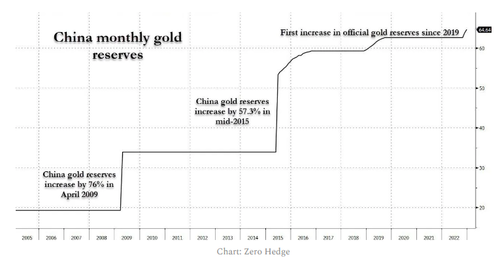
Notably, China is continuing to stockpile gold while selling U.S. Treasuries, an obvious step that a country readying either for war or to challenge the U.S. dollar on a global stage (or both) would be taking.

As Zero Hedge noted last month, China has now bought 100 tons of gold in days.

Chart: Zero Hedge

I was also one of the few outlets last summer to report on the fact that Russia and China openly announced a “new global reserve currency” (announced in July 2022, predicted by me in February 2022). And of course, Russia and China can’t do it on their own: they are working with nations like Saudi Arabia to help put their plans into practice.

Crucial to dethroning the U.S. dollar would be the removal of its use for buying and selling oil - a system that has been in place since the 1970s when the U.S. promised security for the Saudi Kingdom in exchange for the petrodollar system that underpins the dollar’s strength as global reserve currency.

Saudi Arabia looks like it has just ended the petrodollar as of days ago. The admission came on a very public stage, in front of the whole world, at Davos.

The sequence of these events telegraph escalation and we need to take the prospect of China’s threat very seriously.

Espionage on the part of China shouldn’t be a surprise - but have we noticed the economic espionage that has been taking place? For example, I wrote last summer about how China spied on the U.S. Federal Reserve and threatened a U.S. economist for policy information.

All the while, China has been allying itself with Russia further. It was reported today that China is openly now helping Russia with the war in Ukraine, likely in violation of sanctions:

China’s state-owned defense companies have shipped navigation equipment and parts to fighter jets and other military technology equipment to Russian defense companies, according to Russian customs data.

China has sent tens of thousands of shipments of goods to service Russia’s military (some goods had multiple purposes and could be used commercially, the Journal reported).

Meanwhile, China has also expressed its desire to eventually take back Taiwan - it is hardly a secret at this point. Those who know the space the best seem to agree, as recently as last month when General H.R. McMaster said on CBS’s Face the Nation that China is all but guaranteed to try and re-take Taiwan.

"Xi Jinping has made it quite clear, in his statements, that he is going to make, from his perspective, China whole again by subsuming Taiwan. And preparations are underway," he said.

I believe we are on the precipice of an unprecedented era geopolitically. We’ve now seen China steal intellectual property globally, stockpile gold, spy on the Fed, openly state it will challenge the dollar, plan to back its currency with gold or oil, and physically enter U.S. airspace (without any meaningful recourse).

I don’t know what the spy balloon means - but what I do know is that it likely belies additional coming aggression, potentially both physically and economically.

What is it going to take for us to take China seriously as a threat?

https://www.zerohedge.com/markets/prepping-war-chinese-spy-balloon-belies-much-larger-economic-warning-signs

UK's "Nudge Unit" Pushes Various Online PsyOps When People Shop To Build "Net Zero Society"

 by Didi Rankovic via ReclaimTheNet.org,

The Behavioural Insights Team (BIT) – started by the UK government to then in late 2021 become owned by Nesta, which describes itself as an independent charity focused on innovation – has a new report out.

And while its authors present it as a useful “guide” toward building “a net zero society,” what observers critical of this content have taken away from it is that it is promoting, and detailing, various forms of psychological manipulation of people.

The problem that Behavioural Insights Team (aka, “Nudge Unit”) has found for itself to solve is a part of the climate change narrative, where achieving “net zero” means doing away with greenhouse gas emissions.

And they don’t seem to care if the way to get there is through direct manipulation of people, specifically online, via prompts (“nudges”) toward making choices that are not really theirs but serve the agenda.

These choices concern and consume people’s everyday lives: what they wear, what and how much they eat, how they travel to work, whether that job is “climate-friendly,” how they travel just in general and where to, for example, for a vacation.

These are all examples of what the report aims to affect from the behavioral perspective, and clearly, the “solution” is to actively push citizens toward “social transformation.”

In this sense, the report recommends putting prompts in apps that would seek to direct the user to order less takeaway food through what critics might call “reality transformation” – one suggestion is changing the name of small portions to “regular portions.”

At one point, the report mentions BIT case study 4, which deals with “exploring” the role of social media influencers as vehicles to promote “green behaviors.”

BIT case study 12, meanwhile, is about “Helping Solent Transport deliver an effective ‘Mobility as a Service’ app.” Solent Transport is a partnership with local transport authorities, while the main idea here is “encouraging people out of cars” and “nudging” them toward other means of transportation.

BIT case study 15 is one about “encouraging” customers to order smaller portions on takeaway platforms.

Several suggestions are made to make “sustainable food easy,” including utilizing the fact that online shopping “gives many opportunities to provide timely substitution prompts, or encourage personalized goals and tips linked to product filters and ranking.”

BIT says that in producing these case studies of interventions, it partnered with “HMG, the French government, UAE’s Crown Prince Court, World Wildlife Forum, Unilever, Tesco, Sky, Gumtree, and Cogo,” among others.

https://www.zerohedge.com/geopolitical/uks-nudge-unit-pushes-various-online-psyops-when-people-shop-build-net-zero-society