Search This Blog

Sunday, February 5, 2023

J&J's pharma group quietly works through global overhaul, layoffs expected to reach multiple countries

 Three Johnson & Johnson pharmaceutical executives stood before a group of staff in the R&D unit Wednesday, joking about expensive Uber rides and one “phenomenal dinner” at a Japanese steakhouse while attending the J.P. Morgan Healthcare Conference in San Francisco in early January. 

But just minutes earlier, the mood was anything but jovial, as the leaders explained to a nervous group of employees in the Janssen pharmaceutical unit an overhaul of operations for the infectious diseases and vaccine groups, with sweeping layoffs expected to claim staffers' jobs in countries around the world. Some staff members have yet to be told that their positions will be cut.

Fierce Pharma has obtained internal documents and video of a town hall meeting conducted this week describing what J&J called a “comprehensive review” of its portfolio. Moving forward, J&J plans to operate its vaccines and infectious diseases outfits as one group, the executives explained.

James Merson, Ph.D., currently the head of the infectious disease unit, is set to leave the company “to pursue his next opportunity” according to a memo sent to staff. Penny Heaton, M.D., head of the existing vaccines division, will oversee the merged unit.

One memo on the pipeline revisions says the company will continue to invest in all therapeutic areas while “deprioritizing some programs.” But an internal corporate slide presentation that was delivered to the merged therapeutic team and reviewed by Fierce Pharma shows that the company’s infectious disease pipeline is undergoing a major overhaul. 
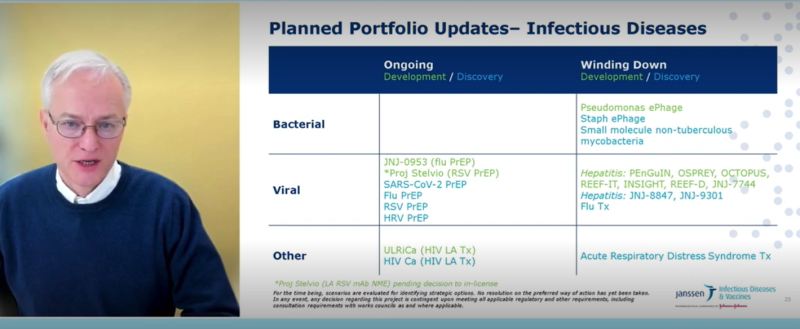
screenshot of townhall presentation
J&J's James Merson presents changes to the infectious disease pipeline in a screengrab from a Wednesday town hall meeting obtained by Fierce Pharma.  (Source)

For example, the company is ending work on its hepatitis B and D therapies and continuing only “legacy studies,” according to an internal presentation slide reviewed by Fierce Pharma. J&J is also discontinuing all antibacterial therapeutic efforts, as well as work on acute respiratory distress syndrome. 

The company is also winding down work of its COVID-19 and HIV vaccines, the latter of which just failed a phase 3 trial. The COVID shot was authorized during the pandemic but failed to gain a foothold in the market due to concerns about blood clots.

Moving forward, J&J plans to focus on pre-exposure prophylaxis to flu, COVID-19, RSV and HRV, the slides show.

The plan was presented to the infectious disease and vaccine team at the Wednesday town hall hosted by Heaton. Merson and Anthony Fernandez, worldwide vice president of vaccines and infectious diseases, contributed virtually. 

When first reached about the cuts, J&J issued the following statement: "As the world’s largest, most diversified healthcare company, we are constantly assessing ways to be more innovative and competitive. We are evolving amidst a rapidly changing environment to better meet the needs of the patients we serve around the world."

In response to follow-up questions about the R&D re-organization, a spokesperson for J&J said: "We have nothing to add beyond the statement I provided yesterday."

Heaton began Wednesday's meeting by saying the company’s R&D divestments were impacting staff in San Francisco and Belgium. She wouldn’t elaborate on how many employees were impacted.

“And obviously I can’t disclose all of the details to you all,” she said at the meeting. “It wouldn’t be appropriate for me to do so because we want to protect the confidentiality of our team members who were impacted.” 

Merson went on to blame the downsizing on “the evolving macroeconomic pressures and internal learnings” that required the company to significantly amend its aspirations. As a result, he said the company needed to focus on where it could win. 

“We’ve learned that we can’t and shouldn’t do everything,” he said. 

References to macroeconomic pressures mirror commentary from the company’s top brass on January 24, during J&J’s public fourth-quarter earnings call. But there was no mention then of the impending R&D rebuild. 

“Looking ahead, while we expect some of the headwinds that impacted 2022 to continue, we have proven that Johnson & Johnson is resilient in times of macroeconomic challenge,” CEO Joaquin Duato said on the earnings call. “In this environment, our approach to 2023 can be best described as prudent, and our priorities for the year are clear and remain consistent.” 

J&J's only publicly identified pipeline culls at the time were a phase 1 solid tumor and prostate cancer candidate, respectively. The layoffs and reduced development efforts come after the company spent nearly $15 billion on R&D in 2022, accounting for more than 15% of sales.

“Investment in R&D remains a top priority to support long-term growth and value creation,” chief financial officer Joe Wolk said on the same earnings call.

The layoffs also come after the company authorized a $5 billion share repurchasing program in September, half of which was completed before the end of 2022. And at the town hall, Fernandez jokingly recounted him, Merson and Heaton ubering around San Francisco on the company’s dime during the latest J.P. Morgan Healthcare Conference, including one trip to a “phenomenal dinner” at a Japanese steakhouse. 

But the joke didn’t land with everyone, given that numerous employees were told they had lost their jobs just hours beforehand. 

“You don’t want to just see a bunch of old, rich people talking about how much fun they have on company expense,” said one employee who attended the town hall. 

It’s not only R&D that’s being affected by downsizing efforts. Two sources familiar with the company’s decision-making say layoffs have hit the company’s neuroscience team as well, particularly the multiple sclerosis sales team. Janssen nabbed FDA approval for Ponvory to treat relapsing MS in March 2021. 

J&J has yet to unveil discrete sales figures for Ponvory, suggesting the med hasn’t met the sales threshold of—at the lowest end of J&J’s reporting—drugs like the $479 million-a-year Procrit. Ponvory’s revenues are likely lumped into J&J’s nebulous “other neuroscience” category, which reeled in a collective $1.73 billion in 2021.

The multiple sclerosis market has become increasingly competitive in recent years with the introduction of generics to Biogen's Tecfidera in 2020, plus Roche's launch of Ocrevus, which quickly scooped up market share and reached blockbuster status after just one year.

While J&J has largely kept mum on its downsizing plans, rumblings of changes afoot arose in October when Wolk offered an ever-so-subtle warning that the company was angling to “rightsize [its] infrastructure” as a two-segment company amid the separation of the consumer health business, Kenvue.

“Clearly, the macroeconomic pressures that all industries and all companies are facing is something that we have to address as well,” Wolk said of J&J’s profit margin in 2023. “While healthcare is a very, very good business and more resilient than most, it’s not as if we’re immune to some of those dynamics.”

It wasn’t immediately clear how many jobs or which functions were under threat, though Wolk told The Wall Street Journal at the time that a major restructuring wasn’t in the cards.

As of the beginning of 2022, J&J counted 141,700 full-time employees among its global staff, up from 134,500 in 2021. About a third of the company’s workforce is based in North America.

J&J typically offers an update on total headcount in its annual report, which is due in late February for 2022. The numbers will be as of January 1. 

While J&J has largely stuck to the background amid a spate of job purges across the industry, the company last fall cut loose 64 employees at its Johnson & Johnson Services location in Manhattan, according to a New York state Worker Adjustment and Retraining Notification (WARN) Act notice labeled as “plant layoff.”

The business there is focused on pharmaceutical supplies, according to the filing, and the reason given for the job cuts was listed as “economic.” The workforce reduction was slated to take place over two weeks from Jan. 13, 2023 through Jan. 26, 2023.

https://www.fiercepharma.com/pharma/johnson-johnson-quietly-works-through-global-overhaul-layoffs-spreading-multiple-countries

After AbbVie, Teva walks away from influential trade group PhRMA

 Taking a cue from AbbVie’s playbook, Teva is the latest drugmaker to walk away from the Pharmaceutical Research and Manufacturers of America (PhRMA).

“Teva has decided not to renew its membership with PhRMA in 2023,” Brian Newell, spokesperson for the influential lobbying group, said over email. Teva also confirmed its departure in a statement provided to Fierce Pharma.

As with AbbVie in December, Teva’s rationale wasn’t immediately clear. Teva is the leading producer of generic drugs worldwide, but the company also markets branded medicines such as migraine prevention med Ajovy and Austedo for tardive dyskinesia.

“We annually review effectiveness and value of engagements, consultants and memberships to ensure our investments are properly seated,” a Teva spokesperson explained over email. “We continue to remain engaged—in DC and around the world—on the issues important to our company and to the millions of patients who rely on our products.”

Stat News first reported Teva’s departure on Thursday.

One way the company will likely stay engaged in Washington is through the Association for Accessible Medicines, where Teva’s senior vice president for the U.S., Christine Baeder, is heir apparent to chair the generic drug lobby’s board of directors, Stat News points out.

When Teva put in a bid to join PhRMA back in 2016, the move proved controversial with certain branded drug makers. An AbbVie executive, for instance, argued in a letter seen by The New York Times that Teva’s admission would dilute the association’s “emphasis on innovation."

But despite Teva’s generics acumen, the company has charted major success with brand-name drugs, too.

While Teva’s PhRMA membership was contentious from the start, AbbVie’s departure late last year proved even more mystifying.

Peddling a similar line as Teva, AbbVie in December told Fierce Pharma that it “regularly evaluate[s] our memberships with industry trade associations and our most recent assessment led us to decide not to renew our membership with select trade associations.”

Alongside its departure from PhRMA, AbbVie also exited the Biotechnology Innovation Organization, plus the Business Roundtable.

AbbVie’s departure may be related, in part, to the passage of Democrats’ Inflation Reduction Act (IRA), which will soon allow Medicare to negotiate the prices of certain medicines. Last summer, PhRMA President and CEO Stephen Ubl called the Senate’s decision to pass the bill a “tragic loss for patients” based on a “litany of false promises.”

AbbVie’s CEO Richard Gonzalez has also gone on the IRA attack, arguing that rather than negotiations, the bill imposes “price controls.”

Now, as Novartis CEO Vas Narasimhan prepares to chair the powerful trade group, PhRMA’s post-IRA ambitions have become a bit clearer.

Speaking on a press call earlier this week, Narasimhan outlined three “core priorities” for the biopharma industry as IRA is being rolled out.

One is to “correct” the distinction that'll enable the government to negotiate prices on small-molecule drugs after just nine years on the market, which is four years faster than negotiations will kick in for large-molecule biologics.

Narasimhan also stressed the need for pharmacy benefit manager reform, plus increased scrutiny of hospital profits, specifically calling for continued efforts to improve the U.S. government’s 340B drug program.

https://www.fiercepharma.com/pharma/after-abbvie-phrmas-black-sheep-teva-walks-away-influential-trade-group

2 deaths spur recall of 19.7M drug delivery devices

 Minneapolis-based Smiths Medical recalled nearly 20 million medical devices after two deaths, 25 injuries and 10,672 incidents were reported, the FDA said Feb. 2. 

In a Class I recall — the most serious type — more than 19.7 million Continuous Ambulatory Delivery Device administration sets and medication cassette reservoirs were pulled from the market in December for two potential issues. A tubing blockage that could stop or under deliver medication has been tied to two deaths, 14 injuries and 1,571 incidents. 

The second potential issue is a false "no disposable attached" alarm that prevents use of the pumps. This issue may lead to a delay of therapy, which can cause serious patient harm or death, the FDA said. There are 11 injuries and 9,101 incidents related to this problem. 

For the recall, Smiths Medical recommended pharmacists and providers use alternative CADD infusion sets "for life-sustaining medications."

https://www.beckershospitalreview.com/supply-chain/2-deaths-spur-recall-of-19-7m-drug-delivery-devices.html

US economy could see 'second chapter' in pandemic price surge

 The new year brought with it hope that a long, painful season of high inflation was finally coming to a close – but the U.S. economy may not be out of the woods yet. 

In a note to clients last week, Ben Emons of the Connecticut-based NewEdge Wealth warned that "there are signs of a second chapter in the pandemic price surge," citing higher than expected inflation readings across the globe. The signs include an unexpected jump in the Spanish inflation rate after a five-month period of slowing price growth, on top of increases in the consumer price gauges in Australia, Japan and Italy. 

In making his case, Emons – a senior portfolio manager – cited Fed research published in January that suggests inflation has become more synchronized globally and is driven by many of the same factors, including housing, energy and transportation. The study indicates that if inflation spikes in several developed nations, it is likely to rise in the U.S. as well.

"These are all forces in the works here," he told FOX Business. "Inflation has not gone to sleep. Inflation never sleeps. It’s higher, and it’s going to stay higher. It may go higher."

One of the main drivers behind the resurgence in price growth is China's decision to relax its strict zero-COVID-19 policy and reopen its economy – the second-largest in the world. Doing so has helped to ease supply chain pressures and revived Beijing's status as a manufacturing powerhouse. But it has also threatened to push up global prices for fuel, industrial metals and food this year because China is the world's largest consumer of most commodities.

Emons also predicted that China's tourism will directly influence the next wave of inflation. Before the pandemic locked down most of the world, China was one of the biggest contributors to global tourism. In 2019, Beijing was actually the leading global spender in international travel with 155 million tourists spending more than a quarter of a trillion dollars overseas.

"There’s clearly a link here between what happens in China and what happens in Japan or Spain or Italy or the U.S.," he said. "It’s all connected with one another in terms of inflation. Everywhere inflation is going up and down for the same reason: it's going up because of the pandemic and going down because central banks are raising rates."

While inflation in the U.S. has retreated from a peak of 9.1% notched in June, there are still signs of underlying price pressures in the economy. Gas prices are up 26 cents from one month ago. Core inflation, which excludes more volatile measurements of food and energy, remains stubbornly high. And on Friday morning, the Labor Department reported that the economy added an astonishing 517,000 jobs in January.

All of that comes despite the most aggressive interest rate hike campaign by the Federal Reserve since the 1980s. Policymakers have lifted the federal funds rate eight consecutive times to a range of 4.5% to 4.75% from near-zero in March 2022. On Wednesday, Fed Chairman Jerome Powell lauded the slow but steady decline in inflation but told reporters that the labor market remains "extremely tight" and is still "out of balance."

The prospect of another inflation spike could leave the U.S. central bank no choice but to raise rates even higher than initially anticipated, according to Emons. He anticipates that inflation will not go back to 2% – the Fed's target – unless there is some "major economic or financial crisis."

https://www.foxbusiness.com/economy/us-economy-could-see-second-chapter-pandemic-price-surge

How The "Unvaccinated" Got It Right

 by Robin Koerner via The Brownstone Institute,

Scott Adams is the creator of the famous cartoon strip, Dilbert. It is a strip whose brilliance derives from close observation and understanding of human behavior. Some time ago, Scott turned those skills to commenting insightfully and with notable intellectual humility on the politics and culture of our country.

Like many other commentators, and based on his own analysis of evidence available to him, he opted to take the Covid “vaccine.”

Recently, however, he posted a video on the topic that has been circulating on social media. It was a mea culpa in which he declared, “The unvaccinated were the winners,” and, to his great credit, “I want to find out how so many of [my viewers] got the right answer about the “vaccine” and I didn’t.” 

“Winners” was perhaps a little tongue-in-cheek: he seemingly means that the “unvaccinated” do not have to worry about the long-term consequences of having the “vaccine” in their bodies since enough data concerning the lack of safety of the “vaccines” have now appeared to demonstrate that, on the balance of risks, the choice not to be “vaccinated” has been vindicated for individuals without comorbidities.

What follows is a personal response to Scott, which explains how consideration of the information that was available at the time led one person – me – to decline the “vaccine.” It is not meant to imply that all who accepted the “vaccine” made the wrong decision or, indeed, that everyone who declined it did so for good reasons. 

  1. Some people have said that the “vaccine” was created in a hurry. That may or may not be true. Much of the research for mRNA “vaccines” had already been done over many years, and corona-viruses as a class are well understood so it was at least feasible that only a small fraction of the “vaccine” development had been hurried.

    The much more important point was that the “vaccine” was rolled out without long-term testing. Therefore one of two conditions applied. Either no claim could be made with confidence about the long-term safety of the “vaccine” or there was some amazing scientific argument for a once-in-a-lifetime theoretical certainty concerning the long-term safety of this “vaccine.” The latter would be so extraordinary that it might (for all I know) even be a first in the history of medicine. If that were the case, it would have been all that was being talked about by the scientists; it was not. Therefore, the more obvious, first state of affairs, obtained: nothing could be claimed with confidence about the long-term safety of the “vaccine.”

    Given, then, that the long-term safety of the “vaccine” was a theoretical crapshoot, the unquantifiable long-term risk of taking it could only be justified by an extremely high certain risk of not taking it. Accordingly, a moral and scientific argument could only be made for its use by those at high risk of severe illness if exposed to COVID. Even the very earliest data immediately showed that I (and the overwhelming majority of the population) was not in the group.

    The continued insistence on rolling out the “vaccine” to the entire population when the data revealed that those with no comorbidities were at low risk of severe illness or death from COVID was therefore immoral and ascientific on its face. The argument that reduced transmission from the non-vulnerable to the vulnerable as a result of mass “vaccination” could only stand if the long-term safety of the “vaccine” had been established, which it had not. Given the lack of proof of long-term safety, the mass-“vaccination” policy was clearly putting at risk young or healthy lives to save old and unhealthy ones. The policy makers did not even acknowledge this, express any concern about the grave responsibility they were taking on for knowingly putting people at risk, or indicate how they had weighed the risks before reaching their policy positions. Altogether, this was a very strong reason not to trust the policy or the people setting it.

    At the very least, if the gamble with people’s health and lives represented by the coercive “vaccination” policy had been taken following an adequate cost-benefit benefit, that decision would have been a tough judgment call. Any honest presentation of it would have involved the equivocal language of risk-balancing and the public availability of information about how the risks were weighed and the decision was made. In fact, the language of policy-makers was dishonestly unequivocal and the advice they offered suggested no risk whatsoever of taking the “vaccine.” This advice was simply false (or if you prefer, misleading,) on the evidence of the time inasmuch as it was unqualified.
  1. Data that did not support COVID policies were actively and massively suppressed. This raised the bar of sufficient evidence for certainty that the “vaccine” was safe and efficacious. Per the foregoing, the bar was not met. 
  1. Simple analyses of even the early available data showed that the establishment was prepared to do much more harm in terms of human rights and spending public resources to prevent a COVID death than any other kind of death. Why this disproportionality? An explanation of this overreaction was required. The kindest guess as to what was driving it was “good-old, honest panic.” But if a policy is being driven by panic, then the bar for going along with it moves up even higher. A less kind guess is that there were undeclared reasons for the policy, in which case, obviously, the “vaccine” could not be trusted. 
  1. Fear had clearly generated a health panic and a moral panic, or mass formation psychosis. That brought into play many very strong cognitive biases and natural human tendencies against rationality and proportionality. Evidence of those biases was everywhere; it included the severing of close kin and kith relationships, the ill-treatment of people by others who used to be perfectly decent, the willingness of parents to cause developmental harm to their children, calls for large-scale rights violations that were made by large numbers of citizens of previously free countries without any apparent concern for the horrific implications of those calls, and the straight-faced, even anxious, compliance with policies that should have warranted responses of laughter from psychologically healthy individuals (even if they had been necessary or just helpful). In the grip of such panic or mass formation psychosis the evidential bar for extreme claims (such as the safety and moral necessity of injecting oneself with a form of gene therapy that has not undergone long-term testing) rises yet further.
  1. The companies responsible for manufacturing and ultimately profiting from the “vaccination” were given legal immunity. Why would a government do that if it really believed that the “vaccine” was safe and wanted to instill confidence in it? And why would I put something in my body that the government has decided can harm me without my having any legal redress?
  1. If the “vaccine”-sceptical were wrong, there would still have been two good reasons not to suppress their data or views. First, we are a liberal democracy that values free speech as a fundamental right and second, their data and arguments could be shown to be fallacious. The fact that the powers-that-be decided to violate our fundamental values and suppress discussion invites the question of “Why?” That was not satisfactorily answered beyond, “It’s easier for them to impose their mandates in a world where people do not dissent:” but that is an argument against compliance, rather than for it. Suppressing information a priori suggests that the information has persuasive force. I distrust anyone who distrusts me to determine which information and arguments are good and which are bad when it is my health that is at stake – especially when the people who are promoting censorship are hypocritically acting against their declared beliefs in informed consent and bodily autonomy.
  1. The PCR test was held up as the “gold standard” diagnostic test for COVID. A moment’s reading about how the PCR test works indicates that it is no such thing. Its use for diagnostic purposes is more of an art than a science, to put it kindly. Kary Mullis, who in 1993 won the Nobel Prize in Chemistry for inventing the PCR technique risked his career to say as much when people tried to use it as a diagnostic test for HIV to justify a mass program of pushing experimental anti-retroviral drugs on early AIDS patients, which ultimately killed tens of thousands of people. This raises the question, “How do the people who are generating the data that we saw on the news every night and were being used to justify the mass “vaccination” policy handle the uncertainty around PCR-based diagnoses?” If you don’t have a satisfactory answer to this question, your bar for taking the risk of “vaccination” should once again go up. (On a personal note, to get the answer before making my decision about whether to undergo “vaccination,” I sent exactly this question, via a friend, to an epidemiologist at Johns Hopkins. That epidemiologist, who was personally involved in generating the up-to-date data on the spread of pandemic globally, replied merely that s/he works with the data s/he’s given and does not question its accuracy or means of generation. In other words, the pandemic response was largely based on data generated by processes that were not understood or even questioned by the generators of that data.) 
  1. To generalize the last point, a supposedly conclusive claim by someone who demonstrably cannot justify their claim should be discounted. In the case of the COVID pandemic, almost all people who acted as if the “vaccine” was safe and effective had no physical or informational evidence for the claims of safety and efficacy beyond the supposed authority of other people who made them. This includes many medical professionals – a problem that was being raised by some of their number (who, in many cases, were censored on social media and even lost their jobs or licenses). Anyone could read the CDC infographics on mRNA “vaccines” and, without being a scientist, generate obvious “But what if..?” questions that could be asked of experts to check for themselves whether the pushers of the “vaccines” would personally vouch for their safety. For example, the CDC put out an infographic that stated the following.

    “How does the vaccine work?

    The mRNA in the vaccine teaches your cells how to make copies of the spike protein. If you are exposed to the real virus later, your body will recognize it and know how to fight it off. After the mRNA delivers the instructions, your cells break it down and get rid of it.”

    All right. Here are some obvious questions to ask, then. “What happens if the instructions delivered to cells to generate the spike protein are not eliminated from the body as intended? How can we be sure that such a situation will never arise?” If someone cannot answer those questions, and he is in a position of political or medical authority, then he shows himself to be willing to push potentially harmful policies without considering the risks involved.
  2. Given all of the above, a serious person at least had to keep an eye out for published safety and efficacy data as the pandemic proceeded. Pfizer’s Six-month Safety and Efficacy Study was notable. The very large number of its authors was remarkable and their summary claim was that the tested vaccine was effective and safe. The data in the paper showed more deaths per head in the “vaccinated” group than “unvaccinated” group.

While this difference does not statistically establish that the shot is dangerous or ineffective, the generated data were clearly compatible with (let us put it kindly) the incomplete safety of the “vaccine” – at odds with the front-page summary. (It’s almost as if even professional scientists and clinicians exhibit bias and motivated reasoning when their work becomes politicized.) At the very least, a lay reader could see that the “summary findings” stretched, or at least showed a remarkable lack of curiosity about, the data – especially given what was at stake and the awesome responsibility of getting someone to put something untested inside their body.

  1. As time went on, it became very clear that some of the informational claims that had been made to convince people to get “vaccinated,” especially by politicians and media commentators, were false. If those policies had been genuinely justified by the previously claimed “facts,” then determination of the falsity of those “facts” should have resulted in a change in policy or, at the very least, expressions of clarification and regret by people who had previously made those incorrect but pivotal claims. Basic moral and scientific standards demand that individuals put clearly on the record the requisite corrections and retractions of statements that might influence decisions that affect health. If they don’t, they should not be trusted – especially given the huge potential consequences of their informational errors for an increasingly “vaccinated” population. That, however, never happened. If the “vaccine”-pushers had acted in good faith, then in the wake of the publication of new data throughout the pandemic, we would have been hearing (and perhaps even accepting) multiple mea culpas. We heard no such thing from political officials, revealing an almost across-the-board lack of integrity, moral seriousness, or concern with accuracy. The consequently necessary discounting of the claims previously made by officials left no trustworthy case on the pro-lockdown, pro-“vaccine” side at all.

    To offer some examples of statements that were proven false by data but not explicitly walked back:

    “You’re not going to get COVID if you get these vaccinations… We are in a pandemic of the unvaccinated.” – Joe Biden;

    “The vaccines are safe. I promise you…” – Joe Biden;

    “The vaccines are safe and effective.” – Anthony Fauci.

    “Our data from the CDC suggest that vaccinated people do not carry the virus, do not get sick – and it’s not just in the clinical trials but it’s also in real world data.” – Dr. Rochelle Walensky.

    “We have over 100,000 children, which we’ve never had before, in… in serious condition and many on ventilators.” – Justice Sotomayer (during a case to determine legality of Federal “vaccine” mandates)…

    … and so on and so on.

    The last one is particularly interesting because it was made by a judge in a Supreme Court case to determine the legality of the federal mandates. Subsequently, the aforementioned Dr. Walensky, head of the CDC, who had previously made a false statement about the efficacy of the “vaccine,” confirmed under questioning that the number of children in hospital was only 3,500 – not 100,000.

    To make more strongly the point about prior claims and policies’ being contradicted by subsequent findings but not, as a result, being reversed, the same Dr. Walensky, head of the CDC, said, “the overwhelming number of deaths – over 75% – occurred in people that had at least four comorbidities. So really these were people who were unwell to begin with.” That statement so completely undermined the entire justification for the policies of mass-“vaccination” and lockdowns that any intellectually honest person who supported them would at that point have to reassess their position. Whereas the average Joe might well have missed that piece of information from the CDC, it was the government’s own information so the presidential Joe (and his agents) certainly could not have missed it. Where was the sea change in policy to match the sea change in our understanding of the risks associated with COVID, and therefore the cost-benefit balance of the untested (long-term) “vaccine” vs. the risk associated with being infected with COVID? It never came. Clearly, neither the policy positions nor their supposed factual basis could be trusted.
  1. What was the new science that explained why, for the first time in history, a “vaccine” would be more effective than natural exposure and consequent immunity? Why the urgency to get a person who has had COVID and now has some immunity to get “vaccinated” after the fact?
  1. The overall political and cultural context in which the entire discourse on “vaccination” was being conducted was such that the evidential bar for the safety and efficacy of the “vaccine” was raised yet further while our ability to determine whether that bar had been met was reduced. Any conversation with an “unvaccinated” person (and as an educator and teacher, I was involved in very many), always involved the “unvaccinated” person being put into a defensive posture of having to justify himself to the “vaccine”-supporter as if his position was de facto more harmful than the contrary one. In such a context, accurate determination of facts is almost impossible: moral judgment always inhibits objective empirical analysis. When dispassionate discussion of an issue is impossible because judgment has saturated discourse, drawing conclusions of sufficient accuracy and with sufficient certainty to promote rights violations and the coercion of medical treatment, is next to impossible.
  1. Regarding analytics (and Scott’s point about “our” heuristics beating “their” analytics), precision is not accuracy. Indeed, in contexts of great uncertainty and complexity, precision is negatively correlated with accuracy. (A more precise claim is less likely to be correct.) Much of the COVID panic began with modeling. Modeling is dangerous inasmuch as it puts numbers on things; numbers are precise; and precision gives an illusion of accuracy – but under great uncertainty and complexity, model outputs are dominated by the uncertainties on the input variables that have very wide (and unknown) ranges and the multiple assumptions that themselves warrant only low confidence. Therefore, any claimed precision of a model’s output is bogus and the apparent accuracy is only and entirely that – apparent. 

We saw the same thing with HIV in the ‘80s and ‘90s. Models at that time determined that up to one-third of the heterosexual population could contract HIV. Oprah Winfrey offered that statistic on one of her shows, alarming a nation. The first industry to know that this was absurdly wide of the mark was the insurance industry when all of the bankruptcies that they were expecting on account of payouts on life insurance policies did not happen. When the reality did not match the outputs of their models, they knew that the assumptions on which those models were based were false – and that the pattern of the disease was very different from what had been declared.

For reasons beyond the scope of this article, the falseness of those assumptions could have been determined at the time. Of relevance to us today, however, is the fact that those models helped to create an entire AIDS industry, which pushed experimental antiretroviral drugs on people with HIV no doubt in the sincere belief that the drugs might help them. Those drugs killed hundreds of thousands of people. 

(By the way, the man who announced the “discovery” of HIV from the White House – not in a peer-reviewed journal – and then pioneered the huge and deadly reaction to it was the very same Anthony Fauci who has been gracing our television screens over the last few years.)

  1. An honest approach to data on COVID and policy development would have driven the urgent development of a system to collect accurate data on COVID infections and the outcomes of COVID patients. Instead, the powers that be did the very opposite, making policy decisions that knowingly reduced the accuracy of collected data in a way that would serve their political purposes. Specifically, they 1) stopped distinguishing between dying of COVID and dying with COVID and 2) incentivized medical institutions to identify deaths as caused by COVID when there was no clinical data to support that conclusion. (This also happened during the aforementioned HIV panic three decades ago.)
  1. The dishonesty of the pro-“vaccine” side was revealed by the repeated changes of official definitions of clinical terms like “vaccine” whose (scientific) definitions have been fixed for generations (as they must be if science is to do its work accurately: definitions of scientific terms can change, but only when our understanding of their referents changes). Why was the government changing the meanings of words rather than simply telling the truth using the same words they had been using from the beginning? Their actions in this regard were entirely disingenuous and anti-science. The evidential bar moves up again and our ability to trust the evidence slides down. 

In his video (which I mentioned at the top of this article), Scott Adams asked, “How could I have determined that the data that [“vaccine”-sceptics] sent me was the good data?” He did not have to. Those of us who got it right or “won” (to use his word) needed only to accept the data of those who were pushing the “vaccination” mandates. Since they had the greatest interest in the data pointing their way, we could put an upper bound of confidence in their claims by testing those claims against their own data. For someone without comorbidities, that upper bound was still too low to take the risk of “vaccination” given the very low risk of severe harm from contracting COVID-19.

In this relation, it is also worth mentioning that under the right contextual conditions, absence of evidence is evidence of absence. Those conditions definitely applied in the pandemic: there was a massive incentive for all of the outlets who were pushing the “vaccine” to provide sufficient evidence to support their unequivocal claims for the vaccine and lockdown policies and to denigrate, as they did, those who disagreed. They simply did not provide that evidence, obviously because it did not exist. Given that they would have provided it if it had existed, the lack of evidence presented was evidence of its absence.

For all of the above reasons, I moved from initially considering enrolling in a vaccine trial to doing some open-minded due diligence to becoming COVID-“vaccine”-sceptical. I generally believe in never saying “never” so I was waiting until such time as the questions and issues raised above were answered and resolved. Then, I would be potentially willing to get “vaccinated,” at least in principle. Fortunately, not subjecting oneself to a treatment leaves one with the option to do so in the future. (Since the reverse is not the case, by the way, the option value of “not acting yet” weighs somewhat in favor of the cautious approach.)

However, I remember the day when my decision not to take the “vaccine” became a firm one. A conclusive point brought me to deciding that I would not be taking the “vaccine” under prevailing conditions. A few days later, I told my mother on a phone call, “They will have to strap me to a table.” 

  1. Whatever the risks associated with a COVID infection on the one hand, and the “vaccine” on the other, the “vaccination” policy enabled massive human rights violations. Those who were “vaccinated” were happy to see the “unvaccinated” have basic freedoms removed (the freedom to speak freely, work, travel, be with loved ones at important moments such as births, deaths, funerals etc.) because their status as “vaccinated” allowed them to accept back as privileges-for-the-“vaccinated” the rights that had been removed from everyone else. Indeed, many people grudgingly admitted that they got “vaccinated” for that very reason, e.g. to keep their job or go out with their friends. For me, that would have been to be complicit in the destruction, by precedent and participation, of the most basic rights on which our peaceful society depends.

    People have died to secure those rights for me and my compatriots. As a teenager, my Austrian grandfather fled to England from Vienna and promptly joined Churchill’s army to defeat Hitler. Hitler was the man who murdered his father, my great-grandfather, in Dachau for being a Jew. The camps began as a way to quarantine the Jews who were regarded as vectors of disease that had to have their rights removed for the protection of the wider population. In 2020, all I had to do in defense of such rights was to put up with limited travel and being barred from my favorite restaurants, etc., for a few months. 

Even if I were some weird statistical outlier such that COVID might hospitalize me despite my age and good health, then so be it: if it were going to take me, I would not let it take my principles and rights in the meanwhile.

And what if I were wrong? What if the massive abrogation of rights that was the response of governments around the world to a pandemic with a tiny fatality rate among those who were not “unwell to begin with” (to use the expression of the Director of the CDC) was not going to end in a few months? 

What if it were going to go on forever? In that case, the risk to my life from COVID would be nothing next to the risk to all of our lives as we take to the streets in the last, desperate hope of wresting back the most basic freedoms of all from a State that has long forgotten that it legitimately exists only to protect them and, instead, sees them now as inconvenient obstacles to be worked around or even destroyed.

https://www.zerohedge.com/political/how-unvaccinated-got-it-right

Ex-NY Gov. David Paterson slams asylum process, calls it a budding ‘industry’

 The US should be prioritizing its own homeless population rather than migrants from other countries, former New York Gov. David Paterson said on Sunday — while claiming that the asylum process is “starting to become an industry.”

The Democrat, in an interview on WABC 770’ “Cats Roundtable’s,” brought up the recent standoff outside a Manhattan hotel where a group of migrants camped out last week when they were told to relocate to a new processing center at the Brooklyn Cruise Terminal in Red Hook.

“What bothered me last week … was when the migrants who were asked to go to the facilities in Brooklyn said that they would rather stay at the one in midtown Manhattan,” he told host John Catsimatidis, saying the city had good reason to want to move them.

“Not two blocks away from that hotel there were other people out on the street who are homeless,” he said. “They have problems too. And they are citizens of the United States. They live here,” he said.

Former NY Governor David Paterson
Former NY Governor David Paterson made the controversial remarks on Sunday.
Eugene Gologursky

Paterson claimed that the migrants who protested the move outside the Watson Hotel were “egged on by the media,” and that individuals “and even members of the media, were … stirring it up just to get a lot of attention.” City Hall has blamed activists for stirring up the protests.

The ex-governor claimed he is “100%” in favor of migrants who seek asylum if they meet the requirements, but appears to think the issue is getting out of hand.

“I don’t know that asylum isn’t starting to become an industry, because so many people are choosing to do this,” he said. “It’s really creating an encumbrance on the city’s resources. I’m glad Mayor Adams has been speaking out about it.”

Picture of migrants outside the hotel.
Some recently arrived migrants, who were asked to move to a Brooklyn site arranged by the city, camped outside of the Watson Hotel on the west side of Manhattan in protest.
Polaris
Migrants sent from NYC who arrived at a Greyhound bus stop in Plattsburgh, NY being driven to the US Canadian Border in Champion, NY
Paterson claimed he is “100%” in favor of migrants who seek asylum if they meet the requirements.
Dennis A. Clark

Paterson was governor of New York between March 2008 and December 2010, succeeding Elliot Spitzer, who resigned in disgrace.

Toward the end of his tenure, he was plagued by allegations of witness tampering in a domestic abuse case and for receiving an unlawful free gift of World Series tickets and lying about it. The Commission on Public Integrity fined him more than $60,000 over the cover up in 2010.

https://nypost.com/2023/02/05/ex-ny-gov-paterson-slams-asylum-calls-it-a-budding-industry/