Clinical trials for BioNTech's cancer vaccines should start this year in Britain, marking an important step towards their possible sale on the open market, the German company's top executive Ugur Sahin told magazine Der Spiegel.
BioNTech, known for its COVID vaccine with U.S. partner Pfizer, is currently deciding which types of cancer it wants to test its personalized cancer immunotherapies on and the locations where it will conduct the trials, Sahin said.
The company wants these therapies, which are based on messenger RNA (mRNA) technology similar to the one that underpins its COVID-19 vaccine, to soon become a regular treatment for cancer patients.
"We believe that this should be possible for large amounts of patients before 2030," Sahin said.
The technology for this type of therapy has come a long way, he said.
"In 2014 we needed 3-6 months to create an individualized cancer vaccine, now we need 4-6 weeks. Our aim is to get it significantly under 4 weeks."
Iomab-B met the primary endpoint of durable Complete Remission (dCR) of 6-months following initial complete remission after BMT with high statistical significance (p-value of <0.0001), 22% of patients achieved dCR in the Iomab-B arm compared to 0% in the control arm
- In patients achieving 6-month dCR with Iomab-b, 1-year survival of 92% and 2-year survival of 60% was achieved; median overall survival (OS) has not been reached in these patients
- Iomab-B demonstrated significant improvement in Event Free Survival (EFS) with a Hazard Ratio = 0.22, p<0.0001
- Iomab-B doubled 1-year survival and median overall survival compared to control arm patients who did not crossover
- Iomab-B was well tolerated with a favorable safety profile – 4 times lower rate of sepsis than control arm
- Company to host conference call and webcast on Saturday, February 18, 2023 at 6:00 PM EST to highlight full SIERRA results
Investor Conference Call and Webcast Details:
Time / Date:
6:00 PM EST on Saturday, February 18, 2023
Presenters:
Sandesh Seth, Chairman & CEO
Madhuri Vusirikala M.D., VP, Clinical Development – BMT & Cellular Therapy
Avinash Desai, M.D., Chief Medical Officer
Caroline Yarbrough, Chief Commercial Officer
Dial-in:
1-877-407-0784 (toll-free domestic) or 1-201-689-8560 (international) or by clicking on this link and requesting a return call
Washington is trying to demonize Moscow and foment the crisis in Ukraine with allegations of Russian crimes against humanity, Russia's ambassador to the United States said on Sunday.
The Biden administration formally concluded that Russia has committed "crimes against humanity" during its nearly year-long invasion of Ukraine, Vice President Kamala Harris said on Saturday.
"We regard such insinuations as an unprecedented attempt to demonize Russia in the framework of the hybrid war unleashed against us," Ambassador Anatoly Antonov said in a statement on the Russian Embassy's Telegram messaging platform.
"There is no doubt that the purpose of such attacks by Washington is to justify its own actions to fuel the Ukrainian crisis."
Organisations supported by the U.S. Agency for International Development have documented more than 30,000 war crimes incidents since the invasion, according to the U.S. government. Ukrainian officials said they were investigating the Thursday shelling of the city of Bakhmut as a possible war crime.
The U.N.-backed Commission of Inquiry on Ukraine says it has identified war crimes but has not concluded whether they amount to crimes against humanity.
Friday will mark a year since Russia launched what it calls "a special military operation" to "denazify" and "demilitarise" its neighbour. Ukraine's President Volodymyr Zelenskiy and Kyiv's Western allies call the invasion, which has no end in sight, an unprovoked, imperialistic land grab.
The war has killed tens of thousands, uprooted millions, pummelled the global economy and made Russian President Vladimir Putin a pariah in the West.
The Kremlin has intensified operations across a broad swath of southern and eastern Ukraine, and a major new offensive has been widely anticipated.
The United States and its allies have provide Ukraine with increasingly sophisticated arms, including modern battle tanks, and Western leaders have discussed more aid at a series of meetings in Europe in recent days.
Years before a gigantic white spy balloon from China captured America’s attention, a top Chinese aerospace scientist was keenly tracking the path of an unmanned airship making its way across the globe.
On a real-time map, the white blimp appeared as a blinking red dot, although in real life its size was formidable, weighing several tons and measuring 328 feet (100 meters) in length—about 80 feet longer than a Boeing 747-8, one of the largest passenger aircraft in the world.
“Look, here’s America,” the vessel’s chief architect, Wu Zhe, told the state-run newspaper Nanfang Daily. He excitedly pointed to a red line marking the airship’s journey at about 65,000 feet in the air, noting that in 2019, that flight was setting a world record.
Named “Cloud Chaser,” the airship had been flying for just shy of a month over three oceans and three continents, including what appears to be Florida. At the time of Wu’s interview in August, the airship was hovering above the Pacific Ocean, days away from completing its mission.
An illustration of Cloud Chaser. (Nanfang Daily)
Wu, a veteran aerospace researcher, has played a key role in advancing the Chinese regime in what it describes as the “near space” race, referring to the layer of the atmosphere sitting between 12 and 62 miles above the earth. This region, which is too high for jets but too low for satellites, had been deemed ripe for exploitation in the regime’s bid to achieve military dominance.
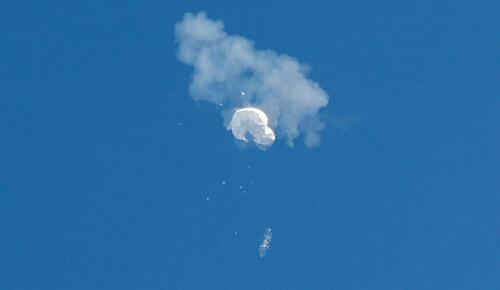
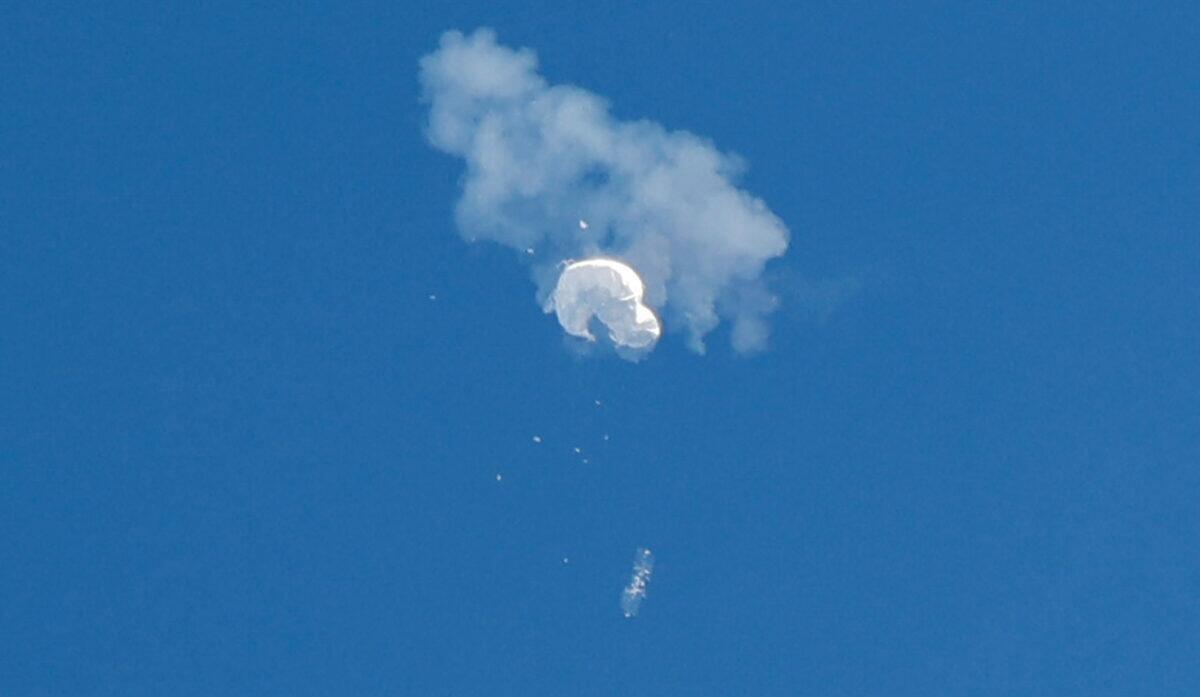
Despite having existed for decades, the regime’s military balloon program came into the spotlight recently when the United States shot down a high-altitude surveillance balloon that drifted across the country for a week and hovered above multiple sensitive U.S. military sites. That balloon, the size of three buses, was smaller than Cloud Chaser.
The U.S. and Canadian militaries have since taken down three flying objects over North American airspace, although President Joe Biden on Feb. 16 said those are likely linked to private companies.
The suspected Chinese spy balloon drifts to the ocean after being shot down off the coast in Surfside Beach, S.C., on Feb. 4, 2023. (Randall Hill/Reuters)
Wu is turning 66 this month. He has ties to at least four of the six Chinese entities Washington recently sanctioned for supporting Beijing’s sprawling military balloon program, which the U.S. administration said has reached over 40 countries on five continents.
As a specialist in aircraft design, Wu has helped develop the Chinese regime’s homegrown fighter jets and stealth technology during his more than three decades in the aerospace field, taking home at least one award for his contribution to the military.
He was the vice president at Beihang University in Beijing, a prestigious state-run aeronautics school, until he voluntarily gave up the title for teaching and research in 2004, and he once served on the scientific advisory committee for the People’s Liberation Army (PLA) General Armaments Department, a now-dissolved agency in charge of equipping the Chinese military.
Public records show that Wu is well-connected in the aerospace field, with stakes in many aviation firms. He is the chairman of Beijing-based Eagles Men Aviation Science, one of the six firms that, along with its branch in Shanxi, Washington has named as culprits in the balloon sanctions.
Both Beihang and the Harbin Institute of Technology, Wu’s alma mater and dubbed “China’s MIT,” are on a U.S. trade blacklist, the former for aiding China’s military rocket and unmanned air vehicle systems, and the latter for using U.S. technology to support Chinese missile programs.
‘Silent Killer’
The Chinese Communist Party (CCP) has long vied for dominance in near space, which Chinese scientists see as a region for a variety of applications, from high-altitude balloons to hypersonic missiles.
From high above, there’s a wealth of information that an aerostat, equipped with an electronic surveillance system, can intercept and turn into an intelligence asset.
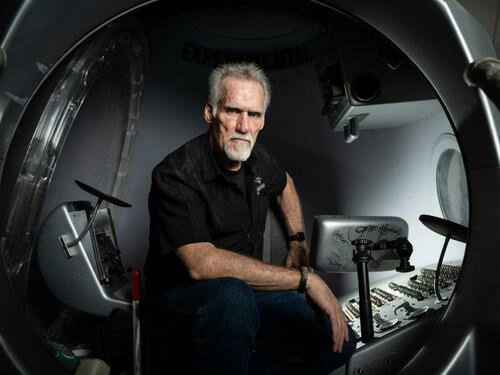
“If you’re flying a balloon that is 100,000 feet up in the air, you’ve got … visibility on the ground of hundreds and hundreds of miles over several states, because it’s up so high,” said Art Thompson, co-founder of California aerospace company Sage Cheshire Aerospace. During his three decades in the aerospace industry, Thomspon has worked on the B-2 stealth bomber and was technical director for the Red Bull Stratos project that broke the record for the highest balloon flight and the largest manned balloon.
Art Thompson, CEO of Sage Cheshire and president of A2ZFX, sits inside a model capsule he built for Red Bull Stratos in Lancaster, Calif., on Aug. 13, 2022. (Samira Bouaou/The Epoch Times)
“Whether it’s phone data, radio data, transmissions from aircraft, as to what the airplanes are, who owns it, all that data is available,” Thompson said.
As early as the 1970s, efforts were underway at the state-run Chinese Academy of Sciences to explore high-altitude balloons, according to a state media report. Lacking the aid of computers, Chinese researchers drew inspiration from German and Japanese aerospace books and cut up newspapers to piece together prototypes.
The result was a helium balloon with an aluminum basket, altogether about the size of a typical hot air balloon. The team triumphantly named it HAPI and flew it into the stratosphere in 1983 to observe signals from a neutron star.
For the Chinese military, there’s high strategic value in aerostats, a technology that was in use as early as the late 1700s by the French as lookouts. Compared to airplanes or satellites, balloons are cheaper and easier to maneuver, can carry heavier payloads and cover a wider area, and are harder to detect, two regular columnists wrote in a 2021 article for PLA Daily, the Chinese military’s official newspaper. They consume less energy, allowing them to loiter in a target area for an extended period. And critically, they are often not caught by radars, so they can easily evade an enemy’s air defense system or be classified as UFOs.
The return to office looks like it’s going backward. After office occupancyroseto over 50.4% in late January, it dropped to 45.6% by early February before recovering slightly to 48.6%. That’s despite many business leaders trying to get their employees back to the office in an effort to prevent “quiet quitting.”
The term “quiet quitting”emergedin early 2022, and refers to doing the bare minimal tasks of your job description well enough that you don’t get fired. The concept quicklywent viralon TikTok.
Yet it only started to gain traction as an issue of concern among business leaders when government data on productivity released in August 2022 showed a sharp and unexpected drop in the first and second quarters of 2022. The following month, Gallup released a survey indicating that as many as half of all Americans may be quiet quitters, further exacerbating business leaders’ concerns about this problem.
Is remote work to blame for quiet quitting?
Many traditionalist leaders rushed to attribute this drop in productivity and rise in quiet quitting to remote work. BlackRock CEO Larry Fink attributed the drop in productivity to remote work. He called for requiring employees to come to the office to address this problem.
Yet the claims of traditionalists don’t add up. If quiet quitting and the resultant drop in productivity stemmed from remote work, we should see a drop in productivity right from the start of the pandemic, when office workers switched to remote work. Then, when offices opened back up, especially after the Omicron wave at the end of 2021, we should see productivity going up as workers went back to the office from early 2022 onward.
In reality, we see the opposite trend. U.S. productivity jumped in the second quarter of 2020 as offices closed, and stayed at a heightened level through 2021. Then, when companies started mandating a return to the office in early 2022, productivity dropped sharply in Q1 and Q2 of that year. Productivity recovered slightly in Q3 and Q4 as the productivity loss associated with the return to office mandate was absorbed by companies–but it never got back to the period when remote-capable employees worked from home.
What explains the drop in productivity associated with quiet quitting?
Forcing employees to come to the office under the threat of discipline leads to disengagement, fear, and distrust, according to the director of research and strategy for workplace management at Gallup Ben Wigert,. Gallup finds that “the optimal engagement boost occurs when employees spend 60% to 80% of their time–or three to four days in a five-day workweek–working off-site.”
The Integrated Benefits Institute found in an October 2022surveythat employees who work remotely or in a hybrid environment reported being more satisfied (20.7%) and more engaged (50.8%).
No wonder, then, that mandates forcing employees to come to the office result in quiet quitting. Disengaged workers aren’t productive. That’s especially the case if they’re looking for a new job. The career website Monster reported that two-thirds of survey respondents would quit rather than return to the office full time. Unsurprisingly, many of those who are forced to return to the office start polishing their resumes and meeting with recruiters.
Solving quiet quitting in the mandated return to the office
The best approach for the future of work is a flexible team-led approach, with team leads making the call on work arrangements that serve the needs of their team. Team leads know best what their teams need, including how to maximize productivity, engagement, and collaboration.
Following thebest practicesfor returning to the office can minimize quiet quitting concerns. A conversation about compensation should always accompany a return to office initiative. For instance,researchby Owl Labs suggests that it costs an average of $863 a month for the average office worker to commute to work versus $432 a month to work from home.
What works best is to pay for fees associated with specific office-related costs, rather than a general salary increase. Pay the commuting costs of your staff. Pay for a nice catered lunch. Pay for their dry-cleaning costs.
Such payments help address the initial discontent and reduce the attrition typically associated with the mandated office return. However, this doesn’t address the quiet quitting that results from people coming to the office and doing the same thing they would do at home, except with a two-hour commute.
An October 2022 survey by Slack found that many knowledge workers who are required to go back to the office are spending up to four hours on video calls. Slack’s head in the U.K. Stuart Templeton said that employers risked turning their offices into “productivity killers,” since “making a two-hour commute to sit on video calls is a terrible use of the office.”
That’s the kind of thing that leads directly to quiet quitting. We know that people are much more productive on individual tasks that require focus at home. The survey by Slack confirmed this impression: 55% of respondents preferred to do “deep work” at home, and only 16% cited the office as a better place for deep work.
Instead, the office should be a place for socializing, collaboration, and in-depth training, especially for newer employees. To address socializing needs, it’s valuable to organize fun team-building exercises and social events as staff comes back to the office.
To facilitate collaboration, it’s important to consider how in-office staff work together with those working from home. Employees who come in on different days of the week still require hybrid collaboration and meetings. To facilitate collaboration between in-office and remote staff, it helps to provide virtual office environments, which put both kinds of workers on a level playing field. Likewise, it’s imperative to improve audiovisual collaboration to facilitate effective hybrid meetings.
There’s no replacement for face-to-face experiences for in-depth training around soft skills, such as effective in-person communication, conflict mediation and resolution, and ethical persuasion. My clients find that if they offer valuable training regularly once their employees return to the office, there’s a reduction in quiet quitting and a boost in employee engagement and productivity.
Finally, it’s valuable to help staff address burnout as part of the return to the office, for example by providing mental health benefits. In a late 2022 Gallup survey, 71% of respondents said that compared to in-office work, hybrid work improves work-life balance and 58% reported less burnout.
While a mandated return to the office will inevitably lead to some quiet quitting and loss in productivity, focusing on helping employees socialize, collaborate, and get great professional development and mentoring shows them the value of the office, which will reduce quiet quitting and boost performance.
“Knowing how this pandemic started is very, very important and very crucial,” said the WHO chief, Tedros Adhanom Ghebreyesus. Yet, reports suggest that the organization responsible for international public health has had to drop the second phase of the investigation.
Dr. Tedros was responding to queries based on an article published on the Nature website, which claimed that the WHO had “quietly shelved the second phase of its much-anticipated scientific investigation into the origins of the COVID-19 pandemic.”
While the scientific community expressed its dismay, not many were surprised. The SARS-CoV-2 pandemic broke out in China in late 2019. Official records put the death toll at 6,842,462, and the total reported cases at 756,411,740. The losses incurred by various countries related to trade and commerce are still being assessed. Some estimates suggest that the impact of the pandemic on the tourism sector has resulted in a loss of $4 trillion.
Despite the staggering numbers and irrecoverable losses, Beijing has focused on shirking blame and obstructing attempts to conduct a thorough scientific investigation into how the Covid -19 pandemic broke out. The scientific community has strongly vouched for a detailed study into the origin and spread of SARS-CoV-2 to prevent future outbreaks.
But, little can be done without access to the outbreak’s epicenter, considered Wuhan, in China. A year after the outbreak, in January 2021, a team of experts assembled by the WHO visited the city where the virus was first detected. They suggested possible scenarios. The most probable was that the virus spread from bats to people, and most likely through an intermediate species. The unsubstantiated “accidental lab leak” theory, which got much media attention, was thought to be “extremely unlikely.” These were just preliminary findings, and the team left hoping to return to conduct an in-depth phase two study.
As the pandemic spread, bringing life to a standstill in most places worldwide, China found itself on the back foot. What should have been the subject of scientific investigation and research soon deteriorated into a political blame game. President Trump’s attempts to name the pathogen “China virus” and digs like “Kung flu” only made matters worse.
Even in the best of circumstances, it is unlikely that Beijing would have been fully cooperative or transparent with international investigators and scientists. But, with ego clashes and national pride at stake, China saw every attempt as one to pin blame rather than conduct a factual, methodical study.
Beijing was unhappy with the proposal to study possible lab breaches in the second phase. Matters seem to have come to a head. Maria Van Kerkhove, an epidemiologist at the WHO in Geneva, Switzerland, told Nature, “There is no phase two.” It is safe to say that all parties could have handled the crisis better.
Without full-fledged site access, efforts to study the virus may remain incomplete. Studies were proposed to narrow the list of animals susceptible to the virus and could act as hosts. Bats in the region of the first outbreak could have revealed valuable information. Blood and water samples from the area may have held some clues. But, with each passing day, such information becomes more difficult to gather.
It is not only the international community the autocratic government is hiding from. According to official data, China’s Covid-19 death toll stands at 83,150. But, epidemiologists suggest that a “realistic tally” could be between 1 million to 1.5 million deaths.
Denied access to the pandemic outbreak epicenter, the world must do what it can to prevent future similar crises. The WHO formed the Scientific Advisory Group for the Origins of Novel Pathogens (SAGO) in November 2021. Its primary function is “to systematically study the emergence of future emerging pathogens with pandemic potential.” The experts have put in place a proposal on “how to conduct origins studies for future outbreaks.”
For now, China’s economic clout and autocratic defiance seem to have thwarted the WHO’s efforts. Unless international pressure is put on Beijing, it is unlikely that we will ever know how a pandemic that claimed millions of lives originated.
Price controls on drugs are like binge eating ice cream. It may feel good at first, but it doesn’t end well.
In his State of the Union address, President Joe Biden made the case for price controls. He talked about how the misnamed Inflation Reduction Act capped the cost of insulin. He decried the high cost of cancer drugs.
“If drug prices rise faster than inflation, drug companies are going to have to pay Medicare back the difference,” he said, adding, “We’re finally giving Medicare the power to negotiate drug prices.”
These are all different forms of price controls on drugs. The allure of this is obvious, and Mr. Biden mentioned it frequently. Everyone likes to pay less. For many, drugs aren’t a luxury good but a lifesaving necessity. Having to pay high prices for those medications can feel like a financial prison. Little wonder there’s electoral appeal in promising lower prices, especially when you can demagogue big pharmaceutical companies.
But there is a large cost to this approach. Emotions and short-sightedness don’t create miracle drugs. And basing public policy on such things will lead to fewer innovations in the future. That’s because price controls reduce drug company profits. If the possibility of profit decreases, so do the research dollars that companies invest in new products.
Applying that the Inflation Reduction Act, they project it will decrease R&D spending by “about 18.5 percent, amounting to $663 billion” by 2039. They project this will lead to “135 fewer new drugs.”
That could have tragic consequences.
“This drop in new drugs is predicted to generate a loss of 331.5 million life years in the U.S., 31 times as large as the 10.7 million life years lost from COVID-19 in the U.S. to date,” they wrote.
Little wonder Mr. Biden failed to mention this. And there’s more. Price controls are supposed to save money. But over the past two decades, profits from research-based pharmaceutical companies accounted for just 1 percent of total health spending. That’s from a paper by Mr. Philipson and Giuseppe Di Cera. Labor expenses make up the bulk of medical costs. With fewer miracle drugs in the pipeline, those labor costs will actually increase. Doctors and nurses will need to care for patients who would have been helped by the drugs that were never developed.
Democrats and Mr. Biden should be honest with the American people about these very real trade-offs, instead of pretending that they don’t exist at all.