Search This Blog

Sunday, February 19, 2023

Biden to discuss more troops in upcoming visit: Polish PM

 Polish Prime Minister Mateusz Morawiecki said on Sunday that he and U.S. President Joe Biden will discuss possibly increasing U.S. troop presence in Poland and making it more permanent during Biden's upcoming visit to Warsaw.

"We are in the process of discussion with President Biden's administration about making their (troop) presence more permanent and increasing them," Morawiecki said on CBS's "Face the Nation."

"I'm very grateful also for sending new Patriot systems and other very modern weapons and munitions because this is also to some extent a proxy for presence of soldiers, but of course the two go in tandem," he said.

Biden will visit Poland over Feb. 20-22 to mark the first anniversary of Russia's invasion of neighboring Ukraine.

The United States bolstered its troop presence in Poland ahead of the Feb. 24, 2022, invasion and currently has roughly 11,000 personnel on rotation there, according to CBS.

Biden said last June that the United States would set up a new permanent army headquarters in Poland in response to Russian threats.

Biden will meet with Polish President Andrzej Duda and Eastern European allies and speak about Ukraine, but has no plans to cross into neighboring Ukraine, according to the White House.

https://www.yahoo.com/now/biden-discuss-more-troops-upcoming-170410312.html

Pentagon Declines To Answer If It Shot Down $12 Balloon With $400,000 Missile

 by Andrew Thornebrooke via The Epoch Times (emphasis ours),

The Pentagon is stonewalling inquiries as to whether one of the unidentified objects it shot down off the coast of Alaska earlier this month was a $12 dollar hobby balloon.

Speculation that the unidentified aerial object the administration shot down earlier this month was actually a cheap hobbyist pico balloon began to build this week after a group dedicated to the hobby reported one of its balloons “missing in action” over Alaska.

A blog post from the Northern Illinois Bottlecap Balloon Brigade (NIBBB) recounted that it had lost contact with its hobby balloon on Feb. 11, and that it was last recorded at an altitude of about 39,000 feet off the coast of Alaska.

Pico balloons are small mylar balloons equipped with trackers that are used by hobbyists to measure weather patterns and can cost as little as $12.

The U.S. military shot down an unidentified object in the same general vicinity at an altitude of 40,000 feet on the same day using a $400,000 AIM-9X Sidewinder missile.

When asked whether that included a pico balloon or if the department had in any way followed up with the NIBBB, the Pentagon deflected.

We have nothing to provide on this,” a Department of Defense (DOD) spokesperson said in an email.

For its part, the NIBBB has said it is not unusual for such a balloon to go without transmission for some days at a time, and until remains from the balloon were collected, the assertion that the U.S. military shot it down was not verifiable.

“As has been widely reported, no part of the object shot down by the U.S. Air Force jet over the Yukon Territory has been recovered,” the NIBBB said in a blog post.

https://www.zerohedge.com/political/pentagon-declines-answer-if-it-shot-down-12-balloon-400000-missile

Hospital Competition and Restrictions on Physician-Owned Hospitals


Matthew Mandelberg

U.S. Department of Justice - Antitrust Division

Michael Smith

Georgetown University Law Center; Government of the United States of America - Federal Trade Commission

Jesse Ehrenfeld

Medical College of Wisconsin; American Medical Association; Vanderbilt University; Uniformed Services University of the Health Sciences

Brian Miller

Johns Hopkins University School of Medicine; Johns Hopkins Carey Business School; American Enterprise Institute

Date Written: February 5, 2023

Abstract

This paper examines hospital competition and restrictions on physician-owned hospital; it proceeds as follows. Part I provides an overview of the seemingly inexorable trends towards further consolidation among healthcare providers and the related competition concerns this consolidation raises. Part II discusses the factors which position POHs well as potential market entrants. Part III describes how the accrual of market power by incumbent hospitals and health systems accentuates the incentives and importance of physicians to identify opportunities for market entry and innovation. Part IV describes the growth of POHs and the subsequent ban on further growth and expansion. Part V then discusses the effects of the POH ban on competition in healthcare markets, potential benefits of relaxing the ban, and more narrowly tailored policy options for addressing concerns associated with physician ownership short of an outright ban. Lastly, Part VI concludes the paper with our recommendation that Congress consider removing the ban on POHs or at least relaxing it.

Note:
Funding declaration: The authors received no funding for this work.

Conflict of Interests: There is no competing interest.

https://papers.ssrn.com/sol3/papers.cfm?abstract_id=4350105

An Opening for Market-Based Health Reform

 U.S. health spending continues to escalate rapidly despite repeated promises by elected leaders to impose a solution. Those failures, focused mainly on more regulation, have created an opportunity for market advocates to make their case for an alternative strategy. They should seize it.

More discipline in health care should be among the nation’s top domestic priorities. After years of rapid cost escalation, the U.S. spends the most on medical services among advanced economies. In 2021, the OECD estimates that the U.S. devoted 17.8 percent of its GDP to health expenditures, which was nearly 40 percent more than the next highest-spending G-7 country (Germany).

Directing more scarce resources to health might be justified if it delivered better results, but multiple credible studies suggest about 25 percent of the total U.S. bill is wasted on services of little or no value to patients. Further, facilities and clinicians often charge inflated prices for their services because there is no reward for offering lower prices and no penalty for charging more than their competitors. The expensive insurance and health system bureaucracy sitting atop this superstructure also provides no clear value for consumers.

Fixing these problems is vital for a strong economy. For years, rising premiums for job-based health insurance have suppressed the wage gains of many households. The federal government’s debt burden is also growing at an alarming rate, with rising expenses for Medicare and Medicaid a main culprit. Slowing health spending escalation would go a long way toward solving both problems.

There are two competing perspectives on what to do. One camp favors ever-stricter regulation, especially on pricing. On the other side are proponents of market incentives, vigorous competition, and consumer choice. The market option is poised for renewed consideration because multiple government-centric schemes have lost credibility.

The Affordable Care Act: The ACA, enacted in 2010, was sold partly as a brake on cost escalation. It handed the government new powers to test alternative payment models (APMs) in Medicare and the broader insurance system. Those experiments, now in place for over a decade, have delivered modest returns and have been no match for the vast, and revenue-hungry, network of facilities and clinician practices wanting to proceed with business as usual. National Health Expenditures were 17.2 percent of GDP in 2010, 6 percent below what they were in 2021.

The Public Option. President Biden believes a voluntary public option, modeled on Medicare, will control costs by expanding price limits on service payments. In the states testing the concept, including Washington, take-up has been lagging, and there is no prospect of transformative savings. A major impediment is the unsurprising reluctance of hospitals and doctors to volunteer cuts in their incomes.

The U.K.’s National Health Service (NHS): The NHS has been held up as a model public insurance plan, but its current crisis is too severe for even advocates to dismiss. The U.K. government, not the private sector, has run the NHS without interference for three-quarters of a century and is fully accountable for its performance. Recent estimates indicate that restricted access to care is contributing to 300 to 500 premature deaths per week.

Public agencies struggle to control costs without harming patients because they lack the required expertise to engineer higher productivity in medical care settings. Instead, to hit financial targets, they resort to spending caps or price controls. In the U.K., the government sets the NHS’s annual budget. In the U.S., the federal government and the states cap the prices Medicare and Medicaid will pay for services. The combination of budget cutting and stagnant productivity leads to waiting lists and inferior care.

Critics of markets want to say the U.S.’s problem is a “laissez-faire” mentality, but what exists today is not a free market. Rather, it is a complex interplay between government regulations and subsidies, and private institutions.

Market reforms hold more potential than stricter regulations to deliver sustainable savings because they rely on voluntary cost cutting by those who are in the best position to re-engineer the care process to be more efficient without harming quality. What they need is financial motivation.

Policymakers can unlock market discipline by stressing two concepts.

Standardization. Insurance coverage and medical services are too complex to expect consumers to know what is or is not required for better health. For apples-to-apples pricing (and premium) comparisons, consumers need standardized offerings. In insurance, that means eliminating confusing and unimportant differences in coverage. Similarly, when shopping directly for medical care, which is possible in about one-third of all patient-provider encounters, consumers need “all-in” pricing for a full medical intervention, such as common surgeries. With standardization, pricing differences will reflect only the relative efficiency of those providing the services or insurance coverage.

Consumer Incentives. Consumers also need incentives to economize. For insurance, that means letting them keep 100 percent of the savings when they opt for more efficient coverage. Likewise, with medical care, patients should benefit fully when selecting lower-priced service providers.

Implementing a market-based reform will not be easy, as it will require changing Medicare, employer coverage, insurance regulations, and price transparency protocols. The scale of the political challenge attracts few takers.

That’s understandable, but the ground is shifting. It is more apparent than ever before that reliance on full government control to discipline medical care spending carries risk. The time is right to promote a structured market as the surest route to a sustainable balance of cost-cutting and quality health care.

James C. Capretta is a senior fellow at the American Enterprise Institute and the author of US Health Policy and Market Reforms: An Introduction, published by AEI Press in 2022.

https://www.realclearpolicy.com/articles/2023/02/15/an_opening_for_market-based_health_reform_881844.html

Why have scientists stopped taking risks?

 A casual consumer of scientific journalism could be forgiven for thinking that we are living in a golden age of research. Systematic evidence, however, suggests otherwise. Breakthroughs comparable to the discovery of DNA — only 70 years ago — have been all too rare in recent decades, despite massive increases in investment. Scientific work is now less likely to go in new directions, and funding agencies are less likely to bankroll more exploratory projects. Even in those areas where scientific progress is still robust, making discoveries still takes a lot more effort than it did in the past. The cost of developing new drugs, for example, now doubles every nine years.

Experts disagree on what has been holding science back. A common explanation is that potential discoveries are fewer and harder to find, absolving scientists, and institutions, from responsibility. In reality, similar complaints have been made in nearly every era, for example by late 19th-century physicists on the brink of discovering relativity. And such explanations can be self-fulfilling: it’s harder to get funding for ambitious exploratory work deemed infeasible by your peers.

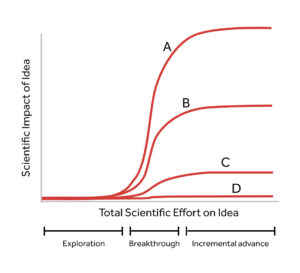
To understand the slower pace of discovery, it is crucial to understand the process by which scientific breakthroughs happen. It can be illustrated by a surprisingly simple three-phase model. First, in the exploration phase, if a new scientific idea attracts the attention of enough scientists, they learn some of its key properties. Second, in the breakthrough phase, scientists learn how to utilise those key properties fruitfully in their work. Third, in the final phase, as the idea matures, advances are incremental. It still generates useful insights, but the most important ones have been exhausted; much of the work in this phase focuses on the idea’s practical applications.

Scientists are quite willing to work on ideas during the breakthrough phase — after all, everyone wants in on a project with good prospects. They are also willing to work on mature ideas, to reap the social benefits of successful ideas. But working on novel ideas exposes a scientist’s career to considerable risk, because most of them fail. This bias against exploratory science is a critical driver of the field’s stagnation, because the greatest risks often come with the greatest rewards. For example, researchers who sought to first edit genes in mammalian cells in 2011 considered CRISPR technology a risky choice, because the technique was still in many ways undeveloped. Today, by contrast, it is one of the most celebrated advances in biomedicine.

The graph below shows the development of four hypothetical ideas — A, B, C and D — through the three stages of this model. Given sustained scientific effort in the exploration phase, ideas A and B will develop into important advances; idea A’s S-curve is steeper in the breakthrough phase, meaning it is of the most significance to the broader scientific community. By contrast, ideas C and D will never amount to much, no matter how much effort is expended on them. The problem for scientists is that, in the exploration phase, the potential impact of all four ideas could appear nearly identical.
This bias against exploratory science points to a critical driver of scientific stagnation: scientists are frequently reluctant to spend their time exploring new ideas and have increasingly turned their attention to incremental science. This is backed up by quantitative evidence. University of Chicago biologist Andrey Rzhetsky and his colleagues found: “The typical research strategy used to explore chemical relationships in biomedicine… generates conservative research choices focused on building up knowledge around important molecules. These choices [have] become more conservative over time.” Another paper by the same team (led this time by UCLA sociologist Jacob Foster) also reports: “High-risk innovation strategies are rare and reflect a growing focus on established knowledge.” Meanwhile, a recent analysis by University of Arizona sociologist Russell Funk and his colleagues tracks a “marked decline in disruptive science and technology over time”, and attributes this trend to scientists relying on a narrowing set of existing knowledge.

And yet, the underlying risk of failure in exploratory research has always been a feature of scientific investigation. So why is it dictating scientists’ behaviour more than ever? In short, because of the change in the way their success is measured. The rule for research scientists used to be “publish or perish”. First articulated in the Forties, this notion designates a scientist who publishes many papers as “productive”. But in recent decades, the importance of this metric has faded. Now, the popularity of a given article trumps all, and popularity is measured by the number of times other scientific papers cite it. Like the sports statistics sites that report the batting averages of professional baseball hitters, services such as Google Scholar and Web of Science report the extent of a scientist’s influence, valuing their work based on the number of citations it has garnered. The new mantra is: be influential or be sidelined.

This fixation has decreased the incentive to engage in exploration. When a scientist ventures into an emerging area of investigation, the work is unlikely to garner many citations, because few other scientists will be working on related topics. By contrast, as a successful idea matures, the relative certainty of making discoveries — however incremental — attracts more scientists to the area, and if many people are working in that field, their work will receive more citations.

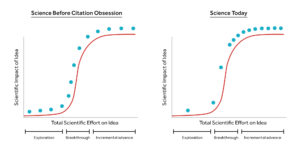
The figures below illustrate the shift in research priorities following this change in scientist incentives. Before the citation obsession, a healthy proportion of scientists was willing to engage in exploration. Today (right panel), scientists are less willing to play with new ideas, and instead pursue incremental advances. This swing in scientist effort has been costly, as fewer ideas have developed into breakthroughs.
Noubar Afeyan, a co-founder of Moderna, is one of many scientists to note that incremental advances are the norm in academia today. He urges reforms to foster a culture in which scientific leaps receive more encouragement — and are rewarded to some extent even when they fail.

One way to achieve this involves indexing the text of a research publication based on the words and word sequences that appear — a process that reveals a list of the ideas upon which an article builds. A paper that relies on more recent ideas is more likely to reflect exploratory science — and services such as Google Scholar should report novelty measures in addition to citation metrics. While those novelty measures are not perfect, they are no more flawed than citation metrics as a measure of scientific influence, and offer one more way to evaluate work. A sports page that reports only batting average would provide a very incomplete picture of the value of a home-run-hitting slugger who strikes out frequently. Scientific evaluation services should similarly avoid presenting an incomplete picture.

An alternative, and idealistic, response would be to stop measuring scientific impact at all — but in reality, this is infeasible. Scientists, like other high-status professionals, cannot escape today’s relentless performance quantification.

Moreover, when used correctly, metrics can serve a useful purpose in allocating limited research dollars. Here, too, scientific endeavour will require a shift. As well as university administrators, funding agencies should start using new novelty metrics when making hiring, tenure, and promotion decisions. Doing so will greatly increase the incentive for scientists to pursue exploratory work. Science as a discipline would become more hospitable to people who might be staying out of academia for fear that exploration is punished rather than rewarded.

Fortunately, at least in the United States, this goal enjoys cross-partisan support. The Biden administration’s first budget, for instance, included $6.5 billion for the founding of the ARPA-H funding model of biomedicine — which seeks to support “high-risk exploration that could establish entirely new paradigms”, by taking funding decisions away from influence-obsessed peer-reviewers. Still, this is merely an incremental step in the right direction; it directly affects the incentives of only a small subset of biomedical researchers engaged with the ARPA-H initiative. To truly reignite biomedical science, fundamental change is needed in the career incentives faced by a larger share of the research workforce.

The development of the mRNA Covid vaccines is an excellent example of what scientists can do when provided with the incentives to pursue novel work. It shows, too, that important discoveries are often the result of a sustained effort by a large community. Katalin Karikó, perhaps the most celebrated of the scientists who worked on the mRNA vaccines, credits hundreds of others for contributing to the effort. But these ideas only develop from infancy to breakthrough if many researchers are willing to try them out, develop them, and debate their merits. When many others are willing to take the risk of trying out new ideas, individual scientists are more likely to get involved.

The history of mRNA vaccine technology also provides evidence of the hostility offered to novel ideas within science. Key research papers related to the early development were time and again rejected by the leading scientific journals, which fear losing status if they publish too much exploratory science, because it’s less likely to go anywhere. Yet as we have seen, it is nearly impossible to understand the feasibility and significance of new ideas in their infancy, when they are still raw and poorly understood. And the rejection of innovative work by top journals renders negative judgments self-fulfilling: without the attention of other scientists, many ideas die in obscurity regardless of their potential.

It is time, then, to put science back on the path envisioned by the engineer Vannevar Bush in his 1945 report for President Roosevelt. Motivated by the loss of academic freedom during the Second World War, it emphasised the importance of open-ended exploration for scientific progress. His view that many valuable discoveries remain to be found was reflected in the title of Bush’s report, “Science: the Endless Frontier”. In the decades since, a monomaniacal focus on influence in research evaluation has fettered this exploration. If we valued it more highly, our frontiers might start to expand again.

Jay Bhattacharya is a professor at Stanford University Medical School, a physician, epidemiologist, health economist, and public health policy expert focusing on infectious diseases and vulnerable populations.

Mikko Packalen is an associate professor of economics at the University of Waterloo

https://unherd.com/2023/02/why-have-scientists-stopped-taking-risks/

Blinken says US has ‘no doubt’ China was conducting surveillance with balloon

 Secretary of State Antony Blinken has made clear that the US has no doubt China was seeking to surveil the US via the balloon that was ultimately shot down off the coast of South Carolina earlier this month.

“I can’t say dispositively what the original intent was, but that doesn’t matter because what we saw when it was over the United States was clearly an attempt to surveil very sensitive military sites,” Blinken said on ABC’s “This Week” in an interview taped Saturday.

“The balloon went over many of them. It, in some cases, loitered,” he added. “We took measures to protect that information. We took measures to get information about the balloon. And I think we’ll know more when we … actually get the remains.”

Following the downing of the suspected Chinese spy balloon, the US military downed three subsequent objects that were much smaller and are now believed to have not been tied to any country’s surveillance program, President Joe Biden said last week. Instead, they were likely used for weather or research purposes by private entities.

US officials have said that the Chinese balloon, in contrast, had a payload – or the equipment it was carrying – the size of roughly three buses and was capable of collecting signals intelligence and taking photos. The balloon traveled over sensitive sites in Montana, officials have said, but the administration has said it tracked the balloon’s path and worked to minimize its intelligence collection capabilities.

The US has said that the balloon was part of a large fleet controlled by the Chinese military that has conducted surveillance over at least 40 countries across five continents in recent years.

“There’s absolutely no doubt in our minds about what the balloon, once over the United States, was attempting to do. And no doubt in our minds about this surveillance balloon program that China has, and again, has been used over more than 40 countries around the world,” Blinken told ABC.

On the topic of Russia’s invasion of Ukraine, the top US diplomat said Sunday he has concerns over China’s support of Russia’s military, specifically that Beijing is considering supplying Moscow with “lethal support.”

CNN previously reported that the US has begun seeing “disturbing” trendlines of late in China’s support for Russia’s military, and there are signs that Beijing wants to “creep up to the line” of providing lethal military aid to Russia without getting caught, according to US officials familiar with the intelligence.

The officials would not describe in detail what intelligence the US has seen suggesting a recent shift in China’s posture but said US officials have been concerned enough that they shared the intelligence with allies and partners at the Munich Security Conference in Germany over the past several days.

“We’ve been watching this very closely,” Blinken told “Face the Nation” on CBS while in Munich.

“The concern that we have now is based on information we have that they’re considering providing lethal support, and we’ve made very clear to them that that would cause a serious problem for us and in our relationship,” Blinken said.

https://www.cnn.com/2023/02/19/politics/antony-blinken-chinese-spy-balloon/index.html

We Don’t Have A Mental Health Crisis. We Have A Lifestyle Crisis

 Americans could learn a thing or two from Harrison Ford. In a rare interview with the Hollywood Reporter last week, the media-shy actor shared how, at 80, he knows exactly “who the f-ck” he is.

When pressed on prior therapy sessions he disclosed in 2002, he offered some honest thoughts. “My opinion is not of the profession, it’s of the practitioner,” Ford said. “There are all kinds of therapy. I’m sure many of them are useful to many people. I’m not anti-therapy for anybody — except for myself. I know who the f-ck I am at this point.”

The Hollywood Reporter pressed him on his own analysis, saying: “Your fans online have done some armchair diagnosis, looking at things you’ve said about being shy in social situations and some of your talk show appearances. Some assume you’ve wrestled with social anxiety disorder. Are they onto something?” Then came Ford’s reply:

Sh-t. That sounds like something a psychiatrist would say, not a casual observer. No. I don’t have a social anxiety disorder. I have an abhorrence of boring situations.

Ford is onto something. We don’t have a mental health crisis as much as we have a lifestyle crisis. That’s not to deny that people are seriously suffering, which is as fundamental to the human experience as pleasure. But everyone seems oblivious as to why they suffer.

In his old age, Ford has completed the journey of self-discovery, one that fewer and fewer people seem able and willing to take. Instead, a wave of apathy has taken over a population that’s succumbed to the pursuit of cheap and immediate dopamine hits through weed, porn, Netflix, and Instagram, powered by a processed, ready-to-eat diet. And it’s made everyone sick. People generally aren’t happy when they’re sick.

Americans are lonelier and more depressed than ever. They’re are also being prescribed more drugs than ever, yet suicides have risen 30 percent since 2000, while life expectancy is on a steady decline. Clearly, something’s not working, especially when 1 in 10 Americans is affected by depression despite antidepressant use at an all-time high. One study from a team of researchers in Saudi Arabia published last year found antidepressants don’t even raise the quality of life over time.

Our ruling class of elites profits most when we’re chronically fat, sick, and depressed, so they keep us hooked on pills engineered by Big Pharma, eager to capitalize on every ailment from anxiety to obesity. A culture allergic to personal responsibility and honest self-reflection (or really any self-awareness) seems to ignore the possibility that anxious and depressed people might have their own mentality to blame for at least some of their problems.

A groundbreaking study published in the journal of Molecular Psychiatry last summer exposed antidepressants as having little more effect than placebos, leading some psychologists to reject the assertion that depression is caused by a chemical imbalance. The findings suggest our high rates of depression aren’t merely a consequence of biology and instead are one of circumstances and our approach to those circumstances. Victimhood never did anyone any favors.

Many blame the heightened prevalence of mental illness on the culture’s destigmatization of even talking about mental health. That might explain some of it among older generations, but not the children by this point.

New data from the Centers for Disease Control and Prevention (CDC) released on Monday confirmed the children are not all right. According to the CDC, teenage girls are suffering the worst of our “mental health crisis.” Federal data shows almost 3 in 5 teen girls, 57 percent, said they felt persistent sadness or hopelessness in 2021. Just 10 years ago, that number was 36 percent.

Teenage boys also saw a sharp increase in sadness or hopelessness, from 21 percent in 2011 to 29 percent 10 years later. Should it come as much of a surprise when kids and teens also report far too much screen time compared to their parents?

The confident Harrison Ford judges himself by his own standards. Younger people seem to have trouble with this, basing their own self-image and self-worth on their peers in a society where everyone is performatively trying to cultivate an Instagrammable lifestyle.

Most Americans probably don’t need more pills and therapy sessions at this point. They need to get away from their screens and go outside.

https://thefederalist.com/2023/02/16/we-dont-have-a-mental-health-crisis-we-have-a-lifestyle-crisis/