Search This Blog

Friday, April 21, 2023

Hunter Biden laptop letter was the real disinformation all along

 The dishonor of our intelligence community, and most of the media, is now complete. 

It turns out the “51 intel experts” letter implying Hunter Biden’s 100% authentic laptop was a Russian fake, and the ensuing efforts to kill Post reporting on it, were the actual disinfo operation

Veteran spook and former acting CIA Director Mike Morrell masterminded it, as he swore under oath, to “help Vice President Biden … because I wanted him to win the election” — at the behest of campaign flunky (now Secretary of State) Antony Blinken.

And Morell plainly also did it in hopes a victorious Biden would hand him the top CIA job.

Not only was there no intricate Russian plot, there was never any evidence suggesting one — only a Biden campaign conspiracy to bury the truth under a tissue of lies. 

Morrell even got a thank-you call from Biden campaign chief Steve Ricchetti, after Biden used his 100% fake letter as “evidence” in a debate to counter President Donald Trump’s attacks on Biden family influence-peddling

But a compliant media really made this possible. 

The “experts” handed the letter to Natasha Bertrand, then at Politico (now at CNN), an eager propagator of such disinformation.

Politico promptly packaged the letter’s “bears the hallmarks of Russian disinformation” language into a headline claiming the experts deemed it to be disinfo, triggering an avalanche of similar reporting and a media-wide refusal to touch the story (except to attack The Post for reporting it).

A picture of Joe and Hunter Biden.
Some believe President Biden has interfered with the investigation of his son Hunter.
AP

Where’s Bertrand’s mea culpa? Her editor’s?

Politico hasn’t even changed its bogus headline implying the laptop was fake. 

But there’s blame to go around. 

Social media companies (primed by false warnings from secret government censors) blocked and downgraded posts sharing The Post’s reporting.

Politico promptly packaged the letter's language into a headline claiming the experts deemed it to be disinfo, triggering an avalanche of similar reporting.
Politico promptly packaged the letter’s language into a headline claiming the experts deemed it to be disinfo, triggering an avalanche of similar reporting.

Our competitors at the New York Times and Washington Post did bogus exposés of how we were “deceived.”

All in a frenzy to help usher Biden into the White House. 

Look: When powerful security-state actors try to sell reporters on a story, the correct response is deep skepticism. 

On Hunter, the “Democracy dies in darkness” crew displayed only willful credulity — at least until they “authenticated” the documents more than a year later, after the suppression ploy had worked

A picture of President Biden.
Many believe that this frenzy is helping Biden ahead of the 2024 presidential election.
Julia Nikhinson – CNP / MEGA

All this after the media fell for a Hillary Clinton campaign op, RussiaGate.

Then again, that adventure in hysteria won the Times and WaPo a joint 2018 Pulitzer Prize.

This is repeated collusion among spooks, politicos and journos to blast out falsehoods and suppress the truth.

Rather than serving the nation, they’ve collaborated in deceiving it.

Absent a full accounting, you can only expect the betrayals to keep coming.  

https://nypost.com/2023/04/21/hunter-biden-laptop-letter-was-the-real-disinformation-all-along/

Supreme Court pauses abortion pill restrictions from taking effect during appeal

 Access to the common abortion pill mifepristone will remain unchanged, for now, after the Supreme Court sided Friday with the Biden administration and paused a lower court ruling.

The justices, in a brief order, said they will put on hold a ruling from a Texas federal judge while the Biden administration’s appeal proceeds.

The decision is a temporary victory for the Biden administration that for now, keeps the Food and Drug Administration’s authority on drug approvals. 

Justices Clarence Thomas and Samuel Alito, two of the court’s conservatives, said they would have denied the request for a pause.

“As a result of the Supreme Court’s stay, mifepristone remains available and approved for safe and effective use while we continue this fight in the courts,” President Biden said in a statement. 

“I continue to stand by FDA’s evidence-based approval of mifepristone, and my administration will continue to defend FDA’s independent, expert authority to review, approve, and regulate a wide range of prescription drugs,” Biden said. 

Biden reiterated his calls for the public to elect more pro-abortion lawmakers.

“The American people must continue to use their vote as their voice, and elect a Congress who will pass a law restoring the protections of Roe v Wade,” Biden said.

Alito, in dissent, wrote that his position did not reflect any view on the merits of FDA’s mifepristone actions. He noted past criticisms levied against the court’s use of the so-called shadow docket, referring to when the high court issues emergency rulings without oral argument or a significant record.

“I did not agree with these criticisms at the time, but if they were warranted in the cases in which they were made, they are emphatically true here,” Alito wrote. 

On April 7, U.S. District Judge Matthew Kacsmaryk suspended the Food and Drug Administration’s 23-year-old approval of mifepristone. Kacsmaryk ruled the agency’s approval process was improperly rushed and resulted in an unsafe drug regimen getting on the market.

The 5th U.S. Circuit Court of Appeals last week paused part of Kacsmaryk’s ruling until it considers the government’s appeal, temporarily preserving the FDA’s original approval of mifepristone. But it left in place another part of the ruling that blocked steps the FDA has taken since 2016 to ease access to mifepristone. 

“As is common practice, the Supreme Court has decided to maintain the status quo that existed prior to our lawsuit while our challenge to the FDA’s illegal approval of chemical abortion drugs and its removal of critical safeguards for those drugs moves forward,” said Erik Baptist, senior counsel at Alliance Defending Freedom, the legal group representing the mifepristone challengers.

“Our case seeking to put women’s health above politics continues on an expedited basis in the lower courts,” he said in a statement.

The high court’s emergency order pauses those remaining portions, which would have otherwise gone into effect Friday night. 

Those preserved changes include allowing mifepristone to be sent through the mail, lifting a requirement for three in-person visits, approving a generic, and approving the drug’s use up to 10 weeks into a pregnancy, rather than seven weeks.

Danco Laboratories, which makes the brand name version called Mifeprex, joined the Biden administration in asking for the stay. 

Danco had told the justices in court filings that, in order to market mifepristone, it would have needed to completely change the drug’s packaging and label and then ask FDA to approve it, typically a monthslong process.

“That would not take place, however, unless the FDA elected to use its enforcement discretion to stop Danco, and the applicants’ papers do not provide any reason to believe the FDA would make that choice,” Alito wrote.

However, federal officials have indicated since the initial decision earlier this month that they were not interested in using enforcement discretion as a way to circumvent a court ruling.

The 5th Circuit has scheduled an oral argument in the government’s appeal for May 17. Access to mifepristone will remain unchanged at least until the three-judge panel issues its ruling, but a party could then again appeal to the Supreme Court.

If they do, the pause will automatically extend until the high court issues its judgment in the case or declines to hear the dispute.

https://thehill.com/regulation/court-battles/3960437-supreme-court-abortion-mifepristone-fda/

HCA looks to acquisition of land as major key to matching growth

 Nashville, Tenn.-based HCA Healthcare, which reported net income of $1.36 billion for the first quarter of 2023, is looking at land acquisition as a key part of its growth plan, Sam Hazen, CEO of the 180-hospital system, told analysts April 21.

"We own land in Austin, Dallas and are purchasing land in Las Vegas and Salt Lake City, and some Florida markets," Mr. Hazen said. "Our communities are growing; we are in great markets with great growth prospects."

The need for such land and subsequent hospital facilities is vital to try and match capacity constraints as well as increased patient demand, Mr. Hazen said. There is an approximate average of 74 percent of occupancy across the entire HCA network, he said.

The hospital operator, which is also building two new hospitals in San Antonio, said its contract labor numbers were down 21 percent on the year and much of the savings there will be channeled back into the network's permanent workforce.

HCA Healthcare is looking at $4.6 billion of capital expenditure in 2023 to meet such growing demand, CFO Bill Rutherford said.

https://www.beckershospitalreview.com/capital/hca-looks-to-acquisition-of-land-as-major-key-to-matching-growth.html

Healthcare cybersecurity market to surpass $52B by 2030

 As cybersecurity becomes more integrated with a healthcare organization's bottom line, a report from research firm Cognitive Market Research projects that the healthcare cybersecurity industry will hit $52.54 billion by 2030.

Five takeaways from the report:

  1. The 2022 healthcare cybersecurity market is valued at $18.26 billion.

  2. The report projects that the market will grow at a compound annual growth rate of 14.2 percent between 2023 and 2030.

  3. The market is expected to grow as healthcare becomes more digitized.

  4. As healthcare organizations transition to the cloud, there will be cybersecurity opportunities for new organizations to protect cloud-based data.

  5. North America has the largest market share of the healthcare cybersecurity market.

XBB.1.16's growth and symptoms: 4 updates

 The latest CDC estimates indicate omicron subvariant XBB.1.16 accounts for nearly 10 percent of COVID-19 cases in the U.S.

That's up from about 7 percent of cases when the agency first started tracking the subvariant April 14. Prior to that, the CDC hadn't been tracking the strain individually, since it was estimated to account for less than 1 percent of cases. The omicron relative is most prevalent in HHS region 6, where it makes up 14.4 percent of cases. That region includes Texas, Oklahoma, New Mexico, Louisiana and Arkansas.

Three more things to know as XBB.1.16 gains traction: 

  1. The variant is driving a surge in India, which saw an eight-month high in the number of new daily cases reported April 20, according to India Today. In an April 21 tweet, Eric Topol, MD, founder and director of Scripps Research Translational Institute in San Diego, said the strain is "unlikely to have such an impact" here in the U.S. 


  1. XBB.1.16 appears to cause a new symptom among children: conjunctivitis that presents without pus, but as "sticky eyes." Among a preprint study of 25 children in India who tested positive between April 4-16, nearly 43 percent had conjunctival involvement, according to Vipin Vashishtha, MD, a pediatrician in India and head of the Indian Academy of Pediatrics Committee on Immunization, who authored the study. The study also found the duration of illness appears to be between one and three days and that the strain is causing a "mild febrile illness," Dr. Vashishtha wrote in a Twitter thread about the findings. Of the children involved in the study, none required hospitalization. 


  1. As the prevalence of XBB.1.16 grows, experts have said they don't anticipate the accuracy of at-home tests to be affected, since it has a very similar profile to XBB.1.5, with a mutation in the spike protein. Most at-home tests are designed to recognize the virus's nucleocapsid protein, not the spike protein. 

House subcommittee to explore concerns on hazardous pathogen research

 In light of COVID-19's origins likely stemming from safety issues at an infectious disease research lab, the U.S. House of Representatives announced a new hearing will take place April 27 as part of further investigations into it.

The hearing — known as "Biosafety and Risky Research: Examining if Science is Outpacing Policy and Safety" — was called to also ensure that pathogen research in the U.S. is conducted as safely as possible. 

The April 27 hearing will focus on follow-up information from a February meeting where witnesses detailed "obstacles to determining the root cause of infectious disease outbreaks and biological incidents," according to the news release. 

"Our Committee's ongoing work has ignited heightened concerns about how we conduct and fund risky research and whether current biosafety measures are still sufficient to mitigate risks," Reps. Morgan Griffith and Cathy McMorris Rodgers, who chair committees that oversee the initiative, said in a joint statement. "This hearing will provide members and the public an opportunity to better understand specific risks involved with gain-of-function research on potential pandemic pathogens, current biosafety practices at high-containment laboratories, and will help better inform upcoming policymaking decisions."

Becker's will continue to follow this coverage and report on new information from the April 27 hearing once it is available.

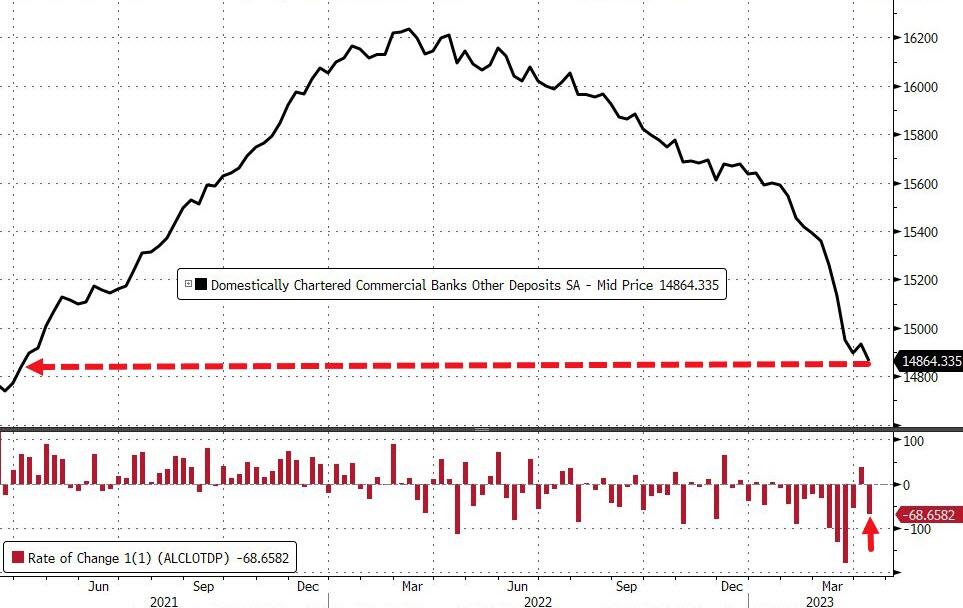
US Bank Deposits Resume Outflows, Led By Large Institutions; Small Bank Loan Growth Slumped

 It's late on a Friday afternoon, but there's still more things to worry about as The Fed's H.8 (commercial bank deposit data) just dropped.

After yesterday's report showed the Fed balance sheet shrinking but bank bailout facility usage higherUS commercial bank deposits (ex-large time deposits) unexpectedly resumed their freefall (during the week-ending 4/12), tumbling $68.66 billion to the lowest since April 2021...