Search This Blog

Monday, May 1, 2023

Travere Therapeutics drug, approved for one rare deadly kidney disease, fails in study of another

 Travere Therapeutics, a biotech focused on treating rare diseases, on Monday announced that a Phase 3 trial of an experimental treatment for focal segmental glomerulosclerosis, a rare and deadly kidney disease, failed to improve kidney function.

In the 371-person study, half of patients were randomly assigned to receive the drug, known as sparsentan, while the other half received irbesartan, a blood pressure treatment used as a control. Both groups were monitored for two years, and while the study’s main measurement — average kidney function — was higher among patients on sparsentan compared to the placebo group, the finding was not statistically significant.

Other secondary measures, such as urine protein levels, were lower among those on the drug, pointing in the right direction, and the company told investors and analysts in a conference call on Monday that the therapy was generally safe.

The company’s leaders told investors and analysts on the call that it plans to meet with U.S. and European regulators to determine if there’s a path forward for the treatment, and that meetings could happen this summer. Until then, they said that it’s too soon to know if the company will run another trial.

The findings are nonetheless a clear setback for Travere, which had hoped to use positive data from the trial to apply for approval to use the drug to treat focal segmental glomerulosclerosis in the U.S. and Europe. And the announcement comes just a few months after the Food and Drug Administration approved sparsentan for IgA nephropathy, a rare and deadly autoimmune disease that attacks the kidneys.

“We are disappointed that we did not achieve the primary efficacy endpoint in this study, but we did see results that trended favorably for sparsentan that we are further exploring to determine a potential path forward in FSGS,” said CEO Eric Dube in a press release. “We are grateful for the patients, their caregivers, the investigators, clinical staff, the patient advocacy groups and our entire team at Travere who came together to support the DUPLEX Study.”

Focal segmental glomerulosclerosis, also known as FSGS, results from a gradual buildup of scar tissue in the parts of the kidneys that filter blood. Over time, the disease can lead to swelling from a buildup of fluid throughout the body, high blood pressure, and kidney failure within 10 to 15 years.

Roughly 40,000 people live with FSGS in the U.S., and on the company’s conference call chief medical officer Jula Inrig noted that 40% of patients will have a disease relapse even after receiving a kidney transplant. Current treatments are meant to control blood pressure and the buildup of protein in the urine, but there’s no approved therapy for FSGS.

Travere had been hoping sparsentan would be the first. The drug is a small molecule that blocks receptors for the peptides angiotensin II and endothelin 1. The biotech originally licensed the rights to it from Ligand Pharmaceuticals in 2012.

At that time, Travere was called Retrophin and run by founder Martin Shkreli, the former hedge fund manager and “pharma bro” who came under fire for raising the price tags of drugs his companies acquired by as much as 2000% to 5000%. He was later imprisoned for defrauding investors and fired by Retrophin’s board in 2014, triggering a legal feud that wasn’t settled until 2019. In 2020, Retrophin rebranded as Travere.

The company’s leaders stressed that they don’t believe results from the FSGS study are bad news for sparsentan’s prospects as a treatment for IgA nephropathy, or IgAN. The drug was granted accelerated approval for IgA nephropathy in February by the FDA based on interim results from a different Phase 3 trial, PROTECT, which found a statistically significant reduction in urine protein levels among those on the therapy.

By the end of this year, the company will have two years’ worth of data from PROTECT, which will shed light on whether the reductions in protein levels that IgA nephropathy patients experienced translate into improved kidney function, the most important outcome in these studies.

https://www.statnews.com/2023/05/01/travere-sparsentan-fails-study-fsgs/

Irritating symptom may be returning with latest COVID strain

 A new coronavirus subvariant is starting to spread in the U.S. and, according to health experts, it could be causing an annoying symptom to return.

According to the Centers for Disease Control and Prevention, roughly 10% of all COVID cases reported last week were determined to be from the omicron-related XBB.1.16 subvariant, being referred to by some as Arcturus.

After first being reported in January, the World Health Organization declared XBB.1.16 a variant of interest in mid-April, The Hill reports.

The Los Angeles County Department of Public Health is warning residents that this omicron sub-strain of COVID-19 may come with an irritating symptom: conjunctivitis

Commonly known as pink eye, health officials also reported that pink eye could be linked to COVID early in the pandemic. Then again last year, experts warned there could be a connection between the then-new omicron variant and itchy, irritated eyes.

Now, some health officials are reporting an increase in conjunctivitis cases nationwide.

That includes Los Angeles County, where the health department has warned that pink eye may be the newest possible symptom of COVID.

“Observational data suggests that people infected with XBB.1.16 may be more likely to experience conjunctivitis as a symptom of their COVID infection, along with more traditional COVID symptoms, such as fever, cough and shortness of breath,” the LA County Health Department said in a statement. “Historically, conjunctivitis was reported in 1 to 3% of COVID-19 cases.” 

Conjunctivitis occurs when the lining that covers your eyelid and eyeball, the conjunctiva, becomes inflamed, optometrist Dr. Melanie Dombrowski tells Nexstar’s WGHP. Symptoms include eyes becoming pink or red, increased tear production, discharge from the eyes, and itching, irritation, or burning, according to the CDC.

Pink eye is common with respiratory infections like the cold and flu.

However, with the limited data available, the department said it is “too early to know with certainty” if XBB.1.16 is truly associated with higher rates of conjunctivitis. 

“Residents should be aware that itchy, watery or red eyes may be a sign of a COVID-19 infection and these symptoms should not be simply dismissed as a result of pollen or seasonal allergies, especially if someone more vulnerable to severe illness could be exposed,” the Health Department said. “The fact that we are seeing new strains, with possibly new and different symptoms, tells us that COVID continues to evolve and the way we think about our protections should reflect what we know.” 

You should talk to your doctor if you have pink eye as well as pain in the eyes, sensitivity to light, blurred vision, intense redness, symptoms that aren’t improving or get worse, or a weakened immune system, according to the CDC.

Older adults and individuals with underlying health conditions are encouraged to take extra precautions to avoid infection, which includes staying up to date on vaccinations, frequent hand washing, and staying home when feeling sick.

Though officials say Arcturus may be more effective at escaping immune response than other subvariants, it doesn’t appear any more severe.

https://thehill.com/homenews/3980761-health-officials-warn-irritating-symptom-may-be-returning-with-latest-covid-strain/

White House considers two key nominations at the Fed

 Biden is likely to nominate current Federal Reserve Governor Philip Jefferson to be the central bank's vice chair and World Bank economist Adriana Kugler as a governor, the New York Times reported on Monday.

Jefferson, a former economics professor who has been on the seven-seat Fed Board for just under a year, would be the U.S. central bank's second-ever Black vice chair. He would fill the spot vacated by Lael Brainard, who in February left to become one of Biden's chief economic advisors.

Kugler, a Colombian-American, would be the central bank's first-ever Latina governor and would fill the position left vacant by Jefferson.

The twin appointments could represent a political sweet spot for Biden who would need to get both appointments through a deeply divided Senate.

Jefferson last year sailed through his Senate confirmation, drawing unanimous approval from a group that confirmed Brainard by a 52-43 vote and Jefferson's colleague Lisa Cook only with the tie-breaking vote of Vice President Kamala Harris.

The choice of Kugler could satisfy Senator Bob Menendez, who broke ranks with fellow Democrats in 2022 to vote against Biden's renomination of Jerome Powell as Fed chair because of what he said was the central bank's diversity problem.

He has been pushing the White House to name a Latino or Latina to the board, and for at least one of the Fed regional banks to name a Latino as Fed bank president for the first time.

The report of Biden's impending nominations came on the eve of a Fed meeting this week where policymakers are expected to continue their fight against high inflation by increasing the benchmark short-term borrowing rate to 5.00% to 5.25%.

Jefferson has joined his fellow policymakers in every rate-hike decision since he took his post last May.

White House press secretary Karine Jean-Pierre told reporters at the White House on Monday that Biden's pick for a Brainard's replacement would come in the "very near future."

https://finance.yahoo.com/news/1-white-house-considers-two-214626017.html

Possible link in neutrophil migration into sensory ganglia and fibromyalgia pain

 A team of biomedical researchers from Queen Mary University of London, Hebrew University and University College London has found evidence of an association between fibromyalgia-type symptoms and migration of neutrophils into sensory ganglia. In their study, reported in Proceedings of the National Academy of Sciences, the group explored possible causes of fibromyalgia in mouse experiments.

Fibromyalgia leads to fatigue, depression, sleep problems and widespread pain throughout the body. In the past, patients with  usually did not have other measurable symptoms, so doctors for many years doubted its existence. In recent years, some physical signs have been found, including elevated levels of neutrophils in the bloodstream and associated cytokines that are produced by the neutrophils.

Some research has also shown that the means by which the neutrophils cause pain by is invading bundles of ganglia in the central nervous system.

Neutrophils are the most abundant type of white blood cell produced by the human body. They play an essential role in fighting off infections as part of the innate immune system. Medical researchers still do not know why elevated levels occur in people with fibromyalgia, but suggest it hints at a possible problem with the  overreacting to some as yet unknown element.

Recent research has also found evidence that fibromyalgia may be the result of the central nervous system amplifying nerve signals as they pass through the brain and —also for some unknown reason. In this new effort, the researchers tested the idea that the overabundance of neutrophils leads directly to pain in patients.

Testing involved collecting neutrophils from fibromyalgia patients with abnormally high levels of the cells and injecting them into test mice. After a brief period, they tested the mice to see if they became more sensitive to pain than usual and found that they did. Dissection showed that the neutrophils had made their way to the  and had invaded sensory ganglia—likely the source of the increase in pain sensitivity observed in the mice.

The researchers say their findings establish a link between  and the pain associated with fibromyalgia, which suggests therapies to reduce such levels may provide relief for such people.

More information: Sara Caxaria et al, Neutrophils infiltrate sensory ganglia and mediate chronic widespread pain in fibromyalgia, Proceedings of the National Academy of Sciences (2023). DOI: 10.1073/pnas.2211631120


https://medicalxpress.com/news/2023-05-association-neutrophil-migration-sensory-ganglia.html

Breathing exercises may reduce Alzheimer's risk

 The exercise was simple: inhale for a count of five, then exhale for a count of five. Do that for 20 minutes, twice a day, for four weeks.

These brief breathing sessions had significant impacts: Volunteers'  variability increased during each exercise period and the levels of amyloid-beta peptides circulating in their blood decreased over the four weeks of the experiment.

That's the finding of a new study from USC Leonard Davis School of Gerontology Professor Mara Mather. Published last month in the journal Scientific Reports, the study may be the first to discover a way that adults, both young and old, can reduce their amyloid beta levels: via breathing exercises that lower the levels in our blood of these peptides associated with Alzheimer's disease.

That's because the way we breathe affects our heart rate, which in turn affects our  and the way our brain produces proteins and clears them away. While we are awake and active, we typically use our . This is sometimes known as the "fight or flight" system but we also use it to exercise, to focus attention, and even to help create long-lasting memories. While the sympathetic nervous system is activated, there isn't much variation in the time between each heartbeat. In contrast, when the parasympathetic system is activated, heart rates increase during inhaling and decrease during exhaling.

When we're young—or older, but very fit—our body slides easily between the sympathetic nervous system and its partner, the parasympathetic nervous system. Sometimes known as the "rest and digest" part of our system, the parasympathetic nervous system allows us to calm down, digest food easily, and sleep soundly. When these kinds of activities occur, the variation between heartbeats is greater.

But as we age, scientists are learning, our ability to access our parasympathetic nervous system—and thus, our heart rate variation—decreases dramatically.

2020 study using smart watches found that  drops on average 80 percent between twenty and sixty years old. This finding could partially explain why we struggle to sleep deeply as we age.

"We know the sympathetic and parasympathetic systems influence the production and clearance of Alzheimer's related peptides and proteins," said Mather, who directs the Emotion & Cognition Lab at the Leonard Davis School of Gerontology. "Nevertheless, there's been very little research on how these physiological changes in aging might be contributing to the factors that make it conducive for someone to develop Alzheimer's disease or not."

Mather and fellow researchers from USC, UC Irvine and UCLA asked participants to do biofeedback exercises twice a day, for 20 minutes at a time. All the participants clipped a  onto their ear; that monitor was connected to a laptop the researchers provided.

Half the group was instructed to think of calm things, like a beach scene or a walk in a park, or to listen to calm music. Meanwhile, they were instructed to keep an eye on their heart rate as displayed on the laptop screen, making sure the heart rate line stayed as steady as possible while they meditated.

The other group was told to pace their breathing in rhythm with a pacer on the laptop screen—when the square rose, they inhaled, and when the square dropped, they exhaled. They also monitored their heart rates, which tended to rise in peaks as they inhaled and dip down to baseline as they exhaled. Their goal was to increase the breathing-induced oscillations in their heart rate.

Study provides evidence that breathing exercises may reduce Alzheimer’s risk
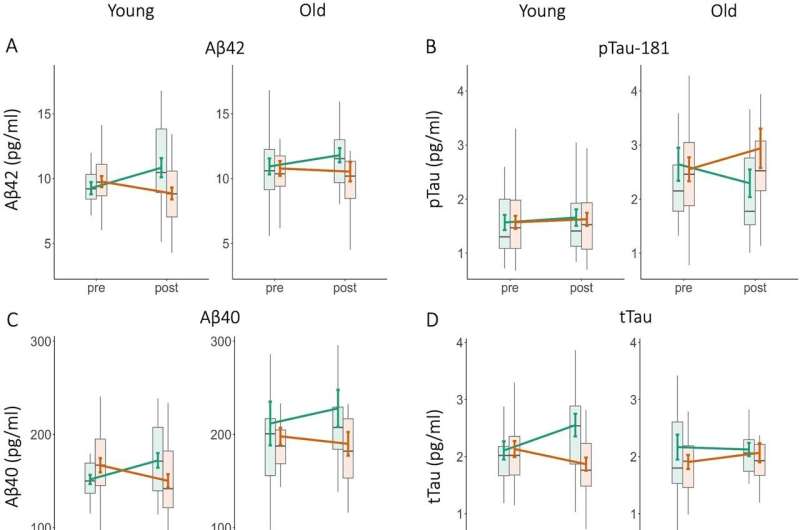
Intervention effect on Aβ and tau levels. Orange represents Osc+ and green represents Osc−. The upper and lower box boundaries indicate the 75th and 25th percentiles respectively. The gray horizontal bar inside each box shows a median value for the box, and the colored vertical line describes the mean and standard error. The outliers are included for the summary statistics but are not shown in the figure. Credit: Scientific Reports (2023). DOI: 10.1038/s41598-023-30167-0

The researchers took blood samples before the participants began the experiment and again, after four weeks of biofeedback training. Then the researchers examined the plasma of participants from both groups, looking for amyloid beta peptides.

In particular, the researchers looked at two peptides, amyloid beta 40 and 42.

Accumulation of amyloid beta in the brain due to increased production and/or decreased clearance is believed to trigger the Alzheimer's disease process. In  who do not yet have signs of amyloid accumulation in the brain, a meta-analysis shows that higher levels of amyloid beta 40 and 42 in circulating blood predicts a greater risk of developing Alzheimer's.

In Mather and colleagues' study, plasma levels of both peptides decreased in the group who breathed slowly and tried to increase their  rate variability (HRV) by increasing oscillations.

Now researchers want to figure out why the peptides decrease when HRV increases, said Jungwon Min, a graduate student in psychology and the lead author on the study. Is it because fewer peptides are being produced? Or because the body clears them out better? Or some combination of both?

Though the current study does give some hints.

"Based on the data we have, it appears the decrease in amyloid beta is due more to decreased production," she said. "But that doesn't exclude the possibility of increased clearance."

Of the study's 108 participants, half were young (ages 18 to 30) and half were old (ages 55 to 80). The younger and the  showed similar effects of the interventions on plasma amyloid beta levels.

The study appears to be the first to find that behavioral interventions can reduce the level of amyloid beta peptides in plasma. Previous research has demonstrated that sleep deprivation and stress can increase amyloid beta levels, but it has proved more challenging to decrease  beta with behavioral interventions.

"At least to date, exercise interventions have not decreased Aβ [] levels," said Mather. "Regularly practicing slow-paced breathing via HRV biofeedback may be a low-cost and low-risk way to reduce plasma Aβ levels and to keep them low throughout adulthood."

Other study co-authors were Kaoru Nashiro, Hyun Joo Yoo, Shai Porat, Christine Cho and Junxiang Wan, of USC; Jeremy Rouanet, Allesandra Cadete Martini, Elizabeth Head, Daniel A. Nation and Julian F. Thayer, of UC Irvine; and Steve W. Cole of UCLA.

More information: Jungwon Min et al, Modulating heart rate oscillation affects plasma amyloid beta and tau levels in younger and older adults, Scientific Reports (2023). DOI: 10.1038/s41598-023-30167-0


https://medicalxpress.com/news/2023-05-evidence-alzheimer.html

CVS ends multi-dose packaging offering SimpleDose

 CVS Pharmacy quietly shuttered its SimpleDose multi-dose packaging offering at the end of March. The offering, which competed with services like Amazon's PillPack, was ended quietly and abruptly, with no announcement or press release; the SimpleDose website was updated to inform patients that they would not be able to have prescriptions filled beyond their current order. Multiple patients and caregivers on Reddit reported that they weren't notified of the cessation.

The company declined to be interviewed, but offered a statement.

"We continuously evaluate our health services strategy to ensure we’re offering our patients what they need, when they need it," they said. "This includes finding the best ways to support our pharmacy patients. As a result, we’ve made the difficult decision to discontinue our SimpleDose program and focus on other pharmacy offerings. Our pharmacy teams will help SimpleDose patients transfer their prescriptions to a convenient CVS Pharmacy location, or another pharmacy of their choice, to help ensure their pharmacy needs are met without delay."

SimpleDose allowed patients with complex medication regimens to have them not only filled by mail, but delivered in 30-day-supply boxes filled with individual doses and instructions about when to take them, at no additional cost to customers.

CVS launched a similar multi-dose offering some time in 2016, but started using the SimpleDose branding in mid-2020, filing for the trademark in 2019. For comparison, PillPack launched as a startup in 2014 and was acquired by Amazon in 2018, leading to some public bristling between Amazon and retail pharmacies.

According to the website, it's not only the mail-order service that's being shut down, but multi-dose packaging in general at CVS retail pharmacies.

"SimpleDose is a unique service that can only be done in facilities with special equipment," the company wrote in a FAQ. "Unfortunately, CVS Pharmacy locations are not able to offer multi-dose packaging."

https://pharmaphorum.com/news/cvs-ends-multi-dose-packaging-offering-simpledose

NYC woman who plowed into BLM protestors dodges jail time with plea deal

 A Queens woman who plowed her car into Black Lives Matter protestors in Midtown was berated by demonstrators outside Manhattan court Monday after she cut a sweetheart plea deal with prosecutors, dodging jail time.

Kathleen Casillo, 53, faced seven years in prison if convicted in the December 2020 incident that left six people injured — but was instead sentenced to five hours of community service as part of the agreement with the Manhattan District Attorney’s Office.

Under the deal, Casillo pleaded guilty to reckless endangerment, a misdemeanor, but that will get knocked down to a mere disorderly conduct violation if she fulfills her sentence and stays out of trouble for six months, prosecutors and her lawyer said.

“You f—ed people’s lives up, you’re a criminal,” one demonstrator screamed at Casillo following the plea hearing in Manhattan Supreme Court. “You’re a criminal and you have not taken responsibility.”

The woman slammed Casillo’s claims that she had hit the gas in panic because the protestors were being “aggressive.”

“They didn’t do anything,” the demonstrator said. “My husband’s back was turned when you hit him and sent him flying into the air. His back was turned. How was that aggressive?”

But Casillo’s defense lawyer said justice had been served.

Kathleen Casillo
Kathleen Casillo, left, in Manhattan Supreme Court with her attorney, Oliver Storch, on Monday. Casillo, who drove into a BLM protest in Midtown in 2020, agreed to a plea deal that requires five hours of community service but no jail time.
Curtis Means for DailyMail.com

“We’re very gratified after an exhaustive and thorough review the Manhattan DA’s office has decided that Kathleen Casillo should not receive a criminal conviction, which we have maintained from the beginning of the case,” attorney Oliver Storch said.

“Ms. Castillo is a retired grandmother who looks forward to putting this horrible ordeal behind her and spending time with her family,” Storch said. “Her thoughts and prayers go out to anybody injured.”

A contrite Casillo also apologized as she left court.

“I”m sorry for everyone, I really am,” she said.

Casillo was in her black BMW sedan with her 29-year-old daughter on Dec. 11, 2020 when she drove into a BLM protest on 39th Street and Third Avenue.

Kathleen Casillo
Casillo in Manhattan court on Monday, where she pleaded guilty to reckless endangerment. She faces no jail time for driving her car into a BLM protest in Midtown in 2020, injuring six people under the plea agreement.
Curtis Means for DailyMail.com

She told cops she feared for her safety — and her daughter’s — when she panicked and stepped on the gas.

Video footage of the incident showed several protestors being hurled into the air, with six people suffering injuries that were non-life-threatening.

Casillo was charged with reckless assault and reckless endangerment and released without bail.

She twice turned down deals that would have had her perform six days of community service and suspended her driver’s license for one year, in exchange for a guilty plea.

Prosecutors with DA Alvin Bragg’s office said Monday they agreed to the new terms because Casillo had no criminal record, did not flee the scene, did not intend to hurt the protestors and took responsibility for the incident.

Kathleen Casillo in Manhattan court.
Casillo, 53, was berated by demonstrators after agreeing to a sweetheart plea deal with Manhattan prosecutors that will have her dodge any jail time for plowing her car into a BLM protest in Midtown in 2020.
Gabriella Bass

“We believe, given all this, it is just to permit the defendant to try to earn a non-criminal disposition,” Assistant District Attorney Andrew Mercer said in court.

“If she fails in fulfilling any of the conditions of this plea — that is, if she does not complete the community service or gets rearrested in the next year — she will not be permitted to withdraw her plea,” Mercer said. “The misdemeanor conviction will stand and she will face possible jail time.”

Under state law, misdemeanor convictions can warrant jail terms of up to one year.

Casillo is due back in court on June 9.

https://nypost.com/2023/05/01/nyc-woman-who-plowed-into-mlb-protestors-berated-outside-court-after-sweetheart-plea-deal/