The Fed’s aggressive interest rate hikes, the surge in retail trader activity, and pandemic-driven valuations have led many previously high-flying public firms to face a sudden reversal of fortunes. Transitioning from pandemic-era policies to a more typical economic environment, firms again need strong business fundamentals to survive in a competitive landscape. A reality check has arrived for the “meme stocks” like GameStop and AMC Theatres, the SPACs (Special Purpose Acquisition Companies) like WeWork and Virgin Orbit Holdings, and even firms with tangible post-pandemic prospects, like Zoom and Netflix.
Among the casualties are a growing number of plant-based meat substitute companies that initially garnered substantial investor interest but have since grappled with low and diminishing consumer demand. In June of this year, UK-based Meatless Farm shut its doors not long after Heck, a maker of meatless sausages, announced that it would substantially reduce its consumer offerings. Nestlé-owned Garden Gourmet also pulled its vegan offerings from UK shops in March 2023. Canada’s Very Good Food Company, a vegan food producer which soared 800 percent on the day of its public offering in 2020, recently collapsed after revealing it had never been profitable.
By far the biggest turnabout has occurred in the most prominent plant-meat substitute enterprise, Beyond Meats. The corporate flagship of the sector conducted its IPO in May 2019 priced at $25 per share, opening at $46 and rising to as high as $72 on its first day of trading. By July 2019 the stock price briefly surpassed $230 per share, spiking above $150 per share several times during the pandemic. But since mid-2021, the stock price fell from over $100 to recently close below $6. For six consecutive quarters, the company has reported negative sales growth amid not only a loss of market share but a contraction in the size of the fake meat market. Nearly one-fifth of the firm’s non-production workforce was laid off early in November 2023. Financial analysts have characterized the firm as in survival mode, with its financial deterioration bringing about a “going concern” risk.
So why are so many plant-based “alternative” meat companies faltering at the same time? Part of the answer, we propose, may derive from a pattern of noisy market signals that we dub Conspicuous Production.
Conspicuous Production refers to the creation of goods that are not necessarily sought by a large consumer base, but that are thought to convey certain social signals when they are marketed to the public. It’s a supplier’s counterpart to the more famous concept of Conspicuous Consumption, wherein consumers purchase products to show off the status, wealth, tastes, or social desirability that ownership of a good is perceived to convey. In the case of conspicuously produced goods, the supplier offers a product that caters to certain social trends and causes, whether or not people are willing to purchase it.
It is not difficult to see how artificial “meat” companies fall into a pattern of Conspicuous Production. These plant-based alternatives are presented as more environmentally friendly alternatives to meat. They ostensibly facilitate the reduction of meat-based diets, which is an increasingly vocal political demand of climate activists. Many of these products are also marketed as vegan under an ideological presumption that eating plants is more ethical than eating animals. A retailer might accordingly choose to carry large selections of plant-based “meat” products out of the belief that it will gain them reputational accolades from their shoppers by signaling social responsibility, sustainability, and similar sentiments. Similarly, a restaurant may add a meat-colored congealed vegetable patty to their burger lineup, hoping to garner goodwill from diners who perceive this offering as environmentally ethical.
But what happens if very few people buy these same conspicuously produced food items?
We suspect that many vegan food companies have mistakenly interpreted the social signaling of “alternative meat” store displays and menu items as indicative of a much larger consumer base than they actually possess. It’s only when they unexpectedly encounter financial difficulties due to sluggish sales that the true state of affairs becomes evident. Furthermore, the prolonged shelf life of plant-based alternatives to meat, attributed to the numerous chemicals and binding agents used in their production, could be convenient for those seeking to showcase their company’s social consciousness by stocking their freezers. As we’ve witnessed during events such as hurricanes, COVID-induced grocery store rushes, and similar natural or political crises, what Pete Earle has termed “Magness Effects” are undeniably real.
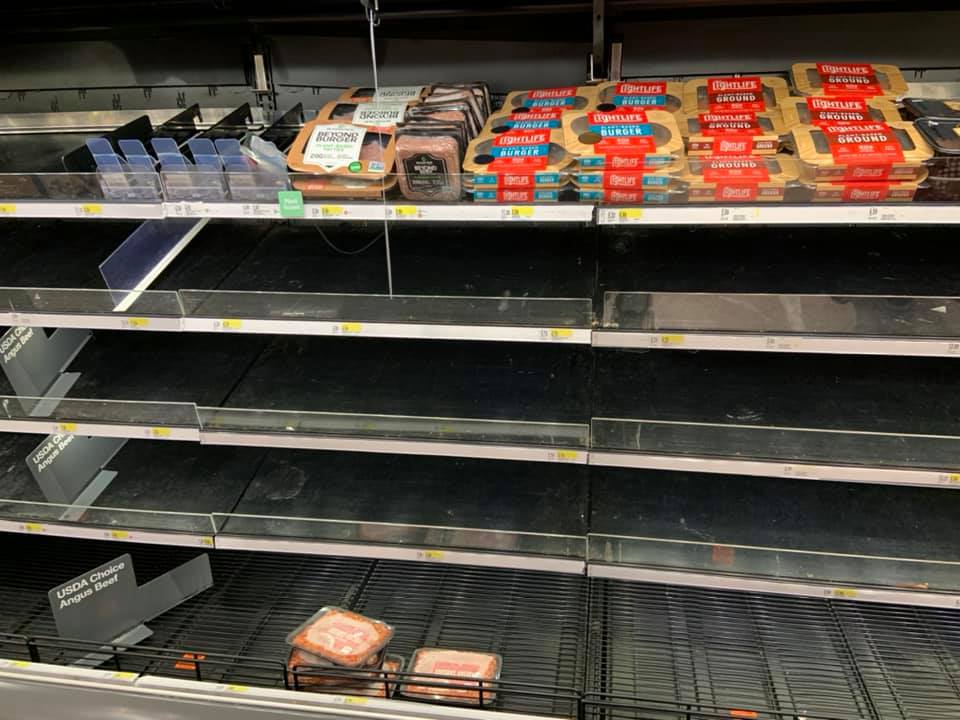
To elaborate, even in situations where there is a glaring and widespread shortage of essential food items due to emergency circumstances, the vegan section of the freezer aisle often remains largely untouched. The majority of consumers simply have no desire to consume such products (and the small minority that does may already have well-stocked freezers filled with these items, again benefitting from their long shelf lives).
Yet, there is an underlying economic rationale behind the existence of these Magness Effects. Rather than aligning their product offerings with genuine consumer preferences, most grocery stores seem to allocate prime shelf space to faux-meat products as a way of projecting a particular image of social responsibility. They hope that when customers pass by a prominently displayed shelf of vegan goods, they may infer that the store is actively promoting values like saving the planet or protecting animals. It’s akin to establishments that prominently place recycling bins in public view, even though, in reality, the recyclables often end up mixed with regular trash once they’re out of sight.
While the vast majority of shoppers are unlikely to open the vegan freezer door and select a package of artificially colored and molded celery stalks masquerading as chicken tenders, a substantial minority perceives this shelf as a testament to the store’s corporate social responsibility toward the environment. Meanwhile, the subset of the population that does consume these products maintains an ongoing oversupply relative to their market share. Since there’s little demand from others, they can walk into the store during a hurricane, blizzard, or other run on groceries and the artificial meat shelf will appear virtually unchanged from a typical Tuesday.
The news is not encouraging for plant-based meat entrepreneurs. A November 18th Telegraph UK article reports that the plunging fortunes of vegan food makers have occurred alongside the resurgence of interest in real meat. “Smashed burgers” account for a substantial part of the renewed interest, with eateries offering twists on the recipe in towns all across the UK. (Unsurprisingly, it’s a style that originated in the United States.) As for meat consumption trends in the US, the USDA estimates per-capita retail weight consumption of 224.6 pounds of red meat and poultry in 2022: 10.3 pounds higher than the average observed from 2012 to 2021.
The desperation of the grass-meat constituency is clear in the headlines of ideologically aligned media supporters. A widely-syndicated16 November Associated Press article implored readers: “Plant-based meat is a simple solution to climate woes — if more people would eat it.”
Yet despite consumers speaking about as clearly as they ever do, an arrow remains in the quiver of the grass-burger constituency. Impossible Foods CEO (and former Stanford University biochemist) Pat Brown recommends a meat tax, drawing comparisons with the levies currently charged on tobacco, marijuana, and sugar products in various jurisdictions. If consumer tastes won’t salvage the market for animal-part-shaped blocks of dyed soy extract, its boosters and beneficiaries are hoping that government interventions will.
In the meantime, the plant-based alternatives industry appears to be facing its first true market test and doing poorly. True, the consumer base for fake meat is not zero. It’s simply a much smaller market than producers perceived, due to the noisy signals and political distortions of Conspicuous Production. The result is a plant-based alternative food industry that far outpaced the interest in what it had to offer, and is now seeing a rapid contraction as the consumer sovereignty corrects those misread signals.
Phillip W. Magness is Senior Research Faculty and F.A. Hayek Chair in Economics and Economic History at the American Institute for Economic Research. He is also a Research Fellow at the Independent Institute. He holds a PhD and MPP from George Mason University’s School of Public Policy, and a BA from the University of St. Thomas (Houston). Prior to joining AIER, Dr. Magness spent over a decade teaching public policy, economics, and international trade at institutions including American University, George Mason University, and Berry College. Magness’s work encompasses the economic history of the United States and Atlantic world, with specializations in the economic dimensions of slavery and racial discrimination, the history of taxation, and measurements of economic inequality over time. He also maintains an active research interest in higher education policy and the history of economic thought. His work has appeared in scholarly outlets including the Journal of Political Economy, the Economic Journal, Economic Inquiry, and the Journal of Business Ethics. In addition to his scholarship, Magness’s popular writings have appeared in numerous venues including the Wall Street Journal, the New York Times, Newsweek, Politico, Reason, National Review, and the Chronicle of Higher Education.
Peter C. Earle is an economist who joined AIER in 2018. Prior to that he spent over 20 years as a trader and analyst at a number of securities firms and hedge funds in the New York metropolitan area. His research focuses on financial markets, monetary policy, and problems in economic measurement. He has been quoted by the Wall Street Journal, Bloomberg, Reuters, CNBC, Grant’s Interest Rate Observer, NPR, and in numerous other media outlets and publications. Pete holds an MA in Applied Economics from American University, an MBA (Finance), and a BS in Engineering from the United States Military Academy at West Point.


