Search This Blog

Tuesday, April 2, 2024

Weaponization Of The Secret Service Has Put RFK Jr's Life At Risk

 by Blake Fleetwood via ScheerPost.com,

Fifty years ago last summer, I met Robert F. Kennedy Jr.

We were in a small group climbing on skis to a spectacular 14,000-foot pass in the snow-covered Chilean Andes. The light, fluffy, bottomless power is about eight feet deep on top of another eight feet of packed winter snow.

We suddenly hear bullets ricocheting off a rock five feet away. The shots sound like someone quickly snapping his fingers. We look down the mountain; five Chilean Alpine troopers are spraying machine gun fire from their hips across a broad swath of the sloop.

Bobby, about 15 feet in front of me, falls into the snow. I think he has been shot, and we are all goners. The shots keep cracking as the rest of us dive for cover into the deep snow. After 20 minutes of hunkering, we peer down the mountain to the stormtroopers. Bobby, the youngest of the group at 19, takes the lead as he stands waving a white handkerchief on top of a ski pole. 

The troopers stop firing and motion for us to come down. Bobby goes up to the leader and starts talking to him. The gunman explains that there is going to be a change in the government, and they want to make sure that no one gets away. After inspecting our gear, they tell us to go on our way. 

The army troopers, under the command of  General Augusto Pinochet, were supported with weapons and bullets supplied by the CIA. The army, with Henry Kissinger’s help and millions of U.S. dollars, was in the throes of staging a coup that, in a few weeks, would murder the democratically elected President of Chile, Salvador Allende, as well as more than 5,000 other innocent civilians. 

This incident helped form Kennedy’s antipathy toward forever wars and other U.S. Empire-building adventures.

We have remained foxhole friends ever since. The same courage Bobby Kennedy showed on top of that mountain pass 50 years ago when facing machine gun-toting thugs he is showing today in his long-shot 2024 presidential campaign.
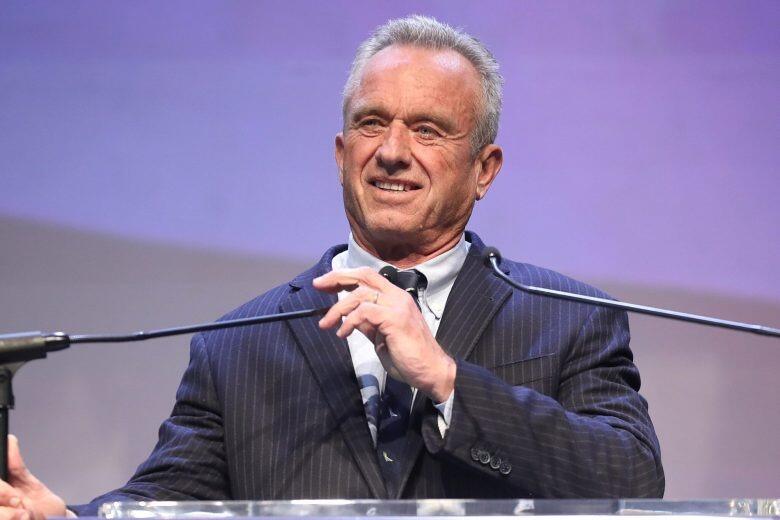
This is why I am so fearful about Robert F. Kennedy Jr. being shot at again. 

The Kennedy campaign made its fifth formal request for Secret Service protection in March, citing a 67-page report of repeated death threats, nutjob letters, two heavily armed intruders to a campaign event, an invader in Kennedy’s Cape Cod house, and another man who invaded Kennedy’s home twice in one day when Kennedy and his wife, Cheryl Hines, were at home. 

President Biden’s decision to deny Secret Service protection to Kennedy seems to be based on political considerations and weaponizes the Secret Service by making it necessary for Kennedy to raise and spend millions of dollars each month for security. 

Kennedy appears to fit neatly into the law governing Secret Service protection for presidential candidates. 

Biden could be helped by forcing Kennedy to continue to pay huge sums for private protection to protect himself, his family, and his supporters. Security costs the campaign 30 cents out of each dollar raised. 

Biden’s motive is not based on historical precedent, the threats and dangers Kennedy faces,  existing laws, or the slightest compassion for a political family that has suffered so grievously.

If the worst happens, Joe Biden will be accountable. Historically, a president can order Secret Service protection for a candidate on his own, as could the Homeland Security secretary, currently Alejandro Mayorkas, after consultation with the Congressional Advisory Committee — the leaders of the Senate and House of Representatives. For a comparison, lesser-known Republican presidential candidate Herman Cain was provided protection a year before the 2012 election by then-head of Homeland Security, Janet Napolitano.

The law states that the president and the secretary of Homeland Security have “broad discretion” in granting protection, and they have repeatedly done so, politics aside. 

Secret Service records recently revealed the agency’s conclusions that Kennedy is at “elevated risk for adverse attention,” and after reviewing credible armed threats against Kennedy, the agency assembled a group of eight teams ready to step in quickly after they get the go-ahead. But they never got it.

The threat to Kennedy is particularly acute because of his controversial politics and his family history—his father, RFK, Sr., a U.S. senator and presidential candidate, and his uncle, John F., a U.S. president, were both assassinated. RFK Jr. has provoked and challenged some of the most powerful forces in our country, especially concerning the military-industrial complex, the CIA, and endless foreign wars that so enrich defense contractors.

The perils to Kennedy arise not only because of his name but also because of the mainstream media’s relentless demonization of him. 

Kennedy’s wife, Cheryl Hines, the lead actress in the popular TV series Curb Your Enthusiasm, accused Biden of “playing politics” with her and RFK Jr.’s safety.

“Yesterday, an intruder climbed the fence at my home and was arrested,” Kennedy tweeted a few months ago. “After being released from police custody later in the day, he immediately returned to my home and was arrested again.”

In September, a heavily armed man impersonating a U.S. marshal and the CIA, with loaded concealed firearms and an accomplice, was arrested after infiltrating a private event. 

No wonder Hines is scared and worried. The Kennedy name is a lightning rod, a bright target for disturbed and demented individuals.  

Judicial Watch, a conservative foundation, filed a Freedom of Information request and lawsuit to determine why Kennedy’s multiple requests for Secret Service protection were not answered. Finally, they obtained a trove of previously hidden emails. 

“These documents confirm the bureaucratic and political runaround the Biden administration went through to ultimately deny Robert F. Kennedy Jr. the requested Secret Service protection,” said Tom Fitton, president of Judicial Watch. “The Biden administration’s refusal to provide Secret Service protection to Mr. Kennedy is dangerous and vindictive.”

According to the reports, higher-ups ordered the Secret Service not to talk to Kennedy’s private security.

Seventy percent of voters do not want Biden or Trump. According to a January 9, 2024, Gallup pollKennedy’s favorability rating of 52% is higher than Biden’s (41%) and Trump’s (42%). According to an earlier Gallup poll, 63% of U.S. adults think that the major parties do “such a poor job” of representing the American people that “a third major party is needed.” This is a 7% increase from a year ago.

Biden’s choice to deny Kennedy protection reflects insecurity, fearing Kennedy’s popularity and radical, transformative message have the potential to endanger his reelection. He might also worry that Secret Service protection will elevate Kennedy’s stature and give him a certain presidential aura as a credible contender among the media and voters. 

For 55 years, every presidential administration has granted early protection to major candidates who requested it. The Biden administration is the sole outlier.

If another Kennedy is killed while campaigning for president, it will be a long-lasting, traumatic stain on the American psyche that will scar the soul of our democracy for decades to come. Unfortunately, we live in violent, polarized times. The United States has surpassed 400 mass shootings in 2023, a record-breaking year in gun violence.

The perils to any Kennedy running for office are self-evident. An assassination attempt would dredge up memories of 1968 when Robert F. Kennedy Sr. and Martin Luther King Jr. were shot and killed, and George Wallace was gunned down and paralyzed, taking him out of the presidential race.

The puzzling thing is that Biden has spent decades transfixed by the Kennedy mystique, tracing his interest in politics to John F. Kennedy. He was a long-time friend of JFK’s brother, Sen. Ted Kennedy, and has a bust of Sen. Robert F. Kennedy exhibited prominently in the Oval Office. Biden employs four members of the Kennedy family as ambassadors and special assistants. In fact, he admired RFK Sr. so much that he lifted some lines from one of his speeches without attribution in 1988. Perhaps Biden imagines himself as the Irish Catholic reincarnation of the Kennedys. Is it now possible that Biden resents Robert Kennedy Jr. for taking away that long-held dream? 

President Biden knows that the Kennedy family has paid an unendurable, heartbreaking price for decades of enlightened public service. What  would Biden ever say to Ethel Kennedy, Bobby’s mother, if he were assassinated? Her husband and her brother-in-law were brutally murdered while serving their country. Two of her sons are already dead, perhaps from lingering trauma suffered from coping from their father’s so public assassination.

What would Biden say to Cheryl Hines? What can he say to Kennedy’s six children and to any bystanders who might get shot and killed as collateral damage? In Ecuador recently, a presidential candidate was assassinated, and nine bystanders were injured. 

The Biden administration has used various pretexts to justify its denial of protection for RFK Jr. The Advisory Committee that green lights  who gets Secret Service protection noted in its last rejection that federal protection should only be granted one year before the election. But now, seven months before the election, nothing has changed.

Serious presidential candidates have routinely received early government protection. Senator Ted Kennedy received government protection in September 1979, 414 days before the November 1980 election. He was running against sitting president Jimmy Carter, who hated Ted Kennedy and deeply resented his attacks on him. But to his credit, considering the tragic Kennedy history, Carter knew it was his obligation and duty to protect Ted Kennedy and not weaponize the Secret Service. 

Other examples of early Secret Service protection:

  • Sen. Barack Obama received protection 18 months, 551 days, before election day 2012, at the request of Sen. Dick Durbin.

  • Donald Trump and Ben Carson got protection in November 2015, a year before the election.

  • Herman Cain got protection almost a year before the 2012 election.

  • Sens. John Kerry and John Edwards each received protection in February 2004, nine months before the election.

  • Bob Dole was offered protection in March 1996, eight months before the election.

  • Pat Buchanan got protection in February 1996, nine months, 250 days, before the election.

  • Bill Clinton received protection in February 1992 after the New Hampshire primary, eight months before the general election.

  • Pat Robertson got it in December 1987, about 11 months before the election, before any of the 1988 primaries.

  • Jesse Jackson got protection in November, a year before the 1988 election.

  • Walter Mondale got protection nine months before the 1984 election.

  • Rick Santorum, Newt Gingrich and Mitt Romney all received protection in February and March 2012, about 10 months before Election Day

  • Sen. Walter Mondale got protection in January 1984, 10 months before the election.

  • Ronald Reagan got protection in January 1980, 10 months before the election.

To repeat: It is less than seven months before the Presidential election in November, and Kennedy still has not gotten the protection he and his family need and deserve. Nikki Haley, asked for Secret Service protection early this month because of increasing threats to her and her family. The Secret Service agreed to her request, even though she is no longer in the race.

Republican Sen. Ted Cruz is outraged at the treatment that RFK Jr. has gotten, asking, “How do you address the fact that previous major presidential candidates, such as Donald Trump, Dr. Ben Carlson, Barack Obama, and Senator Ted Kennedy, received Secret Service protection well over 120 days before the general election?” He also said, “I ask you to act swiftly to provide this major presidential candidate the protection that his exceptional circumstances so clearly warrant.”

Biden’s indefensible inhumane decision must be reversed before it is too late. 

https://www.zerohedge.com/political/weaponization-secret-service-has-put-bobby-kennedys-life-risk

Life in UK: Katie Price low calorie diet advert for Skinny Food banned

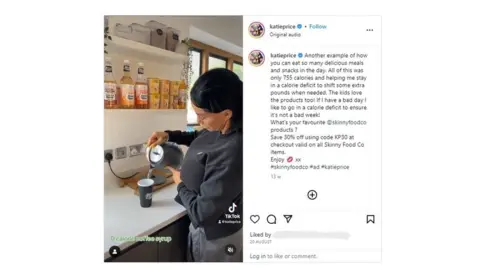
 An advert posted by Katie Price on Instagram, which promoted a low calorie diet for The Skinny Food Co, has been banned by the advertising watchdog.

In the video, posted last August, the former glamour model detailed her meals adding up to only 755 calories a day.

The NHS states the recommended daily intake is around 2,000 calories a day for women and 2,500 for men.

The Advertising Standards Authority (ASA) said the ad was "irresponsible" and must not appear again.

Price has taken the advert down from her Instagram account.

Katie Price/Instagram A screengrab from Katie Price's Instagram

Katie Price/Instagram
The video showed Katie Price talking about her efforts to lose weight

In the Instagram Reel for the diet food firm, the TV personality was seen making meals for herself throughout the day and talking about her efforts to lose weight.

Her day started with porridge and a "delicious" coffee with zero calorie syrup.

For lunch, she had a wrap with zero calorie garlic mayonnaise sauce on top, while dinner consisted of a low calorie chicken tikka curry.

The video ended with Price having low calorie chocolate malt balls as a post-dinner snack.

In her caption for the video, Price wrote: "All of this was only 755 calories and helping me stay in a calorie deficit to shift some extra pounds when needed."

Price said her children also "loved" the products, adding: "If I have a bad day I like to go in a calorie deficit to ensure it's not a bad week!"

PA Media Katie Price sits in a pink chair wearing a pink shirtPA Media

The ASA said that it had received two complaints that the advert irresponsibly promoted a low calorie diet.

In the UK, adverts promoting diets that fall below 800 calories must do so only for short term use and must encourage users to take medical advice before embarking on them.

But the ASA found that the The Skinny Food Co advert included no explicit instruction that the diet must only be followed on a short-term basis, nor any reference to the need to take medical advice before embarking on it.

It warned that consumers would understand from the ad that they could choose to follow a similar diet, that fell below 800 calories a day, without taking medical advice, until they achieved their desired weight.

"For the above reasons, we concluded that the ad irresponsibly promoted a diet that fell below 800 kcal a day," the ASA said.

The ASA also received one complaint that the post was not obviously recognisable as an advert.

Not Guilty Food Co Ltd, which trades as The Skinny Food Co, said that the reel included the hashtag #ad. It also said it could not control what Price ate, but that being in a "calorie deficit" was a proven way to achieve weight loss.

But the ASA said the hashtag #ad was not visible without expanding the text.

Getty Images Katie PriceGetty Images

It therefore concluded that the label was insufficiently prominent to obviously identify the post as an advert from the outset.

It also told The Skinny Food Co and Price to ensure that future adverts were obviously identifiable as marketing communications, and the commercial intent was made clear, and that identifiers such as #ad were clearly displayed.

Price subsequently agreed to remove the advert, saying she followed a calorie deficit approach, which she believed many people in the UK did. She also asked for further information on how to make similar posts compliant in future.

Finally, the ASA also found that because the advert made specific health claims that were not authorised on the Great Britain nutrition and health claims register, it broke the rules.

"We also told them to ensure that their ads did not irresponsibly promote diets that fell below 800 kcal a day, and to only make weight loss or weight maintenance claims for foods if the claim was authorised on the Great Britain nutrition and health claims register and the foods met the associated conditions of use."

The watchdog concluded the ad must not appear again in the form that that was subject to complaints.

The Skinny Food Co and Katie Price have not yet responded to a request for comment from BBC News.

https://www.bbc.com/news/entertainment-arts-68713464

US Cancels Latest Oil Reserve Refill Plan Amid High Prices


The Biden administration won’t move forward with its latest plans to buy oil for the Strategic Petroleum Reserve amid rising prices.

The Energy Department said it was “keeping the taxpayer’s interest at the forefront” in its decision not to purchase as many as 3 million barrels of oil for a Strategic Petroleum Reserve site in Louisiana. The plan for the barrels to be delivered in August and September had been announced in mid-March.

https://www.bloomberg.com/news/articles/2024-04-03/us-cancels-latest-oil-reserve-refill-plan-amid-high-prices

FDA clears first DTx for depression from Otsuka, Click

Otsuka and Click Therapeutics’ Rejoyn has become the first prescription digital therapeutic (DTx) to be approved by the FDA for people with major depressive disorder.

Rejoyn (formerly CT-152), a software-as-a-medical device (SaMD) delivered via a smartphone app, has been authorised as an add-on to clinician-managed outpatient care for adults aged 22 and over with MDD who require antidepressant medicines.

Delivered over six weeks, the DTx is designed to help alleviate MDD symptoms using a combination of cognitive emotional training exercises and brief therapeutic lessons. It is due to be available for download from app stores for iOS and Android in the second half of this year.

Rejoyn is the first fruit of a collaboration set up in 2019 with Otsuka, worth $300 million, focusing on the development of DTx software for MDD. In 2021, the pair teamed up with Verily, the healthcare subsidiary of Google owner Alphabet, to run the pivotal Mirai study of Rejoyn in 286 people with MDD.

In the study, participants aged 22 to 64 were randomised to either Rejoyn or a sham control app as an addition to their antidepressant medication. The DTx includes three components, namely cognitive behavioural therapy (CBT) sessions, emotional faces memory task (EFMT) exercises, and personalised reminders and messaging.

Treatment with Rejoyn met the primary endpoint with a significant mean change from baseline to week six in the Montgomery-Ã…sberg Depression Rating Scale (MADRS) total score, achieving an average 8.78-point reduction versus 6.66 points for the sham group. Symptom improvement was also reported, based on patient- and clinician-reported outcome surveys.

Describing Rejoyn as “physical therapy for the brain”, Click’s scientific advisor Brian Iacoviello of Icahn School of Medicine – a co-inventor of the EFMT test – said the app was designed to help improve connections in the brain regions affected by depression.

“When stronger and more balanced connections are created, the regions of the brain responsible for processing and regulating emotions are better able to work together and symptoms of depression can improve,” he added.

Click hopes to position Rejoyn as a way to enhance the efficacy of antidepressants, saying that only around a third of patients with MDD respond to the first medication tried.

The company’s chief executive, David Benshoof Klein, said it “provides hope for those who are looking for new treatment options, especially one that is easily accessible through the device in the palm of your hand.”

Regulatory approval could only be the first hurdle facing Click and Otsuka, however, as some DTx developers have struggled to build a sustainable commercial business, in part because of uncertain reimbursement pathways.

That has driven some into bankruptcy, notably Pear Therapeutics, which saw its assets sold off last year to various other companies, including Click. Others have been forced to refocus their business operations, such as Akili, which has retreated from the prescription business in favour of a direct-to-consumer (DTC) model.

Last year, US lawmakers reintroduced the Access to Prescription Digital Therapeutics Act, which would create a dedicated benefit category for these products in Medicare and Medicaid, but that has not yet made it onto the statute.

Click is also working on DTx candidates for schizophrenia with Boehringer Ingelheim and with Indivior on software to support people with substance use disorders. Its in-house pipeline is led by a DTx candidate for migraine.

https://pharmaphorum.com/news/fda-clears-first-dtx-depression-otsuka-click

Another Outlandish Overreach By The CDC

 by Jeffrey A. Tucker via The Epoch Times (emphasis ours),

Easter weekend was lovely in every way.

And yet I could not stop thinking about the strange manner in which the Centers for Disease Control and Prevention (CDC) has had such an outsized role in the ruination of American rights and liberties. This agency is supposed to be tracking infectious disease and finding ways out. This mandate became the leverage to allow them to impose nationwide mask mandates, a rental moratorium, a shutdown of the cruise industry, and otherwise send the whole country into fits of hysterics for two years and more.

So it occurred to make an inquiry into how the CDC handles questions of election processes. This is rather important in a democracy. This is how we select our leaders and the central way in which we can claim that the people have some influence over the regime that rules us. It is because of elections that we can claim to be better than ancient despotisms or medieval feudalism. We rule ourselves through the vote. That’s the whole idea.

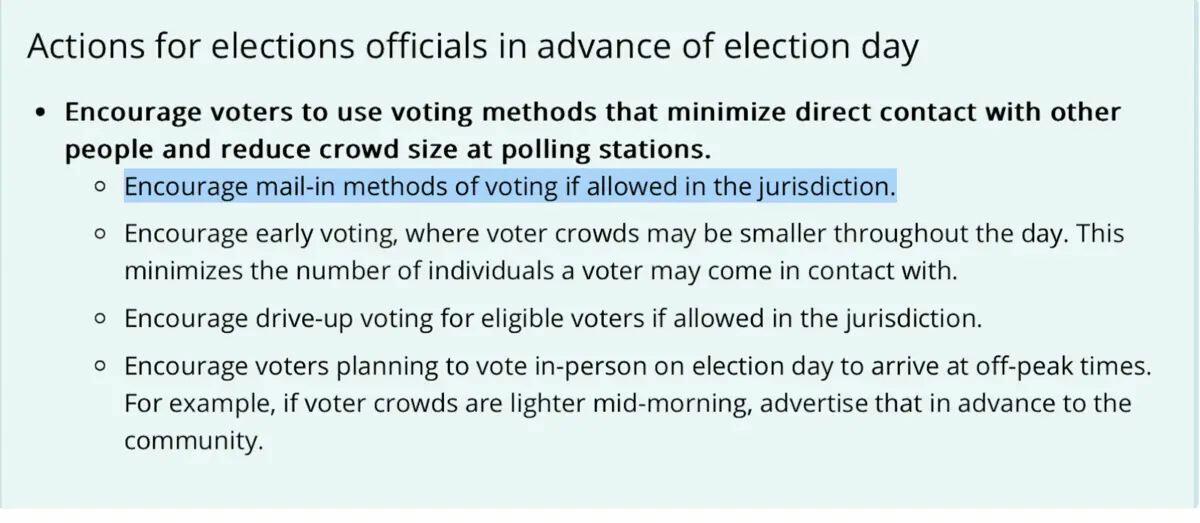
As it turns out, the CDC had quite a large role in guiding election processes. Not that you can find the evidence on their website now. Nope, it’s all been scrubbed. However, if you look at the Wayback Machine, you can find an interesting little point. The CDC strongly recommended mail-in, absentee, and early voting as a means of disease control.

The theory was that people gathering in a polling place would be a super-spreader event. What science did they cite to demonstrate this? None at all. So far as I know, and I’ve looked far and wide, there is not a single study anywhere that purports to show some relationship between disease spread and in-person voting. The CDC just made that up... for whatever reason.

The day was March 12, 2020. This was the same day that President Trump went on national television in the evening to announce that there would be no more travel from the United States to Europe, the UK, and, later, Australia and New Zealand. He further said that all Americans living abroad needed to come home right away or be stuck.

That was a pretty shocking announcement. Nothing like this had ever happened in American history, not even this broadly in wartime. It seemed to come out of nowhere, our rights to travel suddenly deleted.

It seems that President Trump was following the advice of his scientific advisors who later turned out to be snake oil salesmen. Indeed, he seemed extremely uncomfortable making this announcement, almost like he knew that it was weird and probably unwarranted. Strange night.

As it turns out, earlier that day, the CDC decided that the whole country really ought to be voting by mail. They went into the website and edited the page that very day and produced the following checklist.

You can see for yourself at the Archive link. So far, the CDC has not proven itself powerful enough to scrub also its bread crumbs from the archive source, not yet in any case. The time might come. If they succeed, their role in creating the biggest voting scandal in a hundred years might never have been known by future generations.

There is simply no way that the CDC could not have known about the uncertainties and vagaries created by absentee ballots. They are banned by half the countries in the world for that reason. Those that do allow them govern them very strictly. You have to request a ballot. They are sent to your home. You have to provide extensive identity verification. You have to have a darn good excuse. It’s only for hardship cases and never the norm.

It was the CDC that decided to throw all that in the trash. Who even cares about the whole history of democracy, because, after all, there is a virus floating around! It’s amazing that this happened. But just as amazing is the idea of throwing out property rights, which they also did. But there it is.

To be sure, they could not actually force this result. But they sure could grant some scientific heft behind the idea. It also helped that only 10 days later, the U.S. Congress voted $2 trillion in payments to the states, a portion of which was to implement CDC recommendations. Most states were happy to do so, again, with full knowledge that this strategy would yield results that were sketchy at best.

As it turns out, of course, it was the mail-in ballots that might have made the difference in the election, or seemed to in any case. Everything got so much mixed up that it’s hard to say. And it’s not like people did not have warning signs of trouble. The primary season of that spring and summer yielded a slew of controversies about what was and was not true. There were more than enough controversies swirling about by the time of the general election.

The crucial point here is that the CDC massively overstepped the bounds of its mandate by intervening in the processes by which Americans select its leaders, strongly pushing a method that was a known source of fraud. Nor has the CDC ever been held to account for this, not to my knowledge in any case.

They were sued over the rent moratorium and the evil nationwide mask mandate. They lost both cases. But there has been no litigation against the CDC for disrupting the whole system by which we regulate elections. One might suppose that if an executive agency were to do something like this, they would have needed some permission from somebody. Surely such a gigantic change would and should require more than a low-level employee with logins to change a website text.

Speaking of which, who actually did this and why? Aren’t these interesting questions? Why is no one asking them? Where are the investigations? Where is the outrage?

https://www.zerohedge.com/political/another-outlandish-overreach-cdc

Ultrasound therapy shows promise as a treatment for Alzheimer's disease

 University of Queensland researchers have found targeting amyloid plaque in the brain is not essential for ultrasound to deliver cognitive improvement in neurodegenerative disorders.

Dr. Gerhard Leinenga and Professor Jürgen Götz from UQ's Queensland Brain Institute (QBI) said the finding challenges the conventional notion in Alzheimer's disease research that targeting and clearing amyloid plaque is essential to improve cognition.

"Amyloid plaques are clumps of protein that can build up in the brain and block communication between , leading to  and other symptoms of Alzheimer's disease," Dr. Leinenga said.

"Previous studies have focused on opening the  with microbubbles, which activate the cell type in the brain called microglia which clears the .

"But we used scanning ultrasound alone on mouse models and observed significant memory enhancement."

Dr. Leinenga said the finding shows that ultrasound without microbubbles can induce long-lasting cognitive changes in the brain, correlating with memory improvement. The research paper has been published in Molecular Psychiatry.

"Ultrasound on its own has direct effects on the neurons, with increased plasticity and improved brain networks," he said.

"We think the ultrasound is increasing the plasticity or the resilience of the brain to the plaques, even though it's not specifically clearing them."

Professor Götz said the study also revealed the effectiveness of ultrasound therapy varied depending on the frequency used.

"We tested two types of ultrasound waves, emitted at two different frequencies," he said. "We found the higher frequency showed superior results, compared to frequencies currently being explored in  for Alzheimer's disease patients."

The researchers hope to incorporate the findings into Professor Götz's pioneering safety trial using non-invasive ultrasound to treat Alzheimer's disease.

"By understanding the mechanisms underlying  therapy, we can tailor treatment strategies to maximize cognitive improvement in patients," Dr. Leinenga said.

"This approach represents a significant step toward personalized, effective therapies for neurodegenerative disorders."

More information: Gerhard Leinenga et al, Scanning ultrasound-mediated memory and functional improvements do not require amyloid-β reduction, Molecular Psychiatry (2024). DOI: 10.1038/s41380-024-02509-5


https://medicalxpress.com/news/2024-04-ultrasound-therapy-treatment-alzheimer-disease.html

Attempted Suicide Rates More Than Double After Gender-Reassignment Surgery: Study

 Rates of attempted suicide who identified as transgender more than doubled after receiving a vaginoplasty (surgically turning one's dick into a vagina), according to a peer-reviewed study published in The Journal of Urology.

The study looked at rates of psychiatric emergencies both before and after gender-altering surgery among 869 males who went under the knife, and 357 females who underwent phalloplasty (turning one's vagina into a dick) in California between 2012 and 2018.

While researchers found that rates of 'psychiatric emergencies' were high both before and after gender-altering surgery, suicide attempts were markedly higher among those who received vaginoplasties, the Epoch Times reports.

"In fact, our observed rate of suicide attempts in the phalloplasty group is actually similar to the general population, while the vaginoplasty group’s rate is more than double that of the general population," wrote the author of the study.

Among the 869 patients who underwent vaginoplasty, 38 patients attempted suicide—with nine attempts before surgery, 25 after surgery, and four attempts before and after surgery. Researchers found a 1.5 percent overall risk of suicide before vaginoplasty and a 3.3 percent risk of suicide after the procedure. Almost 3 percent of those who attempted suicide after undergoing vaginoplasty did not present with a risk of suicide prior to surgery.

Among the 357 biologically female patients who underwent phalloplasty, there were six suicide attempts with a 0.8 percent risk of suicide before and after surgery. -Epoch Times

Aside from suicide attempts, the study found that the proportion of those who experienced an emergency room and inpatient psychiatric encounter was similar between the two groups - with 22.2% of vaginoplasty and 20.7% of phalloplasty groups experiencing at least one psychiatric encounter.

According to the study, 33.9% of biological males undergoing vaginopasty would experience a post-surgery psychiatric encounter vs. 26.5% for biological women who underwent phalloplasty, if an episode had occurred before surgery.

That's a lot.

As the Epoch Times notes further:

Suicide Rate 19-Fold Higher

In an interview with The Epoch Times, Dr. Alfonso Oliva, a board-certified plastic and reconstructive surgeon, said research into the psychiatric outcomes and long-term follow-up of those who have sex-reassignment surgery is lacking, but an important paper is worth mentioning. In a 2011 paper published in PLOS ONE, researchers found that people who underwent sex reassignment surgery had substantially higher rates of overall mortality, suicidal behavior, and psychiatric morbidity compared with the general population.

It’s hard to refute this paper because it’s a longitudinal study,” Dr. Oliva said. “In Sweden, everyone is in a database, and through diagnosis codes, they’re able to follow what happens to every citizen in terms of their medical history. They waited more than 10 years after people had surgery and found that death by suicide had an adjusted hazard ratio of 19.1.”

You can “quibble” about emergency room encounters, but this study shows that for patients who had transgender surgery, their suicide rate after 10 years was 19-fold higher than the general population, Dr. Oliva said. Additionally, the study excluded people with psychiatric illnesses, so these are individuals thought to have no psychiatric illness outside of dysphoria. 

Surgical Procedures

A phalloplasty is a multistep process undertaken by a biological female who wants to transition to a male, where a penis is created using tissues from the genitals and forearm or thigh. The external genitals, such as the labia or outer labia, are used to create a scrotum, and testicular implants are inserted months later along with an implant that will cause erections.

Vaginoplasty is the most commonly performed gender-reassignment surgery for those with gender dysphoria, with more than 3,000 procedures performed annually. According to Johns Hopkins Medicine, vaginoplasty is a surgical procedure that involves removing the penis, testicles, and scrotum to create a vulva and functional vagina. Surgeons typically create a vaginal canal using the skin surrounding the existing penis and scrotum or by using a skin graft from the abdomen or thigh.

A penial inversion is the most commonly performed procedure where the skin is removed from the penis and inverted to form a pouch that is inserted into the vaginal cavity created between the urethra and the rectum. Surgeons then partially remove, shorten, and reposition the urethra and create a labia majora, labia minora, and clitoris.

Another surgical method involves using a robotic system that enables surgeons to reach into the body through a small incision in the belly button to create a vaginal canal. The type of vaginoplasty performed varies among patients. For example, younger patients who have never experienced puberty may have insufficient penile skin to do a standard penile inversion.

“When you take a child who’s about to undergo puberty—and they suggest giving puberty blockers to stop puberty at age 10 to 11 1/2—and when you do that for little boys, they aren’t able to get tissue from the penis and scrotum, so creating a vagina is very difficult,” Dr. Oliva told The Epoch Times. “You have to use tissue from other areas of the body, such as the peritoneum or the colon. Some researchers in Brazil are actually looking into using tilapia fish,” he added.

After a vaginoplasty is performed, the recovery process is extensive and vaginal dilation must be performed at varying intervals throughout the patient’s life.

Vaginoplasty Associated With Serious Risks

In addition to an increased risk of suicide, vaginoplasty is associated with numerous physical complications, including wound separation, vaginal stenosis, hematoma, rectovaginal fistulas, granulation tissue, bleeding, infection, skin or clitoral necrosis, suture line dehiscence (when the surgical incision opens), urinary retention or vaginal prolapse.

According to a 2021 paper in the International Brazilian Journal of Urology, a rectovaginal fistula is the “most devastating complication” of a vaginoplasty that can occur “despite careful technique” and without obvious injury to the rectum.

rectovaginal fistula is an abnormal connection between the rectum and vagina that can cause fecal incontinence, hygiene issues, vaginal or anal irritation, and potentially life-threatening abscesses and fistula recurrence.

A 2021 review in Andrology found that rates of complications following penile inversion vaginoplasty ranged from 20 to 70 percent, with most of the complications occurring during the first four months following the procedure.

In a 2018 Clinical Anatomy review and meta-analysis, researchers reviewed 125 articles to assess neovaginal complications following surgery. After selecting 13 studies that included 1,684 patients, they found a complication rate of 32 percent, with a reoperation rate of 22 percent for non-esthetic reasons.

“For cosmetic surgery, if the complication rate was more than 2 percent to 3 percent, you wouldn’t have any patients,” Dr. Oliva told The Epoch Times. “These are very high percentage rates that we just accept.”

Dr. Oliva said complications with these surgical procedures are very high and he thinks this is why suicide rates are so high.

People think this is going to solve the problem and it doesn’t,” he said.

A June 2018 paper on postoperative outcomes of 117 patients who underwent vaginoplasty published in the Journal of the American Society of Plastic Surgeons found that 26 percent of patients experienced granulation tissue, 20 percent had intravaginal scarring, and 20 percent experienced prolonged pain.

In a 2017 paper published in The Journal of Urology, researchers followed patients who underwent penile inversion vaginoplasty. Of 330 patients, 95 (29 percent), presented with postoperative complications. Three of those patients developed a rectoneovaginal fistula, and 30 patients required a second operation.

Story continues below advertisement

In a 2016 study published in Urology, researchers retrospectively reviewed clinical records of 69 patients who underwent vaginoplasty from January 2005 to January 2015. Although complications during surgery were not reported, 22 percent of patients experienced major postoperative complications.

“We’ve been transitioning adults in the United States since 2007, but where’s the data from gender identity clinics? Why is nothing published in the United States about long-term function? Why do we have nothing published on sexual function? We should be able to follow that and should be studying it and we’re not,” Dr. Oliva told The Epoch Times. 

*  *  *