Search This Blog

Tuesday, April 9, 2024

Arizona Supreme Court upholds 1864 law banning nearly all abortions

 Abortion will be almost entirely illegal in Arizona after the state Supreme Court on Tuesday upheld an 1864 law that made performing abortion a felony. 

The ruling adds Arizona to the list of 16 other states where abortion is effectively banned. 

In a 4-2 decision, the court rejected arguments that it should uphold the current 15-week abortion ban signed in 2022 by then-Gov. Doug Ducey (R) and enforced after the end of Roe v. Wade. 

Instead, the court ruled that the Civil War-era law passed before Arizona was even a state should be enforced. The court ruled to lift a stay on the law, meaning it goes into effect in 14 days.  

However, the justices also sent the case back to a lower trial court to sort out questions about the law’s constitutionality. 

The century-old law makes abortion a felony punishable by two to five years in prison for anyone who performs or helps a woman obtain one.  It includes an extremely narrow exception for “when it is necessary” to save a pregnant person’s life.  

“The decision made by the Arizona Supreme Court today is unconscionable and an affront to freedom,” state Attorney General Kris Mayes (D) said in a statement. “Make no mistake, by effectively striking down a law passed this century and replacing it with one from 160 years ago, the Court has risked the health and lives of Arizonans.”  

Abortion has been a crucial issue in Arizona, a key swing state where both Mayes and Gov. Katie Hobbs (D) won election in 2022 after running on anger over reproductive rights and the end of Roe v. Wade. 

The law would effectively shutter the eight remaining abortion clinics in the state, though it’s unclear how it will be enforced. It could also force women who need abortion care to travel hundreds of miles to clinics in California.  

Pima County Attorney Laura Conover, who opposed the ban and argued for the plaintiffs during oral arguments in December, said there shouldn’t be any changes to reproductive care in the immediate aftermath of the ruling.   

However, she is concerned that there will be a chilling effect because physicians will be confused about whether they will be arrested for performing abortions. 

“What I can and will continue to say is that the health care that was provided yesterday is still lawful tomorrow,” Conover told The Hill. “Our job as public health and public safety officers is to say that health care, reproductive health care, remains safe and lawful.” 

Mayes has said she will not enforce any bans, and Hobbs has issued an executive order barring county attorneys from prosecuting women and doctors for performing abortions. 

“I am calling on the Legislature to do the right thing right now and repeal this 1864 ban and protect access to reproductive health care. The Republican majority in the Legislature has time and again refused to act to protect our freedoms,” Hobbs said during a press conference Tuesday. “We are 14 days away from this extreme ban coming back to life. It must be repealed immediately.”

The White House in a statement condemned the decision, the latest example of the battle over abortion in the states since Roe v. Wade was overturned. 

“Millions of Arizonans will soon live under an even more extreme and dangerous abortion ban, which fails to protect women even when their health is at risk or in tragic cases of rape or incest,” Biden said. 

“This ruling is a result of the extreme agenda of Republican elected officials who are committed to ripping away women’s freedom.”  

The ruling from Arizona’s GOP-appointed Supreme Court justices comes a day after former President Donald Trump said he thinks individual states will make their own decisions on abortion access, highlighting the stakes in the upcoming election.  

It follows a decision in Florida, where the conservative state Supreme Court ruled to keep a 15-week abortion ban, allowing a near-total six-week ban to take effect next month. The court in a separate decision allowed an amendment on the ballot that would enshrine abortion access to the point of viability. 

Democrats hope to harness anger over the ruling to drive turnout in November for a ballot measure to protect abortion access, as well as for Biden and Rep. Ruben Gallego, who is running for Senate against Republican Kari Lake.

“Arizonans deserve the right to make our own decisions about pregnancy and abortion without politicians and judges interfering,” said Chris Love, a Phoenix lawyer and spokeswoman for the ballot measure campaign. 

Biden won Arizona in 2020 by 0.3 percentage points, becoming only the second Democrat in 70 years to win the state.

“Today’s ruling is devastating for Arizona women and their families. This is not what Arizonans want, and women could die because of it,” Gallego said in a statement. “Our fight against extremist bans like the one enacted today has never been more important — which is why I’m committed to doing whatever it takes to protect abortion rights at the federal level.”

In a statement, Reproductive Freedom for All President and CEO Mini Timmaraju said the decision “will cause untold harm to the people of Arizona” and showed the importance of voting for Gallego and Biden. 

But in a sign of how volatile the issue of abortion has been for Republicans, both Lake and Ducey said they did not agree with the court’s ruling. 

“I oppose today’s ruling,” Lake wrote in a statement, calling on Hobbs and the state’s Legislature to “come up with an immediate common sense solution that Arizonans can support.” 

Lake had previously signaled her support for the 1864 law, before softening her stance. 

Ducey made a similar plea for legislative action. 

“The ruling today is not the outcome I would have preferred,” Ducey said in a post on the social media platform X. “I call on our elected leaders to heed the will of the people and address this issue with a policy that is workable and reflective of our electorate.” 

Ducey expanded the Supreme Court from five justices to seven in 2016. All seven justices were appointed by Republican governors, but only six ruled on the case.

One justice recused himself because he previously accused Planned Parenthood of practicing “generational genocide” in a 2017 Facebook post and participated in a protest outside the organization’s Arizona headquarters in 2015. 

Rep. David Schweikert (R-Ariz.), seen as one of the most vulnerable Republicans, also said he did not support the ruling.  

“This issue should be decided by Arizonans, not legislated from the bench. I encourage the state legislature to address this issue immediately,” he said in a post on X.  

Before Roe was overturned, Schweikert was one of the co-sponsors of a bill in the House that would have amounted to a federal abortion ban. 

Marjorie Dannenfelser, president of the politically powerful anti-abortion group SBA Pro-Life America, called the court’s decision an “enormous victory.”  

“Today’s state Supreme Court decision is a major advancement in the fight for life in Arizona,” she said in a statement. But she added the November amendment means the fight isn’t over.  

https://thehill.com/homenews/state-watch/4583128-arizona-supreme-court-issues-ruling-banning-nearly-all-abortions/

Inflation-adjusted hourly wages lower today than when Biden took office

 Wage growth in the United States has lagged behind inflation for most of President Biden's term in office, with average hourly pay today below what it was in January 2021. 

However, in the last year and overall since the pandemic, wage growth has outpaced inflation, a fact the White House has celebrated as Biden seeks re-election to a second term in November. 

"Inflation is down two-thirds from its peak and annual core inflation is the lowest since May 2021. Wages are rising faster than prices over the last year and since the pandemic," Biden said last month when the Labor Department released its Consumer Price Index (CPI) report for February. 

"Prices for key household purchases like gas, milk, eggs and appliances are lower than a year ago. Inflation is down while unemployment has remained below 4% for the longest stretch in more than 50 years," the president said.

Wages rose 4.1% year over year in March while employers added 303,000 jobs, beating economists' expectations. The unemployment rate dropped to 3.8% from 3.9% in February, according to the Labor Department. Those strong numbers have continued a trend of robust jobs and wage growth, even if the average hourly pay for Americans has not kept up with the growth in consumer prices.

The country's inflation-adjusted, or "real" average hourly wage, as of February 2024 is $11.11 per hour, a decrease of 29 cents from $11.40 in Jan. 2021, or minus 2.54%.

The first three months of Biden's term saw wages grow faster than inflation. But beginning in April 2021, American workers experienced 25 consecutive months of negative real wage growth, averaging -2.0%.

"Between April 2021 and April 2023, prices grew faster than inflation and workers saw their earnings fall about 4% in real terms. But since May 2023, wages have been growing faster than prices again," said Julia Pollak, chief economist for ZipRecruiter. 

Graph shows U.S. wage growth vs. the increasing consumer price index in percent change year over year.

The above line graph shows the annual percent change in average hourly earnings of all employees compared to the annual percent change in the consumer price index for all urban consumers from 2021 to 2024. (Fox News / Fox News)

While inflation today has fallen from a peak of 9.1%, when compared with January 2021 — shortly before prices began to spike — the consumer price index is up a stunning 18.49%. Average hourly earnings of all employees have increased 15.9% over the same period.

Inflation creates severe financial pressures for most U.S. households, especially low-income Americans, who effectively take pay cuts when prices rise. Before the pandemic, workers were used to wages growing at a faster rate than inflation.

"Workers grew accustomed to getting a wage boost each year to keep pace with inflation, plus another boost to capture productivity growth. Wage growth also rose as the unemployment rate fell, the labor market got tighter, and employers had to work harder to recruit and retain workers. So, wage growth was about 1.5% higher than inflation in 2019," Pollak said. 

In the last two months, real wage growth has been 1.2% and 1.1%, hovering around the pre-pandemic average. But Pollak noted that not all workers see wage gains at the same pace.

"Employees in information, manufacturing, construction and retail have now seen their wages grow more slowly than inflation and fall in real terms since the pandemic. Meanwhile, employees in leisure and hospitality have seen their wages go up 28.9% since the pandemic, or 8.9% in real terms — about twice as fast as would have been expected before the pandemic," she said.

"Overall, the lowest earners have seen their wages grow more quickly than those in the middle and at the top, so the wage gap has narrowed since the pandemic, even as the wealth gap widened, due to the enormous gains in housing and stock market wealth experienced by wealthier households."

Looking ahead, Pollak said real wage growth is rising for three main reasons: Inflation is slowing more quickly than wage growth; productivity growth is high; and low unemployment rates are continuing to drive wages higher, so firms can recruit competitively. 

"There are still risks. [For example], the recent surge in oil prices could raise inflation and erode some of the progress workers have made recently," Pollak said. "But for the most part, wage growth appears for now to be headed in the right direction thanks to normalizing inflation and tight labor markets." 

While jobs and wages grow, Biden has called on Congress to do more to lower costs for Americans, especially the middle class. In his State of the Union address last month, the president put forward plans to lower prescription drug costs, build 2 million new homes to lower rents, and cut taxes for Americans making less than $400,000 while raising taxes on businesses and the wealthy.

Former President Trump, the presumptive GOP nominee for president, has called for additional tax cuts to stimulate economic growth and higher tariffs on imported goods to protect American jobs and boost manufacturing.

https://www.foxbusiness.com/economy/started-going-inflation-adjusted-hourly-wages-lower-today-biden-took-office

Biden Labor Dept Lies About Sharing Non-Public Inflation Data With Secret Wall St "Super Users"

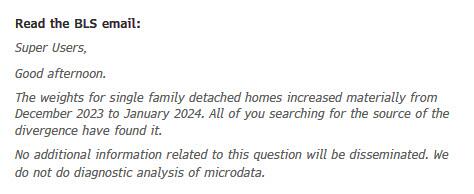
 A little over a month ago, a scandal erupted among the (relatively small( group of economists who keep a close eye on the monthly inflation data reported by the Biden Department of Labor, when they learned that there is an even smaller, and much more exclusive group of economists called "super users" who get preferential treatment from the BLS, including wink-wink-nudge-nudge explanations of where the data may diverge from expectations. That was the case for the January CPI when as Bloomberg first reported, the BLS sent an email to a group of data “super users”, which "explained suggested a surge in a measure of rental inflation — which left analysts puzzled — was caused by an adjustment to how subcomponents of the index are weighted":

Once it became public knowledge that there was a super secret group of preferential "accounts" receiving economic data, immediately following the Bloomberg report, a recipient of the email said that BLS Statistics "tried to retract it and that they were told to disregard its contents." Almost as if they were trying to hide it after the fact.

In retrospect, it appears the BLS really did have something to hide, because in a follow up from both the NYT and Bloomberg, we now learn that an economist from the Bureau of Labor Statistics was corresponding on data related the monthly CPI print with major firms like JPMorgan and BlackRock, in what Bloomberg said "raised questions about equitable access to economic information."

Extending on the report from February, records requested by Bloomberg revealed that the unnamed BLS economist answered numerous inquiries about details within the CPI in recent months, mostly related to computations in key categories within shelter as well as used cars, according to

The back and forth between the financial firms and the economist "who has been with the BLS for many years" was first reported by the New York Times;  as discussed previously, the government bureaucrat sent several emails to a broader group, which he called “my super users” in one of the emails obtained by Bloomberg. The BLS previously lied when it said it doesn’t maintain a list of “super users.”

In mid-February, one user asked if they could be added to the “super user email list,” to which the BLS economist replied minutes later, “Yes I can add you to the list.” The move was an attempt by the lowly paid government worker to curry favor with his much better paid peers on the sell- and buyside so that he could, one day, trade the preferential data access for a cushier job in some hedge fund or Wall Street firm.

As Bloomberg details, while the recipients’ names were redacted from the request, email signature details or disclosures from their employers were visible in some of the provided records. And in addition to BlackRock and JPMorgan, other banks, hedge funds and research firms — Brevan Howard, Millennium Capital Partners LLP, Citadel, Moore Capital Management, High Frequency Economics, Nomura Securities International and BNP Paribas — appeared in the exchanges and declined to comment. Pharo Management and Wolfe Research also came up in the emails but didn’t provide comment.

Understandably, economists - at least those who were not important enough to be on the "super user" list - have been clamoring to find out more about these “super users” are after the BLS staffer addressed an email to those people in February, suggesting that a change to the weights of underlying data within a key measure of rental inflation was behind its surge in January’s CPI. As we reported at the time, the BLS told recipients to disregard its contents, and subsequently tried to clear the confusion with a notice on its website. The agency also said that the email was “a mistake.”

But, as noted above, we now know that this was merely the latest lie by a Biden agency; and so this latest revelation "is likely to prompt a deeper look at the dissemination of economic information that has implications for how major assets trade as well as Federal Reserve policy."

The BLS encourages people to ask questions and makes its staff available to engage with the public, but they strive to create equal access to information for everyone, said Emily Liddel, associate commissioner for publications and special studies at the BLS. Clearly, granting access only to Wall Street giants is not quite the equitable treatment the agency's woke DEI staffers envisioned.

“Obviously this has been an embarrassment for the agency,” Liddel said. “The public puts a lot of trust in us to be fair, and our data providers put a lot of trust in us for the data to be secure. It’s our goal to repair that trust.”

And while the BLS economist often pointed users to relevant links on the agency’s website, at least one case, he shared information that wasn’t publicly available at the time, related to the calculation for the used cars index within the CPI.

Liddel said it is “still under review” whether the employee shared other nonpublic information, and that the issues appear to be isolated to this one staffer. He is not answering incoming user questions at this time, she said.

While it remains unclear who the economist is, the NYT reported that emails obtained through a Freedom of Information Act request show that the agency — or at least the economist who sent the original email, a longtime but relatively low-ranking employee — was in regular communication with data users in the finance industry, apparently including analysts at major hedge funds. And they suggest that there was a list of super users, contrary to the agency’s denials.

At the time, the Bureau of Labor Statistics said the email had been an isolated “mistake” and denied that it maintained a list of users who received special access to information.

And while there is no evidence (yet) that the employee provided early access to coming statistical releases or directly shared other data that wasn’t available to the public, in several instances, the employee did engage in extended, one-on-one email exchanges with data users about how the inflation figures are put together. Such details, though highly technical, can be of significant interest to forecasters, who compete to predict inflation figures to hundredths of a percentage point. Those estimates, in turn, are used by investors making bets on the huge batches of securities that are tied to inflation or interest rates.

Analysts regularly interact with government economists to make sure that they understand the data, but “when such access can move markets, the process for that access needs to be transparent,” said Jeff Hauser, executive director of the Revolving Door Project in Washington. “This stuff is so valuable, and then someone just emails it out.”

In at least one case, emails to super users appear to have shared methodological details that were not yet public. On Jan. 31, the employee sent an email to his super users describing coming changes to the way the agency calculates used car prices, at the time a crucial issue for inflation watchers. The email included a three-page document providing detailed answers to questions about the change, and a spreadsheet showing how they would affect calculations.

“Thank you all for your very difficult, challenging and thoughtful questions,” the email said. “It is your questions that help us flesh out all the potential problems.”

The Bureau of Labor Statistics had announced the change in a news release in early January, but did not publish details about it on its website until mid-February, two weeks after the email from the employee.

It isn’t clear when the employee began providing information to super users, or whether he was the only economist at the agency to do so. Several of his emails were also sent to an internal Bureau of Labor Statistics email alias, suggesting that he did not believe his actions to be inappropriate... or he was simply an idiot.

The super users issue came to light in February, when the employee emailed the group saying that he had identified a technical change that explained an unexpected divergence between rental and homeownership costs in a recent data release. “All of you searching for the source of the divergence have found it,” he wrote.

About an hour and a half after that email went out, a follow-up told recipients to disregard it. In a subsequent online presentation, Bureau of Labor Statistics economists presented evidence that the change identified in the employee’s email was not, in fact, the source of the divergence.

https://www.zerohedge.com/markets/scandal-rocks-bidens-labor-dept-lying-about-sharing-non-public-inflation-data-secret-group

Sonoma Pharma Expands Negative-Pressure Wound Therapy Products for Use in US

 Sonoma Pharmaceuticals (Formerly Known As Oculus Innovative Sciences, Inc.), Inc. (Nasdaq:SNOA), a global healthcare leader developing and producing patented Microcyn® technology based stabilized hypochlorous acid (HOCl) products for a wide range of applications, including wound, eye, oral and nasal care, dermatological conditions, podiatry, animal health care and non-toxic disinfectants, today announced the expansion of its Microcyn® Negative-Pressure Wound Therapy (NPWT) Solution products in the United States.

Microcyn Negative-Pressure Wound Therapy Solution, an innovation in advanced wound care, is now available in convenient sizes of 250mL, 450mL, and 990mL. Designed to meet the diverse needs of healthcare professionals and patients, Microcyn NPWT Solution is a cutting-edge solution that provides effective cleaning and irrigation for wounds with precision and reliability. Microcyn NPWT Solution complements a wide array of negative-pressure therapies. Sonoma's solution delivers optimal wound cleansing and management, promoting faster healing and improved patient outcomes. It does not contain antibiotics, and as a result, it does not promote antibiotic resistance and helps reduce odor by removing necrotic tissue.

Sonoma will showcase this expanded product line at CPHI Japan in Tokyo April 17-19, 2024, at booth 5K-03. Sonoma will also showcase Microcyn NPWT Solution at the Symposium on Advanced Wound Care (SAWC) Spring Conference in Orlando, Florida, May 14-18, 2024 at booth 1102. To set up a meeting at either conference, please contact busdev@sonomapharma.com.

https://www.biospace.com/article/releases/sonoma-pharmaceuticals-announces-expansion-of-negative-pressure-wound-therapy-products-for-use-in-the-united-states/

Nurix Therapeutics Announces Extension of Strategic Collaboration with Sanofi

 Goal is to develop an oral STAT6 degrader investigational new drug with potential to address the needs of patients with type 2 inflammation

Nurix anticipates nominating a clinical candidate within the first year of the extension

Nurix Therapeutics, Inc. (Nasdaq: NRIX), a clinical stage biopharmaceutical company developing targeted protein modulation drugs designed to treat patients with cancer and inflammatory diseases, announced today an extension of the ongoing research program with Sanofi US for STAT6 (signal transducer and activator of transcription 6). STAT6 is a key drug target in type 2 inflammation.

https://www.biospace.com/article/releases/nurix-therapeutics-announces-extension-of-strategic-collaboration-with-sanofi-to-develop-novel-targeted-protein-degraders-of-stat6/

Labor market woes: US small businesses scale back hiring plans

 U.S. small businesses' hiring plans fell last month to the lowest level since the early stages of the COVID pandemic even as the labor market remains tight, according to the latest jobs report from the National Federation of Independent Business (NFIB).

The NFIB's report found that just 11% of small businesses surveyed in March planned to create new jobs in the next three months, down one point from February and the lowest level since May 2020. The decline brings the index below its historic average of 11.8% and the NFIB noted in its report that, "Job creation plans are now below what would be typical in a strong growth economy."

More than half of small business owners, 56%, reported hiring or trying to hire in March – a metric that was unchanged from February and prompted the NFIB to note that "employment activity remains solid, although waning from peak levels." 

"Job openings on Main Street are now in line with the levels before the pandemic," NFIB Chief Economist Bill Dunkelberg said in a press release. "Even with the slowdown in openings, the small business labor market remains tight, and owners continue to compete to retain and recruit employees."

Person looks at job opportunities

The National Federation of Independent Business found that small businesses scaled back their hiring plans last month. (REUTERS/Brian Snyder / Reuters Photos)

The competitive labor market prompted a net 38% of small businesses to report raising compensation, an increase of three percentage points from February which was the lowest reading since May 2021.

Nearly one-third of small business owners, or 31%, have job openings for skilled workers while 14% have openings for unskilled labor.

placeholder
Small Business Shoppers

A majority of small business owners reported finding few or no qualified candidates. (Photographer: Daniel Acker/Bloomberg via Getty Images / Getty Images)

The industry with the highest percentage of small businesses reporting job openings was transportation with 77%, up from 53% a year ago. It was followed by services and construction, which each had 44% of small businesses report job openings.

Construction job openings were down nine points from last month and 29 percentage points from a year ago, and almost half of small businesses in the sector reported having a job opening they can't fill.

open sign

Small businesses' three-month hiring plans dipped to their lowest level since May 2020. (iStock / iStock)

Of those small businesses hiring or trying to hire, an overwhelming 86% of owners reported finding few or no qualified job applicants.

The NFIB's report comes after the ADP National Employment Report released earlier this week showed U.S. companies hiring more than expected in March despite high interest rates and uncertainty over when inflation will subside enough for the Federal Reserve to cut rates.

The reports come ahead of Friday's jobs report from the Bureau of Labor Statistics, which will give Fed policymakers a fresh data point to consider as they weigh potential interest rate cuts this year.

https://www.foxbusiness.com/economy/labor-market-woes-us-small-businesses-scale-back-hiring-plans

'Devout Catholic' Biden Disagrees With Pope's Declaration Gender Ideology Is "Deeply Harmful"

 by Steve Watson via Modernity.news,

The White House quickly responded Monday following a declaration published by the Vatican that denounces ‘gender affirming’ surgery and gender ideology as “deeply harmful,” a “violation of human dignity,” and aimed at “eliminating the basis of family.”

The 20 page declaration approved by Pope Francis outlines that a person’s gender is a “gift from God” and that any attempt at gender reassignment infringes on God’s creation.

The document further asserts that attempts to introduce new rights in relation to gender theory in recent years have “led to instances of ideological colonization,” which the Catholic Church regards as “extremely dangerous.”

“Human life in all its dimensions, both physical and spiritual, is a gift from God. This gift is to be accepted with gratitude and placed at the service of the good,” the declaration states.

It continues,”Desiring a personal self-determination, as gender theory prescribes, apart from this fundamental truth that human life is a gift, amounts to a concession to the age-old temptation to make oneself God, entering into competition with the true God of love revealed to us in the Gospel.”

The push for allowing people to identify as any gender they choose, rather than accepting the gender given to them by God denies “the greatest possible difference that exists between living beings: sexual difference,” the Church further decrees, adding that modern gender ideology “envisages a society without sexual differences, thereby eliminating the anthropological basis of the family.”

The document further clarifies that it is not possible to “separate the masculine and the feminine from God’s work of creation, which is prior to all our decisions and experiences, and where biological elements exist which are impossible to ignore.”

The Church states that only in accepting the difference between genders “each person can fully discover themselves, their dignity, and their identity.”

“Creation is prior to us and must be received as a gift,” the document further asserts, adding “At the same time, we are called to protect our humanity, and this means, in the first place, accepting it and respecting it as it was created.”

Pope Francis previously described gender theory as an “ugly ideology of our times which cancels out the differences [in humanity] and makes everything the same.”

Responding to the declaration during a briefing, Biden press secretary Karine Jean-Pierre stated “We are pleased to see that the document… furthered the Vatican’s call to ensure that LGBTQ+ are protected from violence and imprisonment around the world. However, the president will continue to be an advocate for the rights, safety and dignity of the LGBTQ+ community, including transgender people here in the U.S.”

“What about the more specific comments about gender theory and transgender individuals?” a reporter pressed.

Jean-Pierre responded, “I can speak to the president’s stance, and he’s always been very clear on the importance of protecting or having protections for the transgender community and the broader LGBTQ+ community, and that’s been very clear since day one of his administration.”

Between this and declaring Easter Sunday Transgender day, many are now highly suspicious of Biden’s claim to be a ‘devout Catholic’.

*  *  *

https://www.zerohedge.com/political/devout-catholic-biden-disagrees-popes-declaration-gender-ideology-deeply-harmful