Search This Blog

Thursday, November 7, 2024

Study Calls for Immediate Global Moratorium on COVID-19 ‘Vaccines’

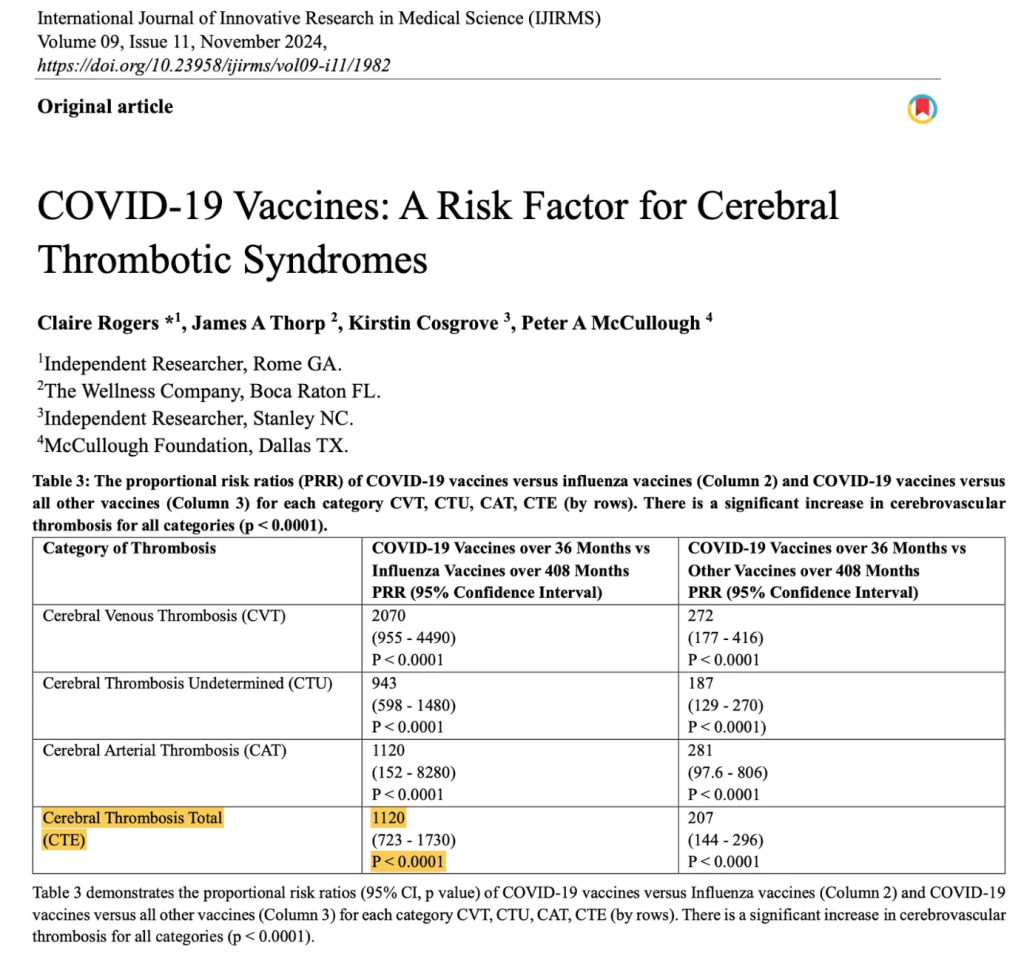
 With the election behind us and immense government public health reform on the horizon, the study by Rogers et al, titled COVID-19 Vaccines: A Risk Factor for Cerebral Thrombotic Syndromes, was just published after successful peer-review in the International Journal of Innovative Research in Medical Science.

The methodology employed for this study is as follows:

Data were collected from the U.S. Centers for Disease Control and Prevention (CDC) and Food and Drug Administration (FDA) Vaccine Adverse Event Reporting System (VAERS) database from January 1, 1990 to December 31, 2023. CTE AEs (cerebral thromboembolism adverse events) after COVID-19 vaccines were compared to those after influenza vaccines and after all other vaccines using proportional reporting ratio (PRR) analysis by time.

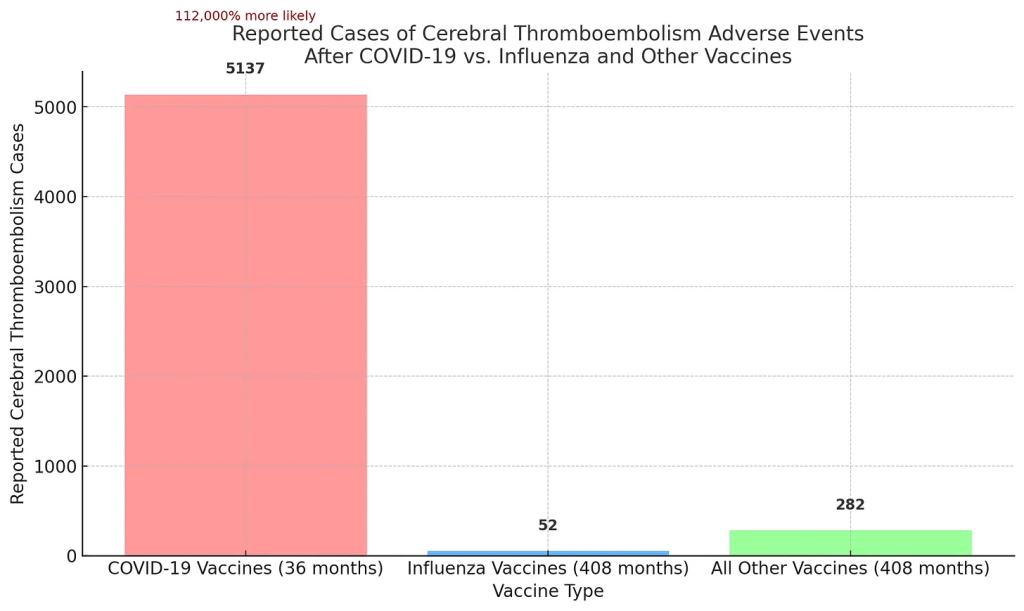
They found that brain clots (cerebral thromboembolism adverse events) are 112,000% more likely to occur after receiving a COVID-19 vaccine than after receiving an influenza vaccine. When comparing COVID-19 vaccines to all other vaccines combined, the likelihood is 20,700% higher. After COVID-19 vaccination, there were 5,137 reported cases of cerebral thromboembolism in just 3 years (36 months). For influenza vaccines over the past 34 years (408 months), there were only 52 reported cases. To visually express this enormous safety signal, I have created the following figure:

Accordingly, the authors concluded:

There is an alarming breach in the safety signal threshold concerning cerebral thrombosis adverse events after COVID-19 vaccines compared to that of the influenza vaccines and even when compared to that of all other vaccines. An immediate global moratorium on the use of COVID-19 vaccines is necessary with an absolute contraindication in women of reproductive age.

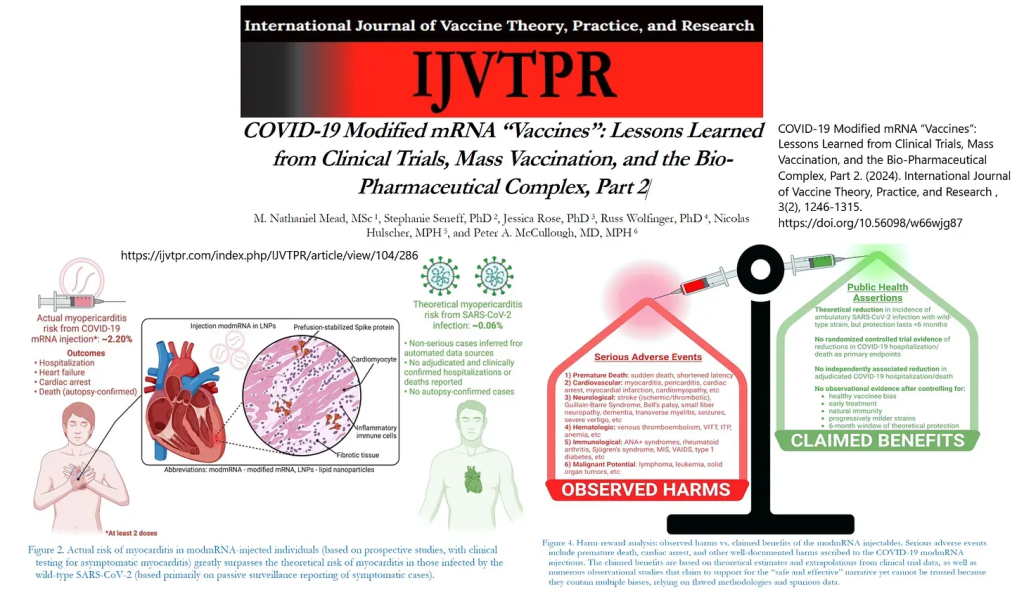
Their call for a global moratorium echoes the comprehensive study by Mead et al and many others:

1) World Council for Health

2) Florida’s Surgeon General

3) The Hope Accord

4) Doctors for COVID Ethics (D4CE)

5) Association of American Physicians and Surgeons (AAPS)

6) McCullough Foundation


Nicolas Hulscher, MPH

Epidemiologist and Foundation Administrator, McCullough Foundation

http://www.mcculloughfnd.org

https://vigilantnews.com/post/new-peer-reviewed-study-calls-for-immediate-global-moratorium-on-covid-19-vaccines/

Judge Denies AstraZeneca's Motion To Dismiss In Vaccine Injury Case

 by Zachary Stieber via The Epoch Times (emphasis ours),

A federal law that grants broad legal immunity to vaccine manufacturers does not protect AstraZeneca against a breach of contract claim brought by a woman who was injured by the company’s vaccine, a U.S. judge ruled on Nov. 4.

A dose of the AstraZeneca COVID-19 vaccine in an undated file photograph. Louai Beshara/AFP via Getty Images

The Public Readiness and Emergency Preparedness (PREP) Act protects manufacturers of vaccines during times of emergency, such as the COVID-19 pandemic.

Brianne Dressen sued AstraZeneca for neglecting to, as promised in a contract, cover the costs of injuries she suffered after participating in the company’s clinical trial in 2020. The pharmaceutical company said it was immune from the lawsuit under the PREP Act.

U.S. District Judge Robert J. Shelby disagreed, ruling on Monday in favor of Dressen and denying AstraZeneca’s motion to dismiss.

While Dressen can’t sue over the injuries, she can over the breach of contract because the legal immunity granted by the law does not cover at least some contractual claims, Shelby said.

“The basis of Dressen’s claim is a broken promise, not a countermeasure,” he said, adding later: “Dressen was administered a covered countermeasure, and she was warned that she may suffer from an adverse reaction, but the fact that she suffered from such reaction was not sufficient to ripen her claim. Rather, she only has a claim because AstraZeneca made a contractual promise to her that happened to involve the effects of a covered countermeasure.”

AstraZeneca put forth a theory in legal filings that immunity from breach of contract claims helps encourage the quick development and deployment of countermeasures during health emergencies, which is the purpose of the PREP Act. Dressen’s lawyers argued enforcing contracts achieves the same result. The judge sided with the latter.

If the PREP Act immunized deceptive contractual inducement and sanctioned illusory promises, then no one would agree to undertake the high-risk activities that are critical during public health emergency responses,” Shelby said. “The PREP Act drafters could not have intended to allow pharmaceutical companies to make illusory promises to clinical trial participants because doing so would erode public trust and undermine the ability to recruit willing participants, which in turn would erode and undermine pandemic preparedness.”

The judge used the example of AstraZeneca agreeing to pay $125 for time and travel reimbursements to Dressen per study visit during the clinical trial. “AstraZeneca’s theory of immunity would allow it to shirk this and any other promise made to trial participants merely because the promise ultimately relates to the administration or use of a vaccine,” he said.

Dressen, a preschool teacher in Utah, volunteered for the 2020 clinical trial. The consent form she signed said AstraZeneca would “cover the costs of research injuries” and “pay the costs of medical treatment.” After receiving the company’s shot, she suffered from a variety of injuries. U.S. National Institutes of Health doctors diagnosed her with vaccine side effects.

AstraZeneca largely declined to offer payment for treatment, beyond a final offer of $1,243, according to court documents.

AstraZeneca’s vaccine was administered widely in some other countries but U.S. authorities never authorized its use beyond clinical trials.

Shelby’s ruling means Dressen’s case will move forward.

Dressen wrote on the social media platform X that the judge “handed down a thoughtful and timely decision.”

“My deepest gratitude to the court for respectfully reviewing this important case and allowing it to move forward,” she said.

An AstraZeneca spokesperson told The Epoch Times in an email that the company cannot comment on ongoing litigation.

“Patient safety is our highest priority,” the spokesperson said. “From the body of evidence in clinical trials and real-world data, the AstraZeneca-Oxford vaccine has continuously been shown to have an acceptable safety profile and regulators around the world consistently state that the benefits of vaccination outweigh the risks of extremely rare potential side effects.”

https://www.zerohedge.com/medical/judge-denies-astrazenecas-motion-dismiss-vaccine-injury-case

'Newsom calls for special legislative session after Trump win'

 California Gov. Gavin Newsom (D) issued a proclamation Thursday to convene a special session of the state Legislature, with the goal of preserving civil rights and enabling potential litigation ahead of the incoming Trump administration.

The special session, scheduled to begin on Dec. 2, will focus on strengthening California legal resources to safeguard fundamental rights, reproductive freedoms, climate action and immigrant families, according to the proclamation.

“The freedoms we hold dear in California are under attack — and we won’t sit idle,” Newsom, widely seen as a prospective Democratic candidate for the White House in 2028, said in a statement.

“California has faced this challenge before, and we know how to respond,” he continued. “We will do everything necessary to ensure Californians have the support and resources they need to thrive.”

The proclamation will be the first of several initiatives taken by Newsom, in partnership with the Legislature, to start “shoring up California’s defenses against an incoming federal administration that has threatened the state on multiple fronts,” according to the governor’s office.

California Attorney General Rob Bonta echoed these sentiments at a Thursday press conference, stressing that he “will continue to use the full force of the law, the full authority of my office, to address injustice, to stand up for all people, especially those who have been long overlooked and undervalued.”

“I’m here today to reassure you that in California, progress will prevail, no matter who is in the White House, no matter who controls Congress,” Bonta said. “In California, we will choose calm over chaos, fact over fiction, belonging over blame.

The Hill has reached out to the Trump campaign for comment.

President-elect Trump and Newsom battled during the presidential campaign, which featured another Californian in Vice President Harris. Newsom was a prominent surrogate for Harris and was crowned with the nickname “New-scum” by Trump.

Newsom’s proclamation, issued just before the attorney general’s address, pointed to “the track record of the first Trump administration” combined with campaign statements and documents as reason for believing that California could endure detrimental consequences.

Among the concerns listed were continued attacks on reproductive freedom, the undoing of clean vehicle policies and long-standing environmental protections, the potential repeal of Deferred Action for Childhood Arrivals and the separation of migrant families, the withholding of disaster aid as political retribution and the politicization of grant programs.

The special session will consider and potentially enact necessary legislation to provide additional funding to the California Department of Justice and offices within the executive branch, per the proclamation.

Those funds would serve to bolster the ability of these agencies to immediately file litigation challenging actions taken by the incoming Trump administration and defend against lawsuits or enforcement actions launched by that administration, the document stated.

The session will also allow legislators to make conforming changes to existing law, consistent with those litigation needs, according to the proclamation.  

While Trump won a resounding victory over Harris, sweeping the swing states and winning the popular vote, she easily defeated him in California. With 60 percent of the vote counted, she led by 1.7 million votes, according to Decision Desk HQ.

“Voters sent a clear message this election, and we need to lean-in and listen,” California State Assembly Speaker Robert Rivas (D) said in a statement.

“But we also must be prepared to defend California values, no matter the challenges ahead, so it makes sense to consider the Governor’s proposal,” Rivas added.

State Senate President Pro Tempore Mike McGuire (D) offered similar comments, stressing that Trump’s first term showed that he “will do what it takes to get his way no matter how dangerous the policy may be.”

“California has come too far and accomplished too much to simply surrender and accept his dystopian vision for America,” McGuire added. “This is an important first step in protecting our progress and the values that make this state great.”

https://thehill.com/homenews/state-watch/4979232-california-special-session-trump/
Study links liver-brain communication to daily eating patterns

 People who work the nightshift or odd hours and eat at irregular times are more prone to weight gain and diabetes, likely due to eating patterns not timed with natural daylight and when people typically eat. But is it possible to stave off the ill effects of eating at these "unusual" times despite it not being biologically preferable?

A new study from the Perelman School of Medicine at the University of Pennsylvania says "yes," and sheds light on how the body knows when to eat. The study, published in Science, explains how researchers discovered a connection between the liver's internal clock and feeding centers in the brain.

The team's research shows that the liver sends signals to the brain via the , letting the brain know if eating is happening at a time that follows the body's circadian rhythm. These signals can get disrupted by working unusual hours. The brain then overcompensates, leading to overeating at the wrong times.

"Both mice and humans normally eat at times when they are awake and alert, and this circuit provides feedback from the liver to the central clock in the brain that keeps the system running smoothly," said the study's senior author, Mitchell Lazar, MD, Ph.D., the director of Penn Medicine's Institute for Diabetes, Obesity, and Metabolism, and the Ware Professor of Diabetes and Metabolic Diseases.

"This feedback is through a nerve connection from the liver to the brain."

Researchers specifically targeted genes called REV-ERBs in the liver cells of mice. REV-ERBs are important proteins that help regulate the body's circadian rhythm. The body's circadian rhythm is an internal 24-hour cycle that regulates various activities including , hormone release, and eating habits.

When these REV-ERB genes were turned off in mice—making the liver have a faulty clock—eating patterns shifted dramatically, with more food consumed during less active times.

The effects were reversible. Cutting the nerve connection in obese mice restored normal eating patterns and reduced food intake.

"This suggests that targeting this liver-brain communication pathway could be a promising approach for weight management in individuals with disrupted ," said Lauren N. Woodie, Ph.D., a post-doctoral researcher in Lazar's lab.

The research team suggests that targeting specific parts of the vagus nerve could help people who work night shifts or experience jet lag by addressing overeating caused by disrupted body clocks.

"These findings open the door to future therapies that can target specific neural pathways to help those struggling with  caused by irregular eating schedules. Future research should focus on what kind of chemical signals the liver sends to the vagus nerve, to help us understand how the  affects the brain and the body through this communication."

More information: Lauren N. Woodie et al, Hepatic vagal afferents convey clock-dependent signals to regulate circadian food intake, Science (2024). DOI: 10.1126/science.adn2786www.science.org/doi/10.1126/science.adn2786


https://medicalxpress.com/news/2024-11-links-liver-brain-communication-daily.html

'Radar stethoscope' could improve contactless health monitoring tech

 A new advance in health monitoring which uses radar to "listen" to patients' heart sounds with remarkable accuracy could lead to a new generation of contactless medical monitoring equipment.

Researchers from the University of Glasgow led the development of the new system, which uses  to track patients' heart sounds like a doctor uses a stethoscope. It improves significantly on previous methods of measuring  using radar waves, which take readings from measurements of patients' chest movements.

In a new paper published in the journal IEEE Journal of Biomedical and Health Informatics, the team demonstrates how they used advanced signal processing techniques to isolate and measure the heart sounds of human volunteers.

Using a 24Ghz continuous-wave radar system, they bounced electromagnetic waves off volunteers' bodies as they lay down, fully-clothed. The reflections of the waves allowed the team to measure not just the movement of their chests but also the sounds their hearts produced as valves opened and closed—a method similar to the way doctors use stethoscopes to hear how patients' hearts are beating.

They used sophisticated filters to remove signal noise and other interference, allowing them to get a clear pulse signal and calculate patients' heart rate.

To test the effectiveness of their method, they collected heart sound and chest movement data from male and female volunteers using radar over periods of 30 seconds, 60 seconds, and five minutes. For each time period, they also measured three different intensities of heartbeat—a "resting" state of between 60 and 80 beats per minute, an "anxiety" state of 100–130 bpm, and a "transition" state of between 80 and 130 bpm.

At the same time, they also monitored the volunteers' hearts using an electrocardiogram (ECG) machine—the current gold standard for clinical measurements of heart rate.

The researchers found that their new system was capable of measuring heart sounds across all intensities with nearly 99% accuracy—their readings differed from the simultaneous ECG measurements by less than one beat per minute.

They also compared the data they collected on chest movement—the conventional method of measuring heart rate with radar—to their improved heart sound method.

They found that the chest movement measurements could fall short of the ECG measurements by 8–50 beats depending on the intensity of the volunteers' heart beat, highlighting the significant improvement their new method represents.

Professor Qammer H. Abbasi, co-head of the Communications, Sensing and Imaging Hub at the James Watt School of Engineering is one of the paper's contact authors. He said, "In recent years, advances in sensing technologies have opened up promising new methods of tracking patients' vital signs without physical contact.

"These advances could help provide clinicians with round-the-clock monitoring of their patients without the use of invasive or uncomfortable wearable sensors, and strengthen  in cases where patients have a communicable illness.

"What we've been able to do with this research is take a big step towards enabling the full potential of radar as a contact-free health monitoring tool. Our signal processing approach has enabled much more accurate detection of heart sounds and measurement of heart rate, which brings it close to the performance of ECG monitoring."

Dr. Hasan Abbas, senior lecturer at the James Watt School of Engineering, is one of the paper's authors. He said, "Unlike camera-based patient monitoring technologies, radar preserves patient privacy by collecting only their vital signs and no information about their movements or activities. The system we've developed could form the basis of a game-changing user-friendly health care technology in the future."

Professor Muhammad Imran is head of the University of Glasgow's Communications, Sensing and Imaging Hub, and a co-author of the paper. He said, "This paper shows that radar can be used to monitor heart sounds with remarkable precision, which could make it invaluable for use in clinical settings and at home in the future.

"We're already looking at other ways to precisely read people's other vital cardiovascular signs using this technique. We hope to develop a more fully-featured commercial design in the future which could pair heart rate monitoring with breathing rate, blood pressure readings and other useful measurements."

Muhammad Farooq, a researcher at the Communications, Sensing and Imaging hub and a final-year Ph.D. student at the James Watt School of Engineering, is also one of the authors of the paper. He said, "The significant accuracy in contactless heart sound detection we've achieved could help unlock the technology's full potential for use in clinical settings, enabling continuous monitoring of vital signs in critical situations.

"This more refined technique for radar remote health monitoring could help facilitate the diagnosis of heart diseases in the future."

More information: Muhammad Farooq et al, Contactless Heart Sound detection using Advanced Signal Processing Exploiting Radar Signals, IEEE Journal of Biomedical and Health Informatics (2024). DOI: 10.1109/JBHI.2024.3490992


https://medicalxpress.com/news/2024-11-radar-stethoscope-contactless-health-technology.html

Even before taking office, Trump puts Mexico on spot — stop the caravans now

 Even before the US polls opened Tuesday, a vanguard of immigrants at least 5,000 strong set out on a long march from deep southern Mexico to the US southern border.

The purpose: to test whether new Mexican President Claudia Sheinbaum will use the military to stop them now that the American election is over.

No less at stake in this fresh northward moving caravan challenge is whether hundreds of thousands more pooled up behind them in southern Mexico — with thousands more a day crossing into Mexico from Guatemala — will observe an unimpeded passage for this vanguard and follow it in a massive human swell that would presumably last until Donald Trump is sworn in January 20.

But Trump isn’t waiting. Just a day before the caravans launched and he won his election, Trump threatened massive, debilitating tariffs on Mexican exports if Sheinbaum lets caravans make it to the border before he gets into office.

“I’m going to inform [Mexico’s president] on day one or sooner that if they don’t stop this onslaught of criminals and drugs coming into our country, I’m going to immediately impose a 25% tariff on everything they send into the United States of America,” Trump declared at his Raleigh, NC, rally on Monday.

“If that doesn’t work,” he added, “I’ll make it 50, and if that doesn’t work, I’ll make it 75. Then I’ll make it 100.”

Recent history shows that this warning shot that Trump fired over the presidential palace has very real potential to impede any mad final mass dash on the southern border during the coming transition period — and much more.

Recall that last December, President Biden struck a backroom deal with Mexico City to alleviate the political spectacle of a badly congested southern border for the coming 2024 political campaign season. For 10 months straight, the deal has had 32,500 Mexican troops and even more federales round up tens of thousands of intending border-crossers from the country’s north and ship them by force to a militarized blockade of its southern provinces.

The operation, known in the Mexican media as “Operation Carousel,” worked wonders, cutting in half world-record illegal border crossings last fall within its first month alone and more every month since.

But no one really knows what would become of Operation Carousel once the American election was over, with Mexico feeling its obligation to the Biden-Harris campaign was now met.

Not least the thousands of trapped immigrants eager to get in before Trump takes office. They’ve been listening with growing panic to his campaign talk about closing the border down immediately while Mexico was trapping them down there and, almost certainly, his very first promissory words of Wednesday morning’s victory speech, “We’re going to fix the border.”

Trump’s tariff threat is not an idle one. Mexico’s economy utterly depends on its US exports. In 2023 and 2024, Mexico overtook China as the US’s largest trading partner, with exports from Mexico reaching their highest in the history of both countries to nearly $379 billion in 2024, increasing another 6.5% in the last quarter. Revenue from Mexican exports to the US totaled a record $593 billion last year.

That won’t be lost on Sheinbaum, a liberal progressive who has long favored passing the mass migration hot potato on to the United States.

As a protégé of former President Andres Manuel Lopez-Obrador (AMLO), Sheinbaum would most definitely recall that her old boss suffered Trump’s first tariff-threat rodeo back in 2019.

That was when Trump, facing a brief but intense surge of family units at the southern border, threatened progressive trade tariffs on Mexican exports that would reach 28% if AMLO did not deploy military to shut down his own southern border with Guatemala and hem in immigrants behind 50 militarized roadblocks leading out of the southern provinces like Chiapas state.

AMLO did as he was told to avoid economic ruination for his country.

Once Biden entered office in 2021, he swept Trump’s tariff threat stick from the table and, politely asking AMLO to keep the operation going, switched to carrots — meaning cash.

The historic mass migration of millions followed — and has now swept Trump into office again.

Will Sheinbaum heed Trump’s tariff threat? She’s being cagey so far, saying only that Trump’s election was “no cause for concern.”

“We are a free, independent, sovereign country and there will be good relations with the United States. I am convinced of this,” she said at a news conference.

The next few months will prove whether that’s true.

Todd Bensman, a senior national security fellow at the Center for Immigration Studies, is the author of “Overrun: How Joe Biden Unleashed the Greatest Border Crisis in U.S. History.”

https://nypost.com/2024/11/07/opinion/even-before-taking-office-trump-puts-mexico-on-spot-stop-the-caravans-now/

Worse Off Now? Real Wages Have Declined Since Nov. 2020

 "Are you better off than you were four years ago?"

Any incumbent president seeking re-election is faced with this political litmus test.

A test that Kamala Harris, as the de-facto incumbent, apparently failed to pass.

As Statista's Felix Richter reports, according to exit polls, 46 percent of voters in key states said that their family was worse off now than it was four years ago, the highest ever in presidential exit polls. But is that really true or are we seeing what some economists described as a "vibecession", i.e. an overly negative perception of an economy that is doing alright?

While the U.S. economy has come through the inflation crisis relatively unscathed, with robust growth, low unemployment and high stock prices, many American families have not.

Or at least it hasn't felt that way.

The main problem with inflation is the fact that it hits consumers right where it hurts: the wallet.

In times of high inflation, when prices increase faster than nominal wages, real wages go down, meaning that workers see (and feel) the purchasing power of their income decline.

During the current inflation crisis, this has been the case from April 2021 to April 2023, when average real hourly earnings declined for 25 consecutive months on a year-over-year basis. In May 2023, real wages began to rise again as nominal wage growth outpaced inflation once again as it normally should.

By looking at cumulative wage growth and price increases since November 2020, we can at least try to answer the question of whether or not Americans are better off than they were four years ago and the answer is: not really.

Infographic: Worse Off Now? Real Wages Have Declined Since Nov. 2020 | Statista


Between November 2020 and September 2024, nominal wages increased 19.2 percent on aggregate.

During the same time, consumer prices have surged by 20.6 percent, though, meaning that prices hikes have erased any wage growth and left real wages 1.1 percent short off where they were four years ago.

https://www.zerohedge.com/personal-finance/worse-now-real-wages-have-declined-nov-2020