Search This Blog

Friday, January 24, 2025

Akero to Present Prelim Phase 2 Data on Cirrhosis Due to MASH Therapy

 Investor webcast on Monday, January 27, 2025, at 8:00 a.m. ET to present clinical data

 Akero Therapeutics, Inc. (Nasdaq: AKRO), a clinical-stage company developing transformational treatments for patients with serious metabolic disease marked by high unmet medical need, will hold an investor conference on Monday, January 27, 2025, at 8:00 a.m. ET to share preliminary topline week 96 results from its SYMMETRY study, a double-blind, placebo-controlled Phase 2b study evaluating the efficacy of efruxifermin (EFX) in patients with compensated cirrhosis (F4) due to metabolic dysfunction-associated steatohepatitis (MASH).

Conference Call / Webcast Details
The company will host a conference call and webcast with slide presentation at 8:00 a.m. ET on Monday, January 27. Please click here to register for the event. The live webcast will be available on the Events & Presentations page of the Akero website, with the recording and presentation available immediately following the event.

https://www.globenewswire.com/news-release/2025/01/24/3015109/0/en/Akero-Therapeutics-to-Present-Preliminary-Topline-Week-96-Results-from-Phase-2b-SYMMETRY-Study-Investigating-Efruxifermin-in-Patients-with-Compensated-Cirrhosis-F4-Due-to-MASH.html

Tevogen Bio Broadens Relationship with Microsoft to Deepen AI Collaboration


  • This expansion is in addition to the previously announced Microsoft for Startups program.
  • PredicTcell, Tevogen Bio’s proprietary technology, is designed for predictive, precision T cell target identification.
  • Tevogen Bio is also proactively investigating potential treatments for Human Papillomavirus (HPV).

Tevogen.AI, Tevogen Bio’s artificial intelligence effort, will integrate Microsoft’s advanced AI tools and the Microsoft Azure cloud platform into two key objectives:

  1. Rapidly Expanding the ExacTcell™ Technology Pre-Clinical Pipeline
    Building on the successful trial results of TVGN 489, Tevogen Bio aims to utilize machine learning to perform critical simulations that will accelerate the identification of new targets. By leveraging Microsoft’s AI, the company can analyze large datasets across the genome with greater speed and accuracy.
  2. Developing Proprietary Algorithms to Decode HLA-T Cell Interactions
    Tevogen.AI, in collaboration with Microsoft domain experts, will create new algorithms to decode the interactions between human leukocyte antigens (HLA) and T cells. This capability is expected to significantly enhance Tevogen Bio’s understanding of immune responses and open new therapeutic avenues, especially in areas with minimal existing data.

Biden Handed China the AI Keys

 American AI companies are feeling the heat over the past month.

China is catching up. In some areas, they are even surpassing the U.S. in artificial intelligence. It may seem hard to believe, but it’s true.

Chinese companies DeepSeek and ByteDance recently released models which are on par with the best models from top U.S. companies OpenAI, Google, and Anthropic.

Here’s what legendary venture capitalist and tech entrepreneur Marc Andreessen had to say about DeepSeek’s new R1 reasoning model:
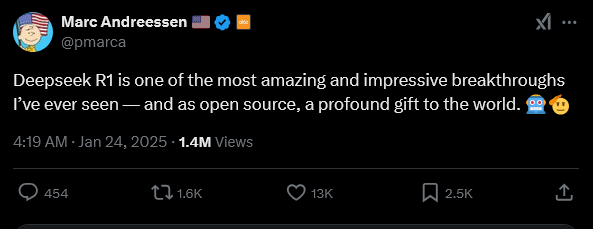
image 1

This Chinese model is “open source” meaning anyone can freely use it in their own applications. And it costs 1/10th to 1/30th as much as the equivalent U.S. models.

Yes, that’s right. China is now “dumping” cheap, high-quality AI access on the world, as they have similarly done with steel, cars, rare metals, and thousands of other products.

On top of all this, these new models are about 95% cheaper to build compared with top American models.

The implications are massive. In the long run, this could threaten not just American AI software companies, but also NVIDIA. If cutting-edge models can be trained with 5% of the previous hardware requirements, what does that mean for GPU sales going forward?

How Did We Get Here?

image 2

Two words: Joe Biden.

The damage his administration caused to American AI efforts will echo for the next decade. President Trump is already working to reverse the damage, but this will take time.

The first thing the Biden admin did was attempt to strangle America’s AI industry. Marc Andreessen has said that in a meeting on the AI industry, Biden officials told his venture capital firm the following:

“Don’t fund AI startups. That’s not something that we’re gonna allow to happen…

They basically said AI is going to be a game of 2 or 3 big companies working closely with the government… We’re going to protect them from competition, control them, and dictate what they do.”

Biden (or his handlers) wanted an AI industry they could control completely. The admin issued AI “safety” executive orders designed to limit competition. Fortunately, Trump has already repealed these EOs, but they set us back for 2+ years.

Operation: Contain China (Status: Failure)

In a 2022 effort to contain China’s AI advancement, Biden cut off the country’s access to high-end NVIDIA GPUs, which are (were) the only suitable hardware to build and run AI applications with.

These tech sanctions have backfired spectacularly. We cornered China and gave them only one way out: innovation. It appears they have met the challenge.

They learned to build cutting-edge AI applications without high-end NVIDIA GPUs. As a result, they can now build models for a tiny fraction of the cost we do.

Fortunately the bulk of their breakthroughs are “open source”, meaning we can learn from and incorporate the designs into future work.

But if we had simply let China have access to top NVIDIA chips, these breakthroughs probably wouldn’t have happened for years. They wouldn’t have needed to. And NVIDIA would have sold a LOT more chips. Now China has its own competing chips, and is making the most of its hardware by maximizing efficiency.

Necessity breeds innovation, and Biden gave China all the necessity it needed. This proves, yet again, that sanctions on big developed countries almost always backfire.

Now we find ourselves in a difficult spot. As I mentioned, Trump is already working to address these challenges, and I believe he will eventually find success.

But we can no longer pretend that China is behind on AI. That era is over. The project to contain their development has failed. It’s time to strike a deal with China, and I continue to believe it will be one of Trump’s top priorities.

In response to these Chinese breakthroughs, Trump is launching the $500B StarGate project with OpenAI, Oracle, Softbank, and others.

Hopefully this project will take the lessons from Biden’s China mistakes to heart. We need to be more efficient with our chips. We can no longer rely on brute force to dominate artificial intelligence.

The wakeup call has arrived. We can no longer underestimate China’s AI sector. American companies will have to step up, and release new cutting-edge products (even if they are unsure about issues like safety).

Things are about to get very interesting.

We’ll keep you updated on this story.

Adam Sharp has been a financial writer and Fed watcher since 2008. He is a contrarian who specializes in non-traditional assets. Adam founded and sold Early Investing, a newsletter about alternative investments. 

https://dailyreckoning.com/biden-handed-china-the-ai-keys/

Argentina Wins Upgrade from Moody’s in Boost for Milei


  • Moody’s raises credit score to Caa3 from Ca; outlook positive
  • Government has aimed to stabilize finances, Moody’s says

Argentina’s credit rating was raised by Moody’s Ratings, which said the government’s efforts to stabilize its finances has decreased the likelihood it will renege on debt obligations.

The ratings company lifted the South American nation one notch to Caa3, the third-lowest level of junk and on par with Ecuador, Bolivia and Ethiopia, while raising the outlook to positive from stable, according to a statement on Friday.

https://www.bloomberg.com/news/articles/2025-01-24/argentina-wins-upgrade-from-moody-s-in-boost-for-milei

Trump Cuts Ukraine Aid As State Dept "Totally Went Nuclear" On Foreign Assistance

 The Trump State Department on Friday halted spending on almost all foreign aid grants for 90 days, which also appears to apply to funding for military assistance to Ukraine, Politico reports.

The guidance, issued by Secretary of State Marco Rubio, was sent to all diplomatic and consular posts, and orders all department staffers to issue "stop-work orders" on nearly all "existing foreign assistance awards."

It appears to go further than President Donald Trump’s recent executive order, which instructed the department to pause foreign aid grants for 90 days pending review by the secretary. It had not been clear from the president’s order if it would affect already appropriated funds or Ukraine aid.

The new guidance means no further actions will be taken to disperse aid funding to programs already approved by the U.S. government, according to three current and two former officials familiar with the new guidance. -Politico

Rubio also outlined the Trump administration's stance on spending, saying “Every dollar we spend, every program we fund, and every policy we pursue must be justified with the answer to three simple questions,” Rubio wrote. The questions: Does the action make America safer, stronger, and more prosperous?

The new order reportedly shocked State Department officials.

"State just totally went nuclear on foreign assistance," a State Department official told Politico.

Rubio was confirmed unanimously by the Senate the day before and is the first of Trump’s Cabinet nominees on the job. Previously, he was a senior senator from Florida, and he served on the Foreign Relations Committee for more than a decade. He developed a reputation as a China Hawk and a fierce critic of the neoliberal foreign policy consensus that emerged after the Cold War.

Shortly after taking the oath of office, he sent a lengthy cable to every US diplomatic and consular post worldwide letting them know that the Biden administration had mistakenly emphasized "ideology over common sense," and "misread the world."

You'll Never Guess Who Still Gets Aid...

The document specifies that Israel and Egypt will continue to receive that sweet, sweet US taxpayer money. It also allows emergency food assistance and "legitimate expenses incurred prior to the date of this" guidance "under existing awards," and also that decisions need to be "consistent with the terms of the relevant award."

One State Department official as well as two former Biden admin officials told Politico that the pause appears to stop aid to Ukraine, Jordan and Taiwan, while the report suggests that the guidance could open the US government to civil liability from lawsuits over unfulfilled contracts if the terms are deemed to have been violated, said the current and former officials. That said, the note from Rubio clearly states that decision need to be "consistent with the terms of the relevant award."

https://www.zerohedge.com/political/trump-cuts-ukraine-aid-state-dept-totally-went-nuclear-foreign-assistance

Trump’s boldest move so far — even Reagan chickened out on it

 By now, no one should be surprised at President Trump’s sweeping reversals of the conventional wisdom on everything from A (asylum) to W (wilderness access)­ — sorry, no executive orders affecting anything beginning with Z yet.

But in revoking President Lyndon Johnson’s 1965 Executive Order 11246 that launched our decades-long imposition of de facto racial quotas under the euphemism “affirmative action,” Trump has gone beyond the boldest imagination of any previous administration.

President Trump signed a slew of executive orders his first day back in the White House.Reuters

A brief history: When the Civil Rights Act of 1964’s Title VII — the clause banning racial discrimination in hiring — was debated in the Senate, opponents charged it would lead to racial quotas.

The Civil Rights Act’s floor manager, future Vice President Hubert Humphrey, denied the claim, saying, “If the senator can find in Title VII any language which provides that an employer will have to hire on the basis of percentage or quota related to color, race, religion or national origin, I will start eating the pages one after another because it is not in there.”

Humphrey lied, essentially. The civil rights lobby was already planning for Johnson’s executive order that called for federal contractors to adopt “affirmative action” — that is, quotas by another name.

Of course, since so many American companies do business with the federal government, this edict affected virtually the entire private sector.

“Individuals will be hired according to their ability, not their color,” Attorney General Robert F. Kennedy told demonstrators in 1963. “I’m not going to go out and hire a Negro just because he is not white.”Bettmann Archive

Although the original EO 11246 didn’t yet mention “goals and timetables,” it did require all companies to file “compliance reports” to the federal government, which were in many ways self-incriminating documents by design.

And the only way to assure compliance and avoid the risk of federal or private civil rights lawsuits was to adopt preferential hiring practices.

By the late 1970s, half the Fortune 500 companies faced civil rights lawsuits alleging racial discrimination.

It was the most dishonest legal regime ever imposed, especially since Title VII included, at critics’ insistence, language explicitly prohibiting preferential hiring by race.

That’s one reason for the decades of legal evasions and linguistic euphemisms, which not only turned the clear language of the Civil Rights Act on its head but repudiated Martin Luther King Jr.’s clarion call for a colorblind society.

It’s why Justice Antonin Scalia observed the Civil Rights Act had been written with “a clarity which, had it not proven so unavailing, one might well recommend as a model of statutory draftsmanship” but because the subterfuges had been transformed into “a powerful engine of racism and sexism.”

Yet Hubert Humphrey never did have to live up to his promise to adopt a high-fiber diet.

Vice President-elect Hubert Humphrey shakes hands with Martin Luther King Jr. in Harlem as Coretta Scott King looks on.Universal History Archive/Universal Images Group via Getty Images

Despite the deep unpopularity of affirmative-action quotas with the American public (and repeated popular votes to end the practice on the state level, including twice in California), no previous Republican administration had the courage to attack it head-on.

The Reagan administration considered revoking EO 11246 in 1985, at the initiative of Attorney General Ed Meese.

President Reagan backtracked on his plan to repeal the 1965 executive order.Jean-Louis Atlan

Ronald Reagan’s cabinet was sharply divided on the issue, with RINOs like Transportation Secretary Elizabeth Dole and Labor Secretary Bill Brock arguing against it and getting several major corporate CEOs to lobby Reagan personally to keep it in place.

Corporate CEOs were so intimidated by the civil rights onslaught that a survey of Fortune 500 companies in the mid-1980s found 88% would keep their affirmative-action hiring regime even if no longer legally compelled to do so.

Faced with the phalanx of opposition from his own cabinet, party and business interests, Reagan quietly withdrew the proposed repeal of 11246.

And thus Trump has now gone where even the Reagan Revolution feared to tread.

This is no minor legal change: It represents the restoration of the principle of equal rights correctly understood.

Steven F. Hayward is the Edward Gaylord distinguished visiting professor at Pepperdine University’s School of Public Policy.

https://nypost.com/2025/01/23/opinion/president-trumps-boldest-move-so-far-even-reagan-chickened-out-on-it-repealing-affirmative-action/

Senate bill would codify Hyde Amendment

 Republican lawmakers reintroduced a piece of legislation that would ban the use of federal funds for abortions or health coverage that includes abortion this week.  

If passed, the bill would essentially codify a decades-old policy called the Hyde Amendment which has banned the use of any federal dollars on abortions since 1977.  

There are two caveats, however. The Hyde Amendment does allow for federal funds to be spent on abortions if continuing a pregnancy endangers the life of the mother or if the pregnancy was the result of rape or incest.  

The reintroduced bill would extend the restrictions to all federal funds and bar abortions from being performed in federal health care facilities or by a federal employee. It would also specify that federal health insurance plans that cover abortion services are not eligible for subsidies under the Affordable Care Act.  

“Using taxpayer dollars to fund abortions is wrong,” wrote Sen. Roger Wicker (R-Miss.), who reintroduced the bill on Wednesday. “My Senate Republican colleagues and I will continue fighting to preserve life.” 

It was also reintroduced by Rep. Chris Smith (R-N.J.) in the House of Representatives on Wednesday. The bill was first introduced in 2023 but failed make it out of a Senate committee.

The Hyde Amendment is not a permanent law but has been attached as a “rider” to the annual congressional appropriations bill for the Department of Health and Human Services and has been renewed every year by Congress, according to health policy nonprofit KFF

The policy has guided public funding for abortions under federal-state Medicaid programs. States are required to foot the bill for abortions that meet the federal exceptions, according to the Guttmacher Institute.  

Among the 36 states where abortion is legal, 19 follow the Hyde Amendment, while 17 states use state funds to pay for abortions for women beyond Hyde limitations, according to KFF.  

https://thehill.com/policy/healthcare/5103151-republican-senators-hyde-amendment-abortions/