Search This Blog

Monday, April 7, 2025

Inside Trump’s Jihadist Elimination Unit at the White House: Senior Director Gorka

 Dr. Sebastian Gorka, the Senior Director of Counterterrorism for the National Security Council (NSC) and a Deputy Assistant to President Donald Trump, told Breitbart News in a lengthy exclusive interview at the White House that Trump has totally reframed how the United States approaches elimination of jihadist terrorists.

“Let’s be clear—President Trump through his National Security Adviser Mike Waltz, and it’s not an accident for the first time in history a former Green Beret is the National Security Adviser, has done a 180 on our counterterrorism policy,” Gorka told Breitbart News. “Let me illustrate this by an incredible story that’s now declassified from the second week of the Trump administration. I’ve been going around the Intelligence Community, the Pentagon, our warfighters, trying to understand what happened the last four years. I was told a horrific story, especially those who are watching the bad guys 12 hours a day from our exquisite platforms, that they’d been tracking jihadis and not been allowed to do anything about it. The last administration, which was really on the side of the bad guys—if you look at the unleashing of the billions of dollars to Iran, if you look at the way they treated Israel and Prime Minister Netanyahu—it was not interested in doing counterterrorism. In fact, they made it so difficult that if you wanted to take out an HVT, a high-value target, it had to go all the way up to the White House through the National Security Adviser Jake Sullivan to the president, Joe Biden or to whoever was functioning with the auto-pen that day, and we thought this was insane. So Mike walked into the Oval Office with myself and with a member of my counterterrorism team in the NSC and we laid a map on the Resolute Desk of a cave complex in northern Somalia that was being used by ISIS and one of the ISIS terror groups’ key financiers, recruiters, and trainers. Mike informed the president we had been surveilling this base, this cave complex, for more than a year and a half. The president looked up from the Resolute Desk and said ‘what do you mean we’ve been watching them under Biden?’ We told him that’s exactly what happened. He said ‘kill them, and kill them now.’ With that big iconic sharpie pen he ticked the ‘go box’ on the operational orders, then my team and I and Mike, we walked out, my Delta Force guy made the requisite phone calls, and less than 30 hours later, underneath the West Wing, in the Situation Room, I was back there with National Security Adviser Mike Waltz, with my team members, and we were watching live hell rain down on this ISIS cave complex in northern Somalia. Now, let’s be clear, that is the beginning of the third week of the Trump administration. That’s how fast President Trump moves, and how decisive he is in taking the war to those who want to kill Americans.”

The interview, taped in mid-March at the White House in the Secretary of War Suite in the Eisenhower Executive Office Building, was more than an hour long and in it Gorka went through in great detail four major actions Trump has already taken inside his first 100 days as president to turn the tide against radical Islamic terrorists.

“The Oval Office is the coolest room in the world,” Gorka said. “This is my favorite in the EEOB, the Secretary of War Suite. This incredible building, this neoclassical building, used to house the whole federal government—everything. We had the equivalent of the State Department, the Department of War was here, and this historic office space is a favorite of someone called Elon Musk—no surprise there.”

The four major actions are the strike Gorka begins to describe above that the president ordered in just his first couple weeks in office, which eliminated an ISIS recruiter hiding in a cave complex in Somalia, the capture of the mastermind behind the Abbey Gate bombing at Hamid Karzai International Airport (HKIA) back in the summer of 2021 when then-President Joe Biden blew the U.S. withdrawal from the war in Afghanistan, a strike against an Islamic leader in Iraq, and now the most controversial of them all the president’s move to authorize the elimination of Houthis in Yemen who have been tormenting American and other ships undercutting free-flowing navigation in a region critical for global commerce. More on each of these four major actions that Trump took including behind-the-scenes details on the president’s decision-making process and how the White House conducted these operations is coming in future parts of this interview. But in this first opening part, Gorka gives a little detail on each.

“Since [the first strike against the ISIS recruiter in Somalia], as you’ve seen, there have been multiple strikes in Iraq, in Syria, in Somalia, and then [in mid-March] the biggest military act the president has taken since the Inauguration, which is basically to allow naval traffic and freedom of passage through one of the most important commercial waterways in the world that has been held hostage by the Houthi jihadists of Yemen,” Gorka said. “This is a waterway that has seen, since Biden in the last year and a half, more than 140 attacks on U.S. vessels. These are the same Houthis who are firing on our military aircraft. The president, when he was told about this, rightfully got incensed. This is now not a secret. He told the DOD, Pete Hegseth, who informed CENTCOM and General [Michael] Kurilla to neutralize the Houthis so that we can have freedom of navigation and the American economy can function again with navigation of those waterways.”

This interview was taped before the Atlantic magazine released the so-called Signal-gate messages, where that publication’s editor, Jeffrey Goldberg, was added inadvertently to a group chat among the senior-most members of President Trump’s administration in which they discussed details relating to the president’s decision to authorize these strikes. Breitbart News is breaking Gorka’s in-depth interview into four major pieces, and this first one being published now is a comprehensive overview of the broader picture of counterterrorism efforts and how things have changed with Trump back in the White House now that Biden is gone from office. Future pieces will take viewers and readers inside the Oval Office, inside the White House Situation Room, and even onto a plane where a terrorist leader was transferred into U.S. custody just hours after the president finished speaking during his joint address to Congress. This first piece also includes Gorka giving viewers and readers a comprehensive look at the active theaters of counterterrorism action worldwide, from different hotbeds in the Middle East to power vacuums in Africa and more. In here, Gorka also details several of what he calls “CT partners,” other nations that help the United States in counterterrorism, and what Trump expects of those partners.

“We call them ‘CT partners.’ We don’t put them in the same bucket as NATO allies—these are CT partners,” Gorka said, adding that the president expects more of U.S. partners and allies in his second term than he did in his first.

“Even more than eight years ago, the president expects our allies and our partners to step up to the plate,” Gorka continued. “People, especially the mainstream media, like to distort the phrase ‘America First’ and misrepresent it. America First is not America alone. President Trump is not an isolationist. You’ve seen what he’s done with NATO, strengthening NATO, and you’ve seen the ties he’s built with nations as diverse as Japan and other countries. The fact is, we expect those who declare themselves to be friends, allies, and partners to do more in our collective interest. If you say you’re a partner, if you say you’re an ally, then behave like that. That’s why we see what the president says about NATO spending, for example. That’s why the president made the comments about Gaza. Can we stop on his Gaza comments for a second? The president said, ‘we’re going to take over Gaza’ and ‘we’re going to fix Gaza.’ He wasn’t talking about gold-plated Trump towers and beaches. It’s not Gaza Lago. What was he doing? If you haven’t read the book The Art of the Deal, you don’t really understand what he’s doing. He said ‘okay we’re going to do Gaza.’ What happens? For 24 hours, regional nations say ‘what do you mean? This is outrageous’ and they get angry. Seventy-two hours later what happens? Certain nations of the region, who really haven’t done very much for the people of Gaza for the last 50 years, say ‘maybe we should invest. Maybe we should help try and fix Gaza.’ So this is what the president does. The Overton window that people talk about expanding—President Trump doesn’t gently expand the Overton window. He makes a comment, whether it’s about Greenland, whether it’s about Gaza, whether it’s about anything, and then what is he doing? He’s blasting the frames, the ceiling, and everything around the Overton window to do what? To engender a discussion so people start to do things in ways that aren’t business as usual.”

Two major such “CT partners” that the U.S. national security officials met with the week this was recorded were, per Gorka, the United Arab Emirates (UAE) and the Jordanians. Gorka said the UAE “can be of great assistance to us with regard to the Houthis and Al-Shabaab, as they’re very active in Africa in terms of investments,” and mentioned UAE’s signing of the Abraham Accords.

“The president is always looking for—it’s not just about national security. It’s about growing the pie of international economics,” he said.

As for the Jordanians, Gorka said, they are his favorite CT partner anywhere.

“As you know, I spent many years teaching counterterrorism for the Defense Department with our partners and with our allies,” Gorka said. “My favorite students outside of the U.S. military were the Jordanians. They are an incredibly, incredibly capable counterterrorism force. The King was one of the very first heads of state to come here after January the 20th.”

Gorka noted that after Trump crushed ISIS in a matter of a few months in his first term, the group’s remnants went into hiding but during Biden’s presidency it began to reconstitute.

“So thanks to President Trump and his crushing of the ISIS caliphate during the first administration—which remember we had been told was impossible, ‘you can’t get rid of the caliphate in Iraq and Syria,’ well, when the president unleashed our special forces and our special operators that time, in five months it was gone,” Gorka said. “So they’ve been forced to reconstitute themselves. Today, under the feckless lack of leadership that was the Biden administration, the picture is not good. The picture is not good that we inherited.”

He pointed to multiple theaters, from the reemergence of Taliban leadership in Afghanistan to power vacuums in Africa to problems elsewhere throughout the Middle East fueled by the Islamic Republic of Iran, which funds various proxy groups like Hamas in Gaza, Hezbollah in Lebanon, and the Houthis in Yemen.

“Let’s look at Abbey Gate, let’s look at the surrender of Afghanistan,” Gorka said. “The nation which originally gave suckle to Bin Laden and Al Qaeda is now under the control of the Taliban again. There is a recrudescence of Al Qaeda. ISIS and ISIS-K, ISIS-Khorasan, is rebuilding their capabilities especially along the Af-Pak border. We say a big thank you to Pakistan that 41 days into the administration with some intelligence we provided to them in the Trump administration that they managed to capture and render to us the Abbey Gate mastermind Jafar. We’ll talk about that separately. So, Afghanistan, number one, and the Af-Pak border region, then we have the reconstitution of ISIS in other parts of the world. They’ve shifted to Somalia, that’s why we took that strike. We have the Houthis in Yemen, who have been just allowed to run rampant and being armed by Iran—the same Iran that was given tens of billions of dollars by the Biden administration. Then, of course, we have Al-Shabaab in southern Somalia. Beyond that, there’s one area that is very disturbing to me because I’m not an Africanist—my background is Middle Eastern jihadism like Al Qaeda and ISIS. When I was briefed by the Intelligence Community on other parts of the world, there is a lot of ungoverned spaces in the African continent and militaries that are not controlled by the nascent governments of those countries. Those ungoverned spaces are being exploited by ISIS and to a certain extent by Al Qaeda. So, we have to work with our partners to help them fight these growing threats on the African continent as well.”

When it comes to what he called the “circus of Iranian proxies,” Gorka said Hezbollah in Lebanon is “the crown jewel.”

“That’s the high end of the jihadi fighting force in terms of dedication, indoctrination, weapons. Hamas were always more of the foot soldiers, more of the expendable proxies for Iran,” Gorka said.

Gorka said the pager operation from Israel has brutally devastated Iran’s proxies in the region, and praised IDF and Mossad figures for their ingenuity, having spent years “seeding” the region with the pagers in what he called an “exquisite” operation.

“They’re not out of the game, but their capability has been deeply weakened,” Gorka said. “I always tell my students when I taught in the military and counterterrorism professionals that in any war whether you’re fighting a nation like Nazi Germany or whether you’re fighting a sub-state actor like Al Qaeda there’s two targets you have to think about and only two predominant targets. Number one, is the capabilities of the enemy. What’s their technology? What’s their weaponry? Do they have tanks? Do they have IEDs? You have to attack their physical capability to do you harm, like the guns they are using or the aircraft they are using. But just as important if not more important, is the will to fight because you can do what we did in Afghanistan and what was derisively called ‘mowing the grass,’ the whack-a-mole exercise where you kill a jihadi, you kill a jihadi, you kill a jihadi. If 10 young men volunteer to replace each jihadi you send to hell, then you’re not actually making things better. You’re actually helping them in terms of their mobilization and getting more recruits. Israel has done a great job. The war isn’t over, but the president is interested in one thing and one thing alone — that the fighting stop, that the peace agreements in Gaza hold, that the hostages are released, and likewise in Ukraine that peace breaks out there as well.”

Gorka also gave his thoughts on the quickly unfolding situation in Syria after the fall of Bashar Al-Assad’s regime late last year. He argued that nobody really can know what will happen there, but the leader of the resistance that took down Assad and now runs the country has deep historical ties to radical Islamic terrorists that are concerning but at the same time the fall of Assad has disrupted Iranian and Turkish operations there.

“Let’s talk about Syria for a moment. Syria is complicated. Why? I don’t think anybody sheds a tear for the fall of the Assad regime,” Gorka said. “The Assad regime was a brutal dictatorship. Nevertheless, what you have in Damascus now isn’t some kind of Jeffersonian Democrat. This individual, [Abu Mohammad al-]Jolani, was a founding member of al-Nusra. Al-Nusra was part of Al Qaeda, it came out of Al Qaeda. So you have somebody who has won a battle to take out this secular Alawite leader and replace the dictatorship with what? We don’t know. All we know is last week this so-called interim president has said that Sharia, Islamic law, will be the law of Syria. Syria, which includes Kurds, Christians, Alawites, Druzes—this is not an exclusively Sunni Muslim nation by any means, so the jury is still out on Jolani and what he wants to do in Syria. At the same time, what do we have? We have the Kurds in the north, we have the SDF—the Syrian Defense Force—and we have the Israelis in the south. Turkey is heavily vested in the region as well. So if anyone tells you they know the future of Syria, they are a liar. Everything is flexible, everything is fluid. However I will say one thing here that is very important: We must be super grateful to the government of Benjamin Netanyahu and to the IDF and to the people of Israel. After that tragic, horrific loss of life on October 7—the greatest loss of Jewish life since the Holocaust—Israel has taken very robust military action and that’s in part why I think the Assad regime fell. They have rewritten the map of the Middle East in a way that will reverberate for at least the next 100 years. One of the very positive aspects of the situation in Syria is because of the fall of the Assad regime and because Russia had to pull out, the Iranian exploitation of the territory of Syria as a resupply route for its proxies and attacks against Israel and elsewhere has basically been nullified so Syria is no longer the playground of Iran like it was just a year ago.”

More from Gorka’s deep dive exclusive interview on the president’s counterterrorism efforts, including inside looks at footage of some of them being killed by U.S. military capabilities, is coming in future pieces of this interview.

https://www.breitbart.com/politics/2025/04/06/exclusive-inside-trumps-jihadist-elimination-unit-at-the-white-house-senior-director-gorka-details-how-potus-has-done-a-180-on-counterterrorism-policy-compared-with-bide/

Why Democrats hate DOGE

 If you haven’t watched the Bret Baier interviews on Fox News with Elon Musk and the other executives who have given their time and expertise to exposing the rampant fraud and inefficiency of our federal government, I urge you to do so.

It will infuriate you, and that’s what we need right now. A lot of voter rage is directed at how Washington is routinely misspending our tax dollars with impunity.

What shines through in the interview is that these volunteers at the Department of Government Efficiency are on a patriotic mission to repair our ship of state. They are hunting down the rats and scoundrels who have played us (we, the taxpayers) for fools for so many years. It is the greatest robbery, with more than $1 trillion of fraud and corruption in world history.

Yet too many Democrats are reacting as if Musk himself is the scoundrel. Apparently, we shouldn’t blame the criminal but the detective.

The “Musk-ateers” have uncovered 10 million Social Security recipients older than 120 (how many monthly checks were sent out?) How about $10 billion in rent for empty office buildings? Hundreds of millions of dollars for foreign aid programs went to “nongovernmental government organizations,” and the money then disappeared down a rabbit hole. More than $150 billion in fraudulent Medicaid spending. A federal workforce that has been MIA for three years. Defense contractors charging the federal government twice as much for weapons systems thanks to “cost-plus pricing” schemes.

In the wake of this epic failure of governance, nearly every leading Democrat in Washington has had the exact same scripted response: “We’re all against waste in government but …” This is followed by a soliloquy about how Elon Musk is going to far …” Translation: Democrats and their army of lobbying bosom buddies aren’t against the rampant fraud and corruption at all. If they were, Presidents Biden or Obama would have done at least something about it.

They never lifted a finger. Nor did Republicans all these years. Washington hid behind a curtain of plausible deniability, even though we had scores of auditors and inspector general reports spotlighting the continuing raid on our federal fisc.

Ripping off taxpayers is one of the biggest businesses in America. It’s so routine that it isn’t seen as a criminal action anymore but rather as the cost of doing business inside the Beltway — like paying off the mob.

Why are Senate Minority Leader Charles E. Schumer, Sen. Elizabeth Warren, Rep. Alexandria Ocasio-Cortez and Al Sharpton not sharing in our collective outrage? Is it because they knew it was happening and feel guilty that they did nothing to stop it? Is it because they think that waste is a normal byproduct of government that can’t be prevented?

Or — and this is the most sinister and obvious explanation: THEY ARE IN ON IT. This could explain how many politicians spent their careers in Congress and retired as multimillionaires.

In other words, what is most revealing about the Washington slime that we are waking up to in real time, thanks to DOGE, is that waste and fraud are the currency of Washington. It pays the bills, and everyone in the swamp gets their cut. Remember: One-third of $7 trillion is the stuff of fortunes.

The classic example is the $2.7 million that Sen. Sheldon Whitehouse directed/laundered to his wife via a nonprofit environmental group she worked for. This was a clear graft, but it went unpunished. We are living through the harrowing last scene in a Hollywood murder mystery when you discover that the police chief was in on it all along.

What is especially maddening is when the Washington elites who profess to stand for “good government” excuse the waste as trivial and then reflexively change the subject to “the rich aren’t paying their fair share of taxes.” Their solution to the fraud and waste is to feed the beast with more money.

In reality, perhaps the greatest public service of the Musk-ateers is that they have taught voters that Washington should never get another penny of our tax dollars until the sewer is completely drained and the tens of thousands of fraudsters inside and outside government are put out of business and hopefully behind bars.

Stephen Moore is a senior fellow at The Heritage Foundation and a co-founder of Unleash Prosperity.

https://www.washingtontimes.com/news/2025/apr/6/democrats-hate-doge/

Mark Penn: Get a grip, Wall Street

 Get a grip Wall Street

The tariff strategy is a risky but determined and certainly bold effort to undo the damage done to the manufacturing sectors of the American economy by unfair trade practices, especially from China. It is a reset of the global economic framework. Whether it works or not I can’t say, but the results will be for everyone to see and the president, who has been successful with some unorthodox strategies in the past, knows his presidency and the success of his party are at stake here. But the markets need to do the math. We only import 11 per cent of our economy and a 20 per cent tariff on half of all imports is only about 1 per cent added costs, most of which goes to reduce the deficit — less than a fraction the impact of sales taxes in virtually any state and these tariffs are often on selected components rather than the finished goods. Yes certain manufacturing industries are affected more than others but then they can search for substitutes and retool. And some brands can now boost their sales if they are made in America and after all that’s the whole point. Wall Street needs to get a grip here — we’ve been through real disasters like the pandemic and the 2008/9 crisis. If every state increased their sales tax 1 per cent the economy would not collapse. We even survived Biden’s 20 per cent inflation, a shock of far greater magnitude. America, remember, has the most adaptable, resilient and innovative economy in the world.

Getting older is not a disease: Overdiagnosis among elderly creating imaginary health crisis.

 Practically everything is considered a medical problem these days. Anything from worrying about school to being chronically late can get you a diagnosis and a prescription. The last thing we need is to treat ageing itself as some kind of terrifying disease.

Of course, we all want to live long and healthy lives. But we must face the inevitability that we will all die of something. For many, this will be caused by some kind of disease, condition or even a terrible accident. But, provided you don’t get hit by the proverbial bus, everyone physically wears out at some point. As you age, so too will your organs begin to reduce in their efficacy, until they eventually shut down altogether.

Last month, a friend of mine – let’s call her Jane – described to me her experience of an annual blood test. Jane is 73, slim, works out at the gym almost every day and eats healthily. She says she feels very fit. So she was in for a shock when she was called in for a face-to-face meeting with her GP to discuss some of her ‘abnormal’ test results. The doctor advised her that she was actually riddled with disease – chronic kidney disease (CKD), pre-diabetes and high cholesterol, meaning a high risk of heart disease. After receiving this unexpected and scary news, her blood pressure was taken. Perhaps unsurprisingly, given the surprise she’d just received, she was also diagnosed with hypertension, putting her at an increased risk of heart attacks and strokes.


The NHS is keen to let us know that we don’t age, so much as become diseased. Over the age of 70, you are likely to be diagnosed with at least one or probably more of the following: pre-diabetes, CKD, hypertension, high cholesterol, chronic obstructive pulmonary disease, cardiovascular disease, prostate cancer, or some other type of cancer, and possibly dementia. Most of these diagnoses result from the fact that test results more often than not fail to take age into account.

A good example of this is CKD. In 2008, the National Institute for Health and Care Excellence (NICE) introduced guidance measures for different stages of kidney disease. What it didn’t do is adjust these for age. Consequently, kidney disease has been found to be more prevalent in those over the age of 60 when compared with the rest of the general population. According to recent estimates from researchers at Johns Hopkins University, more than half of seniors over the age of 75 are believed to have kidney disease. However, not all doctors agree with the NICE guidance. In 2016, an article in the Clinical Biochemist Reviews concluded that ‘in subjects older than 65, CKD category 3A1’, usually meaning a mild to moderate loss of kidney function, ‘is associated with a trivial risk of mortality’. The report proposed an alternate classification for over-65s, under which my friend Jane wouldn’t have been diagnosed with CKD.


What’s more, while catching a disease in its early stages is often a good thing, many of the conditions discovered early are unlikely to advance in older people. For example, pre-diabetes is estimated to affect 50 per cent of people over the age of 65. However, according to one recent study, over-71s with pre-diabetes were more likely to remain in this intermediate state rather than progress into actual diabetes. Many would even return to normal glucose values within six-and-a-half years. The study concluded that having pre-diabetes as an older adult was probably less important than having it when young.

This overdiagnosis can lead to unnecessary procedures, with more risks than benefits. For example, prostate-cancer detection has increased massively, but this is not always a good thing. In a new book by Suzanne O’Sullivan, The Age of Diagnosis: Sickness, Health and Why Medicine Has Gone Too Far, she points out that many prostate-cancer screening programmes don’t necessarily save lives. For every thousand men screened, as many as 20 receive unnecessary treatment. She also highlights that 70 per cent of autopsies carried out on men in their 60s, who died for reasons other than prostate cancer, revealed undiagnosed prostate cancer. Most of these were chance discoveries, and the cancer would likely never have caused these men any significant health problems.


Hypertension is yet another ‘disease’ that older people are routinely diagnosed with. The NHS estimates that 60 per cent of people over 65 have been diagnosed with the condition. But, like CKD, it is a diagnosis that is not routinely adjusted for age. A normal blood pressure range for Jane, at 73, would be 139 / 68. Her average blood pressure measured a respectable 137 / 77. According to the NHS guidance, anything over 135 / 80 is considered hypertension – hence, Jane and many other older people are unnecessarily diagnosed.

The story is similar for high cholesterol. In 2021, 65 per cent of women and 48 per cent of men over 65 were diagnosed with high cholesterol, although it is well-documented that cholesterol rises with age without necessarily being accompanied by the usual increased risk of heart attacks or strokes.


Many will argue that this overdiagnosis is needed to prevent hospital admissions. In reality, the proportion of older people admitted to hospital has been rising, not decreasing, in the UK over the past 20 years. Between 1999 and 2019, rates of hospital admissions in England and Wales increased by 45.6 per cent for 60- to 74-year-olds and by 74.3 per cent for those over 75. This is way out of proportion to the rest of the population, with over-65s making up 15.8 per cent of the general population in 1999 and 19 per cent in 2022. On top of this, unnecessary hospital admissions rose by 107 per cent for people aged between 65 and 69, and 119 per cent for those aged 75 to 79 between 2003 and 2018.

Treating older people as inherently unwell creates a health crisis that simply doesn’t exist. It also stigmatises ageing as a disease, forcing otherwise fit and active older people to live under a cloud of unnecessary anxiety. We should stop labelling getting old as an illness, and let people age gracefully, healthily and without fear.


Sheila Lewis is a retired management consultant and a patient member of Guy’s and St Thomas’ NHS Foundation Trust.

3 ways the media coverage of health care is dishonest

 by Vinay Prasad

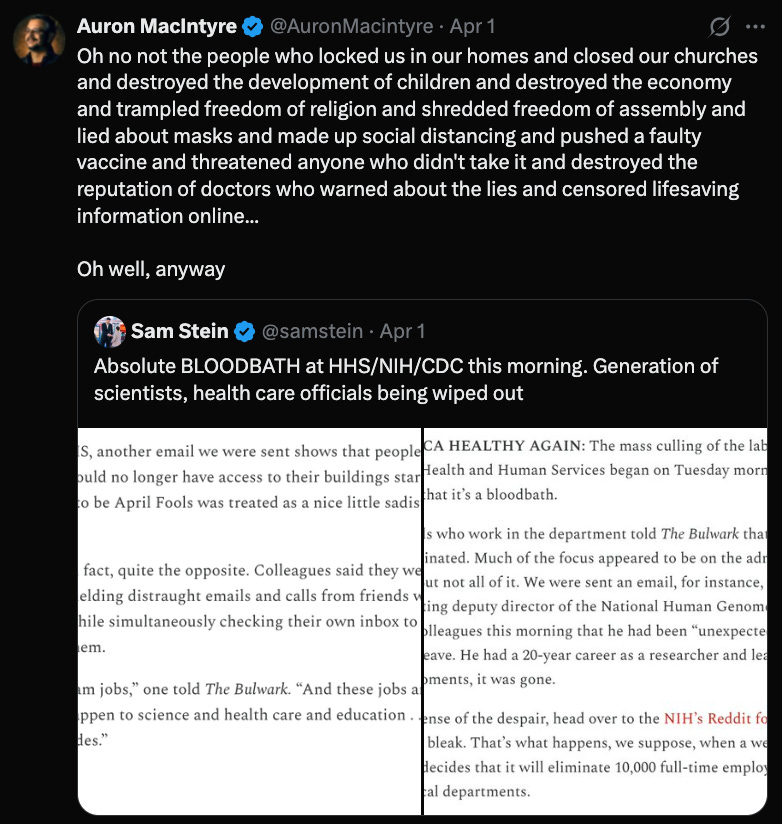
Here are 3 ways the media coverage of medicine and health policy is dishonest.

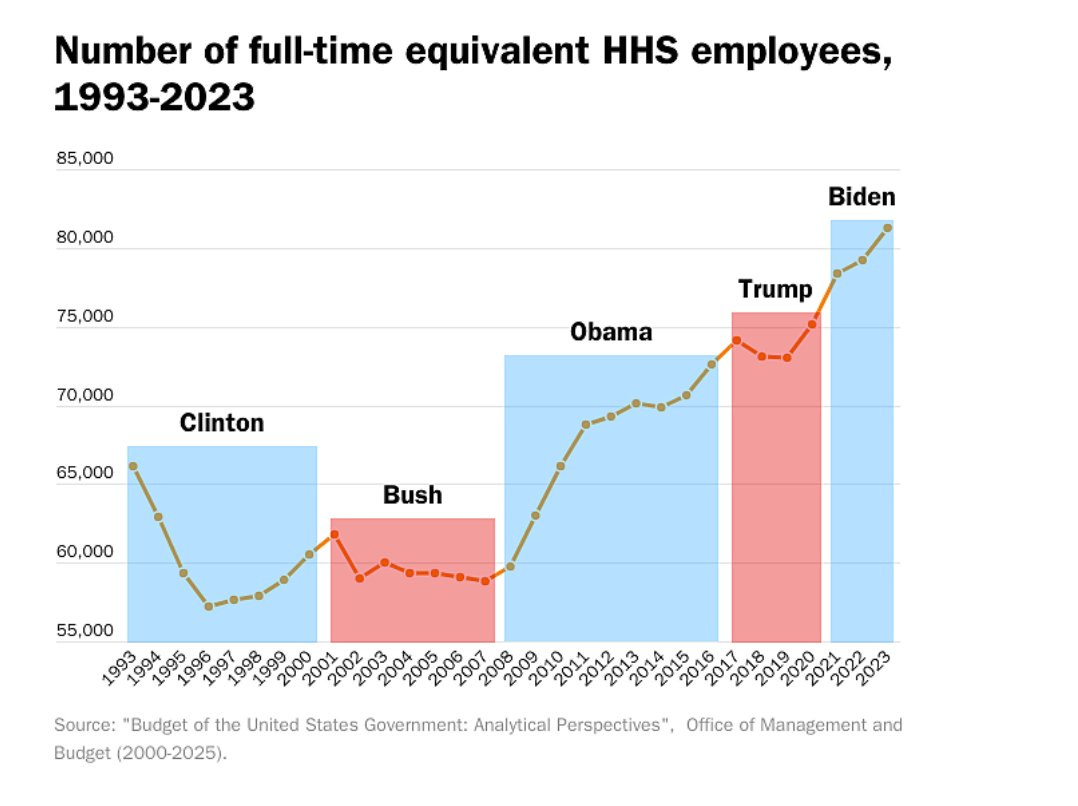
First, the media keeps talking about mass lay-offs but does not put this into the context of HHS growth over time. A reader sent me the figure I was asking for. HHS staffing by year.

Image

I would not have truncated the y axis, but the point is clear. The recent cuts merely reduce the bloated agency to earlier staffing levels.

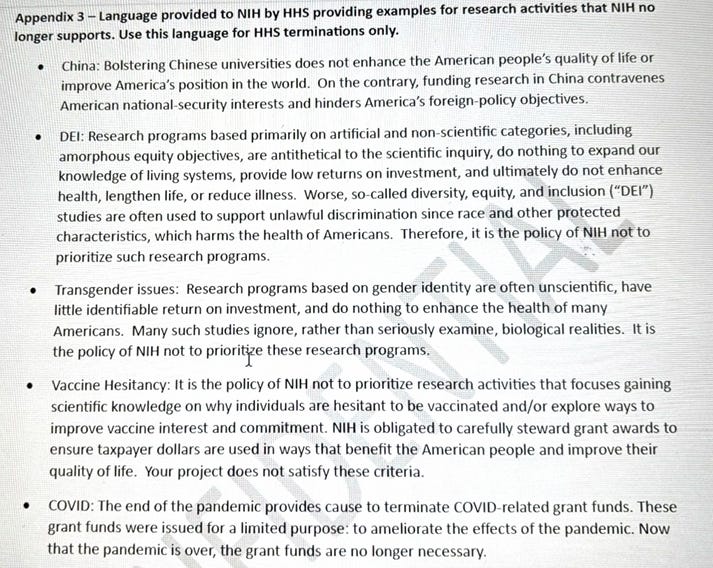
Second, this is White House guidance for what NIH grants to cut

Image

It all seems reasonable to me. Issues that the voters directly voted upon. I would cut most of these as well. Vaccine hesitancy is an important issue, but most current researchers are not studying it honestly. They do not consider the impact of the unethical Biden vaccine mandates on public trust.

Finally, this was cut off from my last post

This issue remains entirely undiscussed in the media.

https://www.drvinayprasad.com/p/3-ways-the-media-coverage-of-health

Iran-backed militias in Iraq ready to disarm to avert Trump wrath

 Several powerful Iranian-backed militia groups in Iraq are prepared to disarm for the first time to avert the threat of an escalating conflict with the U.S. Trump administration, 10 senior commanders and Iraqi officials told Reuters.

The move to defuse tensions follows repeated warnings issued privately by U.S. officials to the Iraqi government since Trump took power in January, according to the sources who include six local commanders of four major militias.

The officials told Baghdad that unless it acted to disband the militias operating on its soil, America could target the groups with airstrikes, the people added.

Izzat al-Shahbndar, a senior Shi'ite Muslim politician close to Iraq's governing alliance, told Reuters that discussions between Prime Minister Mohammed Shia al-Sudani and several militia leaders were "very advanced", and the groups were inclined to comply with U.S. calls for disarmament.

"The factions are not acting stubbornly or insisting on continuing in their current form," he said, adding that the groups were "fully aware" they could be targeted by the U.S.

The six militia commanders interviewed in Baghdad and a southern province, who requested anonymity to discuss the sensitive situation, are from the Kataib Hezbollah, Nujabaa, Kataib Sayyed al-Shuhada and Ansarullah al-Awfiyaa groups.

"Trump is ready to take the war with us to worse levels, we know that, and we want to avoid such a bad scenario," said a commander of Kataib Hezbollah, the most powerful Shi'ite militia, who spoke from behind a black face mask and sunglasses.

The commanders said their main ally and patron, Iran's elite Revolutionary Guards (IRGC) military force, had given them its blessing to take whatever decisions they deemed necessary to avoid being drawn into a potentially ruinous conflict with the United States and Israel.

The militias are part of the Islamic Resistance in Iraq, an umbrella group of about 10 hardline Shi'ite armed factions that collectively command about 50,000 fighters and arsenals that include long-range missiles and anti-aircraft weapons, according to two security officials who monitor militias' activities.

The Resistance group, a key pillar of Iran's network of regional proxy forces, have claimed responsibility for dozens of missile and drone attacks on Israel and U.S. forces in Iraq and Syria since the Gaza war erupted about 18 months ago.

Farhad Alaaeldin, Sudani's foreign affair adviser, told Reuters in response to queries about disarmament talks that the prime minister was committed to ensuring all weapons in Iraq were under state control through "constructive dialogue with various national actors".

The two Iraqi security officials said Sudani was pressing for disarmament from all the militias of the Islamic Resistance in Iraq, which declare their allegiance to Iran's IRGC or Quds Force rather than to Baghdad.

Some groups have already largely evacuated their headquarters and reduced their presences in major cities including Mosul and Anbar since mid-January for fear of being hit by air attacks, according to officials and commanders.

Many commanders have also stepped up their security measures in that time, changing their mobile phones, vehicles and abodes more frequently, they said.

The U.S. State Department said it continued to urge Baghdad to rein in the militias. "These forces must respond to Iraq's commander-in-chief and not to Iran," it added.

An American official, speaking on the condition of anonymity, cautioned that there had been instances in the past when the militias had ceased their attacks because of U.S. pressure, and was sceptical any disarmament would be long-term.

The IRGC declined to comment for this article while the Iranian and Israeli foreign ministries didn't respond to queries.

SHAKEN: IRAN'S AXIS OF RESISTANCE

Shahbndar, the Shi'ite politician, said the Iraqi government had not yet finalised a deal with militant leaders, with a disarmament mechanism still under discussion. Options being considered include turning the groups into political parties and integrating them into the Iraqi armed forces, he added.

While the fate of any disarmament process remains uncertain, the discussions nonetheless mark the first time the militias have been prepared to give ground to longstanding Western pressure to demilitarize.

The shift comes at a precarious time for Tehran's regional "Axis of Resistance" which it has established at great cost over decades to oppose Israel and U.S. influence but has seen severely weakened since Palestinian group Hamas' attack on Israel on October 7 2023 tipped the Middle East into conflict.

Hamas in Gaza and Hezbollah in Lebanon have been hammered by Israel since the Gaza war began while the Houthi movement in Yemen has been targeted by U.S. airstrikes since last month. The fall of Syrian President Bashar al-Assad, another key Iranian ally, has further weakened the Islamic Republic's influence.

Iraq is seeking to balance its alliances with both America and Iran in its dealing with the militias on its soil. The groups sprang up across the country with Iranian financial and military support in the chaotic wake of the 2003 U.S. invasion that toppled Saddam Hussein, and have become formidable forces that can rival the national army in firepower.

U.S. Secretary of Defence Pete Hegseth told Prime Minister Sudani in a phone call on March 16, shortly after the American strikes on the Houthis began, to prevent the militias carrying out revenge attacks on Israel and U.S. bases in the region in support of their allies, according to two government officials and two security sources briefed on the exchange.

The Iraqi-based militias had launched dozens of drone and rockets attacks against Israel in solidarity with Hamas since the Gaza war began and killed three U.S. soldiers in a drone operation in Jordan near the Syrian border last year.

Ibrahim al-Sumaidaie, a former political adviser to Sudani, told Iraqi state TV that the United States had long pressed Iraq's leadership to dismantle Shi'ite militias, but this time Washington might not take no for an answer.

"If we do not voluntarily comply, it may be forced upon us from the outside, and by force."

https://www.aol.com/news/exclusive-iran-backed-militias-iraq-050146971.html