Search This Blog

Saturday, February 7, 2026

Year Two Of The Largest Ever Global LNG Supply Wave Is Hitting Markets

 Roughly two and a half months after Goldman's head of Global Commodities Research, Samantha Dart, laid out a timeline for what she called the "largest ever" LNG supply wave to hit global markets, she published a new client note late this week reiterating that the "supply wave is still on track."

"2025 was year one of what we see as the largest ever global LNG supply wave, lasting seven years," Dart began the note, warning that "this wave is the main driver of a lengthy bearish cycle for European natural gas (TTF) and LNG (JKM), which we expect to bottom in 2028/29."

Dart forecasts that TTF and JKM will average below $5/mmBtu by the end of the decade, around 2028-29, compared with current TTF prices of around $41/mmBtu.

Here is Dart's update on the global LNG supply wave that is in year two, hitting markets:

We see realized 2025 and forecasted 2026 LNG supply largely in line with our previous expectations, despite the recent US disruptions and recent delays to liquefaction capacity starts. Specifically, 2025 global LNG supply averaged 431 mtpa, only marginally below our 433 mtpa expectation as of end-2024, as a large beat in the US (driven by larger-than-expected ramp up at Plaquemines) was ultimately offset by smaller misses across existing LNG producers. We see some of these misses, like for Algeria and Indonesia, as likely structural, owing partly to growing domestic energy demand, and we incorporate further supply losses (-1 mtpa in total initially, but building to -3 mtpa in 2028-2030[1]) in our forward balances.

Global LNG supply has started 2026 below our previous expectations driven by export capacity start delays in the US, Canada, Congo and Australia, though by 4Q26 we expect supply to largely catch up with our earlier numbers.

On net, we still expect 2025-to-2030 global LNG supply growth (+193 mtpa, 45% of 2025 global supply) to far exceed Asia demand growth (+144 mtpa), even taking into account our estimated demand response to low gas prices (>40 mtpa from China alone). We expect this oversupply to take European gas storage to congestion, particularly in 2028/29, leaving a temporary price-driven curtailment of US LNG exports as the likely solver of the imbalance in that period, in our view. We note that all but one of the supply projects in our balances through 2029 have already reached a Final Investment Decision (FID)[2].

The largest ever LNG supply wave is underway, and the early leadership is clear: U.S. capacity is ramping fastest and setting the tone for global balances.

Exhibit 18: The LNG supply wave has started.

Exhibit 12: Supply growth is being led by the U.S.

Exhibit 17: U.S. liquefaction start ups and ramp schedules, the core driver of incremental volumes.

Exhibit 3: Global LNG supply growth remains structurally above Asia demand growth, pushing the market toward a late decade pressure point. In 2028 to 2029, the implied balancing mechanism is supply curtailment, most likely via price driven reductions in US LNG exports as storage and logistics constraints tighten.

https://www.zerohedge.com/commodities/year-two-most-largest-ever-global-lng-supply-wave-hitting-markets

Soros Praises Spain's Sánchez For Mass Amnesty Of 500,000 Illegals

 by Steve Watson via Modernity.news,

Alex Soros, son of billionaire George Soros, has lavished praise on Spanish Prime Minister Pedro Sánchez for granting legal status to up to 500,000 illegal migrants, stating that Sánchez shows “what real leadership looks like” by confronting issues with policies that are “both principled and pragmatic.”

Soros added, “We need more elected leaders like him!” This endorsement comes amid widespread backlash against Sánchez’s open-borders agenda, which critics slam as a betrayal of Spanish citizens.

In a post on X, Alex Soros highlighted Sánchez’s approach, quoting the prime minister’s own words: “They care for aging parents, work in small and large companies, and harvest the food on our tables. On weekends, they walk in our parks and play on the local amateur soccer team….”

The amnesty, implemented via a royal decree bypassing parliament, targets undocumented migrants who arrived before the end of 2025 and can prove at least five months of residence in Spain. 

As The New York Times reported , the Socialist-led government describes it as essential for Spain’s economy, where migrant labor supports agriculture and tourism.

Yet, this move has ignited fury across Spain, with opponents decrying it as an incentive for further illegal entries from North Africa and Latin America. 

As we detailed in our earlier coverage, Spaniards face the prospect of integrating another half-million migrants amid rising tensions and massive resource strains.

The timing of Soros’s praise is telling, as Sánchez’s regime grapples with corruption scandals and probes into his inner circle. 

Facing a firestorm of criticism on X, where users label the amnesty “treasonous,” the far-left government has threatened to “limit and likely ban” the platform entirely.

Sánchez himself, in addition to his underlings, has indicated a desire to ban X.

This crackdown mirrors broader European efforts to stifle dissent, from French raids on X’s offices to EU fines under the Digital Services Act. Musk himself fired back at Sánchez, dubbing him “dirty Sanchez” in response to the censorship push.

Soros’s intervention underscores the globalist playbook: push mass migration to reshape demographics, then silence opposition through free speech restrictions. 

With Spain’s amnesty poised to exacerbate border chaos—echoing Angela Merkel’s 2015 disaster—Sánchez’s policies prioritize foreign arrivals over native Spaniards, fueling demands for accountability.

https://www.zerohedge.com/geopolitical/soros-praises-spains-sanchez-mass-amnesty-500000-illegals

Four reasons pharma is sweeping the Super Bowl despite FDA fears

 Less than six months ago, the FDA initiated a crackdown on D2C advertising, sending out a slew of warning letters and talking about throwing up major impediments to pharma advertising on TV.

“I see the TV ad market heading into Super Bowl 2026 as increasingly precarious,” Sandy Donaldson, cofounder and chief strategy officer of Impiricus and former head of global omnichannel at UCB, told pharmaphorum in an email. “What was once a cornerstone of healthcare brand building is now in the crosshairs of regulatory and political fire from regulators who believe direct-to-consumer drug ads have routinely prioritised hype over clear, balanced risk communication.”

Yet on Sunday, the Super Bowl will feature an unprecedented number of pharma ads from Boehringer Ingelheim, Novartis, and Novo Nordisk, plus telehealth companies Ro and Hims and Hers. Lilly will have a spot in pre-game programming and on Peacock during the game and Pfizer, while skipping the game itself, unveiled a sports-themed ad campaign this week.

So why is pharma advertising surging in the biggest ad playground of the year at a time when you might expect companies to be keeping their heads down for fear of regulatory backlash?

There are several answers to that question, none of them mutually exclusive.

1.    Timing is everything

Ad space during the Super Bowl sells out way in advance, and it’s possible that these companies were locked in before the FDA crackdown in September. Jim Potter, the executive director for the Coalition for Healthcare Communication, says he knows of at least one company that found itself in that situation.

It’s worth noting that of the three big pharmas advertising during the game itself, only one commercial, Novo Nordisk’s Wegovy spot, is a typical drug ad with side effects and warnings at the end. Both Boehringer Ingelheim and Novartis are focused on awareness campaigns aimed at getting people to do screenings, for high uACR and prostate cancer respectively. This would have been a safe option for companies nervous about another regulatory crackdown between September and February, Potter said.

2.    The crackdown that wasn’t

But all of that might be a moot point because so far there hasn’t been that much of a regulatory crackdown.

“If you analyse what happened with the entitled letters, most of those letters are closed out,” Potter said. “Which means they basically went in, they did reshoots or they did some edits, and they brought it back and said, here, how about this? And the agency said, yeah, we're closing out our concern about what we had with your previous ad.”

Though there is likely some kind of guidance or rulemaking still forthcoming, Potter is sceptical that the agency’s rhetoric about closing the so-called 1997 loophole will come to anything.

“From my perspective, that's either a big misnomer or they did really sloppy research through AI to come up with that idea,” Potter said, noting that the FDA's basic premise, that the 1997 rule introduced changes to statutory requirements, is inaccurate, and that even if it weren't, aggressive attempts to limit pharma advertising are still likely to fail in court against First Amendment challenges.

Of note, one area where the FDA enforcement is still very possible, and letters have not been closed out, is GLP-1 compounding, which underlies the Ro and Hims and Hers ads this year. Just yesterday FDA Commissioner Dr Martin Makary posted a warning on X to GLP-1 compounders, promising “swift action”.

3.    GLP-1s need bigger megaphones

The economics of Super Bowl advertising require a product that’s going to have a large enough addressable market to justify the $7 million or more price tag. For pharma in 2026, that’s GLP-1s. Of the seven ads I mentioned at the start of the article, four are related to GLP-1s at least in part.

The Wegovy pill ad is Novo's first ever Super Bowl ad and it features a star-studded case of actors and comedians, Ro is leaning into its partnership with tennis star Serena Williams, and Hims and Hers is airing a more high-concept ad that nevertheless alludes to GLP-1 medications.

Especially as the Wegovy pill is coming out, Lily’s answer is launching soon, and compounders are responding with their own pills, the GLP-1 wars are in full swing. We shouldn’t be surprised that the Super Bowl is a major battlefield.

4.    Taking control of pharma’s narrative

A more interesting explanation is that pharma’s presence at the Super Bowl is about more than poor timing or mass market blockbusters. It might represent a sea change in how pharma is presenting itself to the wider world.

“What the Super Bowl allows healthcare and pharmaceutical brands to do, it's not just about reach, it's about cultural permission,” Heather Coyle, president of the comms agency Triggers, told pharmaphorum. “When pharma and healthcare brands are showing up here, it's signalling this is mainstream, it's not fringe, it's not shameful. They're saying that health belongs in everyday culture, right alongside cars and beer and whatever other pop culture, Doritos, Pepsi that are coming forward, not just in exam rooms.”

Less than a year ago, I wrote about how the IRA caught pharma off guard and the industry was just beginning to reckon with how deeply unpopular it’s become. At last year’s Super Bowl, Hims & Hers caught flack for running an ad that played into that negative public perception of pharma.

Coyle believes that pharma’s presence at the Super Bowl is an effort by the industry to proactively change its place in the culture.

“I think if you take a look at the ads for the Super Bowl this year, they're really framing health choices as reflections of who you are and what life you want, not just clinical decisions and outcomes," she said. "I think that overt shift from, ‘here's a drug for your disease’ to  ‘here's a story you see yourself in’ is a really massive shift.”

https://pharmaphorum.com/sales-marketing/four-reasons-pharma-sweeping-super-bowl-despite-fda-fears

'How Is Lindsey Vonn Skiing With a Torn ACL? Some People Don't Need One'

 The crash looked season-ending, maybe career-ending. On January 30th, Lindsey Vonn wiped out just seconds into her downhill run at the FIS Alpine Ski World Cup in Crans-Montana, Switzerland. She was soon airlifted off the mountain, and reports later surfaced that she’d suffered a complete ACL rupture in her left knee. 

Yet seven days later, Vonn, wearing a brace, completed an official Olympic downhill training run on the Olimpia delle Tofane course in Cortina, placing 11th and instantly igniting a predictable media cycle: minor miracleimpossiblehow is that even safe?  

But if the reports are accurate, nothing “miraculous” happened to the ligament itself. What happened is that the public is watching, in real time, a concept sports medicine has been wrestling with for decades: some knees can function at a very high level without an intact ACL, while others cannot. 

How Is Vonn Able to Ski Again? 

The anterior cruciate ligament (ACL) is a major knee ligament that connects the thigh bone to the shin bone, preventing the shin bone from sliding forward and providing rotational stability. And to be clear it doesn’t just “grow back” in seven days. If it’s truly ruptured, the tissue continuity is gone. What can change quickly is everything around the ligament: swelling, pain, neuromuscular control… and how effectively the athlete can use the rest of the system to dynamically stabilize the knee: muscle, coordination, movement strategy, and (often) bracing. 

That’s where the literature’s not-so-catchy (but very real) term comes in: “Copers.” Athletes who tear their ACL, but are able to return competitive sports without surgery to repair it. 

In ACL research, patients are often described as copers or non-copers. A coper is someone who can return to high function without repeated episodes of the knee “giving way” despite their ACL being torn. A “non-coper” is someone whose knee keeps feeling unstable after an ACL tear, their knee may “give out” during certain movements. When that happens, surgery becomes more necessary, especially if the person wants to return to high-demand sports. 

Is ACL Repair Surgery Always Necessary? 

A key reason many are shocked by Vonn’s comeback is the misconception that an ACL rupture automatically necessitates surgery, with a long recovery. That belief is understandable, since most ACL injuries the public sees occur in elite sport, where reconstruction is common. Moreover, we often see injuries in contact sports, like football, where it’s not just the ACL that gets torn, but other ligaments and knee cartilage (i.e., the meniscus). But when researchers zoom out and synthesize the broader literature, the need for surgery becomes less certain. 

AP
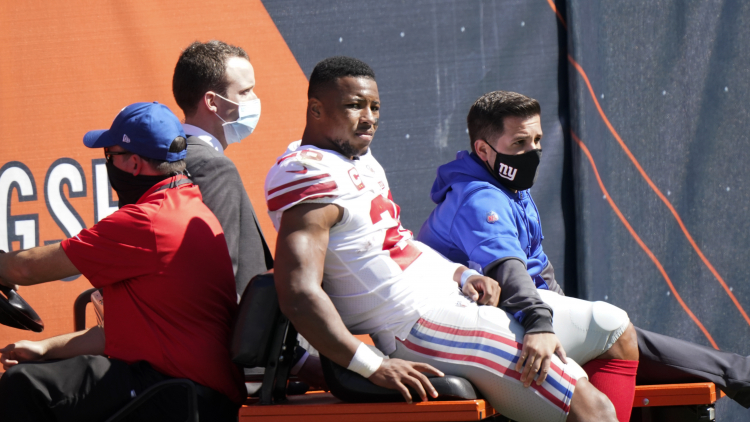
Giants running back Saquon Barkley is carted off due to an injury.

Recent systematic reviews comparing surgical (ACL reconstruction) versus non-surgical (rehab-first) management commonly report that patient-reported functional outcomes can be similar between approaches, while objective stability measures tend to favor surgery. One 2024 systematic review concluded there is insufficient empirical evidence to recommend ACL surgery as the default pathway, noting no differences in functional outcomes overall, but results favor surgery for knee stability and rates of secondary meniscal surgery. Another 2024 review similarly explored conservative versus surgical management, and reflected ongoing uncertainty and variability in the evidence base.  

The most influential “real-world” translation of this debate came from randomized trials comparing two strategies: 1) rehab plus early ACL reconstruction, versus 2) rehab first, with surgery only if it was still needed later. In these studies, “early” surgery was typically done within about 10 weeks of injury. The “delayed” group didn't simply forgo surgery. Everyone in this group started with structured rehab, then clinicians essentially asked: Is the knee becoming stable enough to function well? If yes, surgery could often be avoided. If the knee continued to feel unstable, kept “giving way,” or the athlete couldn’t safely meet their goals, reconstruction remained an option. Many in the rehab-first group never needed surgery at all, and at long-term follow-up (including five years), their self-reported outcomes were similar to those who had early reconstruction. 

To be clear, this isn’t a knock on ACL surgery; it just doesn't need to be the inevitable next step in every case. 

Surgery can improve mechanical stability and may reduce certain downstream risks in some patients, while rehab-first can be an appropriate course for others, especially when instability is not persistent, goals are compatible, and return-to-activity criteria are applied rigorously. The point is that ACL management is case by case.

Clearly, Vonn seems to be delaying or avoiding surgery. But, what allows copers like her to succeed? 

What Makes a “Coper”? 

Importantly, “coper” is not an attitude or personality trait. It’s a classification based on function and stability, often incorporating objective tests (like hop testing), patient-reported knee function, global ratings of knee function, and instability episodes.  

So why do some people become copers while others remain non-copers? The research suggests it’s rarely one single factor. It tends to be a mix of the nature of the injury (for example, whether other structures like the meniscus or cartilage are also involved), the person’s movement skill and baseline training, how quickly swelling and pain calm down, and whether they can regain high-quality strength and control through rehab. Some athletes also naturally move in ways that put less stress on the knee after injury, while others struggle with repeated “giving way” episodes that reinforce instability and limit progress. 

Mechanically, being a coper is less about having “strong muscles” and more about having the right muscles turn on at the right time. The ACL is a passive stabilizer, like a seatbelt. When it’s torn, the body must rely more on active stabilization, meaning the nervous system coordinates the muscles around the knee (especially the quadriceps and hamstrings) to control positioning of the knee. It’s a timing game: microsecond-level coordination, muscle contraction, and precise control, especially during quick transitions, can partially substitute for what the ligament used to do. 

Being a coper is also not fixed. Research published in the Journal of Orthopaedic & Sports Physical Therapy described rehab-first return-to-sport pathways and early screening methods to help predict who may become a coper with rehab and who may remain a non-coper. In that group, a meaningful proportion of athletes who initially tested as non-copers (their knee still felt unstable) later shifted toward potential coper status (a more stable knee) after progressive neuromuscular and strength training. In other words, rehab didn’t just make them stronger, it helped many athletes learn to control the knee better, and the more stable their knees became, the more successful they tended to be long-term. This makes a case for delaying surgery, rather than having it as the automatic pathway following an ACL tear. 

What Makes Lindsey Vonn Unique? 

The coper framework helps explain why a 'miraculous' comeback can be possible. It also helps explain why Lindsey Vonn might be uniquely positioned to pull this off. 

Vonn is a world-class skier in a sport that demands tremendous strength, coordination, agility, and precision. With access to elite rehab, bracing, and careful day-to-day symptom monitoring, she may be able to ski despite a reported ACL rupture - or at least ski long enough to complete training runs and evaluate whether the knee tolerates the demands without swelling or instability. If anyone can coordinate the timing needed to stabilize the knee, on less than a week of rehab, it’s her. 

AP
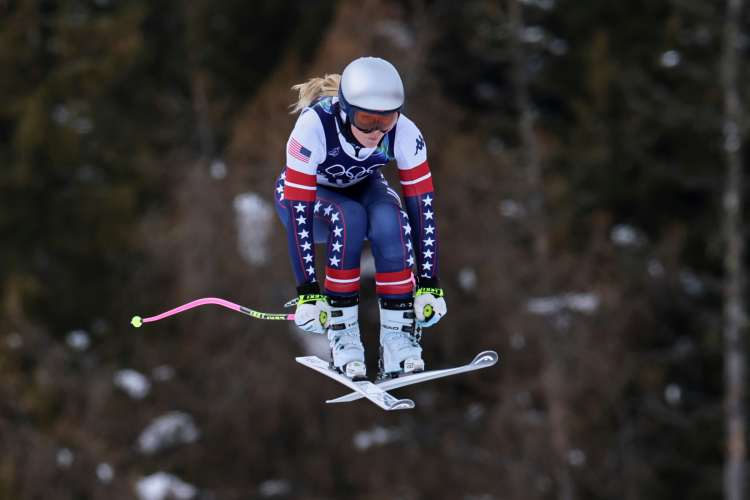
Lindsey Vonn completes a training run at the winter Olympics.

It also shows why extrapolating her scenario to laypersons watching at home is risky: most people do not have the same physical preparation, support system, or sport demands, and many ACL tears include associated injuries that can change the calculus entirely. A 13-year-old athlete who tears an ACL may not have the strength base, movement skill, or neuromuscular “library” built from years of high-level training, and may be far less likely to stabilize an ACL-deficient knee under speed and pressure. 

Conclusion 

If there’s a “media moment” worth capturing here, it isn’t that Vonn defied biology. It’s that the public is getting an accidental crash course in the nuance the research has been pointing to for years: some people can function without an ACL, some cannot, and the best pathway varies person by person: their knee instability history, goals, sport demands, associated injury, and risk tolerance.

Right now, Lindsey Vonn is skiing again, and doing it well. Whether it’s enough to outcompete the very best in the world remains to be seen. 

Regardless of what happens next, Vonn’s ability to return to competitive skiing days after an ACL tear is impressive, but it’s within biological possibilities. She may be in a unique situation to bounce back quickly without surgery because she already has the pre-requisite strength, coordination, and agility to be a world class skier. We shouldn’t think of Vonn as “amazing” because she’s able to return so quickly; rather, she’s able to return so quickly because she is so amazing already. 

Private Markets Push for World’s Wealthy Runs Into AI Meltdown


The salespeople on the front line of a private-markets push to win over the world’s wealthy are quite adept at fielding questions on opacity, liquidity and valuation. Their list of tricky talking points just got a new addition — the so-called SaaSpocalypse.

At the IPEM Wealth conference that kicked off in Cannes this week, a market meltdown linked to fears over artificial intelligence’s impact was an uncomfortable backdrop as a selloff ripped through a raft of software stocks. It also spilled over to private-credit and alternative asset managers, many of whom were out in force at the event. However, evangelists of private markets pitching their products to Europe’s affluent had a different message: Nothing to see here.

The Two Minutes That Made Traders Lose Faith in the Gas Market


More than a week after an extreme bout of volatility roiled the US natural gas market, traders are still fuming over a glitch they say sowed chaos in a key commodity market.

During a record-breaking surge in gas futures on Jan. 27, the New York Mercantile Exchange imposed an extraordinary 2-minute trading halt during the market close that skewed the settlement price and confounded traders already exercised over a demand outlook that had been upended by cold weather. The market pause, which should have lasted only five seconds, was the ninth circuit breaker triggered in the past day.

https://www.marketscreener.com/news/fda-targets-hims-hers-other-marketers-of-unapproved-glp-1-weight-loss-drugs-update-ce7e5ad9de80f125