Sunday, April 26, 2026

RFK Jr. Blasts "Abhorrent" Assisted Suicide: "We Can't Be A Moral Society If America Follows"
by Steve Watson via Modernity.news,
Health and Human Services Secretary Robert F. Kennedy Jr. delivered a blunt warning to lawmakers this week: Canada’s rush to expand assisted suicide is turning a once-free nation into a cautionary tale the United States must reject outright.

Testifying before the Senate Finance Committee and Senate HELP Committee, Kennedy forcefully condemned the program known as Medical Assistance in Dying (MAID). “I think those laws are abhorrent,” he said. Pointing directly to the results north of the border, he added, “And we just see in Canada today, I think the number one cause of death is assisted suicide.”
Kennedy made clear the policy doesn’t stop at personal choice. “And as you say, it targets people with disabilities and people who are struggling in their lives,” he stated. He tied the issue to America’s broader standing in the world: “I don’t think we can be a moral society; we can’t be a moral authority around the globe if that becomes institutionalized throughout our society.”
The comments come as Canada’s experiment spirals. The country is on track to surpass 100,000 assisted deaths before MAID’s 10th anniversary this summer, as noted in a recent New York Post report.
As of 2024, the total already stood at 76,475 — more Canadians killed through the program than died in World War II.
Government-assisted suicide is also spreading like wildfire across the West, often sold as compassion but delivering cost-cutting convenience for cash-strapped socialist healthcare systems.
In the Netherlands, euthanasia now accounts for 6 percent of all deaths and the share is rising every year.
In 2025 alone, 10,341 people died by euthanasia. While most were over 70 with physical illnesses like cancer or heart disease, the cases included 499 dementia patients and 278 listed under vague “other reasons.” One case involved a patient aged between 12-18. Dutch experts are now urging caution for anyone under 25, warning that young brains are still developing and highly susceptible to external pressure and online influence.
Canada’s program began in 2016 limited to terminal cases. Within a year, officials were openly discussing how it could save over $130 million annually in medical costs. Expansions followed: mental illness is scheduled to qualify starting in 2027, and discussions continue about “mature minors” as young as 12.
Belgium and the Netherlands already allow child euthanasia. England, Wales, and Scotland are now pushing similar legislation modeled on Canada’s original law.
The results speak for themselves. In Canada, one in every 20 deaths is now government-assisted suicide. Proponents promised rare, tightly controlled cases. Reality delivered a bureaucratic death machine that quietly expanded to the disabled, the depressed, and the financially burdensome.
Kennedy offered lawmakers a clear path forward. “I am happy to work with you in whatever way we can,” he said, signaling openness to bipartisan efforts to protect vulnerable Americans from the same slope.
Another recent case captured the human cost in Spain, where a 25-year-old woman paralyzed after a horrific gang rape was euthanized despite her parents’ desperate legal fight:
Spanish bishops called it what it is: “Euthanasia and assisted suicide are not medical acts, but deliberate interruptions of the bond of care, and represent a social defeat when presented as a response to human suffering.”
They stressed that “the dignity of the human person does not depend on their state of health… but rather is an intrinsic value that must be recognized, protected and helped in all circumstances.”
The message is simple: when life hurts, the answer is not state-sponsored death but real care, real treatment, and real hope.
Canada and Europe are showing the West what happens when governments treat citizens as budget line items rather than sacred individuals.
Illegal vendors swarm NYC’s Chinatown months after ICE raids
It’s a game of cat and mouse – and knockoff bags.
Illegal vendors are back in full force along Canal Street and scrapping for sidewalk space months after federal authorities carried out a series of raids – but are quick to briefly scatter when NYPD sirens start blaring.
Counterfeit merchants were peddling fake Louis Vuitton handbags and bargaining with customers over other phony accessories this week in Chinatown as surrounding business workers told The Post the black market hawking was as bad as always – or possibly even worse.

Some have cars – where they stuff their inventory — and many vehicles bear out-of-state license plates from Virginia or North Carolina. Some were parked illegally in front of fire hydrants on a recent visit to the illegal market.
“They’re always a problem,” said a gift shop worker Wednesday. “You can’t even walk here.”
“It’s crazier than before the pandemic,” the peeved employee added.
The vendors do get scared off when NYPD cops roll into the area, sometimes as frequently as every couple hours, according to area workers.
They sprinted off and wheeled their goods out of the area even as they tried to close a sale with customers when police vehicles with their sirens blaring arrived around 12:45 p.m. Wednesday.
One under-the-table seller left behind two supposed Vuitton belts behind in the panic.

Another vendor, identified as 46-year-old Yoro Dienge, was hauled away by authorities, police said. The Brooklyn man was charged with second-degree trademark counterfeiting, the department said.
“We are addressing the quality of life that people complain about,” a cop told The Post at the scene.
The local police presence comes after federal immigration enforcement conducted targeted operations to clean up the bustling part of the Big Apple last fall, making several arrests in the process.

But the ICE raids and NYPD enforcement have had little effect, another gift shop worker said.
“When the police is gone, they’re here. They always come back,” he said.
“Police arrest some of them sometimes but a few days later they’re back,” the worker added. “Sometimes they stand in front of the door. We tell them to move out of the way. Sometimes they do, sometimes they argue.”
Alam Mollah, a 65-year-old newsstand owner, told The Post on Tuesday that police can stop by as often as every couple of hours.
“Look, these people can work if they provide money for this country. Since they are living here, they have to help this country because they are making money in this country,” he fumed.
“But the problem is they don’t want to help America. That is the main problem. I pay my taxes and bills but they don’t.”
Bakery worker Jon Lee, 29, also complained “more and more vendors are popping up” and some of the new arrivals “are kind of rude,” causing arguments as everyone battles for a spot on the sidewalk.
“I would say there are a lot more vendors especially on the weekends because it gets quite crowded, making it harder for some of our customers to get inside,” Lee said.
The Strait of Hormuz is squeezing Iran. It's also squeezing China.
Sun Tzu wrote that the supreme art of war is to subdue the enemy without fighting. President Trump is currently subduing two enemies with one strait.
The disruption in the Strait of Hormuz is being covered as an Iran story. However, it is also a China story, and almost nobody is talking about it.
Here is what the numbers show. China buys more than 80% of Iran’s crude oil exports, roughly 1.4 million barrels a day. Most of it is relabeled as Malaysian or Indonesian to dodge sanctions. In total, 45-50% of all Chinese oil imports pass through the Strait of Hormuz. If the Strait is blocked, Beijing loses more than Iranian crude. Saudi, Iraqi, Emirati, Omani, and Kuwaiti oil - all flow through the same waterway.
On April 19, the USS Spruance intercepted and disabled an Iranian-flagged cargo ship, the Touska, in the Gulf of Oman. Marines from the USS Tripoli boarded the vessel after a six-hour standoff. The Touska had previously made voyages to Chinese ports. The message wasn’t for Tehran alone. Beijing was watching too: the ships that carry Iranian oil to China now travel at American discretion.
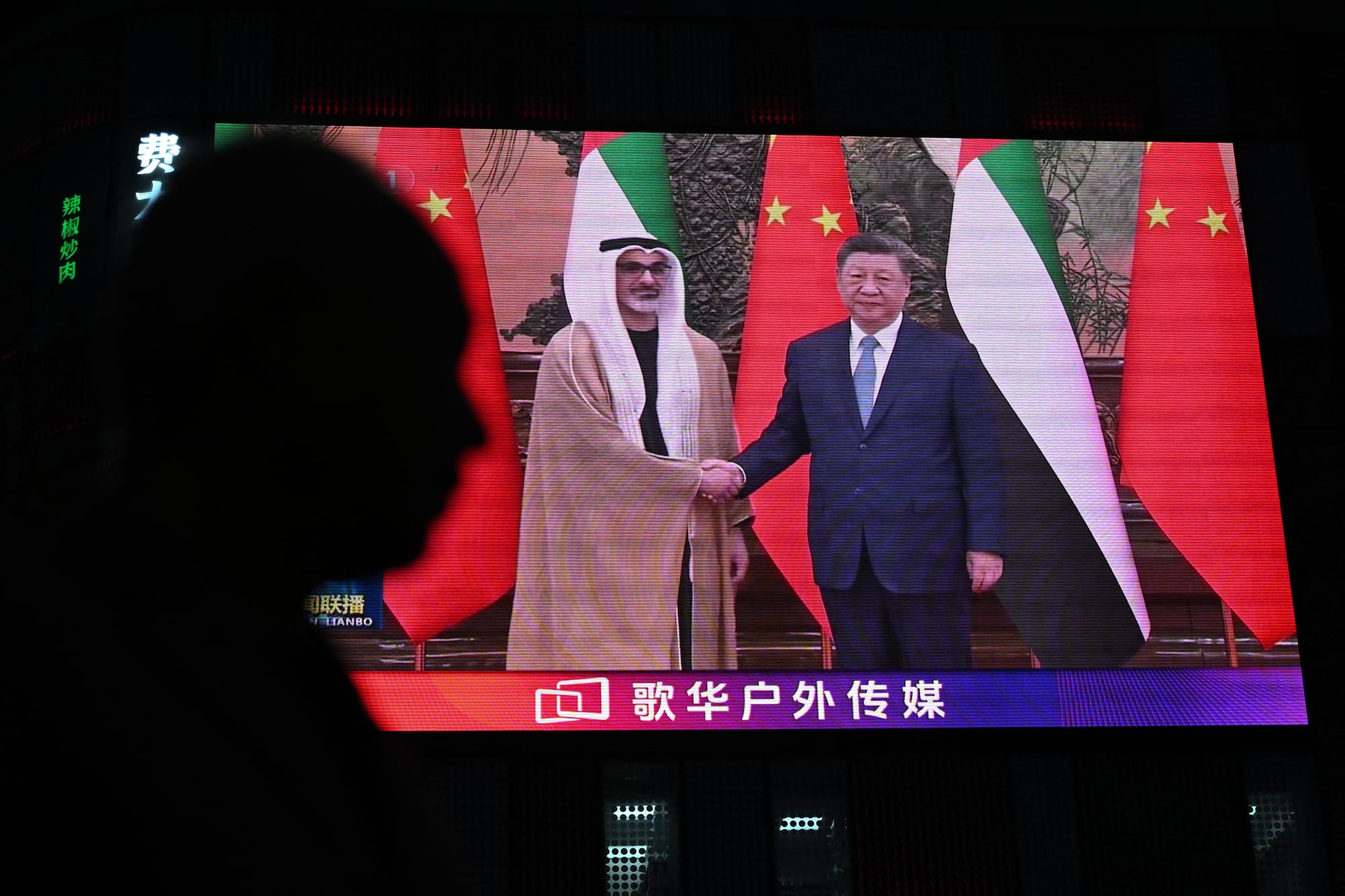
Xi Jinping’s response tells the story. On April 14, a day after the U.S. blockade began, he met the crown prince of Abu Dhabi in Beijing and warned against “the world falling back into the law of the jungle.” Days later, he called Saudi Crown Prince Mohammed bin Salman and urged that “normal passage” through the Strait be maintained. It was the first time Xi publicly called for reopening the Hormuz. He was protecting China's fuel supply, not making a stand for Iran.
Treasury Secretary Scott Bessent made the subtext explicit. On April 15, he said China would “pause” buying Iranian oil because of the blockade. A day earlier, he called China “an unreliable global partner” for continuing to hoard oil while the Strait was shut. An American Treasury Secretary announcing what China will do, and Beijing not contradicting him, clearly shows who holds the leverage.
China saw this coming and was prepared. It spent 2025 aggressively stockpiling oil, adding 1.1 million barrels a day to strategic reserves that now total nearly 1.4 billion barrels, more than three times the U.S. strategic petroleum reserve. That buys roughly 120 days of cover. But 120 days is not forever. And the blockade is already in its eighth week.
The sanctions are also tightening around the workarounds. China officially imports zero barrels from Iran. The trick is relabeling: China imported 1.3 million barrels a day of “Malaysian” crude in 2025. Malaysia only produces 535,000 barrels a day. Washington knows the math. New sanctions target the Chinese “teapot” refineries in Shandong province that process relabeled Iranian crude. And the shadow fleet that carries it is shrinking.
But the real squeeze is diplomatic. Trump’s state visit to China is scheduled for May 14. Xi wants that visit badly. It signals stability, respect, and a functioning relationship between the world’s two largest economies. Trump knows this, and he is using it.
Xi is caught. If he criticizes the blockade publicly, he risks Trump delaying or canceling the visit, as Washington has already done once, pushing it from March to May because of the Iran war. If he stays quiet, he watches his most important oil supplier get strangled while Chinese energy costs rise and his economy slows further. Trump took out Maduro in Venezuela in January, another Chinese oil partner. He struck Iran in February. In both instances, Xi said nothing of consequence.
Trump revealed on Fox Business that he wrote Xi a letter asking him not to supply weapons to Iran. Xi wrote back saying he wasn’t doing so. Then Trump posted on Truth Social: “President Xi will give me a big, fat, hug when I get there in a few weeks. We are working together smartly and very well!” He followed it with: “BUT REMEMBER, we are very good at fighting, if we have to.”
Trump isn't bluffing, and he wants Xi to know it.
The implications stretch beyond oil. Hormuz is a dress rehearsal for the Taiwan Strait. If the world’s most powerful navy cannot keep a 21-mile-wide waterway open against a battered regional power whose fleet has been reduced to speedboats, why would Xi believe the U.S. would risk carriers and submarines to break a Chinese blockade of Taiwan? Taiwan’s TSMC fabricates more than 90% of the world’s most advanced semiconductors. A Chinese blockade would sever the nervous system of the global tech economy, with estimated losses of $10 trillion. What happens in Hormuz doesn't stay in Hormuz. It tells Xi exactly what the U.S. will and won't do if a similar crisis pops up across the globe.
This moment has revealed something Washington understands and Beijing fears: Hormuz squeezes China just as hard as it squeezes Iran. One blockade, applied at one chokepoint, cuts Iran’s revenue and China’s energy supply at the same time.
Sun Tzu advised that the highest form of warfare is to attack the enemy’s strategy, not his army. The blockade of Hormuz attacks two strategies at once: Iran’s bid to outlast American pressure, and China’s bet that it can stay neutral while buying sanctioned oil on the cheap. Anyone watching from across the Pacific should be paying attention.