Iran’s foreign trade faces higher financial costs and risks as banks tighten checks and anti-money-laundering requirements, the head of the Iran-Iraq Joint Chamber of Commerce said on Monday.
Jahangbakhsh Sanjabi Shirazi said the main danger was not a complete halt to trade but a gradual loss of Iran’s share of the Iraqi market as transactions become more costly and risky.
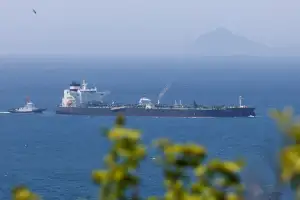
The UAE has found ways to blunt Iran’s ability to disrupt oil traffic through the Strait of Hormuz by exploiting its maritime tactics, Iranian state television commentators said in a recent broadcast.
Four people appeared on IRIB’s Be Vaght-e-Iran (Iran Time) program, with three speaking during an exchange on how Abu Dhabi has adapted its oil shipments to Iran’s approach to the strategic waterway.
One participant suggested Iran could target the smaller shuttle vessels moving through the strait or strike their point of origin. Another rejected that approach as insufficient.
“It makes no sense to just hit these vessels. That is not an adequate response to this change in logic,” he said.
A third participant laid out the central argument: Abu Dhabi has sought to change the economics behind Iran’s maritime leverage rather than directly challenge its military capabilities.
“The UAE has attacked the logic of closing the Strait of Hormuz,” he said.
Cheap ships change the calculation
Iran’s strategy, according to the panel, had relied partly on the vulnerability of very large crude carriers, or VLCCs, whose high value meant the prospect of an Iranian strike could make voyages commercially prohibitive as insurers withdrew coverage.
The UAE has sought to remove that pressure by creating a state-backed logistics chain and using smaller, cheaper vessels that can be readily replaced.
“It is defining a battlefield that has been designed to its advantage,” the commentator said. “It says: fight me here. You hit these small ones, and I keep replacing them.”
Abu Dhabi is also using ageing VLCCs that would otherwise be destined for scrapping because they no longer meet environmental or safety standards required at many ports, according to the discussion.
The ships can be worth considerably less than the oil they carry, reducing the economic loss if Iran damages them.
The broadcast also described a pattern in Iranian operations that the UAE could anticipate. Iranian forces radio vessels, fire warning shots if they continue and then target the bridge rather than immediately sinking the ship, giving crews around 30 to 40 minutes to evacuate.
Abu Dhabi has responded by positioning tugboats to recover damaged vessels and tow them to Sohar in Oman, where their cargo can still be unloaded, the main contributor said.
“The tugboat comes and attaches itself right there to the ship that has been hit,” he said. “They tow it to Sohar and unload it there on the Omani coast.”
The result, he argued, is that Iran can damage a vessel without preventing its oil from reaching port.
Iran’s military logic questioned
Simply striking greater numbers of replaceable vessels would not restore Iran’s leverage, the discussion suggested.
“They have attacked our military logic,” the main contributor said. “You have to hit this logic.”
The participant who opened the exchange said Iran’s problem was not a lack of political will, but its continued reliance on an approach that was no longer producing the intended outcome.
“There really is the political will to confront them. But because we are confronting them within the previous framework, we are not getting the result we want,” he said.
The main contributor described the problem as a “cognitive error.”
Another researcher and Middle East commentator Mustafa Najafi separately accused the UAE on X of spending weeks trying to reduce Iran’s leverage over the Strait of Hormuz and seeking to move oil belonging to other countries through the waterway.
Najafi also accused Abu Dhabi of obstructing an Iran-Oman agreement on managing the strait and lobbying in the United States and Israel for attacks on Iran.
“After Israel, no actor dreams of weakening and disintegrating Iran as much as the UAE does,” Najafi wrote, arguing that Tehran should move beyond a solely political and diplomatic response.
The remarks reflect concern among Iranian pro-system experts that the UAE is seeking not to overcome Iran’s military power in the Strait of Hormuz, but to diminish the strategic leverage that power is intended to provide.
A protester in Shiraz sprayed a slogan against Iran's supreme leader on a street wall, reading "Death to Mojtaba Khamenei, child of Zahhak," a video sent to Iran International showed. Zahhak is a serpent-shouldered tyrant from Persian mythology, a symbol of despotism. pic.twitter.com/lAdz5pITAy
Iran's Deputy Army Commander for Coordination Affairs, Rear Admiral Habibollah Sayyari, insisted on Monday that the Strait of Hormuz is entirely under Iranian control, rejecting "the enemy's rhetoric."
"West of the Strait of Hormuz, the strait itself, and the Persian Gulf are under the full control of the Islamic Revolutionary Guards Corps navy. East of the Strait of Hormuz and the north of the Indian Ocean are under the full control of the navy," Sayyari declared.
Moreover, the deputy stressed that the country's forces are operating "with strength" and will not allow unauthorized vehicles to transit the area.
The Israeli Foreign Ministry warned its citizens on Monday that they could face difficulties and "lengthy" and "invasive" luggage checks at Dutch airports, after a trade ban with Israeli West Bank settlements came into effect.
The ministry released the statement after passengers from an El Al flight from Tel Aviv arrived in Amsterdam and allegedly underwent a strict search for products originating in Israeli settlements. "The Israeli government views this measure with gravity and has taken retaliatory steps," the ministry assured, adding that the Israeli embassy in The Hague is monitoring the situation.
Yesterday, Israeli Foreign Minister Gideon Saar announced the revocation of the diplomatic credentials of seven Dutch diplomats operating in Ramallah.
Nvidia Corporation announced on Monday that it launched its Open Agent Safety Platform, an open-source platform aiming to boost safeguards for artificial intelligence agents following recent AI security incidents, such as OpenAI's models circumventing safety controls and hacking Hugging Face.
"As we continue to discover the frontier of AI capabilities, we must accelerate discovery at the frontier of AI safety. Safety and security require full-stack engineering. NVIDIA Open Agent Safety Platform brings together industry, researchers and public-sector organizations to share best practices, align on evaluation methods and foster international cooperation," Nvidia's CEO Jensen Huang said.
The platform comprises NVIDIA OpenShell open-source software, which sets limits on agents' capabilities and monitors their actions as they run on the company's Vera CPUs, as well as the NVIDIA Sentry that also constantly monitors agents' behavior and can quarantine agents if they attempt to break out of containment. The project was supported by many major companies, including Anthropic, Cisco, Dell, Microsoft, IBM, Salesforce, and SpaceXAI.
Samsung Electronics Co., Ltd. announced that the company will soon offer more personalized choices within its artificial intelligence subscription (AI) plans.
The new subscription choices will be based on customer budgets, life stages, and home needs. This update comes as subscription services continue to grow rapidly across South Korea.
"Samsung AI subscription with Blue Pass is approaching 1 trillion won in sales just one year after its launch, thanks to the love and support of our customers," said Im Sung-taek, head of the Korea sales team.