The UAE has found ways to blunt Iran’s ability to disrupt oil traffic through the Strait of Hormuz by exploiting its maritime tactics, Iranian state television commentators said in a recent broadcast.
Four people appeared on IRIB’s Be Vaght-e-Iran (Iran Time) program, with three speaking during an exchange on how Abu Dhabi has adapted its oil shipments to Iran’s approach to the strategic waterway.
One participant suggested Iran could target the smaller shuttle vessels moving through the strait or strike their point of origin. Another rejected that approach as insufficient.
“It makes no sense to just hit these vessels. That is not an adequate response to this change in logic,” he said.
A third participant laid out the central argument: Abu Dhabi has sought to change the economics behind Iran’s maritime leverage rather than directly challenge its military capabilities.
“The UAE has attacked the logic of closing the Strait of Hormuz,” he said.
Cheap ships change the calculation
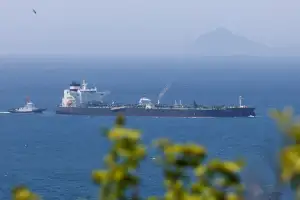
Iran’s strategy, according to the panel, had relied partly on the vulnerability of very large crude carriers, or VLCCs, whose high value meant the prospect of an Iranian strike could make voyages commercially prohibitive as insurers withdrew coverage.
The UAE has sought to remove that pressure by creating a state-backed logistics chain and using smaller, cheaper vessels that can be readily replaced.
“It is defining a battlefield that has been designed to its advantage,” the commentator said. “It says: fight me here. You hit these small ones, and I keep replacing them.”
Abu Dhabi is also using ageing VLCCs that would otherwise be destined for scrapping because they no longer meet environmental or safety standards required at many ports, according to the discussion.
The ships can be worth considerably less than the oil they carry, reducing the economic loss if Iran damages them.
The broadcast also described a pattern in Iranian operations that the UAE could anticipate. Iranian forces radio vessels, fire warning shots if they continue and then target the bridge rather than immediately sinking the ship, giving crews around 30 to 40 minutes to evacuate.
Abu Dhabi has responded by positioning tugboats to recover damaged vessels and tow them to Sohar in Oman, where their cargo can still be unloaded, the main contributor said.
“The tugboat comes and attaches itself right there to the ship that has been hit,” he said. “They tow it to Sohar and unload it there on the Omani coast.”
The result, he argued, is that Iran can damage a vessel without preventing its oil from reaching port.
Iran’s military logic questioned
Simply striking greater numbers of replaceable vessels would not restore Iran’s leverage, the discussion suggested.
“They have attacked our military logic,” the main contributor said. “You have to hit this logic.”
The participant who opened the exchange said Iran’s problem was not a lack of political will, but its continued reliance on an approach that was no longer producing the intended outcome.
“There really is the political will to confront them. But because we are confronting them within the previous framework, we are not getting the result we want,” he said.
The main contributor described the problem as a “cognitive error.”
Another researcher and Middle East commentator Mustafa Najafi separately accused the UAE on X of spending weeks trying to reduce Iran’s leverage over the Strait of Hormuz and seeking to move oil belonging to other countries through the waterway.
Najafi also accused Abu Dhabi of obstructing an Iran-Oman agreement on managing the strait and lobbying in the United States and Israel for attacks on Iran.
“After Israel, no actor dreams of weakening and disintegrating Iran as much as the UAE does,” Najafi wrote, arguing that Tehran should move beyond a solely political and diplomatic response.
The remarks reflect concern among Iranian pro-system experts that the UAE is seeking not to overcome Iran’s military power in the Strait of Hormuz, but to diminish the strategic leverage that power is intended to provide.

No comments:
Post a Comment
Note: Only a member of this blog may post a comment.