Monday, September 28, 2026

Boat Migrants Who Have Entered Britain Now Outnumber Its Soldiers
by Steve Watson via Modernity News,
Britain now has more illegal Channel arrivals under the Labour government, which has been in power two years, than it has soldiers in the British Army.
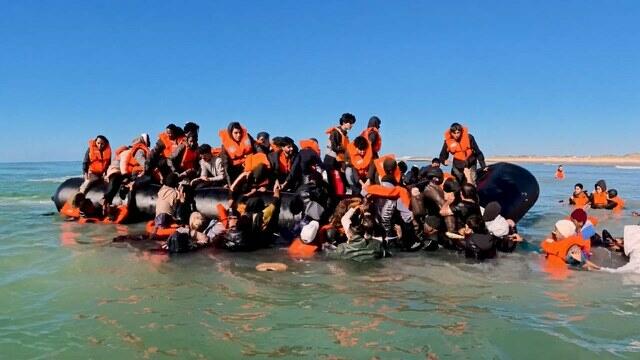
Home Office figures put small-boat arrivals since Labour took office on 4 July 2024 at 83,279. The regular Army stands at 83,000.
On Wednesday alone, 781 people came ashore - the worst single day since Andy Burnham replaced Sir Keir Starmer as prime minister in July. The first three days of the week delivered 1,085 arrivals. Across 809 days of Labour government, that works out at roughly 103 people a day.
Shadow home secretary Chris Philp said the milestone speaks for itself. "Labour has let an entire army-sized population cross the Channel illegally," he said. "More people have arrived in small boats than we have soldiers defending Britain. That is completely bonkers. Labour has lost control of our borders and seems utterly incapable of getting it back."
Former Royal Navy officer Chris Parry went further. Labour's intake, he said, amounts to six-and-a-half divisions of fighting-age men. "That's more divisions than were in the Allied assault wave on D-Day," he added, calling the crossings "amphibious operations against our coast."
The comparison is worse when the rest of the services are brought in. Labour's small-boat total already sits 15,429 ahead of the Royal Navy and RAF combined, which together field 67,850 full-time personnel. And this is only the post-election slice. Under the Conservatives, around 128,000 people arrived by dinghy. Since records began in December 2018 the running total has blown past 200,000 - higher than the combined strength of the Army, Navy and RAF.
Writing in the Mail after more than 1,200 people crossed from Monday, Reform UK leader Nigel Farage said: "It is utterly insane. And if it wasn't clear before, the events of the past few days have proved beyond any reasonable doubt that both Border Force and the Home Office have completely lost control."
He added: "Years ago, I warned the small boats crisis would define this era of British politics. Predictably, the chin-stroking commentariat declared I was exaggerating. Well, look where we are now."
"Ordinary Britons rightly ask if successive governments cannot stop people from arriving illegally in broad daylight, let alone under cover of darkness without detection, then what exactly is the point of having a border?" Farage asked. His party wants the largest military operation in the Channel since the Second World War and a return of every illegal arrival to France.
Two boats this week reached British beaches without Border Force interception - one at Samphire Hoe between Dover and Folkestone, another near Folkestone the day before. Home Secretary Shabana Mahmood ordered an "urgent review" and said even one uncontrolled landing is "one too many." Education Secretary Lucy Powell then told GB News that "you can't stop everything all of the time," while insisting Mahmood was taking "swift action to find out what's gone wrong here and make sure it doesn't happen again."
Border Force union official Lucy Moreton was less diplomatic. Undetected landings are "absolutely, definitely happening," she said, with abandoned vessels and reports "all the way down to Falmouth." "If we don't look for it, we don't know it's happening. We don't know it's happening, we don't have to deal with it."
Labour's first act in 2024 was to scrap the Rwanda deterrent. Shadow energy secretary Andrew Bowie said the latest numbers follow from that choice. "We've got a government that is oblivious to the scale of the problem we face in the Channel," he said. "It's not a surprise, frankly, because the very first thing this Labour government did was get rid of any sort of deterrent to prevent illegal migrants coming into this country."
Former Home Office borders director Glyn Williams told BBC Radio 4's Today programme that "the consequences of a failing policy... are becoming more and more extreme," and that "more extreme measures" may now have to be considered.
The official line is that crossings are down 42 percent this year and that summer 2026 was the quietest since 2020. That is the defence ministers reach for while dinghies still beach in Kent and Britain discusses paying France another billion pounds for the next small-boats deal. GB News presenter Patrick Christys called the week "full-on illegal migrant carnage."
The people coming off those boats do not vanish. They are processed, housed and parked on the public. We have already covered what that looks like on the ground. In Piddington, Oxfordshire - 350 residents, 46 children, no shop, no pub - a Home Office paper for the old MoD depot discussed 3,510 "service users" against an official planning figure of 1,256 single adult males. Ten migrants for every local.
Similar dumps are lined up at Linton-on-Ouse, Barnham and Crowborough as hotels are emptied into former barracks.
The legal machine that then keeps them here is not a refugee system. It is a production line. A Home Office official who has handled thousands of cases put the genuine share at "at best 1 per cent." Package stories, recycled police letters, staged nightclub photos, modern-slavery claims that cannot be disproved. Grant rates still run in the tens of thousands. Removals do not.
Who helps keep the Channel route open is another story again. NGO networks on the French coast have spent years treating the crossing as a humanitarian project rather than a breach of an island nation's border.
Migration Watch chairman Alp Mehmet urged "Military-age men are pouring into Britain across the Channel. Illegal Channel crossings are now a major political crisis, and pose a real and present threat to our national security."
Almost 90 percent of those intercepted since 2018 have been male; two-thirds are aged 18 to 39. People-smuggling gangs have told reporters that Iran has used the route to move operatives in return for a "favour" once on British soil. In 2023, nineteen suspected terrorists linked to Islamic State and al-Shabaab were reported to have arrived the same way.
A country that cannot stop a dinghy in daylight does not have a border policy. It has a ferry service run by criminal gangs, underwritten by hotels, lawyers and a claims system that treats refusal as the hard option.
Labour inherited a failure and then dismantled the one deterrent it had. Burnham now inherits the same beaches, the same numbers, and an actual Army smaller than the cohort that has already washed up on his party's watch.
Samsung NeuroLogica CyberKnife imaging pact lifts Accuray
Sunday Samsung NeuroLogica CyberKnife imaging pact lifts Accuray 52% pre-market
- Accuray announced Sunday agreements with Samsung NeuroLogica to pursue volumetric imaging for CyberKnife.
- PR Newswire release timed with ASTRO 2026 meeting in Boston, where firms highlight the work.
- No commercial product, deal terms or timeline given; effort is phased and regulatory-dependent.
- Royal Marsden is the first clinical site evaluating the imaging-plus-radiosurgery concept.
- Friday close was $0.22; weekend news produced the early Monday pre-market jump to $0.33.
- 52% move far exceeds the stock’s 6-7% average daily range as a $39 million micro-cap.
- X posts mainly recirculated the press release and flagged the pre-market percentage gain.
- No fresh 8-K, offering or other filing since Friday; reverse-split vote is set for October 6.
Kodiak Sciences' Phase 3 wet AMD trial meets primary endpoints for Zenkuda and tabirafusp-ted
Kodiak Sciences' Phase 3 DAYBREAK wet AMD trial meets primary endpoints for Zenkuda and tabirafusp-ted
- Zenkuda showed strong efficacy, with a majority of patients maintained on a 24-week dosing interval under strict treat-to-dryness criteria.
Sony Group (SONY) Exits CES 2027, Shifts Focus Amid Unprofitable Hardware Segment
On September 28, 2026, Sony Group Corp (NYSE: SONY) announced it will not participate in the 2027 Consumer Electronics Show (CES), ending its decades-long presence at the event. This move coincides with Sony’s strategic pivot away from hardware showcases toward entertainment and creator-focused technologies.
- Sony’s current Price-to-Sales (P/S) ratio stands at 1.74, notably above its historical median of approximately 1.25, signaling that the market prices in expectations of future growth despite the company’s ongoing unprofitability, making earnings-based valuation metrics like P/E less relevant.
- SONY’s GF Score™ is a robust 82 out of 100, reflecting solid financial health and operational quality despite recent earnings challenges.
- Insider activity reveals no insider purchases over the past 12 months, with insiders selling shares valued at $30.6 million, while guru ownership remains mixed with six premium gurus holding SONY, five trimming, and three adding to their positions recently.
What's Behind the News?
Sony’s decision to forgo CES 2027 marks a significant shift in its public-facing technology strategy. The company, which has historically used CES as a platform to showcase innovations across consumer electronics and hardware, notably did not have a dedicated booth at the most recent CES. Instead, it participated in a joint venture with Honda to display an electric vehicle concept that has since been discontinued. This withdrawal underscores Sony’s renewed focus on entertainment and creator-centric technologies, moving away from hardware-centric exhibitions.
Founded in 1946 and headquartered in Tokyo, Sony Group Corp is a diversified conglomerate operating in the technology sector with a market capitalization of $138.06 billion. Its business spans gaming through PlayStation, music production, film and television via Sony Pictures Entertainment, and imaging solutions, including the world’s leading CMOS image sensors for smartphones. The company also maintains a financial services arm, partially spun off in 2025. Sony’s broad portfolio reflects its hybrid identity as both a hardware manufacturer and an entertainment powerhouse.
Is SONY Overvalued on a Price-to-Sales Basis?
Sony’s current Price-to-Sales ratio of 1.74 is elevated compared to its historical median of about 1.25, indicating that investors are pricing in expectations for growth despite the company’s lack of profitability. The industry median P/S tends to be lower, suggesting that the market may be attributing a premium to Sony’s diversified business model and future prospects in entertainment and technology services. Importantly, Sony’s trailing twelve months earnings per share (EPS) is negative (-$0.24), rendering traditional earnings-based valuation metrics like the Price-to-Earnings (P/E) ratio ineffective for assessing its value.
Countries Importing The Most Military Drones
Two countries at war with each other account for more than nine in ten of the military drones that crossed borders over the past four years.
Ukraine took delivery of 8,664 foreign-supplied military drones from 2022 through 2025, most of them American, while Russia received 6,720, mostly Iranian Shahed-136s, according to SIPRI data compiled by Visual Capitalist. Taiwan, a distant third, received 291.
SIPRI's count leaves out most of what is actually flying. It tracks only large drones and long-range one-way attack models, so the cheap first-person-view drones fighting much of the war at the front don't register, and neither do drones a country builds at home.
As Visual Capitalist explains further,
Drones have become one of the defining weapons of modern warfare, and international trade in them now revolves around a single conflict.
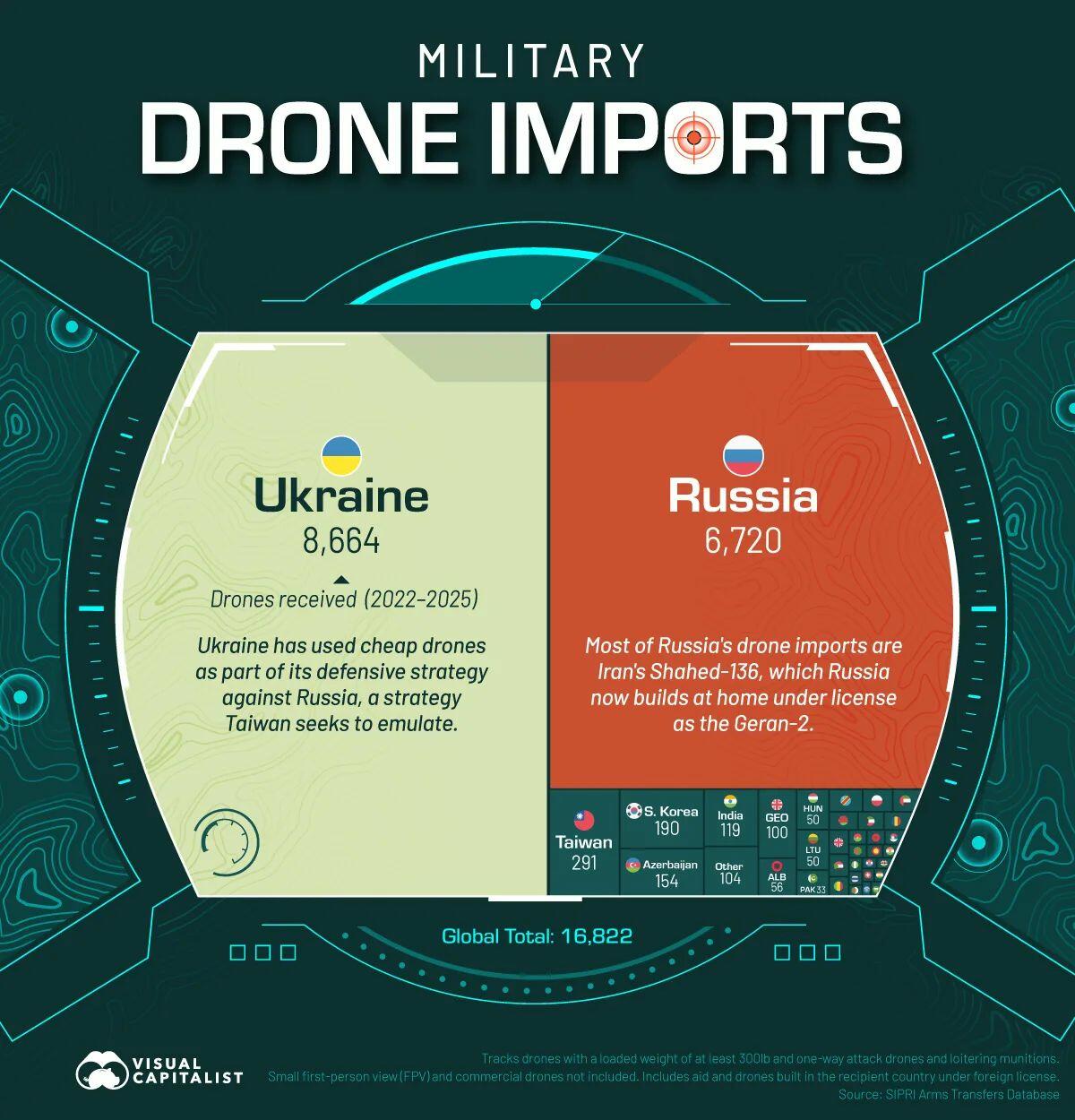
This graphic ranks countries by the number of military drones they received from foreign suppliers from 2022 to 2025, using data from the SIPRI Arms Transfers Database. The figures include drones sent as aid and those built in the recipient country under a foreign license.
SIPRI tracks major weapons only: drone aircraft with a loaded weight of at least 150 kg, plus one-way attack drones and loitering munitions, which it classifies as missiles. Small first-person-view (FPV) and commercial drones fall largely outside its scope.
Ukraine and Russia Dominate Military Drone Imports
The ranking drops off sharply after the top two countries. No other country received even 300 military drones during the period.
Ukraine's supply was heavily concentrated among U.S. systems, which accounted for 83% of its recorded total. Russia's recorded imports, meanwhile, were attributed to Iran.
The table below shows the number of military drones each country received in 2022-2025 and its share of the global total.
| Rank | Country | Military Drone Imports (2022-2025) | Share of Global Total |
|---|---|---|---|
| 1 | 🇺🇦 Ukraine | 8,664 | 51.5% |
| 2 | 🇷🇺 Russia | 6,720 | 39.9% |
| 3 | 🇹🇼 Taiwan | 291 | 1.7% |
| 4 | 🇰🇷 South Korea | 190 | 1.1% |
| 5 | 🇦🇿 Azerbaijan | 154 | 0.9% |
| 6 | 🇮🇳 India | 119 | 0.7% |
| 7 | 🇬🇪 Georgia | 100 | 0.6% |
| 8 | 🇦🇱 Albania | 56 | 0.3% |
| 9 | 🇭🇺 Hungary | 50 | 0.3% |
| 9 | 🇱🇹 Lithuania | 50 | 0.3% |
| 11 | 🇵🇰 Pakistan | 33 | 0.2% |
| 12 | 🇨🇩 DR Congo | 29 | 0.2% |
| 13 | 🇵🇱 Poland | 26 | 0.2% |
| 14 | 🇦🇪 UAE | 22 | 0.1% |
| 15 | 🇧🇾 Belarus | 20 | 0.1% |
| 16 | 🇰🇼 Kuwait | 18 | 0.1% |
| 16 | 🇷🇴 Romania | 18 | 0.1% |
| 16 | 🇬🇧 UK | 18 | 0.1% |
| 19 | 🇸🇩 Sudan | 17 | 0.1% |
| 20 | 🇲🇱 Mali | 15 | 0.1% |
| 21 | 🇧🇫 Burkina Faso | 10 | 0.1% |
| 21 | 🇲🇦 Morocco | 10 | 0.1% |
| 21 | 🇷🇸 Serbia | 10 | 0.1% |
| 24 | 🇧🇩 Bangladesh | 9 | 0.1% |
| 25 | 🇰🇬 Kyrgyzstan | 8 | <0.1% |
| 26 | 🇳🇪 Niger | 7 | <0.1% |
| 26 | 🇳🇬 Nigeria | 7 | <0.1% |
| 26 | 🇹🇭 Thailand | 7 | <0.1% |
| 29 | 🇩🇿 Algeria | 6 | <0.1% |
| 29 | 🇭🇷 Croatia | 6 | <0.1% |
| 29 | 🇰🇪 Kenya | 6 | <0.1% |
| 29 | 🇨🇭 Switzerland | 6 | <0.1% |
| 29 | 🇹🇯 Tajikistan | 6 | <0.1% |
| 34 | 🇽🇰 Kosovo | 5 | <0.1% |
| 34 | 🇸🇦 Saudi Arabia | 5 | <0.1% |
| -- | Other | 104 | 0.6% |
| -- | Global Total | 16,822 | 100.0% |
Most of Russia's drone imports were Shahed-136s, which Russia first imported from Iran and now produces in its own versions as the Geran-2. SIPRI says there is little indication that continued Iranian input is still needed.
Small Military Drone Trade Is Far Bigger
Outside Russia and Ukraine, Taiwan is the largest importer of military drones, with 291 U.S.-made loitering munitions delivered in 2025.
Its drone push has been influenced by Ukraine, and government plans call for up to 200,000 drones over the coming decade, more than 10 times the entire global total recorded from 2022 to 2025.
This gap exists because SIPRI's database, the same one behind our ranking of the biggest arms importers, tracks major weapons: large drones plus long-range one-way attack drones, with the latter making up 97% of the transfers shown here. The small, inexpensive first-person-view (FPV) drones that now do much of the fighting at the front mostly fall outside its scope.
Those drones move in far larger numbers. The UK alone delivered more than 85,000 smaller military drones to Ukraine in six months of 2025, about five times SIPRI's recorded global total for the entire four-year period.
Drones built domestically are also excluded, since SIPRI only counts weapons that cross borders or are produced under a foreign license. Ukraine's defense industry can now produce more than 8 million FPV drones a year, while Ukrainian intelligence estimates that Russia builds about 2,800 Geran-2 drones per month, far above the 2,000 a year SIPRI records under the Iranian license.
https://www.zerohedge.com/geopolitical/ranked-countries-importing-most-military-drones
'EU seeks more ships to make Red Sea mission operational'
EU foreign policy chief Kaja Kallas said on Monday that the bloc needed more ships for its Red Sea naval mission, Aspides, to become operational.
Speaking before a meeting of EU defense ministers in Brussels, she said she had urged member states to contribute but had received no new firm commitments.