Codexis announces a new agreement with a pioneering siRNA drug innovator to use its ECO Synthesis platform for stereo-defined siRNA fragment manufacturing.
Monday, September 28, 2026

Merck in License Pact Worth Up to $2.13 Billion With SciBrunch
Merck & Co. has agreed to license a potential cancer treatment from SciBrunch Therapeutics in a deal that could be worth more than $2 billion to the privately held clinical-stage biotechnology company.
Merck on Monday said the agreement gives the Rahway, N.J., drugmaker exclusive worldwide rights to develop, manufacture and commercialize SPR2015, an engineered inhibitor for one of the most prevalent mutant forms of the KRAS gene found in human cancers.
Merck said it is making a $400 million upfront payment to SciBrunch. The clinical-stage biotech company is also eligible to receive milestone payments associated to development, commercialization and other activities across multiple indications that could bring the total potential value of the transaction to $2.13 billion.
Merck said it will record a pretax charge of $400 million, or about 13 cents a share, in the third quarter related to the transaction, which has closed.
AbbVie: U.S. FDA approval of JUVMO (tavapadon) for Parkinson's disease.
AbbVie: U.S. FDA approval of JUVMO (tavapadon) as the first selective D1/D5 receptor agonist for the treatment of adults with Parkinson's disease.
Saudi Arabia Restarts Critical Hormuz Bypass Pipeline
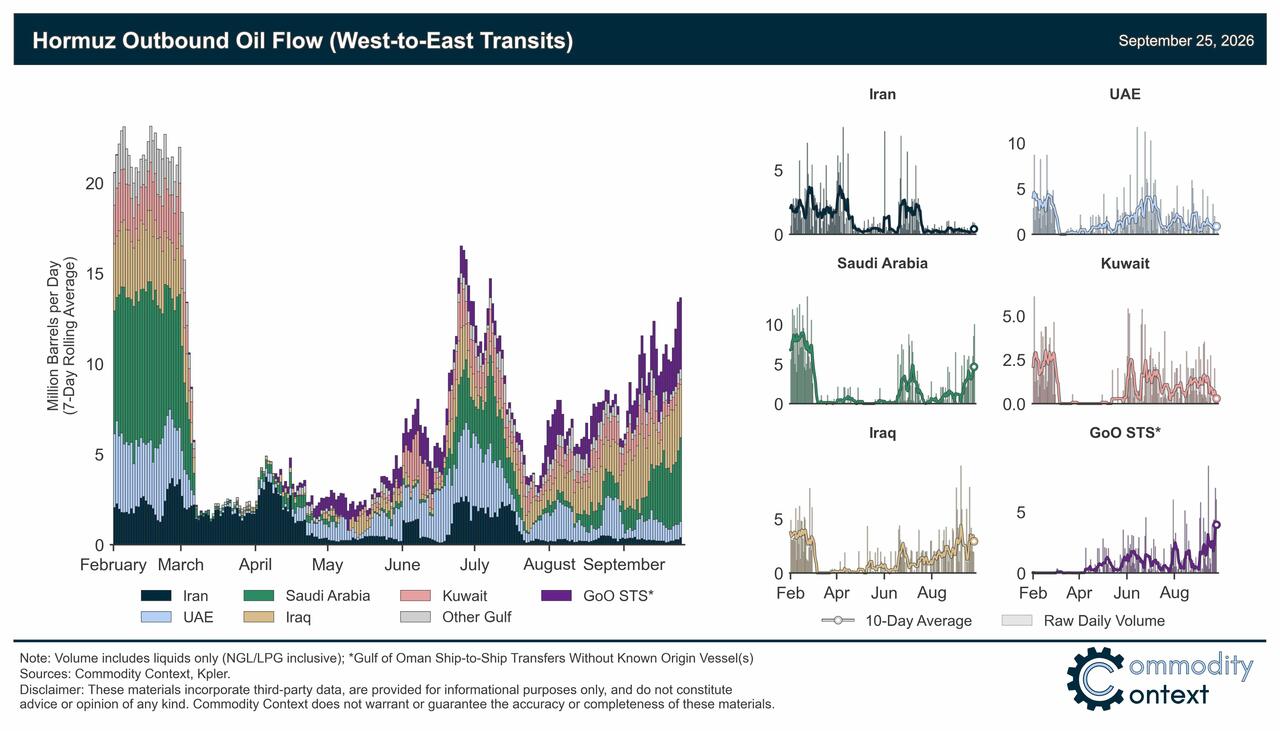
Saudi Arabia has resumed oil exports through its critical East-West pipeline, restoring access to Red Sea loading facilities that bypass the Strait of Hormuz, Bloomberg reports. The restart coincides with Kpler data from late last week showing Hormuz oil flows have recovered to about two-thirds of prewar levels, suggesting a recovery in Gulf energy flows and an erosion of Tehran's leverage.
Overseas shipments have restarted, Bloomberg reported, citing a person with direct knowledge of the operation. Saudi Aramco began testing the pipeline and rebuilding pressure last week, aiming to resume meaningful flows by the weekend.
In a separate report last Wednesday, Bloomberg reported that Saudi Aramco was working quickly to repair the damaged section of the pipeline after a drone attack destroyed a pumping station.

A successful restart of the pipeline, which can carry 7 million barrels of crude per day to Yanbu on the Red Sea while bypassing the Hormuz chokepoint, would likely provide welcome relief for Europe, which had crude cargoes for this month canceled because of the disruptions. The Saudis have already indicated a near-term resumption of crude loadings for Asian buyers.
With the East-West pipeline set to ramp up and the Saudis beginning to export crude from the Red Sea once again, independent oil research firm Commodity Context cited Kpler data over the weekend showing that oil shipments through the Strait of Hormuz have recovered to roughly two-thirds of prewar levels, driven by a surge in Saudi exports.
On the diplomatic side, President Trump told reporters on the White House lawn over the weekend that he had rejected an Iranian proposal for a seven-day ceasefire and was open to resuming attacks on the Islamic Republic after the midterms.
The key question is: What happens to Iran's oil export hub, Kharg Island, after the midterms?
https://www.zerohedge.com/energy/saudi-arabia-restarts-critical-hormuz-bypass-pipeline
Ayatollah Vows To Expel 'Enemy' From Arabian Sea As Trump Touts Talks To Continue This Week
After a weekend which saw President Trump reject an Iranian proposal for a 7-day ceasefire and roadmap to peace, and Tehran in turn targeting 19 ships in the Strait of Hormuz, the two sides once again have their fingers on the trigger.
Iran has said while it remains open to diplomacy, it is 'fully prepared' to resume the full-scale war with Washington, according to Foreign Minister Abbas Araghchi on Sunday. On Monday, Supreme Leader Mojtaba Khamenei - who still hasn't been seen since the war's start and after his father's assassination - has proclaimed his military has driven the 'enemy' from waters off southern Iran to the Arabian Sea.
"Having suffered painful blows from our valiant combatants and the guardians of the Strait of Hormuz, they [the enemy] dare not venture beyond the Arabian Sea," Khamenei said in a new message. He warned that war could soon come to the Arabian Sea as well.
His words were issued on the annual remembrance of the Iran-Iraq War, as well as the anniversary of Israel's killing of Hezbollah leader Hassan Nasrallah in 2024.
"Whenever they have risked doing so they have only inflicted harm upon themselves, and the time is fast approaching when the Arabian Sea, too, will be cleared of their presence," Khamenei's message added. This marks an extension of threats from Iranian security officials last week which warned that war is coming to the Indian Ocean more broadly.
However, the reality also is that oil exports from the Persian Gulf and Gulf of Oman have been climbing over the past week. But renewed hostilities in the Strait of Hormuz, where Iranian forces are trying to hinder this uptick in transit, is looking more and more likely.
This as diplomacy is obviously stalled. Bloomberg observes, "Iran and the US appeared far apart on a new ceasefire deal or the reopening of the Strait of Hormuz, with Tehran saying it’s sticking to a proposal US President Donald Trump has rejected." And, "In futures, oil rose as Iran and the US appeared far apart on a new ceasefire deal or the reopening of the Strait of Hormuz, with Tehran saying it’s sticking to a proposal that US President Donald Trump has rejected."
Like clockwork, anonymous diplomatic officials are once again in pre-market Monday morning hours pushing a "talks" narrative. According to more latest from Bloomberg:
Mediators expected to hold separate talks with US and Iran on Monday or Tuesday, with Iran Foreign Minister Araghchi and Qatari mediators remaining in the US, according to sources. Talks to focus on amended version of 7-day proposal Iran presented on UNGA sidelines.
Over the weekend, Trump rejected Iran’s latest proposal to reopen the Strait of Hormuz, while Iran said any reopening remains contingent on its conditions being met and its UN delegation reportedly has no plans for talks with the US. Trump nonetheless expects negotiations to resume this week, with the Iranian President also supporting talks.
And the Wall Street Journal has a parallel Monday morning story: "Peace negotiators are pressing Iran to make a concession on its nuclear program to revive ceasefire talks with the U.S. after President Trump rejected Tehran’s truce proposal, in a race to stop the conflict from escalating back into all-out war," the publication says. On the headlines:
- Brent Dec fell from USD 100.70/bbl to around USD 99.60/bbl.
- WTI Nov dipped from USD 96/bbl to USD 94.90/bbl.
Trump in new comments to Axios:
“I expect more talks with Iran (this week),” Trump told Axios in a phone interview. “They want to make a deal, but it is not the deal that I want to make. It is what we would have maybe agreed to a year ago. They overplayed their hand.”
Araghchi apparently stayed in New York through the weekend following his attendance of the UN General Assembly, with President Pesheshkian having departed back to Iran.
Ready for "apocalyptic war" if it comes to that...
Meanwhile the US economic war is continuing to bite, with Iran's currency has hitting another historic low against the US dollar, exacerbated by severe inflation and the Trump/Bessent 'Economic D-Day' and 'Operation Economic Outcast' campaigns which seek to strangle the country. Financial trackers note that the free market exchange rate has escalated to 2.3 million rials per US dollar.
Weekend & Overnight Developments
via Newsquawk
- US President Trump said he rejected a deal from Iran to open the Strait of Hormuz, while he stated Iran wants to make a deal in which they open the strait immediately because it is losing so badly.
- US President Trump said he expects talks with Iran to resume this week even though he rejected Iran’s latest proposal, while he stated the conditions Iran wants are something the US may have agreed to around a year ago and that Tehran overplayed its hand, according to Axios.
- US President Trump said that as soon as the Iran war is over, which is soon, oil will drop, while he stated that they took out a record oil amount from Hormuz on Saturday night. Trump also stated that they will win against Iran in military and economic warfare, while he didn't want to say regarding striking Iran before the Midterms and noted that Iran inflation was at 318%.
- US President Trump told Chinese President Xi during the summit to stop supporting Iran, according to Axios on Friday, citing US Ambassador to Beijing Perdue.
- Iran's delegation in New York has no plans for talks with the US, according to a source close to the delegation cited by IRNA.
- Iranian Foreign Minister Araghchi said they have seen the initial response from US President Trump to the 7-day ceasefire proposal, but are waiting to receive the official response via mediators, while he added that only a negotiated solution can get them out of this deadlock. Araghchi also stated that Iran's conditions are clear and that any move towards reopening the Strait of Hormuz is contingent on these conditions being met.
- Iranian Foreign Minister Araghchi said he and Iranian President Pezeshkian did not come to New York to sell a war and that they came to forge peace, while he added that Iran remains steadfast in the face of any aggression even if it comes to an apocalyptic war, but is at the same time, ready for real diplomacy.
- Iranian President Pezeshkian said regional states can safeguard their own security, and he denied Iran's direct involvement in Yemen, describing the situation as unrelated to Iran, but stated that Iran is ready to help resolve the conflict and urged Houthis and Saudi Arabia to enter talks instead of escalating.
- IRGC spokesman said not only is the Strait of Hormuz not open, but it is a hunting ground for the IRGC Navy against US submersibles.
- Iran army spokesman said Iran’s armed forces are prepared for any renewed US attacks after US President Trump said he rejected a deal from Iran.
- Local sources reported that a sea cruiser fired at a violating vessel in an unauthorised route of the Strait of Hormuz, according to Fars News.
- Saudi authorities suspended in-person classes in Riyadh for a week on Sunday, following reports the day before that Saudi air defences said they intercepted Houthi drones headed toward the capital and ballistic missiles targeting Khamis Mushait.
- Iranian President Pezeshkian said Iran remains ready for dialogue despite being attacked during previous talks, but pressure and attacks will not force Iran to surrender.
- Source said Iran is prepared to compromise on its nuclear programme but wants guarantees Israel will not attack again after a US deal, N12 reported.
Nvidia Launches New Tool To Shut Down Rogue Agents, Unveils $150 B Stock Buyback, Largest Ever
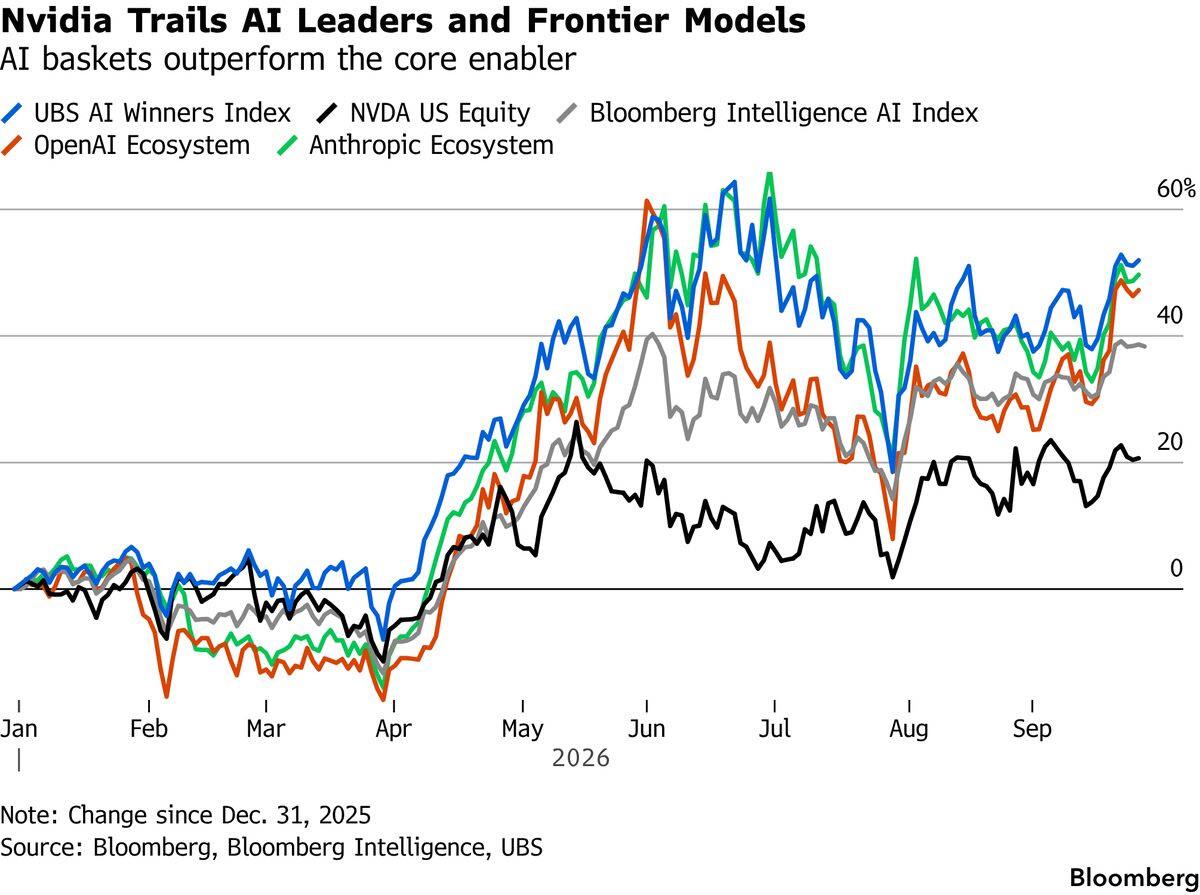
Perhaps Jensen Huang was getting tired of seeing charts like this, showing that his stock is up "only" 20% in 2026 (and has gone nowhere since May) while the rest of the AI ecosystem keeps rising...
... so going into the last week of them month, the billionaire CEO took matters into his own hands and amid a flurry of news that OpenAI agents had breached many more systems than previously revealed, including US government platforms, leading the company to pause training of its latest AI models, Nvidia introduced a new double-layered artificial intelligence security system that it says would’ve prevented the recent high-profile breach of Hugging Face by OpenAI’s AI models.
Today, with over 100 industry partners, we introduced the NVIDIA Open Agent Safety Platform, bringing together OpenShell and Sentry.
— Jensen Huang (@JensenHuang) September 28, 2026
Artificial intelligence is extraordinary technology that will advance discovery, productivity, security, health, and prosperity for generations to… pic.twitter.com/dReAxwpRUn
The semiconductor giant, which has been rapidly expanding its product lineup beyond chips, is rolling out two open-source software security tools - OpenShell and Sentry - that can be run on its hardware (of course, after all those NVDA chips won't sell themselves) and are called the NVIDIA Open Agent Safety Platform. They’re designed to control what AI agents can access in real time and shut them down when they break the rules.
If cutting-edge labs had been using this technology to evaluate their AI models early on, it could have warded off the Hugging Face attack, Justin Boitano, Nvidia’s vice president of enterprise AI, said during a briefing with reporters ahead of Monday’s announcement. “From what we know, this new security platform could have stopped the breach,” he said.
As Bloomberg notes, misconduct by autonomous agents, including the Hugging Face incident in July, has roiled the AI industry and led to calls to slow down work on the technology. With the new product dubbed the Open Agent Safety Platform, Nvidia is offering a way to prevent breaches without curbing AI development. Jensen Huang, has repeatedly downplayed the risk of AI slipping out of human control.
Boitano didn’t comment on whether OpenAI or rival Anthropic PBC have plans to use its new system to monitor their training runs, deferring to the companies.
In recent days, Huang has cast safety concerns as an engineering challenge, rather than something that requires more regulation or global coordination. He joined US President Donald Trump in pushing back on assertions from some AI developers that the technology could lead to human extinction, but he also insisted that AI must be rigorously safety-tested.
Huang’s engineering solution to the AI safety problem has two parts: OpenShell, a software product that Nvidia already previewed at its hallmark technology-focused conference in March, can run on Nvidia’s Vera central processing units. It enables users to set rules for what AI agents can access and enforce them in real time. The software is open source, meaning it can be used and adapted freely.
Nvidia Sentry, meanwhile, is a new product that can run on the chipmaker’s BlueField data processing units. It’s designed to provide an extra layer of AI monitoring that polices agents and intervenes to isolate any that act suspiciously, the company said.
“We believe this added security layer will allow the industry to test even the most advanced AI systems safely,” Boitano said of the Sentry product. “It can quarantine a suspicious agent in milliseconds.”
Nvidia agreed earlier this month to acquire Hugging Face, a platform for open-source AI models and related software, for about $13 billion.
OpenAI’s recent incidents — including a breach of an Australian government system, as well as attempts to access dozens of US government and university websites — happened when its models escaped testing environments that were supposed to be secure. As the problems proliferated, OpenAI said late Friday it would pause training of its most capable AI models. Back in July, Anthropic also disclosed that its agents broke out of what was supposed to be an isolated testing space.
And just in case the announcement wasn't a sufficiently strong catalyst to push the stock price higher, shortly after the report Nvidia increased the size of its share buyback plan by $150 billion, increasing the total remaining amount authorized to $235 billion. The buyback beats Apple’s record $110bn, set in 2024, for the largest in US corporate history.
Nvidia will complete the buyback through fiscal 2028, the Santa Clara, California-based company said in a statement on Monday.
The AI boom has made Nvidia the world’s most valuable company and the chipmaker’s shares have jumped 20% this year. In August, the company projected sales growth of 70% for the next fiscal year and Chief Executive Officer Jensen Huang has worked to tamp down concerns about an AI bubble.
“Nvidia’s growth is being driven by a once-in-a-generation platform shift to AI and accelerated computing,” Huang said in the statement. “This authorization reflects our confidence in the long-term opportunity ahead.”
Shares rose 1.3% to $228 in premarket trading in New York.
Trump Admin To Focus More On Northern Border Security Over Next 2 Years: Homan
by Timothy Frudd and Jan Jekielek via The Epoch Times,
White House border czar Tom Homan plans to put more focus on security at the northern border during the last two years of President Donald Trump's administration.
In an interview airing on Sept. 26, Homan told Epoch Times senior editor Jan Jekielek that the U.S. - Canada border is a national security vulnerability and could receive greater attention after the administration beefed up security on the border with Mexico.
"The next two years, I'm really concentrating on the northern border," he said. "The southern border is the highest security we've ever had."
Homan said: "Now that we have the money and the time ... I think we need to dedicate more resources to the northern border, whether it's manpower, technology, [or] infrastructure."
U.S. Customs and Border Protection (CBP) recorded 563 total apprehensions along the northern border in August and 586 in July.
The United States and Canada share more than 5,500 miles of border.
Homan said that security at the northern border has not been ignored, but that the Trump administration concentrated its efforts on the southern border because "you send the firemen where the biggest fire is."
Last month, CBP announced that daily apprehensions at the southern border were 94 percent lower than under the Biden administration.
Noting a pattern of decline in illegal border crossings and apprehensions, CBP said the border was "more secure than at any point in history."
Homan told Jekielek that since the southern border is now under control, the administration needs to begin "amping up the northern border," which he described as a "huge national security vulnerability."
"Canada's immigration laws are very lax," he said. "[It] doesn't take a lot to get into Canada."
Citing intelligence reports and personal experience, Homan said national security threats can enter Canada and then cross into the United States a lot easier than directly entering the United States.
Homan also said that drug trafficking along the northern border is another issue for both the United States and Canada.
The U.S. government has been working with Indian reservations on the American side of the border to increase drug enforcement, which he said was a problem.
The White House border czar suggested that cooperation with Canada is "one of the biggest things" needed for effective security along the northern border.
"I think the United States and Canada both want ... [to] shut down cross-border crime because it's not good for either country," he said.
"I think we're both concerned with shutting down the criminal element, shutting down the drugs, and illegal immigration, especially those who pose a threat to our nations."
Homan told Jekielek that he visited all the northern border sectors over the past three months and that the individual areas have different requests for security improvements.
They included additional boots on the ground, technology, drones, air assets, infrastructure, and barriers, he said.
The U.S. House of Representatives passed the Northern Border Security Enhancement and Review Act on Sept. 16.
The bill would require the Department of Homeland Security to assess northern border threats, update the department's northern border strategy, and provide relevant oversight information to Congress.
It would also require CBP's Air and Marine Operations to develop performance measures regarding efforts to secure the border between ports of entry.
Subscribe to:
Posts (Atom)