Sunday, October 4, 2026

10-Year Cost Of Democratic Socialist Policies Could Hit $350,000 Per Household, White House Says
by Jacki Thrapp via The Epoch Times,
American taxpayers would face a net fiscal burden of over $350,000 per household in the next decade if the Democratic Socialists of America's top policies were adopted, according to a report released Oct. 1 by President Donald Trump's Council of Economic Advisers.
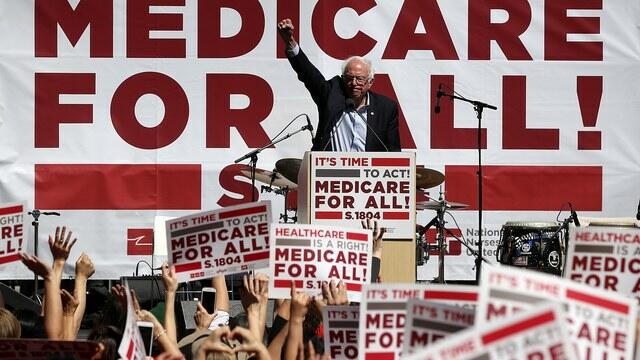
The report predicted a net fiscal burden of more than $49 trillion from 2027 to 2036 - larger than the national debt, which hit a milestone of $40 trillion in August.
The report added up the presumed costs for Democratic Socialists of America's agenda items such as loosening border restrictions, handing out amnesty to all illegal immigrants in the country, abolishing the police and U.S. Immigration and Customs Enforcement (ICE) officers, eliminating prisons, providing government-run healthcare for everyone, and canceling all student debt.
The majority of the cost would come from Medicare for All, which is predicted to cost $47.4 trillion out of the $52.8 trillion in gross costs, which was lowered to nearly $49 trillion due to the estimated $3.9 trillion that would be collected from the wealth tax.
Medicare for All proposals would transform the United States into a single-payer healthcare system in which the federal government covers all medical services, eliminating the out-of-pocket costs for patients.
The second most expensive proposal, according to the report, would be canceling student debt and making college free. That comes at a price tag of $3.6 trillion.
Student Loan Debt Statistics by the Education Data Initiative suggest that Americans currently owe roughly $1.9 trillion in student debt. Nearly $1.7 trillion of that debt is held by the federal government and is owed by nearly 43 million loan recipients.
The third-largest spending item would come from a mandated 32-hour workweek, costing approximately $918 billion in lost tax revenue.
The Trump administration described the proposals' potential impact on the economy, suggesting they would make everyday costs skyrocket with double-digit inflation and prices rising an extra 130 to 160 percent over 10 years.
The Epoch Times contacted the Democratic Socialists of America for comment and did not hear back by publication.
The report came out the same day Trump kicked off his 32-day campaign blitz for Republicans facing tough races in the November midterms.
During a speech at Peterbilt Motors' factory in Denton, Texas, on Thursday, Trump highlighted the resurgence of manufacturing in the United States and touted the economy's performance under his administration.
"We announce all these great numbers," Trump said. "The best numbers in the history of any president. There's never been any president that's got $21 trillion invested in our country. Not even close."
The president also showed his support for Texas Attorney General Ken Paxton, a Republican, who is in a tight U.S. Senate race against Democrat James Talarico.
After the speech, Trump made a rare presidential visit to the Choctaw Nation of Oklahoma for a rally. Only a handful of U.S. presidents have visited tribal nations while in office.
Zelensky Vows To Hammer More Russian Refineries As G7 Greenlights Emergency Fuel Dump
President Volodymyr Zelensky told Reuters in an exclusive interview that Ukraine plans to intensify attacks on Russian oil refineries in response to continued strikes on Ukrainian cities. The threat comes as the Trump administration pressures European allies to release up to 100 million barrels of emergency oil and diesel stocks ahead of the Northern Hemisphere winter, with a global refining crunch already straining fuel supplies.
Zelensky told the outlet that Ukrainian intelligence had obtained documents outlining what he described as Russian President Vladimir Putin's new war doctrine to broaden attacks on civilian infrastructure ahead of winter.
"We saw documents and we know that they allow them to attack infrastructure, logistics, and especially to attack in the cities, in the villages, everywhere, roads, schools, hospitals," Zelensky said. "To pressure people to leave the capital, leave different cities: this is the goal of the operation."
Zelensky then said, "We have to respond in any way (we can). With their attacks on our energy, we have to respond on their energy. First of all, oil refiners, etc.: what gives money to them for this war. But we will not respond, of course, just like them, on any civilian objects."
Zelensky's plan to further destroy Russia's refineries comes as the Trump administration seeks to revive peace negotiations. Zelensky said Russia had shown no willingness to discuss either peace talks or a ceasefire covering energy infrastructure.
The Trump administration's move to pressure European countries and other G7 members into releasing as much as 100 million barrels of emergency oil and diesel stocks, as confirmed by French President Emmanuel Macron on Friday, is likely in response to Zelensky's expanding drone and missile attacks on Russian energy assets, as stockpiles for critical fuels are well below seasonal levels for this time of year.
The International Energy Agency is coordinating the emergency release, which will take place over the next four months, according to Macron.
Goldman energy analyst Nikhil Bhandari warned last month that the global refining crisis stems from a combination of disruptions in the Strait of Hormuz and, more importantly, Ukraine's bombardment of Russian refineries. Those attacks have prompted Moscow to extend its diesel export halt, suggesting the refining crisis could linger well into next year and keep refined-product prices elevated.
Meanwhile, last Thursday at the Valdai Discussion Club in Moscow, Putin warned the Western allies to cease their escalation in Ukraine, stressing he's willing to use "all weapons" in the Russian arsenal in the scenario that Russia's exclave of Kaliningrad comes under attack.
Yemeni leader launches op to reclaim Houth-held areas
Chairman of the Presidential Leadership Council of Yemen, Rashad al-Alimi, announced on Sunday that a military operation had begun to retake areas controlled by the Houthi militant group.
Al-Alimi said in a televised address that the armed forces, security forces, and other military formations had been instructed to begin operations under an approved plan aimed at restoring government control over Houthi-held areas, adding that the government's forces would seek to extend "the authority of the state and its institutions over the entire territory."
The Saudi-backed president noted that the operation will continue until "victory is achieved."
https://breakingthenews.net/Article/Yemeni-leader-launches-op-to-reclaim-Houth-held-areas/67229172
'UK's Greens pass motion calling for abolition of Israeli state'
The Green Party of England and Wales passed a motion calling for the abolition of the state of Israel on Sunday, defining Zionism as a "racist ideology."
The vote passed with support from 1,022 party members, while another 813 voted against the motion. Zack Polanski-led party called for the establishment of a "single democratic Palestinian state in all of historic Palestine with Jerusalem as its capital," affirming its support for the Palestinian people to resist "Israeli occupation."
"Drop the charges. End the Genocide. Deproscribe Palestine Action," Greens leader Zack Polanski stated during the party's annual conference in Brighton.
'Tass: Brazilian troops seen in Rio during election'
Brazilian army units and armored vehicles were deployed on the streets of Rio de Janeiro on Sunday as the country held general elections, TASS reported, citing its correspondent in the city.
The military patrols were reportedly seen in western districts of Rio.
Brazil's Superior Electoral Court had authorized federal troops to support election security during the first round of voting.
https://breakingthenews.net/Article/Brazilian-troops-seen-in-Rio-during-election/67229521
Supreme Court to weigh energy companies' bid to end Boulder climate-change lawsuit
When the Supreme Court returns to the bench Monday for the first time since late June, it will kick off its new term with a major case involving an effort by the city and county of Boulder, Colorado, to hold fossil-fuel producers accountable for the impacts of global climate change.
The lawsuit from Boulder is one of dozens filed by states and local governments against energy companies in state courts that seek money damages for past and future harms that they allege are caused by the buildup of greenhouse gases in the atmosphere, which has led to global warming.
The long-running dispute brought by Boulder targets Exxon Mobil, the nation's largest energy company, and Suncor Energy, which operates two oil refineries in Colorado. The suit remains in its early stages, and the issue before the Supreme Court is whether the suit can proceed or is barred by federal law. A win for Boulder from the Supreme Court wouldn't mean it will ultimately prevail against the fossil-fuel producers in state court.
"This is not a judgment about whether these cases will succeed. It's a judgment about whether folks get to make their case," said Jonathan Adler, a law professor at William & Mary who has written about federalism and environmental law and filed a friend-of-the-court brief in support of Boulder. "And even if they get to make their case, the scope of what they can pursue could well be narrowed and might well be narrowed significantly."
Boulder's lawsuit dates back to 2018. Filed in state court, the city and county allege that Exxon and Suncor's conduct has caused or contributed to climate change, which has in turn forced Boulder to confront extreme heat, larger and more frequent wildfires and damage to the ecosystem, among other issues.
Boulder officials raised five claims under state law. They argue that the energy companies' production and allegedly deceptive marketing of fossil fuels has led to "unchecked" use of their products that has caused a rapid rise in the concentration of greenhouse gases in the atmosphere.
Exxon and Suncor attempted to move the case to federal court, but that effort was unsuccessful. The companies also asked the Boulder County District Court to dismiss the case on the grounds that federal law foreclosed the claims against them. When the state court denied that request, the companies asked the Colorado Supreme Court to step in.
The state high court sided with the city and county of Boulder, and Suncor and Exxon appealed to the U.S. Supreme Court.
In addition to considering whether federal law precludes Boulder's state-law claims, the Supreme Court asked lawyers for both sides to address whether it has jurisdiction to review the Colorado Supreme Court decision.
Only eight of the nine justices will participate in the arguments Monday, as the Supreme Court said last week that Justice Samuel Alito had chosen to recuse himself from the case. No reason was given for Alito's decision. His financial disclosure for 2025 shows that he had individual holdings in two energy companies, ConocoPhillips and Phillips 66. He did not report individual stocks in either Exxon or Suncor.
Alito's absence leaves open the possibility that the Supreme Court divides 4-4 in the case. If that happens, the decision of the lower court — the Colorado Supreme Court, in this case — would stand.
A "national problem"
Lawyers for Exxon and Suncor argued in Supreme Court filings that the Constitution and the Clean Air Act preclude claims that seek to address harms caused by interstate greenhouse-gas emissions. The Clean Air Act, they said, did not invite state law to apply to disputes involving interstate pollution.
If the Colorado Supreme Court's decision is upheld, "it would authorize all fifty States, the tens of thousands of municipalities, and even the hundreds of millions of individuals in our country to ask local courts to establish countless, conflicting climate policies for the Nation," Exxon and Suncor lawyers argued.
Additionally, the energy companies and the Trump administration, which supports Exxon and Suncor in the case, warned that efforts like Boulder's to secure relief for the effects of greenhouse-gas emissions — including those released abroad — undermine the government's control over foreign affairs.
"Such lawsuits would create an end-run around the United States' existing diplomatic channels for addressing climate change in favor of innumerable state judicial ones," lawyers for Exxon and Suncor said. "And the imposition of potentially devastating liability on fossil-fuel producers will undercut the government's pursuit of primacy in global energy production."
Because greenhouse gases emitted from sources in every state and around the world cannot be unmixed and traced, the companies warned that allowing all 50 states to apply their own laws would result in confusion. Only a "neutral, uniform federal law" can resolve disputes over the regulation of air and water, they said.
"It's a national problem, so it requires a national solution," Michael Williams, solicitor general of West Virginia, told reporters during a briefing Wednesday.
West Virginia and 25 other states are backing Suncor and Exxon Mobil and argue that Boulder's lawsuit jeopardizes their ability to achieve their own policy goals on energy production and environmental protection.
"We don't take issue with the idea that a state can actually regulate sources within its own borders. So if West Virginia wants to regulate a coal plant in West Virginia, we claim the right to do that," Williams said. "In the same way, if Colorado wants to regulate emissions coming from Colorado in Colorado, they're free to do that as well. What they're not free to do is say, hey you emitters, anywhere in the world … we're going to make you pay money for any of those emissions anywhere in the world."
But lawyers for Boulder urged the Supreme Court to dismiss the appeal on the grounds that it does not have jurisdiction. If the justices opt not to, they said the Colorado Supreme Court decision should be upheld.
"Does anything implicit in the Constitution bar this suit?" they wrote in a filing. "Nothing does."
Boulder noted there is often litigation to address the local impacts of problems that could benefit from international solutions, like food contamination, human trafficking and the fentanyl crisis. The city and county's effort to hold energy companies liable is just another example, they said.
"That climate change is a global problem does not disempower states from redressing its local harms either," they wrote in a filing. "This litigation is not an attempt to solve climate change; it merely asks that petitioners bear their fair share of local costs incurred in part because of their tortious conduct."
Boulder also pushed back on the energy companies' argument that the Clean Air Act preempts its claims, and said that law governs emissions, not the conduct of the upstream fossil-fuel producers. Plus, lawyers for the city and county said they did not sue for emissions, but over allegedly deceptive marketing and production, which the Clean Air Act does not regulate.
"Indeed, avoiding liability would not require reducing emissions at all — only telling the truth, so the public can make informed consumption decisions free of the distorting effect of petitioners' misrepresentations," they said.
The Trump administration argues that Boulder's suit invites "needless diplomatic friction" with the foreign countries where Exxon and Suncor produce and sell their fossil fuels. But Adler, the William & Mary professor, noted that the Trump administration has withdrawn from international agreements that seek to address global warming and greenhouse-gas emissions.
The foreign-affairs argument "seems to suggest that any time the executive branch claims that it would like to negotiate in a space that could be implicated by companies being held liable for damages that they may have contributed to, that would really give the executive branch the ability to preempt any sort of litigation that it wanted. That can't be the law," he said. "If there was an actual conflict between an actual treaty, of course that could preempt state law. But we don't even have that."
Adler also said that Congress could weigh in and restrict suits against fossil-fuel companies for the harms tied to their products. In fact, it took similar action in 2005 when lawmakers passed a federal law that shields gun manufacturers from civil lawsuits that seek to hold them accountable for harms stemming from the criminal misuse of their firearms.
"If Congress believes that what's going on here is a combination of plaintiffs' lawyers and activists trying to make energy less available or less affordable, or to otherwise create pressure on fossil-fuel companies, Congress has the tools to address that," he said. "That's a job for the legislature, not a job for the courts."
A decision from the Supreme Court is expected by summer of 2027.
Subscribe to:
Posts (Atom)