Search This Blog

Tuesday, May 15, 2018

Pfizer’s biosimilar of Amgen, J&J’s anemia treatments gets FDA nod

Pfizer Inc’s Retacrit was approved by U.S. health regulators as a biosimilar to current anemia treatments from Amgen Inc and Johnson & Johnson on Tuesday, setting it up to compete against more established brands.
A year ago the U.S. Food and Drug Administration rejected Retacrit as a copy of Amgen’s Epogen and Johnson & Johnson’s Procrit, citing here issues with a potential manufacturing facility in Kansas.
Shares of the rival companies dipped in afternoon trade.
“People were surprised last time when Pfizer didn’t get a first round approval for a biosimilar, so I think people certainly expected it this time. Its not a surprise,” Baird analyst Brian Skorney said.
Epogen’s $1.10 billion in sales accounted for about 5 percent of Amgen’s 2017 revenue, but analysts believe a competing product is unlikely to hurt the company.
“Its nice to see that the FDA is moving along and approving biosimilars but the commercial impact to Amgen is quite minimal,” Jefferies analyst Michael Yee, who has a “buy” rating on Amgen’s stock, told Reuters.
Johnson & Johnson’s Procrit brought in sales of $972 million in 2017, accounting for 2.7 percent of its total sales.
The FDA has been pushing to approve copies of expensive branded drugs to increase competition in the market as the Trump administration rallies against exorbitantly priced medicines.
Biosimilars aim to copy biologic products, which are made inside living cells, but they can never be exact duplicates.
Tuesday’s approval allows Retacrit’s use as a treatment for a drop in red blood cells caused by chronic kidney disease, chemotherapy, or the use of zidovudine in HIV patients.
The biosimilar was also approved for use before and after surgery to safeguard against the need for red blood cell transfusions due to blood loss from surgery.

Aptevo Gains On IXINITY Med Performance

Aptevo Therapeutics is one of the most uncovered stocks I know.
The company rallied recently on the back of its IXINITY drug performance, however it still has a very rich pipeline.
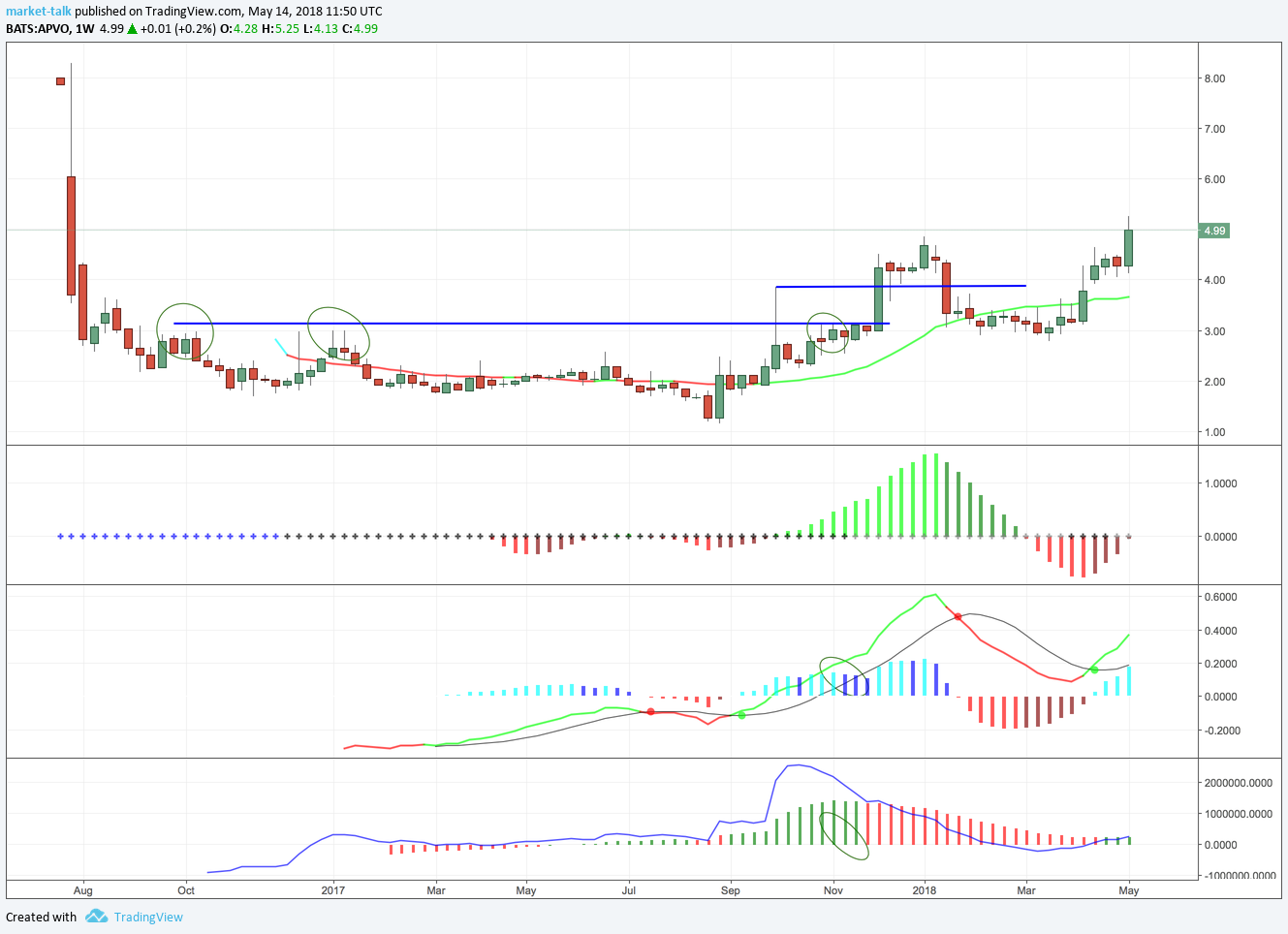
The stock rallied from $3 to $5 recently, however two analysts that cover the stock recently upgraded their price targets to $9 and $12 a share.
Aptevo Therapeutics’ (APVOQ’18 results were mostly inline. First quarter EPS came in at -$0.63 missing by $0.07, and revenue came in a notch higher by $0.07M.
The real positive twist was the company’s IXINITY product, which is finally gaining traction. For the quarter IXINITY revenue increased 93% Y/Y to $4.1M. What is IXINITY?
From the company’s website:
IXINITY [coagulation factor IX (recombinant)] is a medicine used to replace clotting factor (factor IX) that is missing in adults and children at least 12 years of age with hemophilia B. Hemophilia B is also called congenital factor IX deficiency. Hemophilia B is an inherited bleeding disorder that prevents clotting. Your healthcare provider may give you IXINITY to control and prevent bleeding episodes or when you have surgery
In March 2018 the company announced patient reported data using IXINITY:
  • 89% of patients reported that they were very satisfied or somewhat satisfied with IXINITY
  • Since starting IXINITY, a majority of patients reported that they were very active (22%) or somewhat active (56%)
  • The median reported annualized bleed rate (ABR) among patients taking IXINITY for prophylaxis was 1.6, which is consistent with the median ABR seen in the pivotal clinical trial, which was 1.52
  • A majority of patients on IXINITY reported no problems or slight problems on all domains of quality of life: mobility, self-care, usual daily activities, pain or discomfort, anxiety or depression.
APVO has had a good track record of developing assets and getting a good price for them.
As a reminder, I first mentioned APVO back in September of 2017 when the stock was around $2 a share, saying APVO was worth at least $5 a share (please consider: Aptevo Therapeutics Likely Worth At Least $5 A Share).
At the time I had a small position from about the $1.5 handle, but tripled my position just under $2 a share. Please recall that at the time the company announced it agreed to sell its three marketed hyperimmune products, WinRho SDFHepaGam B, and VARIZIG, to Saol Therapeutics for a total consideration of up to $74.5 million.
Prior to the company’s divestitures, the market cap of APVO was just $28M. I then calculated the net cash position, which was about $94.4M (or about $4.40 per share), and figured the pipeline must be worth at least $0.60 per share, and set a price target of $5 a share.
Well today the stock is at the $5 handle. And the question now is, what might IXINITY be worth as an asset? This is very difficult, if not impossible to answer.
But depending on the market research firm you want to believe, the global Hemophilia treatment drugs market might be worth $15 Billion by 2024, according to research firm Grand View ResearchThis includes all types of Hemophilia, not just Hemophilia B.
So even if APVO gets a small piece of this pie, it will go a long way for APVO’s stock. And while the company has several other products in the pipeline, I think the market is positioning itself in the stock mostly betting on the future value of IXINITY.
Might APVO be interested in selling IXINITY? I don’t know, and we have no such indication from management. However the truth is that everything is for sale at the right price.
But the company is not just about IXINITY. The company’s ADAPTIR Platformcenters around the generation of immunotherapeutics. The company aims to develop immuno-oncology candidates that focus on redirected T-cell cytotoxicity. Currently the company has 2 candidates, one in phase 1 and the other in phase 2 trials.
Otlertuzumab currently in phase 2 trials is a humanized monospecific ADAPTIR molecule that targets CD37. CD37 is a cell surface protein expressed on normal and transformed B cells that has been implicated in diverse cellular processes including cell adhesion, proliferation, differentiation, motility, and tumor invasion.
APVO414 currently in phase 1 trials is a humanized bispecific ADAPTIR molecule that binds to prostate-specific membrane antigen (PSMA) and CD3. PSMA expression is upregulated in prostate cancer and is highest in advanced, metastatic castration-resistant prostate cancer (mCRPC).
More about the company’s pipeline here.

Aptevo Therapeutics is a very uncovered stock

APVO is one of the most uncovered stocks I know. There are only two analysts covering the company, and management does not even hold a conference call.
Recently Piper Jaffray updated APVO’s price target from $6 to $9 a share, and Roth Capital initiated coverage with a price target of $12 a share (link here).
In a note to clients, analyst Jotin Marango of Roth Capital said (link here):
In our view, Aptevo remains under the Street’s radar with a clinical and commercial pipeline, as well as a versatile technology platform enabling growth in new directions. As we look forward, we believe that two ongoing clinical programs may provide dynamic catalysts for the near/medium term, while the technology platform, with two pending INDs, provides fundamental depth to future value.
And judging from the stocks behavior, it seems the market agrees with the above price targets.

Technical note

The above chart is on a weekly scale. Unless something catastrophic happens over the next several weeks, all technical indicators point to higher prices.

Bottom line

I continue to be long APVO from the $2 handle, having traded my position back and forth on the way up.
Personally I do not have a specific price target, and prefer to think that the analysts mentioned above know better than me.
As with all biotech stocks, there is a lot of risk. However in the case of APVO the risk might be lower. Not only because of the high growth rates of IXINITY, but also because the company’s cash position is still about $3.25 per share.

New Jersey court rips up Optum’s $6.7B prescription drug contract, orders rebid

A New Jersey appeals court has invalidated OptumRx’s $6.7 billion prescription drug management contract with the state, ruling the company violated bidding rules.
A three-judge panel ruled (PDF) last week that the company’s bid to be the next pharmacy benefit manager for New Jersey’s 835,000 public workers broke bidding rules, and ordered a rebid for the contract.
The company’s proposal included a provision to adjust its pricing based on certain benefit plan changes, which violated bidding specifications and gave the UnitedHealth Group-owned company “a clear competitive advantage over the other potential bidders,” according to the panel.
OptumRx’s proposal, “permitted it to ‘hedge’ its bid, thereby reducing its financial risk from adverse Plan Design changes,” the court said. “That set it apart from the other bidders who agreed to be bound by all of the terms of the Bid Solicitation.”
New Jersey’s prescription drug plans are self-insured and the state uses a PBM to manage the plans and their costs. Last year, in an online reverse auction, OptumRx beat out Caremark PCS Health LLC and Express Scripts for the three-year contract, which was slated to start Jan. 1.

But Express Scripts, which was the incumbent PBM for the state, filed an appeal and request for a stay in December which the court granted. The stay was later reversed following a motion for reconsideration by the then-Christie administration.
A spokeswoman for Express Scripts told FierceHealthcare the company “is encouraged by the decision and looks forward to the opportunity to participate in the rebidding process.”

High levels of workplace exercise linked to early death

Men with highly physical jobs appear to have a significantly higher risk of early death compared with men who have largely inactive jobs, suggests a study published in the British Journal of Sports Medicine.
Physical  is generally considered to be an important preventive behaviour for non-communicable diseases while physical inactivity has been estimated to account for around 7% of the global  burden.
Accordingly, international guidelines encourage people to engage in up to 30 minutes of at least moderate intensity  daily, but such guidelines do not distinguish between occupational,  and transportation related activity.
Recent research has suggested that there is evidence of a physical activity paradox, with beneficial health outcomes associated with leisure  physical activity, but detrimental health outcomes for people engaging in high level occupational physical activity.
An international team of researchers led by Dr. Pieter Coenen from the VU University Medical Center in Amsterdam, The Netherlands, decided to carry out a systematic review of evidence regarding the association between occupational physical activity and all-cause mortality.
They searched existing studies that had assessed the association of occupational physical activity with all-cause mortality and identified 17 studies from which pooled data on 193,696 participants were used in a meta-analysis.
The various studies collectively covered the period from 1960 to 2010.
This analysis showed that men with high level occupational physical activity had an 18% higher risk of early death compared with men engaging in low level occupational physical activity. This was still the case even when levels of leisure time physical activity were taken into account.
No such association was observed among women. Indeed, the opposite seemed to be the case for females.
The authors described the new study as the first to find evidence consistent with the physical activity paradox in this systematic review with meta-analysis of studies with a large number of participants.
The researchers concluded: “The results of this review indicate detrimental health consequences associated with high level occupational physical activity in men, even when adjusting for relevant factors (such as leisure time physical activity).
“This  indicates that physical activity guidelines should differentiate between occupational and  time physical activity.”
More information: Do highly physically active workers die early? A systematic review with meta analysis of data from 193 696 participants, British Journal of Sports Medicinebjsm.bmj.com/lookup/doi/10.113 … bjsports-2017-098540

Can Fido fetch the fountain of youth?

Humanity’s search for a fountain of youth stretches back centuries, but modern scientists hope new research in dogs might be barking up the right tree.
The Dog Aging Project is looking at a  known as rapamycin, which is already approved by the U.S. Food and Drug Administration for use in people with cancer or who’ve had organ transplants.
One known action of the drug is to suppress the immune system, according to the U.S. National Cancer Institute. But paradoxically, a study by drug maker Novartis also found rapamycin appeared to boost the immune function of folks aged 65 and older.
Although it may not be clear how the drug works,  know the medication has extended the lives of yeast, flies and worms by about 25 percent. It has also lengthened the lives of mice, even when given at older ages, the researchers noted.
In , the researchers now hope to add about 20 percent more to the animals’ ball-chasing time on Earth.
What about humans? Right now, Matt Kaeberlein, leader of the Dog Aging Project, said, “It’s complete speculation, but with something like rapamycin, we might get 10 to 15, maybe as much as 20 years. And in most people, they would be healthy additional years.”
He explained that it’s harder to compare the life spans of humans and mice, but he expects to get a “much better feel for overall health from dogs than in mice.” But research on animals often does not produce the same results in humans.
Kaeberlein is co-director of the University of Washington Medicine’s Nathan Shock Center of Excellence in the Basic Biology of Aging.
Dogs age in a similar manner to humans, just faster, he explained. Dogs age about seven times faster than humans do, with large dogs aging even faster, he said. So, researchers can follow the dogs for their whole life span, to see if an intervention is able to slow aging.
Dogs also offer the advantage of living in the same environments as people do. “That’s just not something we can capture in lab studies,” Kaeberlein said.
Kaeberlein and his team’s first study included 40 dogs from the Seattle area. The main purpose was to make sure the drug was safe. These are people’s pets, after all, Kaeberlein said. Sixteen pets were excluded because they had underlying health conditions, although they had no outward symptoms.
The researchers gave a deliberately low dose of the drug or a placebo to the 24 participating dogs for 10 weeks. The pooches weighed at least 40 to 50 pounds and all were middle-aged (more than 6 years old), Kaeberlein said.
The study was double-blinded. That means neither the researchers nor the pet parents knew which dogs got the drug and which got the placebo.
Kaeberlein said there were virtually no side effects from the drug, and that heart function appeared to improve in the dogs given the drug. He added that the dogs that seemed to benefit the most were those that had lower heart function going into the study.
People whose dogs received the drug said their pets had more energy and were more affectionate. But at the time they answered the survey, they had no way of knowing if their dog had received the drug or not.
Kaeberlein cautioned that while the findings are hopeful, this is a small study that needs to be replicated.
In doses used to suppress the immune system after an organ transplant, rapamycin has been linked to an increased risk of type 2 diabetes. Kaeberlein said the researchers tested  in the dog and didn’t find evidence of higher blood sugar.
The researchers are already actively enrolling dogs in the next study that will look at , activity, thinking and memory. This study will include 50 dogs.
They’re also planning a larger trial of the drug to begin in 2019, but it’s currently just in the planning stages. The researchers are also planning a longitudinal study to follow a large group of dogs—about 10,000—over a long period (at least five years, but hopefully 10 to 15) to understand the biological and environmental factors that influence aging in dogs.
Kaeberlein said that, in addition to rapamycin, there are a number of other interventions that may be able to extend aging, including metformin and acarbose, two drugs used to treat type 2 diabetes.
More information: May 11, 2018, webinar with Matt Kaeberlein, Ph.D., co-director, University of Washington Medicine’s Nathan Shock Center of Excellence in the Basic Biology of Aging, Seattle

Providers expect Amazon to lower medical supply prices

Providers welcome a disruptor like Amazon to shake up the medical supply space, and most think the giant e-tailer will deliver lower prices, according to a new survey.
Some 62% of 152 CEOs, materials managers, operations directors and other executives said they support Amazon’s growing presence in the medical supply sector, according to a Reaction Data survey. Nearly the same amount said the company could deliver medical supplies faster and at a lower price than current medical supply companies.
“It’s clear that providers would want someone like Amazon who could come in and do things differently,” said Mark Wagner, global vice president of Reaction Data.
Amazon has been adding to its Amazon Business platform, which eclipsed more than 85,000 sellers and 1 million customers last year. The 3-year-old service also recently rolled out a Business Prime membership that provides free two-day shipping, similar to its consumer-oriented program.
The platform offers unique pricing and quantity discounts on more than 5 million products ranging from syringes, microscopes, infusion pumps, catheters, IV bags, sutures and forceps to larger items like hospital beds. Large organizations can integrate Amazon Business into their purchasing systems and directly transfer data to streamline processing.
But it remains to be seen whether Amazon will expand beyond commodities and target more specialized medical devices and equipment that physicians prefer. About half of the survey respondents said Amazon should stick to commodity items while 9% said it should focus on surgical, 8% on pharmaceuticals and 8% on IV solutions.
Brandi Greenberg, a managing director with the Advisory Board Co., said Amazon should serve as a wake-up call to suppliers.
“Amazon’s efforts here will almost certainly accelerate price pressure on suppliers, while also threatening to ‘unbundle’ items that historically have been grouped together through GPO or distributor arrangements,” Greenberg said.
Amazon has opened the door for other e-commerce platforms like Supply Clinic, where dentists can peruse implants, orthodontics, cements and other products from more than 100 manufacturers.
Certain health systems have said they are fed up with recent rate hikes from group purchasing organizations, which are branching out into consulting, private drug labels and other services.
Larger health systems have reinforced that sentiment by forming their own procurement and distribution hubs and cutting out middlemen.
While Amazon has the edge in brand awareness and its sophisticated IT and distribution network, it would have to overcome long-standing GPO relationships, logistic issues related to fragile, high-margin supplies and immediate delivery demands, and the idiosyncrasies of the healthcare industry, experts said.
Amazon reportedly walked back its rumored plans to enter the pharmacy sector, but that is likely only a temporary delay, Wagner said. Amazon, Berkshire Hathaway and JPMorgan Chase are teaming up to form a healthcare company to serve their U.S. workers.
It will be interesting to see what type of relationship Amazon has with GPOs, whether they will look to partner or go head to head, said Graham Triggs, direction of professional services at Reaction Data.
Either way, when four screws used in a foot surgery cost $15,000—as reported by Kaiser Health News—something has to give, he said.
“I think everyone is taking a wait-and-see attitude at this point,” Triggs said. “If orders come fast and accurately on commodities, providers will branch out and try something new. Never bet against Amazon.”
Still, only 59% of survey respondents were aware of Amazon’s business offerings, 29% said they were unfamiliar, and 12% said they were neutral.
Amazon has reportedly met with major hospital executives and rolled out a program with a large hospital system to stock dozens of outpatient facilities with a customized catalog.
“This is a win-win for providers because it gives them leverage,” Triggs said.

Classification rule change may cut PTSD diagnoses by 50%

Proposed changes to the upcoming 11th edition of the International Classification of Diseases (ICD-11) will reduce the proportion of individuals who meet diagnostic criteria for posttraumatic stress disorder (PTSD) by about 50%, a new study suggests.
“Importantly, our data suggest that ICD-11 might miss the moderate, and more easily treatable, cases of PTSD,” lead author Anna Barbano, BS, a research associate in the Department of Psychiatry at New York University School of Medicine in New York City, told Medscape Medical News.
“Our data suggest ICD-11 PTSD diagnostic criteria could warrant a little caution if used to strictly sanction treatment coverage,” said Barbano.
The study was published online May 14 in Psychological Medicine.

Heterogeneous Population

The ICD is produced under the auspices of the World Health Organization. ICD-11 is currently a beta draft; the final version is expected to be released in June.
ICD-11 PTSD diagnostic rules offer somewhat of a “radical change” from ICD-10 criteria, said Barbano. Whereas ICD-10 takes a fairly broad diagnostic approach and includes 13 symptoms in its diagnostic template, ICD-11 proposes to remove symptoms common to PTSD and other disorders, particularly mood and anxiety disorders (for example, sleep disturbances and irritability), and restrict the criteria to symptoms ostensibly specific to PTSD, she explained.
With the goal of increasing the specificity of the disorder, the proposed ICD-11 template has only six criteria: dissociative flashbacks, nightmares, hypervigilance, exaggerated startle response, avoidance of external reminders, and avoidance of thoughts and feelings associated with the traumatic event.
Barbano and colleagues assessed differences in rates, severity, and overlap of diagnoses using ICD-10 and ICD-11 PTSD criteria in 3863 survivors of traumatic events (mostly motor vehicle accidents). They applied ICD-10 and ICD-11 rules to the Clinician-Administered PTSD Scale (CAPS) at consecutive assessments from the time of the traumatic event to about 15 months after exposure to trauma.
Although there was “very high” overlap (97%) between individuals who were identified as having PTSD on ICD-10 and ICD-11 criteria, ICD-11 identified “only about half as many participants as ICD-10 across assessment intervals,” Barbano said. Specifically, 47% to 57% fewer individuals were diagnosed with PTSD under ICD-11 criteria.
In addition, the severity of PTSD symptoms identified by ICD-11 criteria (CAPS total scores) was 31% to 36% higher than those identified by ICD-10 criteria alone. “However, those who were identified only by the ICD-10 still had CAPS scores that were indicative of moderate or threshold PTSD, so pretty symptomatic,” Barbano said. On the basis of these findings, she suggested that ICD-11 might miss the moderate cases.
These results suggest clinicians should use caution in strictly applying ICD-11 PTSD criteria, she said.
“People express PTSD and posttraumatic psychopathology in diverse ways. Diagnostic templates are all kind of an approximation of these responses. For this reason, trying to be particularly specific in the operational definition can possibly miss a large proportion of individuals with different symptom phenotypes. Homogeneity may be good for clinical research, but real-world individuals often have more varied responses,” said Barbano.

Concerning Findings

Reached for comment, David Spiegel, MD, professor and associate chair of psychiatry and behavioral sciences at Stanford University School of Medicine, Palo Alto, California, said this study was conducted by “leading figures in psychiatric epidemiology and PTSD. The paper is clearly written and deserves to be taken seriously.”
The findings, said Spiegel, are “noteworthy and concerning. They show that the ICD-11 criteria for PTSD reduce the proportion of people meeting diagnostic criteria for PTSD by about half, excluding from consideration important and long-held criteria, such as sleep disturbance, intense reaction to reminders of trauma, cognitive and affective symptoms, including negative expectations about the future, and inappropriate guilt. These are core symptoms,” said Spiegel.
The new criteria are inferior to the old ones. Dr David Spiegel
“They show that ICD-11 selects for only severe symptomatology, and the difference between ICD-10 and 11 is not due to comorbidity with other disorders such as depression. This problem is even more serious, because PTSD, despite having acute onset, is a chronic disorder, lasting 10 years or more without treatment,” Spiegel, a member of the National Academy of Medicine and distinguished life fellow of the American Psychiatric Association, told Medscape Medical News.
“The result of this change will be that many moderately symptomatic people with PTSD will be denied treatment, through lack of recommendation or problems with reimbursement. The new criteria are inferior to the old ones. It has taken decades for us to recognize PTSD as a true psychiatric disorder — diagnosable and treatable. I see these people every week in my practice. It is a shame to artificially restrict recognition and treatment of their disorder,” said Spiegel.
The study was funded by a US Public Health Services grant. The authors and Dr Spiegel have disclosed no relevant financial relationships.
Psychol Med. Published online May 14, 2018. Full text