Search This Blog

Friday, September 14, 2018

Serious Infection Risk with Biologics for Atopic Dermatitis


Off-label use of biologic agents to treat refractory atopic dermatitis posed a significant risk of serious infection as compared with systemic nonbiologic agents, data on almost 400,000 patients showed.
A propensity-matched analysis showed that treatment with a biologic agent doubled the risk of hospitalization for a serious bacterial or opportunistic infection as compared with high-potency topical steroids or nonbiologic systemic therapy. Infection risk also varied substantially among nonbiologic systemic agents, with cyclosporine posing the lowest risk and azathioprine and mycophenolate the greatest risk, as reported here at the European Academy of Dermatology and Venereology congress.
“This is the largest comparative safety evaluation of its kind to date in adult patients with atopic dermatitis,” said Mia Schneeweiss, a student at Harvard Medical School and Brigham and Women’s Hospital in Boston. “Biologics were associated with a greater risk of serious infection requiring hospitalization than either nonbiologic systemics or topical steroids.”
The analysis did not include patients treated with newer biologic agents specifically approved for atopic dermatitis, such as dupilumab (Dupixent). Investigators intend to update the analysis with data on outcomes with the newer agents, as well as long-term outcomes with all the treatments, she added.
The study had its genesis in the increasing use of systemic nonbiologic immunomodulatory drugs and systemic biologic agents to treat atopic dermatitis that is inadequately controlled by topical steroids. Mixed results have emerged from studies use of biologic agents to treatment recalcitrant atopy; however, experience with systemic biologic and nonbiologic agents in other conditions (such as psoriasis and rheumatoid arthritis) has shown an increased risk of bacterial infections, Schneeweiss noted.
“Few population-based studies have evaluated the safety of off-label use of these systemic agents for treating severe atopic dermatitis,” she said. “Additionally, comparative safety data among nonbiologic and biologic immunomodulatory agents in the treatment of atopic dermatitis is limited.”
In an effort increase the evidence base, investigators undertook an analysis of a commercial insurance claims database encompassing 2003-2016 and 180 million lives. They used diagnostic codes to identify all adults with a diagnosis of atopic dermatitis and initiating treatment. Patients with other indications for any of the medications of interest (psoriasis, arthritis, organ transplantation, etc.) were excluded.
The primary outcome was first occurrence of hospitalization for a serious bacterial or opportunistic infection. Patient characteristics were assessed 6 months before the study and followed for an additional 6 months.
The study consisted of two cohort analyses. The first involved patients who initiated treatment with a low-potency topical corticosteroid and subsequently had treatment escalation to one of three therapeutic categories: high-potency topical corticosteroids, biologics and disease-modifying drugs (including anti-TNF agents, rituximab [Rituxan], and tofacitinib [Xeljanz], and nonbiologic systemic therapy (methotrexate, cyclosporine, azathioprine, prednisone, and mycophenolate).
The second cohort comprised patients who started treatment with any type of topical corticosteroid and subsequently had treatment escalation to a biologic or systemic nonbiologic agent.
The first cohort included 396,734 patients who initiated treatment with a high-potency topical corticosteroid and 403 patients who started treatment with a biologic agent. The second cohort included 153,890 patients who initiated treatment with a systemic nonbiologic agent and 2,116 who who started a biologic drug.
In the first cohort, patients who escalated to a high-potency topical steroid had a total of 1,039 qualifying hospitalizations for serious infection, resulting in a rate of 2.62 per 1,000. That compared with 16 events in the 403 patients who initiated treatment with a biologic agent, resulting in a rate of 39.70 per 1,000. An unadjusted analysis produced a relative risk of 15.16 for patients treated with biologics.
The second cohort analysis showed 1,239 hospitalizations for infection in the patients who were new users of systemic nonbiologic agents (8.05/1,000) versus 47 hospitalizations among new users of biologic therapies (22.21/1,000). Comparison of the two groups yielded a relative risk of 2.76 for the patients who received biologic therapy.
A multivariate analysis with propensity matching yielded similar relative risks for the two cohorts: 2.74 for the comparison of biologics versus high-potency topical corticosteroids and 2.16 for the comparison of biologics versus systemic nonbiologic agents.
Investigators also compared the relative risk of infection-related hospitalization for the five systemic nonbiologic agents. Cyclosporine emerged with the lowest overall relative risk, ranging from 0.17 to 0.55 in comparisons with other four systemic nonbiologic, followed by prednisone and methotrexate. Mycophenolate was associated with the highest relative risk (1.64 to 5.88), and azathioprine had a two- to fourfold higher risk versus all other agents except mycophenolate (0.61).
Schneeweiss reported having no relevant disclosures. Co-investigator Joseph F. Merola, MD, disclosed relationships with Biogen/IDEC, AbbVie, Amgen, Eli Lilly, Novartis, Pfizer, Janssen, UCB, Samumed, Celgene, Sanofi, Regeneron, Merck, and GlaxoSmithKline.

J&J launches, label expansions to fuel ‘above-market’ growth through ’25


Like its peers, Johnson & Johnson faces pricing and biosim threats in the coming years. But thanks to new launches and label expansions for existing meds, the drugmaker believes it can continue to outperform rivals in pharmaceuticals, execs said on a conference call Thursday.
On Thursday’s call, J&J execs highlighted esketamine, recently filed with the FDA in treatment-resistant depression, plus erdafitinib for metastatic urothelial cancer, as future growth drivers. The submission for the latter drug should be completed in the coming weeks, they said. For its already marketed meds, J&J plans to file applications for 50 new uses through 2021, more than 10 of which have a sales potential of more than $500 million.
Over the last several years, J&J has outperformed the branded drug industry in annual sales growth, according to the Thursday presentation, and the company committed to continue the trend through new offerings and add-on uses.
The pipeline developments come as J&J’s megablockbuster immunology med Remicade continues to battle in the market against biosimilars from Pfizer and Merck. Despite the competition, Remicade has held the majority of share thanks to J&J’s contracting. A lawsuit brought by rival Pfizer, which manufactures a biosimilar to Remicade, challenges the aggressive contracting as “anticompetitive.”
Despite J&J’s success defending Remicade, Executive Vice President and Worldwide Chairman for Pharmaceuticals Jennifer Taubert said J&J expects “continued erosion” for the blockbuster, plus further generic erosion for Concerta and Velcade. Additionally, Tracleer and Procrit are expected to face new competition, she said. The generic situation for prostate cancer med Zytiga remains an unknown—for now—following a patent trial that has completed; the company is awaiting a judge’s ruling. Still, J&J execs maintain the company can achieve strong pharma growth even without Zytiga.

Along with biosimilars, J&J executives highlighted pricing pressure from public and private payers as a threat in the coming years. But, they said, J&J has realized 100% of its growth from volume increases in 2017 and the first half of 2018, so the company is well positioned against that challenge.

Options Trader Makes a Big Hedge Against a Marijuana ETF


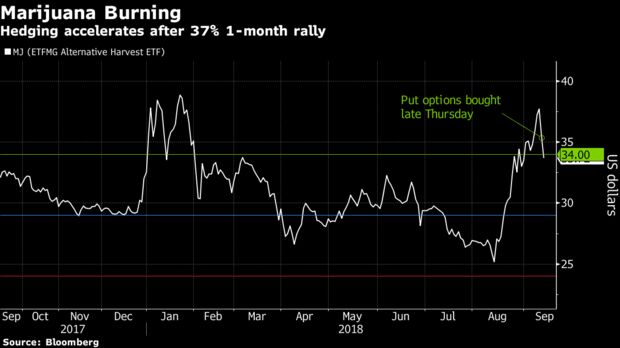
An options buyer put a sizable hedge against the U.S. exchange-traded fund tracking the marijuana industry in a bet that pot stocks won’t continue to soar.
Shortly before the market closed Thursday, the investor bought 5,000 October $34 puts and 5,000 October $24 puts on the ETFMG Alternative Harvest ETF, which goes by the ticker MJ, while simultaneously selling 10,000 October $29 puts. The move sent total options volume in the fund to more than five times its 20-day average. Put options give investors the right to sell the underlying shares for a set price.
The ETF lost 6.3 percent on Thursday, but has rallied nearly 40 percent over the last 30 days as its largest components — Cronos Group Inc., Tilray Inc. and Canopy Growth Corp. — have soared. Tilray, for example, has more than quadrupled in that time. The fund fell more than 5 percent in early trading Friday, but rebounded and was up 1.5 percent to $35.87.
The wager would pay off if Thursday’s downturn continues. The meteoric climb in marijuana shares was halted, at least temporarily, by reportsthat U.S. authorities may make it more difficult for cannabis industry workers, investors and users to enter the country.

Lupin receives FDA approval for generic pneumonia med


Lupin announced that it has received approval for its Atovaquone Oral Suspension USP, 750 mg/5 mL from the United States Food and Drug Administration (FDA) to market a generic version of GlaxoSmithKline LLC’s Mepron Oral Suspension, 750 mg/5 mL.
Lupin’s Atovaquone Oral Suspension USP, 750 mg/5 mL is the generic version of GlaxoSmithKline LLC’s Mepron Oral Suspension, 750 mg/5 mL. It is indicated for prevention and acute oral treatment of mild-to-moderate Pneumocystis carinii pneumonia (PCP) in patients intolerant to trimethoprim-sulfamethoxazole (TMP-SMX).
Atovaquone Oral Suspension, 750 mg/5 mL had annual sales of approximately USD 117.4 million in the US (IQVIA MAT June 2018).

Lonza Launches Early-Intermediates Supply Initiative for Small-Molecule APIs


  • Is aimed at addressing concerns regarding over-dependence on regional supply of pharmaceutical ingredients to the Western pharmaceutical industry
  • Leverages more than 600m3 chemical capacity at the Visp (CH) chemical complex operating under ISO quality systems
  • Provides a critical link in Lonza’s end-to-end service offering covering early intermediates, active pharmaceutical ingredients (APIs), drug product intermediates and specialized finished drug product supply
Lonza Pharma & Biotech today announced the launch of its pharmaceutical early-intermediates supply initiative. The initiative leverages chemical production facilities at the company’s Visp (CH) site to address increasing global early-intermediates supply security and quality concerns. Lonza now offers its customers an integrated supply chain from non-GMP early intermediates to cGMP advanced intermediates and APIs.
Lonza will supply ISO-certified early intermediates to customers under customized arrangements in order to simplify supply chains. These arrangements can be based on replacing current sources of non-GMP material, forward processing of basic or specialty chemicals, or back integrating current API supply. The seven ISO-certified plants within the Visp complex provide more than 600m3 of reactor volume and a full range of capabilities across an array of chemical technologies to service customer requirements.
‘Lonza’s Visp site is well positioned to help address our customers’ concerns over their API supply chain. As a world leader in API development and manufacturing, we have been diversifying and replacing our early-intermediates supply base with internally produced material,’ said Michael Banks, Vice President Early Intermediates, Lonza Pharma & Biotech. ‘We are now able to offer this early-intermediates supply option directly to customers under flexible arrangements that meet their specific needs.’
Lonza has a well-established base for chemical synthesis at its Visp site with more than 40 years’ track record in the production of APIs and their intermediates. The Visp infrastructure includes a vast array of development, clinical scale and manufacturing capacity, capabilities and expertise for both small molecules and biologics.
Lonza’s second small-molecule site in Nansha (CN) was built and operates to ICH* standards for the development and manufacture of APIs, providing additional supply chain capability and flexibility to a global customer base.
‘We are dedicated to the high-quality, secure supply of intermediates and APIs for ensuring uninterrupted supply of life-saving medicines. We are also focused on innovation – across our technologies, services and business models – to help bring new medicines to market,’ said Gordon Bates, President Chemical Division, Lonza Pharma & Biotech. ‘The launch of our early-intermediates initiative is another important chapter in pursuing this mission.’

Allergan says revenue from aesthetics unit may double by 2025


Allergan Plc (AGN.N) said revenue from its medical aesthetics business could double by 2025, even as it faces increasing competition for its blockbuster wrinkle treatment, Botox.
The drugmaker announced earlier on Friday the acquisition of Bonti Inc, which makes a shorter-acting neurotoxin than Botox.
Chief Commercial Officer Bill Meury said Allergan expects revenue at its medical aesthetics unit to grow to $7 billion to $8 billion. That compares with revenue of $3.8 billion from the business in 2017.
Beyond Botox, the unit includes dermal filler Juvederm, the CoolSculpting fat-freezing systems, and other treatments.
AGN.NNEW YORK STOCK EXCHANGE
-0.63(-0.33%)
AGN.N
  • AGN.N
  • RVNC.O
  • EOLS.O
He said the forecast implied an 8 to 10 percent compound annual growth rate.
Meury said the Bonti acquisition would allow the company to market a new “starter toxin.” Patients could test drive the treatment, which lasts for two to four weeks, to help them decide if they want to use longer-term Botox.

Nearly 20% of Employees Have Inpatient Out-of-Network Health Care Claims


Approximately twenty percent of employees with insurance had at least one out-of-network claim for inpatient care, according to a Peterson-Kaiser Tracker analysis. Employees with out-of-network provider bills may experience increased stress due to the cost of healthcare because they are largely responsible for out-of-network costs.
In 2016, 15.5 percent of all inpatient admissions claims that took place within in-network facilities included services from an out-of-network provider, indicating that choosing an in-network care site is not necessarily a predictor of what costs a payer will cover.
Overall, 17.6 percent of claims related to inpatient admissions involved out-of-network services.
The research team inferred that the high prevalence of out-of-network billing may stoke employee concerns about the affordability of medical services. In recent years, employees have experienced an increase in their cost sharing commitments for employer-sponsored coverage, leading to concerns over affordability.
Employees enrolled in limited network employer plans, such as an HMO or exclusive provider organization (EPO) plan, typically experience high-cost out-of-network bills, according to KFF researchers. HMOs and EPOs typically do not cover any form of out-of-network care.
Even employees in PPO plans, which are benefit packages that may provide coverage for out-of-network care, also face significant out-of-network costs.
“The [PPO] plan may have somewhat higher cost-sharing amounts (for example, it may have a separate or higher deductible) for services from out-of-network providers,” KFF explained. “Second, and more importantly, the providers they use may ask them to pay any difference between what the plan reimburses and the amount that the provider charges for its services.”
KFF found that employees sometimes face surprise medical bills when an in-network provider refers the employee to an unknown out-of-network provider for services.
“Other instances of out-of-network service use may be inadvertent, such as where an enrollee encounters an out-of-network provider (maybe an anesthesiologist) in the course of treatment at an in-network hospital or surgical center, or when their in-network provider refers them to an out-of-network provider for services such as laboratory testing or radiology,” KFF explained.
Surprise medical bills can create significant financial challenges for employees. A separate KFF survey found that seven out of ten with unaffordable medical bills did not realize the bills were for out-of-network care.
The team explained that the practice of balance billing can also make employees vulnerable to out-of-network costs.
Balance billing is when the provider asks the patient to pay the difference between the costs covered by their insurance plan and the out-of-network costs. Employer health plans rarely have cost-sharing policies that protect employees from balance billing, the team added.
The Peterson-Kaiser Tracker found that ED claims are the most likely to result in an out-of-network provider bill. The team estimated that 27.2 percent of all inpatient admissions with an ED claim were from out-of-network providers.
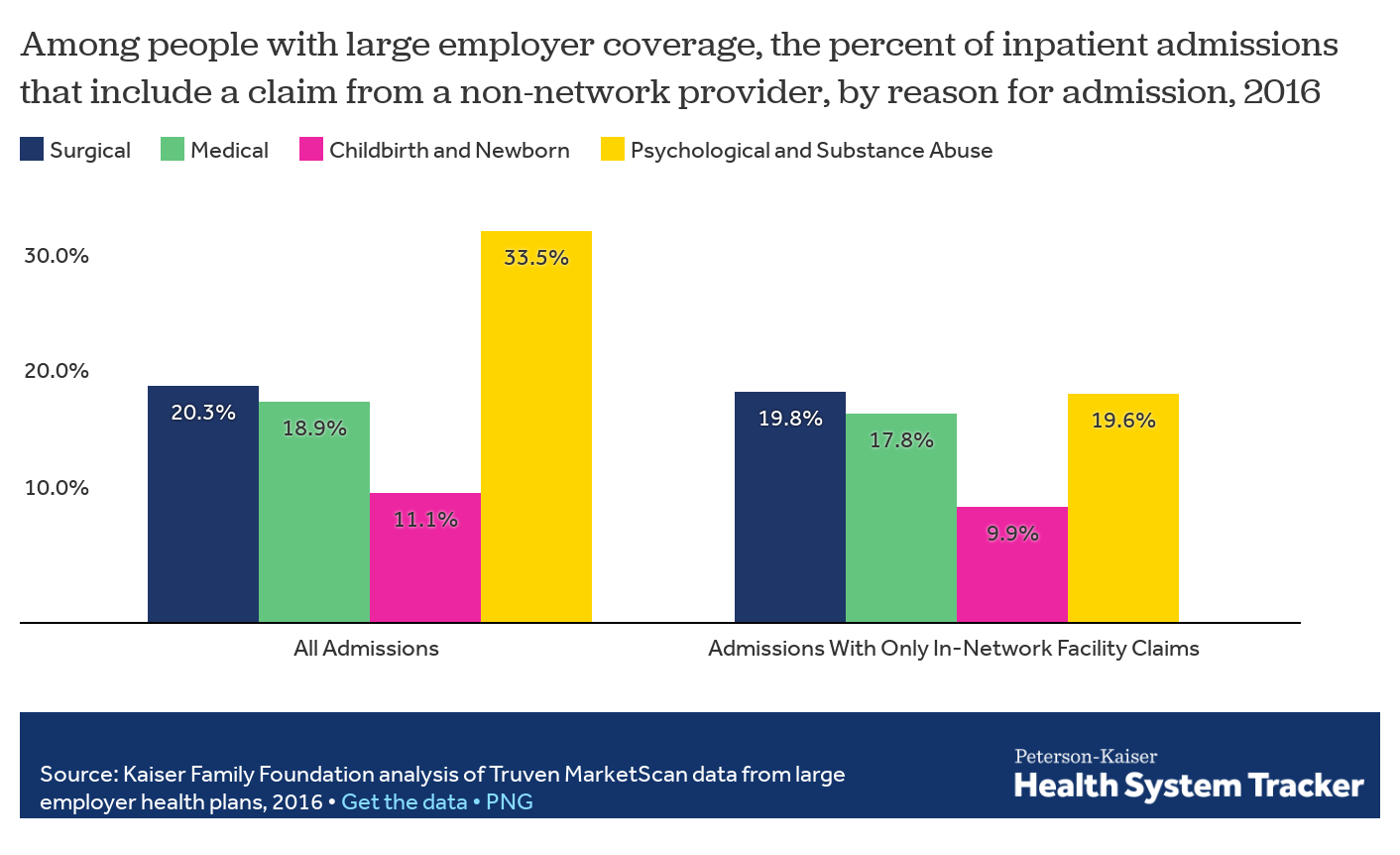
Patients that receive inpatient mental health treatment are the more likely to receive out-of-network bills from providers than patients using other inpatient services outside of emergency care.
Out-of-network provider claims based on reasons for inpatient admissions
Source: Peterson-Kaiser Tracker
In 2016, a third of all inpatient mental health services were billed by out-of-network providers. Twenty percent of inpatient surgical services and 18.9 percent of inpatient medical services were also billed by out-of-network providers or facilities.
Outpatient service claims (7.7 percent of claims) and outpatient facility charges for emergency and surgical care (9.2 percent of claims) were less frequently billed by out-of-network providers.
The Kaiser Family Foundation explained that many employees may seek out-of-network services because they prefer a specific provider outside their network due to the provider’s reputation, familiarity, or convenience. Employees also are likely to seek out-of-network care when services like mental healthcare are not offered by in-network providers.
Employers may want to design benefits that address mental health to keep employees from using in-network services that are cheaper than out-of-network services. Employers may also want to explore new contracting options with providers to ensure beneficiaries are able to use more affordable healthcare services.
“In many instances, it is doubtful that enrollees could reasonably anticipate or control their use of out-of-network providers,” KFF said. “For inpatient admissions, enrollees using only in-network facilities still have at least one claim from an out-of-network provider in over 15 percent of admissions. For both inpatient and outpatient services, enrollees using emergency rooms have a much higher likelihood of having an out-of-network claim, even when they use in-network facilities.”
High out-of-network costs can add onto an employee’s other stressful cost commitment including premiums and deductibles. Employers offering benefits may want to reduce their employees’ financial burdens by redesigning cost sharing or by assessing providers to develop high performance networksthat lead to lower care costs in general.