Search This Blog

Monday, January 21, 2019

Chinese Government Takes Action Against CRISPR Researcher


China government officials told the Xinhua News Agency that the researcher who became world famous for using CRISPR on human embryos “will be transferred to public security authorities,” and the individuals involved in the research will be “severely dealt with according to the law.”
On Monday, November 26, He Jiankui, a researcher at the Southern University of Science and Technology of China in Shenzhen, announced he had used CRISPR gene editing within the context of in vitro fertilization, to modify the CCR5 gene in human embryos. He did this for seven couples, and, he went on to announce, a set of twins had been born. A later announcement indicated there was another pregnancy.

The research was widely condemned worldwide for violating moral and ethical standards. It was, basically, unnecessarily performing research on human embryos that became babies using technology that was not thoroughly understood. Not only are there concerns about off-target CRISPR edits that could cause unforeseen problems, such as cancer, but, because He performed the procedures on the embryos, those genomic changes will be passed onto the children’s children, if and when they are ready to have children of their own.
He made his announcement at the Second International Summit on Human Genome Editing at the University of Hong Kong. Shortly afterward, he left Hong Kong and went into hiding. Meanwhile, the China government, Rice University, and the U.S. National Institutes of Health (NIH) promised to launch investigations. Rice University and the NIH are involved because He Jiankui was assisted by Michael Deem, who was one of He Jiankui’s graduate advisors at Rice University in Houston. Deem holds a small stake in two commercial genetics companies He Jiankui launched in China and reportedly was in China to assist with the procedures.
He has defended his action, but the U.S. National Academies of Science, Engineering and Medicine have found that the research was unnecessary and dangerous. According to more recent data, eight couples were involved in the research. The men all had under-control HIV infections. The babies were at no risk of HIV.
Of the eight couples, one woman implanted with the genetically modified embryos carried to term and gave birth to twins. Another couple is also reportedly pregnant. One couple dropped out of the program and five others did not get pregnant.
The Chinese government has indicated that implanting these types of embryos is illegal in that country and that He Jiankui forged an ethics review in order to begin his experiment. Those institutional reviews are the only paperwork Chinese scientists need to open experimental trials. In the U.S., they would also require federal permission.
China’s science ministry stated that it “resolutely opposed” the experiment and would work to “improve relevant laws and regulations and improve the scientific research ethics review system.”
Shenzhen, China-based Southern University of Science and Technology, indicated that it was firing He Jiankui. They had previously denied any knowledge of the experiment.
Regulatory authorities in Guangdong Providence, where Shenzhen is located, informed the news service they were modifying the gene-edited babies, as well as the second pregnant woman.
The news agency reported that He Jiankui acted in “the pursuit of personal fame,” and said his “behavior is a serious breach of ethics and scientific integrity, a serious violation of state regulations.”


GSK Chairman Sir Philip Hampton Steps Down Ahead of Company Split


GlaxoSmithKline Chairman Sir Philip Hampton will step down from his role ahead of the company’s plan to split into two separate business units. The U.K.-based pharma giant said it has started the process to find a successor to Hampton, who has led the board of directors since 2015.
Hampton’s decision came about one month after Chief Executive Officer Emma Walmsley announced her intention to split GSK into two different business units, one, a consumer healthcare business in a partnership with Pfizer, and the other, GSK’s pharmaceutical business. For the partnership with Pfizer, the U.S. company will contribute its consumer healthcare business to GlaxoSmithKline’s existing consumer healthcare business. Combined, the 2017 global sales for the consumer businesses were approximately $12.7 billion. Under the terms of the arrangement, Pfizer will receive a 32 percent equity stake in the joint venture.

In his announcement this morning, Hampton said that following GSK’s deal with Pfizer and the separation of the businesses, this was the right moment to step down. Hampton said a new chairman of the board will be able to “oversee this process through to its conclusion over the next few years and to lead the Board into this next phase for GSK.”
Vindi Banga, GSK’s Senior Independent Director on the board, said there is a clear strategy in the company’s future. Banga said GSK has a clear pathway forward and that “this is a good time to start the process to find Philip’s successor.”
Hampton joined GSK’s board of directors on Jan. 1, 2015. It was a time of transition for the company as sales of its core respiratory medications were waning. Hampton was tasked with helping to guide the company back to profitability.
Shares of GSK are up slightly in premarket trading after Hampton’s announcement was made public. Shares of GSK are trading at $39.12 ahead of the market’s open.
GSK’s decision to spin off the consumer healthcare business into a separate entity was a bold plan for Walmsley. In early 2018 there had been rumors that GSK was intending to acquire Pfizer’s consumer healthcare business. However, in March, the company walked away from the deal. Walmsley said at the time that any deals the company made should meet its “criteria for returns and not compromise our priorities for capital allocation.” Days later though, GSK plunked down $13 billion to buy out Novartis’ share of its joint consumer health business unit that markets products such as Sensodyne toothpaste and Panadol headache tablets.
Now, the company is in business with Pfizer’s consumer health program, with that company owning less than half of an equity stake. The deal with Pfizer came a few weeks after GSK snapped up Tesaro Oncology and its PARP inhibitor program for $5.1 billion. For GSK, the deal will bolster its pharmaceutical business and accelerate the build of its pipeline and commercial operations in the oncology space. GSK has been streamlining its operations to focus on drug development that will accelerate growth, such as in oncology.

Alnylam, Israel’s Medison partner to commercialize Onpattro, RNAi portfolio


Alnylam Pharmaceuticals and Israel’s Medison Pharma announced an exclusive agreement to commercialize Onpattro as well as other investigational therapeutics under development in the Alnylam RNAi portfolio. “Our partnership with Medison marks an important step in our global commercial expansion and signals our intent to ensure that patients suffering from serious rare diseases have access to our medicines, regardless of location,” said Theresa Heggie, SVP and Head of Europe, Middle East and Africa, and Canada, Alnylam Pharmaceuticals. The agreement between Alnylam and Medison includes Onpattro, approved in the European Union in August 2018 for the treatment of hATTR amyloidosis in adults with stage one or stage two polyneuropathy; givosiran, a late-stage investigational RNAi therapeutic for the treatment of acute hepatic porphyria; and lumasiran, a late-stage investigational RNAi therapeutic for the treatment of Primary Hyperoxaluria Type 1. These medicines are not currently approved for use in Israel and givosiran and lumasiran have not yet been approved by any regulatory authority, Alnylam noted.
https://thefly.com/landingPageNews.php?id=2851233

Vertex says European Commission granted label extension for Orkambi


https://thefly.com/landingPageNews.php?id=2851234

Abbott: FDA approves TactiCath Contact Force Ablation Catheter


Abbott announced FDA approval of the TactiCath Contact Force Ablation Catheter, Sensor Enabled, a new ablation catheter “designed to help physicians accurately and effectively treat atrial fibrillation.” The company added, “The approval further expands Abbott’s portfolio of cardiac ablation tools that integrate with the company’s EnSite Precision cardiac mapping system to help physicians develop more precise images of the heart during cardiac ablation procedures.”
https://thefly.com/landingPageNews.php?id=2851241

Sunday, January 20, 2019

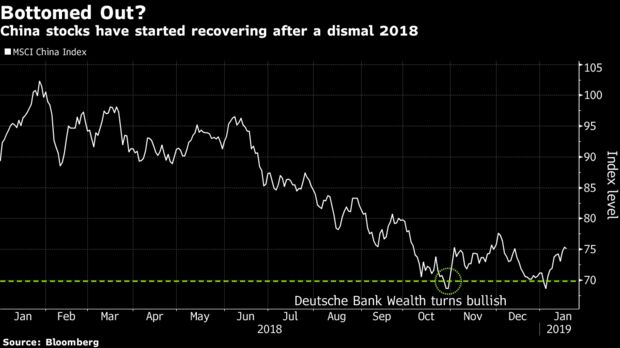
Fund Managers Who Called China Stock Bottom See More Gains Ahead


At the end of October, when Chinese shares were in freefall, the chief investment officers at Deutsche Bank Wealth Management made a bold call: the worst was over for the world’s second-largest equity market.
Since the start of November, the MSCI China Index of the nation’s shares has rebounded more than 7 percent.
For Christian Nolting, global chief investment officer, and Tuan Huynh, chief investment officer for Asia-Pacific, those gains are just the start. China’s A shares will lead an advance among Asia ex-Japan equities this year, the two money managers say. While they declined to give a specific target for Chinese stocks, they expect the regional ex-Japan gauge to climb almost 5 percent more in 2019.
Tuan Huynh
Photographer: Graham Crouch/Bloomberg
Here are their reasons for optimism:
  • Asian shares tend to bounce back after bad years, they say. There’s truth to this pronouncement. The MSCI Asia Ex-Japan Index, which plunged 16 percent in 2018, hasn’t posted back-to-back annual declines since 2002.
  • The Chinese government is likely to add more stimulus to the economy, according to Nolting and Tuan. That’s already happening. Since the start of this year, China has announced a flurry of tax cuts, credit policy tweaks, looser property measures and record injections via open-market operations.
  • Earnings growth at Chinese companies is likely to be in the high single digits or low double digits, they say.
  • And concerns about China’s economic slowdown, in their eyes, may be somewhat overdone. They expect the government to take steps to ensure that gross domestic product growth doesn’t fall below 6 percent.
China is “one of our most preferred calls,” Tuan said in an interview in Singapore. Equity markets including China priced in an earnings recession in 2018 that just didn’t exist, he said.
The money managers, which help oversee $336 billion at Deutsche Bank Wealth globally, issued their call on Chinese shares in a CIO note to clients on Oct. 25, according to the company. They turned bullish on U.S. equities in December, just before the S&P 500 Index started its climb this year. The U.S. benchmark stock gauge was up 5.2 percent already in 2019 through Thursday’s close, and Nolting and Tuan predict it will advance to 2,850 by year-end, which implies a gain of more than 8 percent from Thursday’s close.
Deutsche Bank Wealth likes infrastructure stocks in most markets as governments are more likely to provide stimulus in 2019 than central banks, which are raising interest rates and reducing their balance sheets, according to Nolting and Tuan. It also likes consumer-discretionary shares in Asia, which it says will benefit from the region’s burgeoning middle-class.

Computer program makes pharma patents airtight


Routes to making life-saving medications and other pharmaceutical compounds are among the most carefully protected trade secrets in global industry. Building on recent work programming computers to identify synthetic pathways leading to pharmaceutically complex molecules, researchers in Poland and South Korea have unveiled computerized methods to suggest only synthetic strategies that bypass patent-protected aspects of essential drugs. Their work appears January 17 in the journal Chem.
“When we started this project, I was somewhat skeptical that the machine would find any viable synthetic alternatives — after all, these are blockbuster drugs worth gazillions of dollars, and I was sure that the respective companies had covered the patent space so densely that no loopholes remained,” says senior author Bartosz Grzybowski, a professor of chemistry at the Ulsan National Institute of Science and Technology (South Korea) and the Polish Academy of Sciences and the lead developer of the organic synthesis software Chematica. “It turns out that the loopholes are there, and we can find new retrosynthetic pathways that circumvent the patents entirely.”
Those pharmaceutical patents protect the company’s intellectual property while also preventing competitor companies from using certain key synthetic solutions — developed painstakingly by experiment to maximize yield, increase purity, and reduce costs — when attempting to produce desired compounds. To get to viable unpatented options, the researchers “froze” challenging portions of each target molecule, forcing the computer to substitute unconventional yet chemically plausible approaches on the basis of mechanistic rules. They tested their system out on three notable commercial medicines with different chemical hurdles: linezolid, a last-resort antibiotic; sitagliptin, an antidiabetic drug; and panobinostat, a multiple myeloma treatment.
In each case, when allowed to run without constraints, the program recommended the commercial syntheses. But when even a few atoms and bonds were designated as untouchable, it innovated by applying Chematica’s existing functions to propose new plans that neatly avoided those already patented. “By algorithmically locating the key bonds on which patents hinge and propagating them down Chematica’s retrosynthetic trees, we can generate synthetic solutions from alternative yet economical starting materials, achieving a real practical impact,” Grzybowski says.
Chematica’s patent-dodging abilities could also alter how chemists approach intellectual property and patent law. For example, machine-aided searches could be used to restrict many different parts of a target molecule, lumping radically different syntheses into a single airtight patent. According to Grzybowski, however, such a patent would not necessarily stay loophole-free forever, thanks to the likely future experimental discovery of novel reactions driving chemical knowledge forward through healthy competition.
Overall, the researchers hope that their software will aid pharmaceutical companies in better protecting their intellectual property and, simultaneously, will help accelerate research and development in organic chemistry by supplying synthetic routes that differ from standard approaches. “This work illustrates the benefits of pushing chemists to think algorithmically and asking computer scientists to grasp key chemical concepts, delivering chemical artificial intelligence results that matter beyond the confines of academia,” adds co-author Piotr Dittwald, a research fellow with training in mathematics and computer science.
Story Source:
Materials provided by Cell PressNote: Content may be edited for style and length.

Journal Reference:
  1. Molga et al. Navigating around patented routes by preserving specific motifs along computer-planned retrosynthetic pathwaysChem, 2019 DOI: 10.1016/j.chempr.2018.12.004