Search This Blog

Friday, January 15, 2021

Big Call: 'Vaccinations Should Bring Virus Under Control In Next Few Weeks'

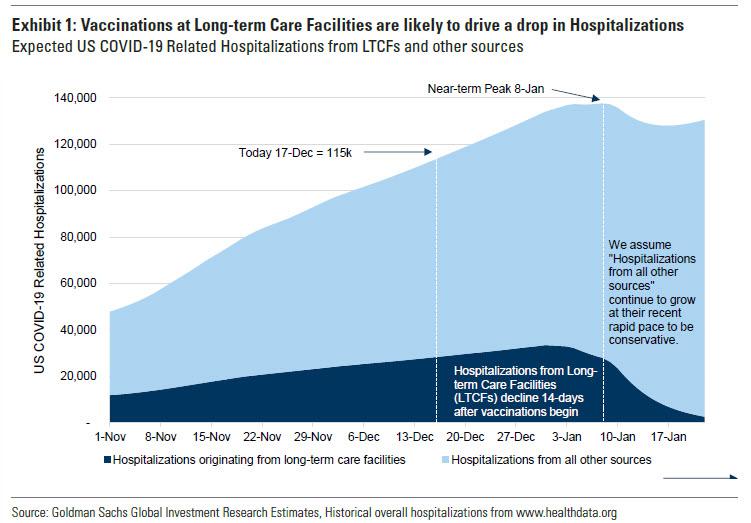
 One month ago, we presented to our readers an analysis from Goldman Sachs, according to which the rapid rollout of vaccinations at long-term care facilities would lead to a decline in US hospitalizations around Jan 9, and would then push total covid-related hospitalizations to nearly zero by the end of the month.

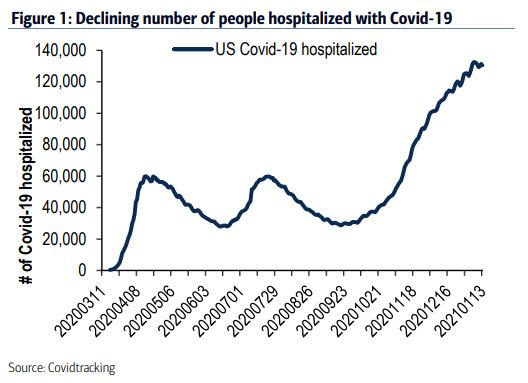
While Goldman may have been off by a few days, it was almost spot on: as Bloomberg reported earlier this week, citing the Covid Tracking Project, the US hospitalization numbers are now dropping compared with a week earlier in both the Northeast and Midwest, the critical inflection point that Goldman had pegged for Jan 9.

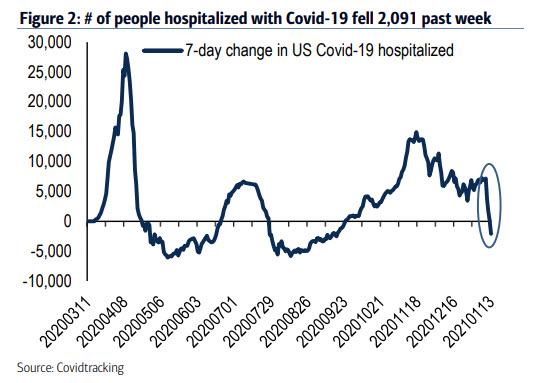
An analysis from BofA confirms this critical inflection point. According to the bank, we saw a 2,091 person decrease in the number of people hospitalized in the US with Covid-19 over the last week, the first decline since September 23rd.

Considering that just four days ago there was a 7,167 person weekly increase and since then the number has declined gradually..

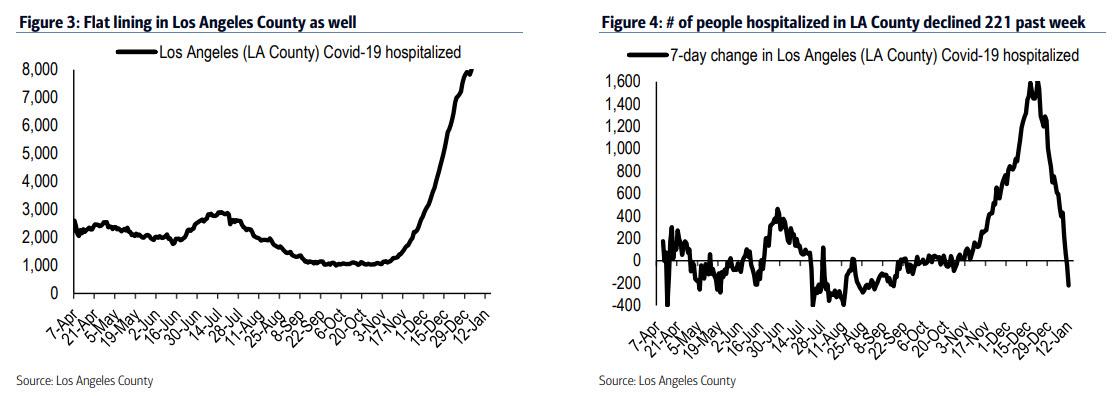
... this is a huge improvement. While the decrease is broad based (31 of 51 states+DC), the decline in weekly change of course is dominated by CA, FL, GA, NY and TX. Further inspection shows continued improvement in the fall outbreak states (mainly in Midwest) and stabilization in some of the worst more recent winter outbreaks, such as in Los Angeles County that saw a weekly decline of 221 after having peaked at an increase of 1,612 on December 22nd.

All this is happening just as Biden is about to be inaugurated: what an amazing coincidence!

Endemic SARS-CoV-2 will maintain post-pandemic immunity


Dr. Reddy’s Gets OK to Conduct Phase 3 Trial for Sputnik V Vaccine in India

 Dr. Reddy’s Laboratories Ltd (BSE: 500124, NSE: DRREDDY, NYSE: RDY, NSEIFSC: DRREDDY) announced today that it has received approval from the Drugs Control General of India (DCGI) to conduct phase 3 clinical trial for the Sputnik V vaccine in India.

The phase 3 study of Sputnik V will be conducted on 1500 subjects as part of the randomized, double-blind, parallel-group, placebo-controlled study in India.

Earlier, the Data and Safety Monitoring Board (DSMB) reviewed the safety data from the phase 2 clinical trial of the vaccine and recommended the phase 3 recruitment. In its report, the DSMB concluded that no safety concerns were identified and the study met the primary endpoints of safety.

G V Prasad, Co-chairman and Managing Director, Dr. Reddy’s Laboratories said, “This is an important milestone in the progress of this pivotal clinical trial of the vaccine. We expect to commence the phase 3 study within this month and will continue to fast-track our efforts to bringing in a safe and efficacious vaccine for the Indian population.”

In September 2020, Dr. Reddy’s partnered with Russian Direct Investment Fund (RDIF) to conduct the clinical trials of the Sputnik V vaccine and for its distribution rights in India.

https://www.businesswire.com/news/home/20210115005495/en/Dr.-Reddy%E2%80%99s-Receives-Approval-to-Conduct-Phase-3-Clinical-Trial-for-Sputnik-V-Vaccine-in-India

23 die in Norway after receiving Pfizer COVID-19 vaccine

 Twenty-three people died in Norway within days of receiving their first dose of the Pfizer COVID-19 vaccine, with 13 of those deaths — all nursing home patients — apparently related to the side effects of the shots, health officials said.

Common reactions to the vaccine, including fever and nausea, “may have contributed to a fatal outcome in some frail patients,” Sigurd Hortemo, chief physician at the Norwegian Medicines Agency, said in a Friday statement

All 13 were nursing home patients and at least 80 years old. While officials aren’t expressing serious concern, they are adjusting their guidance on who should receive the vaccine. 

The news comes just over a week after officials reported the deaths of just two nursing home residents after they received the Pfizer jab. 

More than 30,000 people in Norway have received the first shot of the Pfizer or Moderna coronavirus vaccine in the Scandinavian country since late last month, according to official figures.

“We are not alarmed by this,” Steinar Madsen, medical director with the agency, told Norwegian broadcaster NRK. “It is quite clear that these vaccines have very little risk, with a small exception for the frailest patients.”

“Doctors must now carefully consider who should be vaccinated,” he added. “Those who are very frail and at the very end of life can be vaccinated after an individual assessment.”

The agency reported Thursday that a total of 29 people had suffered side effects, including the 13 people who died. 

Twenty-one women and eight men experienced side effects, officials said. 

Besides those who died, nine had serious side effects — including allergic reactions, strong discomfort and severe fever — while seven had less serious ones, including severe pain at the injection site.

In total, more than 57,000 cases and 500 coronavirus-related deaths have been reported in Norway, according to Johns Hopkins University.

Health officials noted that around 400 people die each week in the nursing home population.

A Pfizer rep said the pharmaceutical giant is “aware of reported deaths” following the administration of the vaccine in Norway and is working with the Norwegian Medicines Agency “to gather all the relevant information.”

“Norwegian authorities have prioritized the immunization of residents in nursing homes, most of whom are very elderly with underlying medical conditions and some which are terminally ill,” a spokeswoman said in a statement. “[The Norwegian Medicine Agency confirms] the number of incidents so far is not alarming, and in line with expectations.”

 “All reported deaths will be thoroughly evaluated by [the agency] to determine if these incidents are related to the vaccine,” she added. “The Norwegian government will also consider adjusting their vaccination instructions to take the patients’ health into more consideration.”

https://nypost.com/2021/01/15/23-die-in-norway-after-receiving-pfizer-covid-19-vaccine/

Verily sees big opportunities to help reopen businesses in 2021

 Google sister company Verily rapidly expanded the scope of its work in healthcare and research during the COVID-19 pandemic.

Its Baseline Platform has supported COVID-19 testing and research efforts with multiple partners this year, having screened and tested nearly 2 million people across 351 testing locations, according to the company.

Leveraging its technology capabilities, Verily sees big opportunities to expand its work with employers through its Healthy at Work program. Launched in June, the program helps businesses and universities reopen safely.

"Employers are relying heavily on digital health to ensure their employees’ health and wellness in the workplace and at home. The lines between work and home are continuing to stay blurred and health technology will continue to play a big role in employee health and safety throughout 2021," said Vivian Lee, M.D., Verily's president of health platforms, during a Fierce JPM Week interview.


Verily has developed technology around population health, clinical care delivery and chronic disease management through programs like its virtual clinic Onduo. These capabilities, along with its data science expertise, can be valuable for employers and universities as they look to bring employees and students safely back to buildings, according to Lee.

"We’re seeing a lot of uncertainty as we navigate the new normal. Our efforts at Verily as we step up and try to help the nation is also, in turn, really enabling us to double down on our efforts around virtual health and digital health," Lee said.

Healthy at Work combines testing, symptom tracking, data analytics and the latest guidance from the Centers for Disease Control and Prevention and other public health authorities.

"It's the research side that I find fascinating," Lee said. "Our data scientists have built sophisticated epidemiologic models. We got involved in COVID very early and we had a little more time to build that expertise and experience, so with these epidemiological models, organizations are able to address very practical questions."

For example, she said, "Universities are coming to us and saying, 'We only have 10% of dorm space set aside for COVID positive students, how can we make sure we stay below the threshold and make sure that the dorm doesn’t exceed capacity? How frequently should we test students, who should test more or often or less often?'"

Employers need the same capabilities and data insights, she said.


"Employers say that they have limited budgets for this and want to know how often to test employees and who they should be testing in order to ensure they can keep worksites healthy and safe," Lee said.

Verily closed out 2020 with a massive $700 million funding round that will be used to rapidly scale up its commercial work. The round was led by its parent company and Google holding firm Alphabet as well as investors Silver Lake, Temasek, Ontario Teachers’ Pension Plan and other backers.

The capital will be used to support the expansion of some of Verily’s leading commercial businesses, including its new stop-loss insurance business launched in 2020 in conjunction with Swiss Re. Called Coefficient Insurance Company, the business will combine innovative health technology solutions with novel insurance and payment models and aims to protect self-funded employers from unexpected and large employee health benefit claims.

Employers are worried about the volatility of healthcare costs as a result of the pandemic, Lee said. 

"There are employees who may be putting off important care, and then needing something acutely or have been suffering through COVID. Stop-loss insurance is a very important piece of what we’re providing that is enabling them to insure against the volatility that is happening now with their healthcare costs," she said.

Coefficient will focus on what Verily calls "precision risk" to provide self-funded employers with more predictable benefit plan protection.


"We are seeing much of our work in Verily needed even more urgently than ever as a result of what’s been happening in the world, whether it’s being able to connect with individuals to look over their own health at home or working with employers who are needing more support for their employees through digital tools," Lee added.

Given the financial impact of COVID-19 on the economy, there will increased pressure from payers to reduce the cost of care and improve outcomes with fewer resources, Lee said.

"We can’t afford healthcare costs that we’ve seen in the last few decades, and with the shift from volume to value, we need to support that with all our technologies," she said.

https://www.fiercehealthcare.com/tech/fierce-jpm-week-verily-sees-big-opportunities-for-digital-health-to-help-reopen-business-2021
Top healthcare items in Biden's proposed $1.9T COVID-19 relief plan

 President-elect Joe Biden’s new $1.9 trillion COVID-19 relief plan includes money for boosting subsidies to help pay down the costs of Affordable Care Act exchange plans, bolstering supplies and for vaccine distribution.

The American Relief Plan announced late Thursday includes new investments in supplies for strapped hospitals, money for vaccines and testing and seeks to give frontline healthcare workers new federal protections.

A key pillar of the plan is $20 billion for a national vaccine program that partners with state and local governments. The plan will launch community vaccination centers around the country and mobile units for any hard-to-reach areas.

“We must ensure that those on the ground have what they need to get vaccinations into people’s arms,” the plan said.

Biden will also work with Congress to expand the federal matching rate to 100% for the administration of vaccines to ensure that all Medicaid enrollees get vaccinated.


The call for more vaccine funding comes amid criticism from some provider groups that Health and Human Services needs a more coordinated plan for the distribution of the vaccine.

HHS Secretary Alex Azar blamed states and localities for the slow rollout of vaccines, saying that states have been too prescriptive in only giving vaccines to certain priority groups even though the federal government left distribution up to states.

Biden’s plan also calls for $50 billion for testing and give funding to purchase rapid tests and expand capacity.

The president-elect also seeks to expand the public health workforce with money to hire 100,000 public health workers.

“These individuals will be hired to work in their local communities to perform vital tasks like vaccine outreach and contact tracing in the near term,” the plan said.

Hospitals could also be aided by a plan to invest $30 billion in the Disaster Relief Fund that will ensure sufficient supplies and personal protective equipment.

Hospitals have been under constant strain to get enough PPE, ventilators and other supplies such as critical drugs since the onset of the pandemic. Hospital finances have also been strained as the costs for such supplies have skyrocketed.

Biden will call for another $10 billion to expand domestic manufacturing of any supplies, a nod to problems with the overreliance of foreign manufacturing for the needed supplies. Some hospital systems have even bought stakes in domestic manufacturers of PPE to ensure they have enough supplies.

Another major boost for providers is a directive from Biden to Congress to authorize the Occupational Safety and Health Administration to create a COVID-19 protection standard that shields workers from unsafe working conditions and retaliation related to the pandemic.

Nurses unions such as National Nurses United have pushed OSHA to deliver this standard amid concerns that nurses are fighting the virus under unsafe working conditions in some facilities.

Biden inserts other major healthcare priorities in the plan, chiefly a bid to expand and increase the value of the subsidies for ACA exchange plans. He doesn’t want any ACA enrollees to not pay more than 8.5% of their income for coverage.

It remains unclear what parts of Biden's plan could get through Congress, although money for vaccine distribution likely will have bipartisan support. The $900 billion COVID-19 relief package passed late last year also included money for vaccinations.

https://www.fiercehealthcare.com/hospitals/from-vaccine-money-to-aca-subdsidy-boost-here-s-top-healthcare-items-biden-s-proposed

More transmissible UK coronavirus variant found in 10 U.S. states: CDC

 A new, more transmissible variant of the coronavirus first discovered in Britain has been detected in 10 U.S. states, the U.S. Centers for Disease Control and Prevention said on Friday, warning that it could become the dominant circulating variant in the United States by March.

The variant, known as B.1.1.7, is believed to be twice as transmissible as the current version of the virus circulating in the United States.

Its rapid spread will increase the burden on health resources at a time when infections are surging, further sapping strained healthcare resources and increasing the need for better adherence to mitigation strategies, such as social-distancing and mask-wearing, the CDC said in its weekly report on death and disease.

It also increases the percentage of the population that needs to be vaccinated to achieve protective herd immunity to control the pandemic, the CDC said.

https://www.reuters.com/article/us-health-coronavirus-usa-variant/more-transmissible-uk-coronavirus-variant-found-in-10-u-s-states-cdc-says-idUSKBN29K2CD