Search This Blog

Tuesday, February 9, 2021

Valneva open to partners for COVID-19 vaccine as it looks beyond Europe


French pharmaceutical company Valneva is open to production partnerships should its COVID-19 vaccine candidate secure approval and generate enough interest beyond Britain and the European Union, its chief financial officer said.

David Lawrence said the drugmaker was exploring an entry into the U.S. market for its vaccine, the only French shot close to entering late-stage human trials. Britain was due to receive the first doses produced in late September at the earliest, he said.

Valneva has signed a deal with Britain for up to 190 million doses by 2025 in a transaction worth potentially up to 1.4 billion euros ($1.69 billion). Lawrence said he expected talks with the European Union for a provisional 60 million doses to conclude "within the next few months".

The company's vaccine, derived from the technology behind its licensed Japanese encephalitis vaccine, will be produced in Scotland, with an estimated capacity of 200 million doses next year. It will use an adjuvant made by U.S. company Dynavax.

"If it's clear there's going to be demand beyond Livingston's (Scotland) capacity, then we will think very hard about partnering in different regions potentially," Lawrence told Reuters on Monday.

He did not say with whom the company might team up. Any partnership might involve both production and access to markets.

Countries worldwide are in a race against time to vaccinate their populations against a virus that has infected more than 106 million people globally and get their economies fully operational again.

Lawrence said Valneva had begun talks with a number of potential buyers in the summer. Orders by EU countries are made centrally through the European Commission.

"The UK moved very quickly," he said.

In the United States, where vaccines developed by Moderna and Pfizer/BioNTech have been approved so far, top infectious disease doctor Anthony Fauci urged a quicker rollout on Monday.

"We were not in the race in the U.S. We are now thinking very carefully about how we can participate going forward," Lawrence said.

Valneva was on track to deliver the results of its phase I and II trials by early April, Lawrence said. If successful, a phase III trial involving 4,000 subjects would start soon after at sites in Britain. This would likely involve a comparison against a proven vaccine rather than a placebo, he said.

Although the company was not advanced enough in trials to assess the efficacy of its vaccine on variants, Lawrence said its inactivated whole virus technique could easily be adapted.

"We feel we've got very close to plug and play if we wanted to adapt," he said.

https://www.marketscreener.com/quote/stock/DYNAVAX-TECHNOLOGIES-CORP-19120561/news/Valneva-open-to-partners-for-COVID-19-vaccine-as-it-looks-beyond-Europe-32396864/

Heat Biologics Sees Positive Data From Lung-Cancer-Treatment Trial

 Heat Biologics Inc. said it saw positive interim data of its Phase 2 trial of HS-110 in combination with Bristol-Myers Squibb's Opdivo nivolumab in advanced non-small cell lung cancer.

The company's HS-110 is an "off-the-shelf" allogeneic cell-based therapy designed to activate patients' immune system against multiple cancer testis antigens to elicit a diverse and robust immune response against tumor cells.

Heat Biologics said substantial survival benefit was observed in a cohort of previously treated, checkpoint inhibitor naive patients with advanced non-small cell lung cancer.

A median progression free survival of 1.8 months and a median overall survival of 24.6 months was observed with a median follow-up time of 19.4 months. The one-year survival rate of cohort A is 61.7%.

For NSCLC patients who had previously been treated with a checkpoint inhibitor and whose disease had subsequently progressed, a median progression free survival of 2.8 months and median overall survival of 11.9 months was observed with a median follow-up time of 11.9 months.

The company said 30% of the patients in Cohort A and 26% of the patients in Cohort B are still alive. HS-110 has a favorable safety profile and has been administered in 200 patients to date. There have been no treatment-related serious adverse reactions. A review of immune-related adverse events reported in the study raised no safety concerns.

https://www.marketscreener.com/quote/stock/HEAT-BIOLOGICS-INC-40311468/news/Heat-Biologics-Sees-Positive-Data-From-Lung-Cancer-Treatment-Trial-32396179/

Qiagen reports Q4 beat on added boost from non-COVID-19 products

 U.S.-German genetic testing specialist Qiagen reported better-than-expected quarterly earnings on Tuesday, citing very strong demand for COVID-19 testing combined with improvements in non-COVID-19 areas of its portfolio.

Qiagen said fourth-quarter net sales rose 36% to $571.2 million on a currency-adjusted basis, beating the $539.14 million expected on average by analysts in a Vara Research poll, as improved trends for its QuantiFERON tuberculosis test, cancer diagnostics and DNA sample technologies complemented coronavirus-related sales.

The company confirmed its guidance for 2021 adjusted EPS and net sales growth.

https://www.marketscreener.com/quote/stock/QIAGEN-N-V-40135659/news/Qiagen-reports-Q4-beat-on-added-boost-from-non-COVID-19-products-31959997/

Tenet Q4 2020 Results; To Retire $478M Debt; 2021 Guidance

 Tenet Healthcare Corporation (Tenet) (NYSE: THC) today announced its results for the quarter ended December 31, 2020 (4Q20).

Ronald A. Rittenmeyer, Executive Chairman and Chief Executive Officer, stated, “In 2020, we along with so many others faced challenges we had never experienced in the history of our company. Our ability to perform under such challenging and constantly evolving circumstances underscores the strength of all of our colleagues within the Tenet enterprise and the positive impact of our multi-year turnaround. We implemented a comprehensive and active response to the pandemic, focused on the safety of our personnel and our patients, and steadily improved performance in each operating segment as we moved through the year. We continued to advance top-tier clinical programs to serve growing acute and chronic care needs in our hospitals, while completing a transformational ambulatory transaction and pivoting our business toward higher-growth, lower cost-of-care settings. And, we continued to post an improved level of margin performance at Conifer, whose support of all of their clients was exceptional."

Rittenmeyer continued, "Our resilience as an organization was tested, and we outperformed, delivered on our commitments and continued building a framework for our future growth and success. We followed our stated strategy ensuring the improvements were sustainable and the changes became part of our permanent fabric. We are very proud of every one of our colleagues across the Tenet enterprise for their selfless commitment to our patients, each other and our communities."

Tenet's results for 4Q20 versus the quarter ended December 31, 2019 (4Q19) as well as the year ended December 31, 2020 (FY 2020) versus the year ended December 31, 2019 (FY 2019) are as follows:

($ in millions, except per share results)

4Q20

4Q19

FY 2020

FY 2019

Net income (loss) from continuing operations available (attributable) to Tenet common shareholders

$414

$(3)

$399

$(226)

Net income (loss) from continuing operations available (attributable) to Tenet common shareholders per diluted share

$3.86

$(0.03)

$3.75

$(2.19)

Adjusted EBITDA excluding grant income

$832

$799

$2,247

$2,730

Adjusted EBITDA

$1,278

$799

$3,146

$2,730

Adjusted diluted earnings per share from continuing operations

$4.72

$0.95

$7.92

$2.84

The table above as well as tables and discussions throughout this earnings release include certain financial measures that are not in accordance with Generally Accepted Accounting Principles (GAAP). Reconciliations of GAAP measures to the Adjusted (non-GAAP) measures used are detailed in Tables #1-3 included at the end of this earnings release. Management’s reasoning for the use of these non-GAAP measures and descriptions of the various non-GAAP measures are included in the Non-GAAP Financial Measures section of this earnings release.

COVID-19 Pandemic (COVID)

As previously disclosed, the Company has been experiencing operational and financial challenges associated with COVID. As Tenet continues to manage COVID and its impact on operations, the Company remains committed to the highest standards of safety, with protocols focused on the protection of its patients and employees, including the distribution of vaccines to its caregivers. Operational teams monitor real-time data to ensure sufficient staffing, intensive care unit bed capacity and personal protective equipment (PPE). Outpatient facilities are also safely performing elective procedures, and the Company's hospitals and ambulatory platform continue to follow all state and local guidelines concerning elective care.

Transformative Acquisition

On December 10, 2020, the Company announced the acquisition of a portfolio of 45 ambulatory surgical centers from SurgCenter Development (SCD) for approximately $1.1 billion. As anticipated, all the related individual transactions were completed in 4Q20.

The SCD transaction:

  • Expands USPI ambulatory business in line with Tenet's stated strategy
  • Cements Tenet's position as the preeminent national musculoskeletal services leader across the care continuum
  • Investment is in lower cost of care, highly efficient, consumer-friendly facilities that improve healthcare affordability and access
  • Enhances Tenet's overall business mix and earnings profile

Early Retirement of Debt

The Company also announced today it plans to retire $478 million of 7.000 percent senior unsecured notes due in 2025 using available cash on hand. In conjunction with this transaction, Tenet expects its annual cash interest payments will be lowered by approximately $33 million.

Results from Continuing Operations Available to Tenet Common Shareholders

  • Net income from continuing operations available to the Company's common shareholders in 4Q20 was $414 million, or $3.86 per diluted share, versus a net loss from continuing operations of $3 million, or $0.03 per diluted share, in 4Q19. Also, 4Q20 included the benefit of $446 million pre-tax ($339 million after-tax, or $3.16 per diluted share) of grant income, including the impact of updated grant revenue recognition guidance authorized by the Consolidated Appropriations Act of 2021 enacted in December 2020.
  • For FY 2020, the income from continuing operations available to the Company's common shareholders was $399 million, or $3.75 per diluted share compared to a net loss from continuing operations of $226 million, or $2.19 per diluted share, for FY 2019. FY 2020 included an after-tax loss of $240 million, or $2.26 per diluted share, from early retirement of debt transactions, partially offset by the change in tax accounting method during the third quarter of 2020 of $119 million, or $1.12 per diluted share, and a favorable income tax benefit of $88 million, or $0.83 per diluted share, due to an increase in the deductibility of interest expense for income tax purposes as a result of the Coronavirus Aid, Relief and Economic Security (CARES) Act. FY 2019 included losses of $227 million pretax, $224 million after tax, or $2.14 per diluted share, associated with early retirement of debt transactions.


http://www.digitaljournal.com/pr/4969270

Karuna initiated outperform at RBC

 On potential of schizophrenia therapy

https://www.carelyst.com/karuna-initiated-outperform-at-rbc-citing-potential-of-schizophrenia-therapy/

Only 20% Of Recent Shorts Have Been Reestablished

 As markets rallied back the past six days as the turmoil from the reddit short squeeze has faded, hedge fund performance has improved, and exposures have been added.

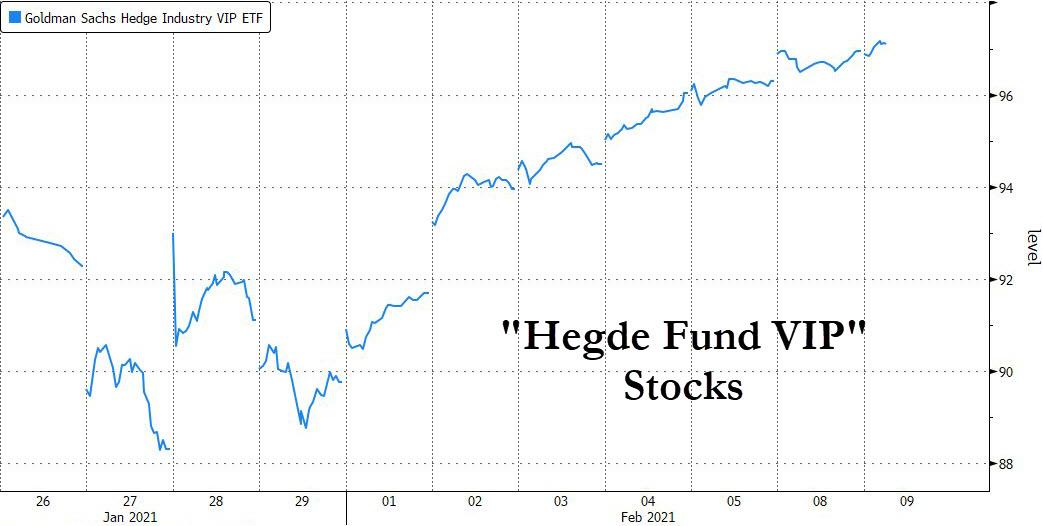
That said, as JPM calculated in an overnight note, the magnitude of active gross additions vs. the prior reductions remains fairly muted for Equity L/S funds across regions. In fact, only 20% or less of last week’s active gross reductions have been added back this week. Furthermore, with bears having been badly burned by the horde of WallStreetBettors (and their various hedge fund accomplices), short additions among the High SI stocks remain fairly muted this week which may explain the outsized performance of Hedge Fund VIP longs in recent days.

Other strategies which generally took off less gross, have added most of it back.  That said, gross exposure levels remain a couple % below its YTD high on 1/22, but net exposures globally are now up slightly over the past 2 weeks and up 8% YTD as a result of the short legs lagging according to JPM.

The lack or broad regrossing, coupled with increased asymmetric activity on the long side, which has further shrunk market liquidity could explain the violent move higher in recent days.

This is also why equity L/S fund performance has improved as longs outperformed shorts by 2-3% MTD, with JPMorgan noting that "given the market rally and high net exposures among the group, performance is likely close to flat YTD."

Finally, which sectors/industries have seen the most gross/net added back? Here is the answer according to JPM:

  • In NA, TMT has seen the most re-grossing and has been net bought over the past week.
  • In EMEA, Banks, Autos, and Tech Hardware saw the most re-grossing over the past week, but net flows were slightly negative for all three groups, despite relatively strong returns.
  • In APAC, Financials and Health Care saw re-grossing this week, while Materials and Industrials were the most net bought.

In a separate analysis, Citi analysts warned that the short squeeze looks set to drive a further rally in the S&P 500 index. According to the bank, amid fears of forced squeezes nearly $10 billion worth of shorts were unwound last week on the S&P 500, the largest rate since April, and $21 billion shorts still remain and are in loss, analysts at Citi said.

“There is potential for further short squeezes supporting market gains for another week or two given the size of the remaining short base,” the Citi analysts wrote in a report late on Monday according to Reuters.

On the other hand, Citi calculated that at 4,000 on the S&P - or about 90 points away - longs could be tempted to take profit, potentially holding back the market in the short term.

https://www.zerohedge.com/markets/only-20-recent-shorts-have-been-reestablished

Primary care, nimble in pandemic's first year, now needs more targeted support

 First, the good news.

Primary care practices showed nimbleness as small businesses, such as by quickly shifting to telehealth services, in the face of historic challenges posed by the global pandemic, according to a new policy brief published by the Urban Institute

Doctors also indicated they aren't planning on going anywhere despite the financial and logistical challenges they've faced in the last year and, if anything, have been steeled by their commitment to their work. "COVID made me realize I can’t retire. I’m like the glue that keeps it all together," one doctor told researchers examining the impact of the first year of the COVID-19 pandemic on primary care practices across the U.S.

But, the industry is going to need ongoing—and better targeted—support as the nation enters its second year of responding to the health crisis, researchers said in the policy brief funded by the Robert Wood Johnson Foundation.


In particular, they said, future iterations of federal funding support should be better targeted to support providers in the most need. Many practices may need support for general operating expenses after experiencing lagging patient demand for well visits and other elective services, they wrote. "Although federal financial assistance and the increased use of telehealth helped many practices stay afloat in 2020, current trends in virus transmission will continue to put financial and safety pressures on primary care practices," they wrote. "Additional federal support is likely needed, at least in the short-term, to ensure continued access to sufficient PPE and adequate reimbursement for services delivered via audio and video technology."

Practices indicated much of the support they received was from their communities, but they would benefit from more support from payers.

In one case, a Virginia primary care practice said an insurer offered financial help but only on the condition the practice refrain from being acquired by a hospital or larger physician group for a number of years. However, in other cases, practices said insurers did offer valuable assistance, such as continuing to pay for telemedicine services at parity with in-person services, even though the state mandates no longer required it.

Practices also indicated a new willingness to enter into capitated payment arrangements with payers in order to avoid the financial uncertainties of fee-for-service should utilization once again be suppressed, researchers wrote.

And, while there were a number of supports for practices, they lacked a national blueprint or protocols for the best way to respond to a pandemic. Primary care groups had to implement creative changes to the way they do business, the researchers wrote.

"In large part, PCPs’ response to COVID-19 was a bottom-up process, with PCP practices making mostly independent, rapid, and varied decisions to fundamentally shift the way they deliver care," the researchers wrote.

https://www.fiercehealthcare.com/practices/primary-care-practices-stitched-together-creative-responses-first-year-covid-they-need