Search This Blog

Wednesday, October 13, 2021

Moderna Won't Share Its COVID Vaccine Formula

 Moderna will not share the formula for its COVID-19 vaccine with other companies despite calls from international organizations for the company to do so, Moderna chairman Noubar Afeyan said in an interview with The Associated Press.

Moderna concluded it could increase global supply faster by expanding its own production instead of sharing its mRNA technology with manufacturers in other nations, Afeyan said. 

"Within the next six to nine months, the most reliable way to make high-quality vaccines and in an efficient way is going to be if we make them," Afeyan told The Associated Press. 

Afeyan noted the company went from zero production to 1 billion doses in less than a year and said "we think we will be able to go from 1 to 3 billion" in 2022.

Moderna has come under criticism for distributing its vaccine mainly to the United States and other wealthy Western nations instead of poorer countries. The United Nations health agency and the World Health Organization are among international groups urging Moderna to share its formula.

Afeyan said Moderna, a Massachusetts-based company, is helping poor nations by working with the U.S. government and other governments to send more doses overseas. 

"There is more supply in the EU and the U.S. government than they will be able to use," Afeyan told The Associated Press.

He also said Moderna has committed to provide up to 500 million doses of vaccine to COVAX, the U.N.-backed vaccine program. He said 40 million doses should ship in the last three months of this year and the rest next year, the AP reported.

The Biden administration has privately urged Moderna and Pfizer to agree to joint ventures in which they would license technology to contract manufacturers to provide more vaccines to low- and middle-income countries, The New York Times reported, citing an unnamed senior administration official.

Pfizer ended up agreeing to sell the U.S. an extra 500 million doses at a not-for-profit price, but the company did not license its technology, the Times said.

Some advocates say Moderna should share because it took $2.5 billion from the U.S. government's Operation Warp Speed to develop its vaccine, the Times reported.

https://www.medscape.com/viewarticle/960776

Goldman Picks Winners, Losers In $20B COVID Antiviral Market Battle

 Ten days have passed since Merck dropped its bombshell announcement about Molnupiravir, its "revolutionary" anti-viral that purports to lessen severe COVID and death by half in vulnerable unvaccinated patients.

But as scientists warn about potential unexamined safety issues with molnupirvavir, analysts at Goldman Sachs are reminding clients that Merck is hardly alone in the race to produce an effective antiviral that could function like the Tamiflu of COVID.

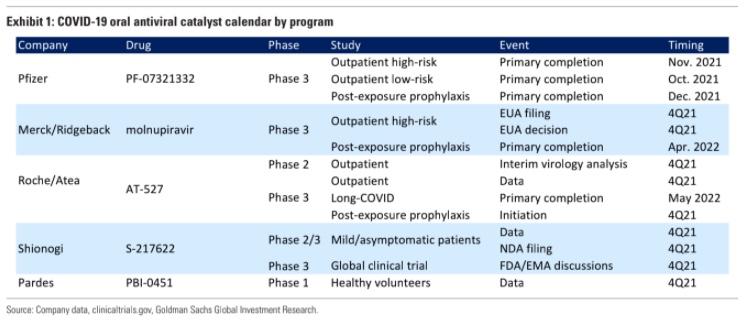
Looking ahead to Q42021 and on to Q12022, Goldman is looking forward to drug readouts from Roche, Pfizer, Shionogi and others developing oral antivirals. Goldman's discussions with clients about the potential influence of antiviralls "...indicate that key questions about oral antivirals largely center on: 1) clinical differentiation among the various programs; 2) data and approval timelines, supply, and pricing; and 3) the potential for pediatric and prophylactic use. Within, we size up the market potential and TAM with our market model and frame key upcoming readouts for the late stage programs. We also provide a list of upcoming catalysts in the category."

For investors seeking "exposure to the antiviral theme", Goldman recommends 1) Roche, as preclinical data for its AT-5227 suggest "differentiation" vs. molnupiravir, 2) Shionogi, whose S-217622 represents an alternative to RNA polymerase therapies, and 3) Divi's Labs, which will ride molnupiravir's coattails.

As for the losers, Goldman sees Eli Lilly and Regeneron, who produced antibody treatments that never really caught on.

Using the 10MM molnupiravir courses expected to be on the market for $700/course (40x what it costs to produce), Goldman estimates that the "commercial opportunity" for COVID antivirals is between "$15 billion and $20 billion." That figure represents near-term sales; over time, Goldman estimates the market for COVID antivirals to be around $5 billion/$6 billion. Although the analysts look for prices to decline as more competitors are approved and enter the market.

Although Goldman's team focuses on the "commercial" aspects of antivirals, its analysts note that their success could lead to significant "cultural" changes. If people were confident that COVID could easily be treated without a trip to the hospital, they would be less incentivized to wear masks and observe social distancing and other new features of the COVID era.

Goldman's analysts put together a table showing their expectations for the timing of each drug's approval.

Goldman's assessment about the TAM for COVID antivirals is based on the following assumptions:

  1. COVID-19 becomes endemic in perpetuity, thereby requiring the maintenance of a vaccinated population as well as the use of effective therapies to treat those who are unvaccinated, immunocompromised, and breakthrough cases.
  2. That following a relative peak of infections in the acute phase of the pandemic (starting late 2019 and still continuing) that the rate of infections will settle at a relatively consistent endemic level.
  3. A relatively consistent vaccination rate in perpetuity that assumes maintained protection, boosters, and/or updated vaccines that experience the same relative uptake.
  4. A lower rate of high-risk patients in the EU and ROW vs. the US. Generally, average BMI and hypertension rates are lower in the EU and Asia.
  5. An average of 2 potential post-exposure prophylactic patients per infection, and that all major oral antiviral candidates will be approved in this indication.
  6. That the post-exposure prophylactic population will be given an extended course of treatment compared to the primary treatment population as observed on both the Tamiflu and Relenza labels (e.g., 10 days vs. 5 days).
  7. That the oral antivirals will significantly erode the antibody therapeutic market in the near term, particularly in the post-exposure prophylaxis setting due to their relative convenience and cost savings.
  8. An initial price of ~$700/course in the US based on the previously announced government tender offer for 1.2mn courses of molnupiravir, and that prices will be relatively lower in the EU ($500) and ROW ($150).

As far as sales, Goldman outlines its bull, bear and base cases in a chart.

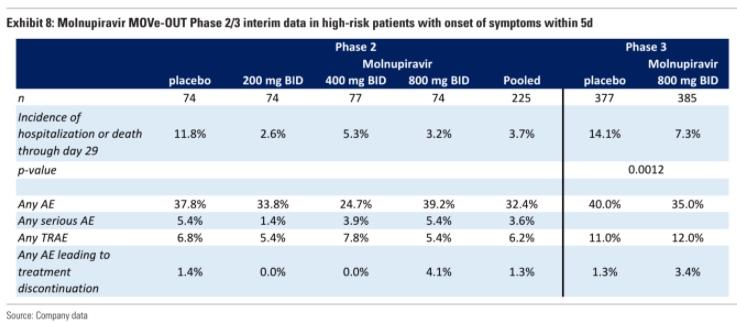
As far as what we know about molnupiravir so far is from a Phase 2/3 analysis with unvaccinated high risk patients.

Looking at opportunities for distribution abroad, Goldman notes that Divi's Labs should benefit from molnupiravir due to its ability to manufacture generic anti-retroviral API and finished doses. Citing data from - of all places - the Clinton health access initiative - Goldman says the overall market size in Low and Middle Income Countries is roughly $1.7 billion.

Bottom line: in the coming weeks, the outlook for COVID anti-virals will become increasingly important to the market.

Cesarean Deliveries Skyrocket in Pregnant Women With COVID-19

 Regardless of whether they were symptomatic, pregnant women infected with COVID-19 at a Texas hospital had extraordinarily high rates of cesarean deliveries, and more than a third of their newborns were admitted to the neonatal intensive care unit (NICU), a researcher said.

From March to September 2020, 65.6% of 32 symptomatic patients and 60.9% of 69 asymptomatic patients underwent a cesarean delivery compared with a 2019 cesarean rate of 31.7% in the U.S., reported Kristine Lane, a medical student at the University of Texas Medical Branch at Galveston, during the American Society of Anesthesiologists annual meeting.

In addition, 59.4% of symptomatic patients and 44.9% of asymptomatic patients needed emergency treatment during deliveries compared with a normal hospital rate of 2%. NICU admission was required in 43.8% and 36.2%, respectively, and respiratory support for newborns was needed in 31.3% and 29.0%, respectively.

"COVID-positive women were more likely to have complications with the delivery process at a vastly increased rate compared to the average non-COVID patient," Lane told MedPage Today. "The increase in the prevalence of emergent cesarean section with symptomatic infection could be caused by reduced oxygenation and endothelial cell dysfunction. This potential for poor oxygenation could also contribute to the difference in newborn outcomes."

Research published early in the pandemic, including a systematic review and a Spanish study, linked COVID-19 infection in pregnant women to high rates of cesarean sections. However, a large U.S. study published in August found no increase in cesarean deliveries among women infected with COVID-19, though it did find "higher rates of mortality, intubation, ICU admission, and preterm birth" compared with women without COVID-19.

Infected pregnant women "may be more susceptible to severe respiratory infections and embolic complications," co-author Rovnat Babazade, MD, also of the University of Texas Medical Branch at Galveston, told MedPage Today. "During pregnancy, the maternal immune system adapts to allow for the growth of the fetus. Because of an altered immune response modulation in pregnancy, severe disease may be more likely due to COVID infection, causing release of damage-related proteins and a precipitous pro-inflammatory response."

Additionally, "maternal infection with COVID-19 has correlation with increased newborn complications, like increased hospitalization, lower birth weights, and increased respiratory distress requiring oxygen support. We still do not know the risk of vertical transmission, the long-term outcomes of children born to COVID-positive mothers, or the actual toll -- physical and mental -- on patients and healthcare providers of additional precautions during the delivery process."

This retrospective study tracked women ages 16 to 45 and defined emergent deliveries as those with complications, such as non-progressing labor, fetal malpresentation, or preeclampsia, requiring induction or cesarean delivery.

Among the symptomatic women, 40.6% had fever, 37.5% had cough, and 28.1% had shortness of breath.

"There was one case of a newborn who tested positive for COVID after delivery, which was concerning for vertical COVID transmission in utero," Babazade noted. "The infant was born at 35 weeks to a symptomatic mother with respiratory distress and required intensive care unit admission for 4 days and oxygen support. The repeat COVID PCR and the nucleic acid amplification testing (NAAT) nasopharyngeal swab at 48 hours were positive. Proper PPE protocols were followed during delivery, which was an emergent C-section due to severe maternal COVID symptoms, and the mother only visited the infant via the phone."

These findings aren't surprising, Brian Casey, MD, of the University of Alabama at Birmingham, told MedPage Today. "We too have observed a high rate of cesarean delivery in women with symptomatic COVID infection," he said. "Often, acute deterioration in the maternal condition drives the decision to emergently deliver the baby before term. However, it is curious that the cesarean delivery rate in asymptomatic women is almost as high."


Disclosures

OrthoPediatrics: Prelim Q3 Unaudited Revenue

 OrthoPediatrics Corp. (“OrthoPediatrics” or the “Company”) (Nasdaq: KIDS), a company focused exclusively on advancing the field of pediatric orthopedics, today announced preliminary revenue for the third quarter ended September 30, 2021 and provided a related business update.

Preliminary unaudited third quarter 2021 revenue is expected to be approximately $25.1 million, up 13% when compared to revenue of $22.2 million in the third quarter 2020. The third quarter 2021 revenue was impacted by increased COVID-19 Delta cases as well as respiratory syncytial virus (RSV) cases within the children’s hospitals combined with hospital staff shortages. Despite this impact, the Company reiterates its 2021 total revenue guidance range of $97 to $101 million. The preliminary quarterly revenue estimate for 2021 included in this press release is prior to the completion of review and audit procedures by the Company’s independent registered public accounting firm and therefore subject to adjustments.

OrthoPediatrics will host a conference call on Thursday, November 4, 2021, at 8:00 a.m. ET to discuss the results. The dial-in numbers are (855) 289-4603 for domestic callers and (614) 999-9389 for international callers. The conference ID number is 8161847. A live webcast of the conference call will be available online from the investor relations page of the OrthoPediatrics’ corporate website at www.orthopediatrics.com.

https://finance.yahoo.com/news/orthopediatrics-corp-announces-preliminary-unaudited-200400234.html

Why Crispr's Gene-Editing Dive Helped Reinvigorate Its Chief Rival, Allogene

 Analysts were split Wednesday as they compared Crispr Therapeutics' (CRSP) gene-edited cancer drug to Allogene's (ALLO) — but CRSP stock tumbled as ALLO stock popped.

Both companies are working on CAR-T treatments. This method of targeting cancer involves training white blood cells to find and destroy cancer, then infusing them into the patient. Existing drugs from Novartis (NVS) and Gilead Sciences (GILD) do this with a patient's own cells. But Crispr, Allogene and Fate Therapeutics (FATE) are attempting to use donor cells, a process called allogeneic.

Crispr unveiled test results for 26 lymphoma patients who received its drug, dubbed CTX110, for at least 28 days. Overall, 58% of patients responded to the treatment. And 38% had no signs of cancer, a phenomenon known as a complete response.

But analysts zeroed in on the durability of those responses. At six months, just 21% of Crispr's patients still had a complete response. In comparison, 36% of patients in Allogene's study showed no signs of cancer at the six-month mark. But Allogene's study was recently placed on hold due to safety issues.

"With the recent clinical hold placed on Allogene's programs, Crispr is now clearly leading the pack in the allogeneic CAR-T space," Needham analyst Gil Blum said in a report.

CRSP Stock Dives On Cancer Test

In midday trading on the stock market today, CRSP stock sank 6% near 96.40. Meanwhile, ALLO stock jumped 6.9% near 14.40, and FATE stock edged up 1.3% near 59.80.

Crispr says its allogeneic CAR-T drug could offer an improvement over autologous options, which uses a patient's own cells. Crispr applies its gene-editing technology — also known as CRISPR — to the donor cells. This "off-the-shelf" version of CAR-T could cheaper to make and easier to mass produce.

Needham's Blum notes the results from Crispr's study put it in line with already commercial CAR-T drugs from Novartis and Gilead. The studies used for their approvals show 72% of patients responded to Gilead's drug, Yescarta. Half of patients responded to Novartis' rival drug, Kymriah.

Crispr also argues that its drug is safer. The labels for Yescarta and Kymriah warn against a side effect known as cytokine release syndrome. In this, multiple organs become inflamed. But there were no serious cases of the syndrome in Crispr's test.

Just one patient died in Crispr's study vs. five in Allogene's study, RBC Capital Markets analyst Luca Issi said in a report. Infections were lower in Crispr's study, but rates of all cytokine release syndrome — which includes milder cases — were higher. Issi has a sector perform rating on CRSP stock.

Pivotal Time For Allogeneic CAR-T

Crispr is now planning to expand the study in the first quarter of 2022. The company hopes the study could offer enough evidence for approval.

The results came less than a week after the Food and Drug Administration placed Allogene's programs on a clinical hold, citing safety questions. ALLO stock collapsed more than 46% the following day. The news also sent CRSP stock down more than 4%.

Allogene uses several different technologies to create its "off-the-shelf" CAR-T. It uses a gene-editing method called TALENS and a non-harmful lentivirus to deliver the drug. Crispr's CTX110 relies on CRISPR technology for both the editing and drug delivery.

https://www.investors.com/news/technology/crsp-stock-will-it-and-its-gene-edited-cancer-drug-rise-after-allogene-fall/

FDA OKs Keytruda as first-line cervical cancer treatment

 The FDA approved a combination of pembrolizumab and chemotherapy, with or without bevacizumab, for certain women with persistent, recurrent or metastatic cervical cancer.

The approval applies to women with tumors that express PD-L1 with a combined positive score (CPS) of 1 or greater, as indicated by an FDA-approved test.

The agency also converted from accelerated to regular approval use of pembrolizumab alone for this subgroup of women with disease progression on or after chemotherapy. The accelerated approval had been granted in June 2018 with the companion diagnostic PD-L1 IHC 22C3pharmDx (Dako North America Inc.), according to an FDA press release.

The FDA based approval of the combination on results of the randomized phase 3 KEYNOTE-826 trial, presented last month during the virtual ESMO Congress 2021. The trial included 617 women with persistent, recurrent or metastatic cervical cancer who had not been treated with systemic chemotherapy.

Researchers randomly assigned the women 1:1 to 200 mg pembrolizumab (Keytruda, Merck) or placebo every 3 weeks for up to 35 cycles. All women also received chemotherapy with paclitaxel and cisplatin or carboplatin, and 63.6% in the pembrolizumab group and 62.5% in the placebo group also received bevacizumab (Avastin, Genentech).

Investigator-assessed OS and PFS served as main efficacy outcome measures.

Treatment continued for 2 years or until disease progression or unacceptable toxicity.

Among 548 women with a tumor PD-L1 CPS of 1 or greater, median OS was not reached (95% CI; 19.8 to not reached) in the pembrolizumab group and 16.3 months (95% CI, 14.5-19.4) in the placebo group (HR = 0.64; 95% CI, 0.5-0.81). Results previously reported by Healio also showed median PFS of 10.4 months with pembrolizumab vs. 8.2 months with placebo (HR = 0.62; 95% CI, 0.5-0.77). The pembrolizumab group also had a higher objective response rate (68% vs. 50%) and longer median duration of response (18 months vs. 10.4 months).

The most frequently reported adverse events among women who received pembrolizumab, chemotherapy and bevacizumab included peripheral neuropathy, alopecia, anemia, fatigue/asthenia, nausea, neutropenia, diarrhea, hypertension, thrombocytopenia, constipation, arthralgia, vomiting, urinary tract infection, rash, leukopenia, hypothyroidism and decreased appetite.

https://www.healio.com/news/hematology-oncology/20211013/fda-approves-keytruda-regimen-as-firstline-treatment-for-cervical-cancer

Sesen Bio Expands CMC and Clinical Teams

 Sesen Bio (Nasdaq: SESN), a late-stage clinical company developing targeted fusion protein therapeutics for the treatment of patients with cancer, today announced the expansion of its chemistry, manufacturing, and control (CMC) and clinical development teams with the hiring of Eun Jang as Senior Director, Analytical Sciences, and Chèrie Kaefring as Director, Clinical Operations. The addition of these new team members demonstrates Sesen Bio’s strong commitment to and continued focus on the development of Vicineum™ for the treatment of BCG-unresponsive non-muscle invasive bladder cancer (NMIBC).

“I am delighted to welcome Eun and Chèrie to Sesen Bio to further strengthen our capabilities across our CMC and clinical teams,” said Dr. Thomas Cannell, president and chief executive officer of Sesen Bio. “Their deep clinical and analytical expertise is the right match for our CMC and clinical needs as we chart our path forward in consultation with regulators. I am confident Eun and Chèrie will each make valuable contributions to Sesen Bio and to our mission of saving and improving the lives of patients.”

These hirings come as Sesen Bio is preparing for CMC and clinical Type A meetings with the US Food and Drug Administration (FDA) for Vicineum™. The Company has submitted a request for the CMC Type A meeting, which is anticipated to occur at the end of October, and expects the clinical Type A meeting to occur later in the fourth quarter of 2021.

https://www.biospace.com/article/releases/sesen-bio-expands-cmc-and-clinical-teams/