Search This Blog

Saturday, November 20, 2021

Mrna COVID Vaccines Dramatically Raise Endothelial Inflammatory Markers, ACS Risk Measured by PULS Cardiac Test: a Warning

 Steven R Gundry

Our group has been using the PLUS Cardiac Test (GD Biosciences, Inc, Irvine, CA) a clinically validated measurement of multiple protein biomarkers which generates a score predicting the 5 yr risk (percentage chance) of a new Acute Coronary Syndrome (ACS). The score is based on changes from the norm of multiple protein biomarkers including IL-16, a proinflammatory cytokine, soluble Fas, an inducer of apoptosis, and Hepatocyte Growth Factor (HGF)which serves as a marker for chemotaxis of T-cells into epithelium and cardiac tissue, among other markers. Elevation above the norm increases the PULS score, while decreases below the norm lowers the PULS score.The score has been measured every 3-6 months in our patient population for 8 years. Recently, with the advent of the mRNA COVID 19 vaccines (vac) by Moderna and Pfizer, dramatic changes in the PULS score became apparent in most patients.This report summarizes those results. A total of 566 pts, aged 28 to 97, M:F ratio 1:1 seen in a preventive cardiology practice had a new PULS test drawn from 2 to 10 weeks following the 2nd COVID shot and was compared to the previous PULS score drawn 3 to 5 months previously pre- shot. Baseline IL-16 increased from 35=/-20 above the norm to 82 =/- 75 above the norm post-vac; sFas increased from 22+/- 15 above the norm to 46=/-24 above the norm post-vac; HGF increased from 42+/-12 above the norm to 86+/-31 above the norm post-vac. These changes resulted in an increase of the PULS score from 11% 5 yr ACS risk to 25% 5 yr ACS risk. At the time of this report, these changes persist for at least 2.5 months post second dose of vac.We conclude that the mRNA vacs dramatically increase inflammation on the endothelium and T cell infiltration of cardiac muscle and may account for the observations of increased thrombosis, cardiomyopathy, and other vascular events following vaccination.

https://www.ahajournals.org/doi/abs/10.1161/circ.144.suppl_1.10712

Protective immunity after recovery from SARS-CoV-2 infection


PDF: https://www.thelancet.com/action/showPdf?pii=S1473-3099%2821%2900676-9

The SARS-CoV-2 pandemic is now better controlled in settings with access to fast and reliable testing and highly effective vaccination rollouts. Several studies have found that people who recovered from COVID-19 and tested seropositive for anti-SARS-CoV-2 antibodies have low rates of SARS-CoV-2 reinfection. There are still looming questions surrounding the strength and duration of such protection compared with that from vaccination.
We reviewed studies published in PubMed from inception to Sept 28, 2021, and found well conducted biological studies showing protective immunity after infection (panel). Furthermore, multiple epidemiological and clinical studies, including studies during the recent period of predominantly delta (B.1.617.2) variant transmission, found that the risk of repeat SARS-CoV-2 infection decreased by 80·5–100% among those who had had COVID-19 previously (panel). The reported studies were large and conducted throughout the world. Another laboratory-based study that analysed the test results of 9119 people with previous COVID-19 from Dec 1, 2019, to Nov 13, 2020, found that only 0·7% became reinfected. In a study conducted at the Cleveland Clinic in Cleveland, OH, USA, those who had not previously been infected had a COVID-19 incidence rate of 4·3 per 100 people, whereas those who had previously been infected had a COVID-19 incidence rate of 0 per 100 people. Furthermore, a study conducted in Austria found that the frequency of hospitalisation due to a repeated infection was five per 14 840 (0·03%) people and the frequency of death due to a repeated infection was one per 14 840 (0·01%) people. Due to the strong association and biological basis for protection, clinicians should consider counselling recovered patients on their risk for reinfection and document previous infection status in medical records.

Will rapid testing make holiday gatherings safer?

 Even with large numbers of people fully vaccinated, some public health officials worry that big gatherings this holiday season could lead to big outbreaks of COVID-19. But families looking to reunite have at least one infection-averting tool that they didn't have last year: rapid at-home testing kits.

The kits aren't foolproof, and most aren't as reliable as the lab-based alternative when it comes to detecting infections in their earliest stages. Also, the cost can be high if you have to check a houseful of people.

If used in the right circumstances, however, an at- can warn you in a matter of minutes if Cousin Antoine's cough or Aunt Maggie's muscle aches are signs of a potentially grave threat to the rest of the family. Even better, the tests can make it easy for your invited guests to check for an active infection before they trundle off to your home.

One other crucial caveat: If you haven't been fully vaccinated, the Centers for Disease Control and Prevention cautions against traveling to that holiday get-together. And if you're determined to travel sans vaccination, the CDC recommends doing so only if you get a negative COVID test one to three days days before departure, then quarantining for seven days after arrival (or fewer, if you test negative again).

Here's a rundown of how the tests work, how reliable the results are, who makes them, where to find them and how much they cost.

What are at-home rapid COVID tests?

The key word here is "rapid," as in delivering results in about 15 minutes. Unlike the self-testing kits that you have to send to a lab for processing, the rapid kits let you process your samples at home—in fact, most of them let you watch the results slowly emerge on a test strip, the way you might watch an image form on a Polaroid (but with higher stakes).

The U.S. Food and Drug Administration has given emergency-use authorization to two kinds of rapid tests: molecular and antigen. The molecular tests, which boast higher sensitivity but carry a higher cost, examine the genetic material in your sample for the presence of the SARS-CoV-2 virus. The antigen tests look for the presence of a protein that binds to the coronavirus' RNA.

Only one of the three approved home molecular tests—the Lucira CHECK-IT kit—is easily found online, and it's pricy: Amazon sells it for $89 per test.

A quick search for antigen tests, on the other hand, found six of the nine approved tests available to U.S. consumers in stores or online, one from two different manufacturers:

  • iHealth—$14 for a two-pack at the company's website.
  • QuickVue—$20 to $24 for a two-pack at local pharmacies.
  • BinaxNow—about $24 for a two-pack at local pharmacies.
  • CareStart—$24 for a two-pack at RiteAid.
  • BD Veritor—$26.50 for a two-pack at Amazon.
  • Inteliswab—$29 to $40 for a two-pack from medical supply stores online.
  • On/Go—$35 for a two-pack at Amazon, Walmart and the company's website.

One other antigen test, by Celltrion, is available in bulk quantities from medical supply stores online for about $10 per test.

Different antigen test kits come with different features—for example, some have smartphone apps that can display your test result, which would be useful if you're asked to show proof of a negative test. And the performance of the tests may vary, although all did well enough to win the FDA's emergency authorization.

Dr. Ashish K. Jha, dean of the Brown University School of Public Health, said the BinaxNow test has been the most widely used, so it has more of a track record than the other tests. But he said people shouldn't pay too much attention to brand names, given that the tests have been in relatively short supply. "Any of the tests that you can find are way better than not having tests," he said.

How reliable are the results?

The coronavirus that causes the COVID-19 disease can take several days to build up steam (or "viral load"), which means you aren't likely to show symptoms or be infectious to others immediately after you've caught it. That's why public health officials advise you not to get tested immediately after you've been exposed to people who might be infectious.

Molecular tests, however, use chemical techniques to amplify the amount of genetic material in a sample, enabling them to detect the presence of the coronavirus at a very early stage—in some cases, even before a person can pass along the infection to others. On the other hand, they may also find leftover traces of the virus after a person is no longer contagious. And like any test, they are subject to contamination and other glitches that can cause erroneous results, including the occasional false positive. It's not common, but it's more likely to happen in communities that have few cases of the disease.

Antigen tests have proven to be as good as molecular tests at avoiding false positive results. And according to the CDC, these tests are also just as good when it comes to detecting COVID in someone who is showing symptoms of the disease, such as a cough, a fever and a sore throat.

Where the tests fall short, the CDC warns, is with people who have the virus but show no symptoms, especially if they're in the early stages of infection and may not yet have enough of a viral load to infect others. The agency recommends that people perform a second antigen test a few days after the first one, which is why the kits are sold as two-packs.

If you haven't been vaccinated and you've come into close contact sometime in the previous two weeks with someone who had COVID, the CDC recommends that you get a molecular test just to be sure you're not infected.

What's the best use of rapid tests?

Testing can reduce the risk in a variety of holiday scenarios, but Jha and Dr. Robert Wachter, chair of the department of medicine at UC San Francisco School of Medicine, said it makes the most sense in two situations: if unvaccinated people will be joining you for the holidays, or if people in your group would be at high risk of deadly complications if they contracted a breakthrough case of COVID-19. "Other than that, while it could render a gathering a smidgen safer, it doesn't feel worth it to me to spend a few hundred bucks testing 10 or so people," Wachter said in an email.

Another factor weighing in favor of testing is when there is a high rate of COVID infections in the community, Jha said. But which community determines the amount of risk? That may be hard to figure out if you have guests coming from several parts of the country.

When and how often you should take a test depends on the nature of the gathering. "Rapid tests are a measure of contagiousness," Jha said, "and so you want to test as close as you can of getting together with people." If it's just a Thanksgiving day meal, Jha said, "The ideal situation would be to test on Thursday morning."

But if it's a holiday weekend visit, he and Wachter suggested testing more than once—say, just before arriving and again in a day or two—especially if you'll be in the presence of unvaccinated people. "Two negative tests, you're really good to go," Jha said, adding that if you're around people at high risk of COVID complications, you could even take a test daily.

"In an unvaccinated population, one single test is probably not good enough," Jha said. For proof, he pointed to the ceremony President Trump held last year for new Supreme Court Justice Amy Coney Barrett. Attendees had to have gotten a negative test result to gain admission but it still turned into something close to a superspreader event.

How do you test yourself?

The typical process starts with taking a sterile swab from the kit and tracing the inside of each nostril several times. That gathers the sample. The next step depends on the type of test.

With , the swab is inserted into a small container, where the sample is mixed with a reagent, a substance that starts the process of revealing the sample's genetic makeup. The container is then placed in a base unit, where the magic (technically, the isothermal amplification) happens. The results appear on the base unit or in a smartphone app.

With , the swab is placed in a disposable reader (often made of paper) where it meets a . You add a few drops of the kit's reagent, then watch to see whether the strip shows a positive, negative or inconclusive result.

Be sure to read and follow the instructions carefully to collect a proper sample and avoid contamination. With the popular BinaxNow , for example, you're supposed to swab each of your nostrils for 15 seconds and rotate the swab three times after placing it in the reagent.

https://medicalxpress.com/news/2021-11-holiday-covid-safer-rapid.html

Ohio's COVID-19 numbers trending in wrong direction

It's been nearly two years since the coronavirus (COVID-19) was first identified. But while Ohio has made progress, the state's top medical official said that its numbers are currently trending in the wrong direction.

In a virtual press conference on Thursday, Ohio Department of Health Director Dr. Bruce Vanderhoff addressed the recent wave of COVID-19 cases that has coincided with the start of the holiday season. In doing so, Dr. Vanderhoff warned that Ohio's coronavirus numbers are currently on the rise.


"The Delta Variant appears to have gotten a second wind. Hospitalizations have significantly increased and right now, one in seven patients in our hospitals has COVID-19," Dr. Vanderhoff said. "Yesterday, there was more than 2,800 patients in our hospitals with COVID and more than 800 are fellow Ohioans fighting COVID in the ICU. In the last 21 days, hospitalizations have, in fact, increased by 23 percent and ICU admissions have increased by 15 percent. These numbers are, quite simply, going in the wrong direction.


"COVID-19 cases are, similarly, trending in the wrong direction. Yesterday, more than 6,300 cases were reported from the previous 24 hours. That's the highest number we've seen since early-October. More people are getting sick and more are being hospitalized.

In order to combat that the state's recent trends, Dr. Vanderhoff stressed the need for those who have not yet received the COVID-19 vaccine and those who are eligible to receive the COVID-19 vaccine booster to do so.

"We all want to be on the other side of this thing," Dr. Vanderhoff said. "In order to be there, we simply need more people to get vaccinated."


https://www.wkyc.com/article/news/health/coronavirus/dr-bruce-vanderhoff-covid-19-warning-11-18-2021/95-7f3d8ee9-df16-4157-b23d-b7c0bca05976

Covid vaccine ‘waning immunity’: How worried should I be?

 There have been warnings from doctors and the UK's Health Security Agency that waning immunity is leading to deaths even of people who have had two doses of a Covid vaccine. So how much protection are we left with?

Let's nail some basics. The immune system has two big roles - to stop us getting infected, and if that fails, to clear our bodies of an infection.

I want you to stretch your imagination and picture your immune system as a medieval castle.

Surrounding the castle is a hostile and ruthless army of coronaviruses desperate to break in.

Your first defence is an outer wall patrolled by a legion of archers. These are your body's neutralising antibodies. If they can hold the viral army off, then you won't get infected.

But if the walls crumble and the antibody-archers wander off, then the virus is in. It has stormed the castle and you now have an infection.


Yet all is not lost. There are still troops inside the fortified keep at the heart of the castle. These are your memory B and memory T cells. Like knights on horseback they can rally the troops, lead the immunological charge and send the hostile invaders packing.


The Covid vaccines have been training your body's troops - this includes both antibodies and those memory cells that react to an infection - to take on coronavirus.

At least one of those defenders is waning and this is not a surprise. This happens after every vaccine or infection.

"There is good evidence that antibodies are waning with time, and that has left us with obvious defects," says Prof Eleanor Riley, an immunologist from the University of Edinburgh.

The desertion of these antibody-archers from their posts, has been made worse by the emergence of the Delta variant. It is just better at spreading and getting into our body - it's like a new army rocking up outside the walls, but this one's brought a cave troll and siege weapons.


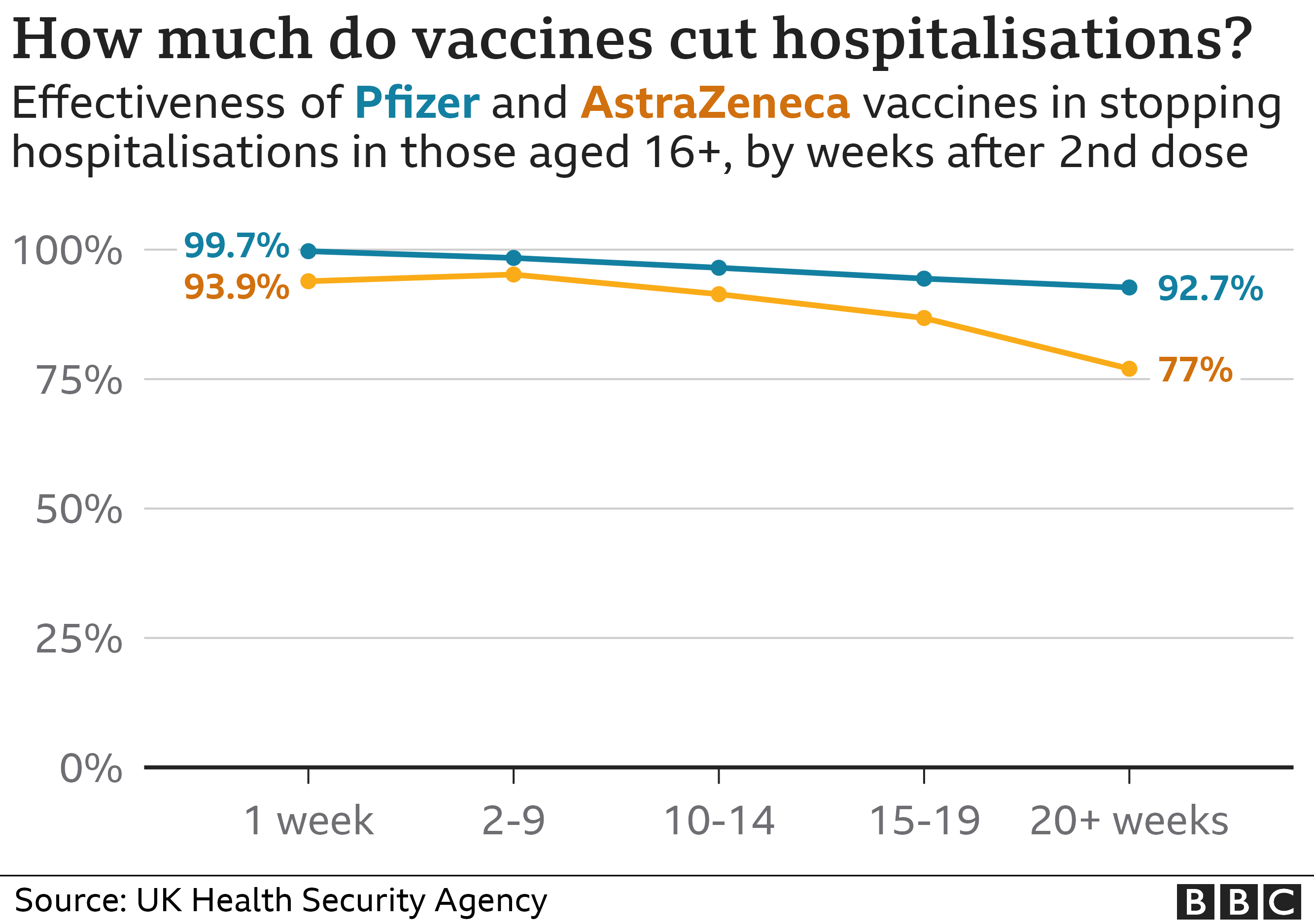
You may have noticed the consequences of this yourself - people you know who have been double vaccinated, but have still caught Covid. Research, which has not been formally published, estimates that the AstraZeneca vaccine reduced any form of Covid symptom by 66% shortly afer the second dose. Five months later that figure had fallen to 47%. For Pfizer, the numbers fell from 90% to 70%.

This is obviously an issue for governments trying to contain the spread of the virus. Whether the viral invasion will cause severe damage as it tries to burn and pillage its way through your body now depends on your second line of defence. However, the vaccines are now keeping fewer people out of hospital.

Graph: How much do vaccines cut hospitalisations? - showing effectiveness of Pfizer and AstraZeneca vaccines in stopping hospitalisations in those ages 16+, by weeks after 2nd dose

Prof Adam Finn, from the University of Bristol and a government vaccine adviser, says: "We are seeing significant numbers of unvaccinated and vaccinated people coming into hospital.

"The protection you have against relatively mild infection wanes more quickly, but protection from getting into hospital or killing you wanes more slowly."

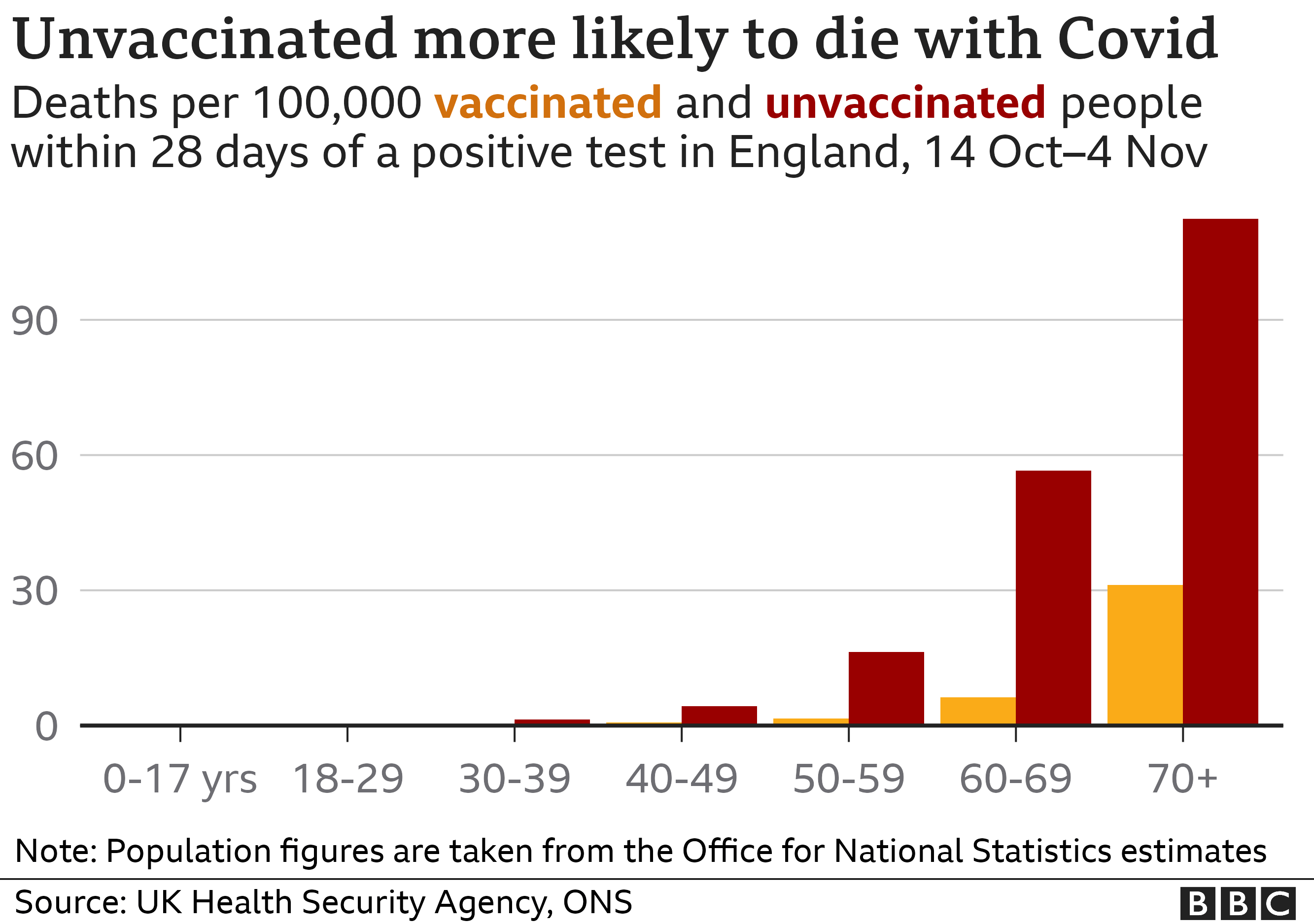
The greater risk of needing hospital care or even of dying is concentrated in the elderly. The overwhelming majority of deaths in people who have been double vaccinated have been among those over 70. People in that age group are still far better off than someone who they share a birthday with, but turned down the jab. And as you can see, the risks in younger age groups who have been double vaccinated are small.

Graph - Unvaccinated more likely to die with Covid. Showing deaths per 100,000 vaccinated and unvaccinated people within 28 days of a positive test in England, 14 Oct - 4 Nov

The constant onslaught of time ages every cell in our body - including those that make up the immune system. Getting older makes it harder to train the immune system with vaccines, and it is slower to respond when an infection arrives. It may be that now antibodies have waned far enough, this frailty in the immune system is being exposed.

"It's possible older people initially had protection, but now those antibodies have weakened, they may not have the second line of defence," says Prof Eleanor Riley.

"That may be why we're seeing elderly, fragile people dying despite two doses."

All of this is layered on top of the fact that with age tends to come ill health. Since the start of the pandemic, age has been one of the biggest factors in how likely you are to die of it. The oldest people were also the first to be vaccinated, so their immunity has had more time to wane.

People who start with a weakened immune system, including cancer and organ transplant patients, have a subtly different problem as their bodies do not respond as well to vaccines.

"Their antibodies are waning at a similar rate to healthy people, but they obviously start off at a lower point," says Dr Helen Parry, from the University of Birmingham

It is worth noting there are important differences between the Oxford-AstraZeneca and Pfizer-BioNTech vaccines that have done most of the work protecting people in the UK.

"They seem to be good at different parts of the immune system," says Dr Parry.

"The mRNA vaccines (Pfizer) are really potent at antibody formation, the AstraZeneca vaccine is really good at generating T-cell responses."

To go back to the castle, Pfizer may be better at manning the outer walls with archers to keep Covid out, while AstraZeneca is good for the inner keep.

The good news is that even with waning, these are still exceptionally good vaccines. At the start of the pandemic, people were dreaming of a vaccine that could cut deaths by 50%. Even with waning and in the most at-risk age groups, that protection is still in the region of 80-90%.

"Even the worst cases, six months later, are better than what we hoped for when we designed these vaccines," says Prof Finn. "They're still really good."

The even better news is that there is already evidence that the booster campaign - which has reached more than 11 million people in the UK - is making a difference. Data from the Office for National Statistics shows antibody levels - those first defenders against infection - have gone up again in the oldest age groups.

"Giving a booster to the most elderly is a slam dunk," says Prof Finn.

Everyone is now closely monitoring the figures to see if this brings down the number of cases and deaths.


https://www.bbc.com/news/health-59260294

NOLA Bars and Restaurants Will Require Vaccine Proof for Entry Through Mardi Gras

 New Orleans Mayor LaToya Cantrell’s administration confirmed today that the city’s policy requiring proof of vaccination or a negative COVID-19 test for indoor entry at bars and restaurants will remain in place at least through Mardi Gras 2022, which falls next year on March 1, 2022.

New Orleans’s current mandate requires customers to show proof of vaccination or a negative antigen test to dine or drink inside restaurants, bars, and breweries, or to enter music venues, event spaces, strip clubs, and casinos. “That’s the way we are going to get through this safely,” city spokesperson Beau Tidwell said Tuesday of keeping the mandate in place through Mardi Gras. New Orleans was just the third U.S. city to issue vaccination requirements, after New York and San Francisco (though those mandates don’t allow for a negative COVID test as an alternative, as New Orleans’s does).

In early October, city officials announced that parades would roll in New Orleans for Halloween for the first time since 2020, saying that the city would use data collected from the Krewe of Boo parade to gauge impact on local COVID numbers. At the same time, Mayor Cantrell expressed optimism for an official Mardi Gras 2022, hinting at possible COVID rules for both krewes and tourists.

Tidwell said today that that preliminary data collected from Krewe of Boo last month showed that 93 percent of the crowd and 98 percent of float riders were vaccinated against COVID-19. “We had a large parade and we did it safely. That is very encouraging news, and we want to make sure those conditions maintain: the high levels of vaccinations in the crowd and on the floats and that the vaccine mandate remains in place,” said Tidwell.

The administration dropped New Orleans’s indoor mask mandate in late October ahead of Halloween weekend, a few days after Louisiana Gov. John Bel Edwards dropped his statewide mask mandate. At the same time, the city adjusted its vaccination policy: a negative antigen test is now accepted for entry into businesses, as opposed to the negative PCR test required when the vaccine mandate was first issued in August.

While people will have to show proof of vaccination or the negative test to get inside a bar, restaurant, sporting event, concert, or ball during Mardi Gras (quite a burden on establishments during the tourist-heavy season) outdoor parades are set to roll without any such requirements. At a meeting last month, Cantrell reportedly hinted at the possibility of requiring vaccine proof or a negative COVID-19 test for visitors to the city during Mardi Gras, though it’s unclear how that would be executed and Tidwell did not mention the possibility Tuesday. Float riders and marching krewe members will be required to be vaccinated or have a negative COVID test to participate in parades, however.

New Orleans currently has a COVID-19 positivity rate of 0.6 percent and is averaging 25 new cases a day, Tidwell said Tuesday.

https://nola.eater.com/2021/11/16/22785978/new-orleans-bars-restaurants-vaccine-mandate-through-mardi-gras-2022

‘Too late’: Some question why boosters weren’t authorized for all adults sooner

 Friday’s authorization by federal officials to expand Covid-19 booster shot eligibility to all adults was met with overwhelming support from public health experts. But some were puzzled as to why the Food and Drug Administration didn’t make the move sooner. 

Despite a plan by the Biden administration to have boosters available to nearly all Americans by late September, the FDA had only authorized a third shot of the Pfizer-BioNTech vaccine for certain populations, such as those 65 and older and people with underlying medical conditions, up until this point.

With enough convincing evidence to demonstrate safety in those groups, experts said they were frustrated that it took until now to authorize the Pfizer-BioNTech and Moderna boosters for everyone else.

“This is too late,” said Dr. Robert Murphy, executive director of the Institute for Global Health at the Northwestern University Feinberg School of Medicine and a professor of infectious diseases. “What is the problem in getting the best treatment out there quickly?”

The FDA signoff, which was followed by an endorsement from the Centers for Disease Control and Prevention, formalizes what has cropped up in a patchwork of states in recent days. Governors from Massachusetts to California have allowed people 18 and older to get boosters. Their decisions come ahead of the holidays, when indoor gatherings are expected to lead to a spike in Covid cases, including breakthrough infections.

“We’ve had the evidence for the need for boosters for several months,” said Dr. Dorry Segev, professor of surgery at Johns Hopkins University School of Medicine and professor of epidemiology at Johns Hopkins Bloomberg School of Public Health.

He added that he has heard of people fibbing to get boosters before they officially qualify.

“When you have people exaggerating their work situation or their medical risk situation or feeling like they have to flat-out lie to get the protection they need, that’s a failing on the FDA and CDC’s part,” he said. 

But others were not as quick to cast judgment, arguing the FDA needed time to review safety data, including the rare risk of myocarditis associated with the Covid shot and a third dose of it.

If anything, said Dr. Gregory Poland, director of the Mayo Clinic’s vaccine research group, the FDA was “working at record speed,” given that Moderna only submitted its application for booster expansion earlier this week and Pfizer did so earlier this month.

“I think it would have been a public relations disaster to say ‘We aren’t going to review the data, we’re just going to approve it,’” he said. 

Tener Goodwin Veenema, a professor and visiting scholar at the Johns Hopkins Center for Health Security, agreed.

“I just don’t think there’s anything to be gained in looking backwards and criticizing what has happened. We are still in the midst of a pandemic. We are looking at the potential of another surge,” she said. “We just have to keep a laser-focus on getting as many Americans vaccinated as possible, including children who are now age-eligible.”

The FDA did not respond to NBC News regarding its booster shot timeline. In an interview Friday with The Associated Press, the agency’s vaccine chief, Dr. Peter Marks, said “we move as rapidly as we can.” 

“We have to do the right analyses to make sure that when we take an action, we can stand behind it,” he said. “Our goal is to make sure that the person who is on the fence, or perhaps doubting whether to take the vaccine, feels confident enough in our decisions that they are willing to come along and take the vaccine or take the booster.”

Will people actually get a third dose?

Whether people will choose to get a third dose remains to be seen. The experts all agreed that initially allowing just a portion of the population to get boosters likely led to confusion.

“It’s fueling the anti-vaccine crowd,” Murphy said. “You don’t know if you’re supposed to take the vaccine or not take it, if it works or not. This kind of messaging is not helping.”

While the FDA could have used more nuanced language — such as more forcefully indicating that their initial decision was based on the best available data at the time — the messaging problem was unavoidable, Poland believes. 

“We were doing it in real-time,” he said. “If we had been studying these vaccines and using them for low-grade outbreaks over five or 10 years like most other vaccines, we’d have come out with a different set of recommendations, but the pandemic did not allow that luxury.”

And it’s not clear whether the general public would understand the evolving nature of the recommendations and the science behind them, Segev said. He worried many people would “start to see the messaging as, ‘Tomorrow they‘re just going to tell me something different, so why should I listen to them now?’”

The hope of the nation’s top infectious diseases doctor, Dr. Anthony Fauci, is that adults will listen.

Pointing to studies from Israel, where many have received a third dose of the Pfizer shot, Fauci has repeatedly said in recent months that boosters have been shown to be safe and effective. 

He argued this week that even though the vaccines are still providing protection against severe illness and hospitalization, a third shot will provide benefits beyond that.

“I don’t know of any other vaccine that we only worry about keeping people out of the hospitals,” Fauci said at a White House briefing Wednesday. “I think an important thing is to prevent people from getting symptomatic disease.” 

https://www.nbcnews.com/news/us-news/-late-question-boosters-werent-authorized-adults-sooner-rcna6125