Search This Blog

Friday, April 21, 2023

US jury set to decide test case in Tesla Autopilot crash


A California state court jury began deliberating on Thursday in what appears to be the first trial related to a crash involving Tesla's Autopilot partially automated driving software.

The verdict could offer an important sign of the risk facing Tesla Inc as it tests and rolls out its Autopilot and more advanced "Full Self-Driving (FSD)" system, which Chief Executive Elon Musk has touted as crucial to his company's future, but which has drawn regulatory and legal scrutiny.

Justine Hsu, a resident of Los Angeles, sued the electric-vehicle maker in 2020, saying her Tesla Model S swerved into a curb while it was on Autopilot and then an airbag was deployed "so violently it fractured Plaintiff's jaw, knocked out teeth, and caused nerve damage to her face."

She alleges there are defects in the design of Autopilot and the airbag, and is seeking more than $3 million in damages for the alleged defects and other claims.

Tesla denies liability for the 2019 accident. It said in a court filing that Hsu used Autopilot on city streets, despite Tesla's user manual warning against doing so.

Tesla calls its driver-assistant systems Autopilot or Full Self-Driving, but says the features do not make the cars autonomous, and that human drivers should be "prepared to take over at any moment."

The EV maker introduced its Autopilot in 2015, and the first fatal accident in the United States was reported in 2016, but the case never went to trial.

The current trial, which has not been reported by other media, has unfolded in Los Angeles Superior Court over the last three weeks, and featured testimony from three Tesla engineers.

It comes at a critical time for the company as it braces for a spate of other trials starting this year related to the semi-automated driving system, which Musk has claimed is safer than human drivers.

During closing arguments on Thursday, Hsu's attorney, Anum Arshad, said one of Tesla's own expert witnesses admitted Autopilot could not perform as the company advertised.

"Tesla still maintains it's the safest vehicle in the road. All it takes for you to decide this case is common sense. The car came out looking better than Justine did," she said.

Michael Carey, an attorney for the carmaker, said Hsu drove straight into the median, which she had several seconds to see.

"The evidence proving distraction is pretty straightforward," he said.

BELLWETHER CASE

While the trial's outcome will not be legally binding in other cases, it is considered a test case because it would serve as a bellwether to help Tesla and other plaintiffs' lawyers hone their strategies, experts say. 

Cassandra Burke Robertson, a professor at the Case Western Reserve University School of Law who has studied self-driving car liability, said early cases "give an indication of how later cases are likely to go."

Tesla is also under investigation by the U.S. Justice Department and the National Highway Traffic Safety Administration over its claims about self-driving capabilities and the safety of the technology, respectively.

The main question in Autopilot cases is who is responsible for an accident while a car was in driver-assistant Autopilot mode - a human driver, the machine, or both? Hsu's lawsuit alleges that the Tesla vehicle hit the curb so suddenly that she had no time to avoid it even though she had her hands on the steering wheel and was alert.

Reuters was first to report that a 2016 video used by Tesla to promote its self-driving technology was actually staged, to show capabilities - such as stopping at a red light and accelerating at a green light - that the system did not have, according to testimony by a senior engineer.

The details about the video were from a deposition of a Tesla executive in another case.

That executive, Ashok Elluswamy, director of Autopilot software at Tesla, testified during the Hsu trial last week about the videotape. During her closing argument, Hsu's lawyer, Arshad, said Elluswamy also acknowledged that Tesla's sensors do not always recognize when a driver's hands are on the wheel.

Also at issue in the Hsu trial is the airbag.

The plaintiff's lawyer said the airbag should not have deployed under these circumstances and that it was deployed with much greater force than it should have been.

A verdict for the plaintiff would likely be more significant than a Tesla win, particularly if the jury concludes Tesla defrauded Hsu, said Bryant Walker Smith, an assistant professor at the University of South Carolina School of Law.

"All of the actual or alleged issues with Autopilot, from faulty performance to driver distraction to misrepresentation, could become an order of magnitude greater with FSD," he said. "So think of Autopilot litigation as a preview for what might be ahead."

https://www.marketscreener.com/quote/stock/TESLA-INC-6344549/news/US-jury-set-to-decide-test-case-in-Tesla-Autopilot-crash-43599788/

Of course Biden officials are interfering in son’s case — why else has Hunter skated for 5 years?

 Let’s say you lied on a required federal firearms form to conceal your use of illegal drugs so you could buy a .38 caliber handgun, then you irresponsibly lost that gun across the street from a school, and then the government found video evidence of you waving that gun around while cavorting with a prostitute.

If you had done all those things within a few days in 2018, do you suppose that by five years later, the government would have taken exactly zero action against you?

No arrest.

No indictment.

No prosecution.

In fact, do you think that, if it were you who had done all these things, the only government action would be an apparent attempt by a federal law-enforcement agency — say, the Secret Service — to conceal what had happened?

A senior Internal Revenue Service criminal investigator has been overseeing the Hunter Biden (pictured) probe.
A senior Internal Revenue Service criminal investigator whistleblower who has been overseeing the Hunter Biden (pictured right) probe, has been complaining about political interference.
AP

Do you imagine you’d be that lucky?

Or do you figure that you’d have long ago been charged with making a false statement and illegally possessing a firearm — especially with the government being run by a Democrat, such as President Joe Biden, who has a history of demagogically crusading against Second Amendment rights?

No, you’d be in serious legal trouble. In fact, there’s only one way to get off scot-free for this kind of egregious behavior.

You have to be Joe Biden’s son.

That’s the lesson to take away from the inevitable yet startling news that a whistleblower — a senior Internal Revenue Service criminal investigator who has been overseeing the Hunter Biden probe — has complained to the IRS, to the Justice Department, and now to House and Senate committees that the probe has been undermined by political interference.

A lawyer for the whistleblower has reported that “preferential treatment and politics” have been “improperly infecting decisions and protocols that would normally be followed by career law enforcement professionals in similar circumstances if the subject were not politically connected.”

Of course, that has to be true.

How else could Hunter Biden have been under investigation for so many years with no charges?

The gun offenses are so straightforward that they’d take a competent investigator five days, not five years, to wrap into a prosecutable case.

Some of the tax offenses, which stretch back seven years or more, are so undeniable that liens were placed on Hunter’s properties, and it has been widely reported that he borrowed millions of dollars from a crony to pay what he owed the government.

It gets worse.

The salient feature of the investigation is not Hunter Biden.

It is the Biden family — specifically, the question of why, when Joe Biden exercised significant influence over U.S. policy regarding several foreign governments, including such anti-American regimes as China and bastions of corruption as Ukraine, people closely tied to those governments believed it was in their interests to pay millions of dollars to Joe Biden’s unstable son, his smooth-operator brother, and other Biden relatives.

The long-awaited though always obvious answer comes from the IRS whistleblower: Political interference from the Biden administration has prevented investigators from taking basic steps they would take in any similar situation where millions of dollars of foreign money had been paid in blatant efforts to influence a U.S. official.

US Attorney General Merrick Garland.
Attorney General Merrick Garland (pictured) has been adamant that David Weiss, the Delaware U.S. attorney nominally heading up the Biden probe, has not faced any interference from the Justice Department.
AFP via Getty Images

Investigators haven’t been able to look into possible money laundering offenses or failures to register under federal laws requiring disclosure of work done for foreign governments and interests.

Also obvious under the circumstance, albeit dismaying to hear it said aloud by an authoritative source: Suspect testimony has been provided to Congress by Attorney General Merrick Garland (who seems to be the official described by the whistleblower’s lawyer as a “senior political appointee”).

Garland has been adamant that David Weiss, the Delaware U.S. attorney nominally heading up the Biden probe, has not faced any interference from the Justice Department.

The whistleblower counters that there is readily available evidence of a failure “to mitigate clear conflicts of interest in the ultimate disposition of the case.”

Chairman Rep. James Comer.
House Oversight Committee Chairman James Comer asserted that the Biden administration may be obstructing justice as a reaction to the whistleblower’s revelations.
AP

Again, how could there not be?

The conflict of interest in the Biden Justice Department’s investigation of Biden’s son could not be clearer, yet Garland has refused to appoint a special counsel.

Federal regulations call for such an appointment whenever there is evidence warranting investigation or prosecution but the Justice Department is conflicted.

In 2019, a whistleblower provided information about potential wrongdoing by President Trump in a conversation with Ukraine’s president.

The whistleblower’s connection to what he reported was far more attenuated than that of the IRS whistleblower here, and the information the Trump whistleblower disclosed was far less clear.

That didn’t stop Democrats, who then controlled the House, from turbocharging investigations — to the point that Trump was eventually impeached even though no crime had been committed.

House Oversight Committee Chairman James Comer (R., Ky.) reacted to the IRS whistleblower revelations by asserting that the Biden administration may be obstructing justice — which actually is a crime.

The whistleblower’s lawyer says his client wants to testify about the political roadblocks that have obstructed investigators.

Comer needs to make that happen — preferably in public.

There’s already been too much inaction from behind the scenes.

Andrew C. McCarthy is a former federal prosecutor.

https://nypost.com/2023/04/20/of-course-biden-officials-are-interfering-in-his-sons-case-why-else-has-hunter-skated-for-five-years/

Moderna and Merck’s mRNA Cancer Vaccine Impresses but Caution Urged

 Messenger RNA (mRNA) vaccines have arguably saved millions of lives since the start of the COVID-19 pandemic. In a recent interview with The Guardian, Moderna CMO Paul Burton indicated the same would be true for cancer and that his company could have these vaccines ready by the end of this decade.

Certainly, experts agree that COVID-19 highlighted the potential of mRNA in other areas like cancer and heart disease. But can Moderna—and science as a whole—realize this potential in as few as five years, as Burton told The Guardian?

At the 2023 American Association for Cancer Research's annual meeting, Moderna and Merck presented data from the Phase II trial of their therapeutic vaccine mRNA-4157/V940, in combination with Keytruda (pembrolizumab), for high-risk melanoma following complete resection. Compared with Keytruda alone, the combination led to a 44% reduction in the risk of recurrence or death. Over 12 months of observation, the recurrence-free survival rate was 83.4%, which dropped slightly to 78.6% over 18 months.

It was the first randomized, controlled trial to show benefit from this type of cancer vaccine, Jeffrey Weber, deputy director of NYU Langone’s Perlmutter Cancer Center and the study’s senior investigator, told NBC News on Sunday. These vaccines are designed with mRNAs encoding tumor-specific antigens that teach the immune system to kill the cancer cells that contain them.

Burton told The Guardian he believes Moderna will be able to offer personalized cancer vaccines against multiple different tumor types. The Boston-based biotech currently has four other mRNA vaccines, each currently in Phase I studies. This begs the question, just how quickly can Moderna get them across the finish line?

Despite the positive data, Moderna’s stock took an 8.4% hit on Monday after analysts said the road to regulatory approval for the mRNA-4157/V940-Keytruda combo would likely not include accelerated approval. SVB Securities analyst Mani Foroohar said in a note to clients that accelerated approval for adjuvant treatments is rare and that the data presented by Merck and Moderna was not likely to break this precedent.  

Cancer Vaccines: The Concept

Nested in pipelines belonging to Moderna, BioNTech and more, mRNA vaccines have long been envisioned for cancer. By targeting tumor-associated antigens, called neoantigens, these therapies can wipe out cancer cells while leaving healthy tissue untouched.

“The spectrum of mutations is really fairly unique for an individual patient, so if you’re going to make a vaccine, it’s probably best to do it in an individualized way, which is what we’ve done here,” Eric Rubin, senior vice president of clinical oncology at Merck, told BioSpace.

He emphasized the importance of testing the neoantigen therapy against early-stage cancer, as opposed to a cancer that has metastasized.

“I think it was very important and may underlie why so many prior trials of cancer vaccines have failed,” he said, adding that most of these have been in the metastatic setting. “If this study had been done in a metastatic setting, it might not have been positive.”

Catching the cancer at this stage may prevent it from ever reaching the metastatic stage, he said.

Gerald Linette, oncologist and professor of medicine at the Perelman School of Medicine, University of Pennsylvania who was not involved in the trial, agreed, saying that patients with bulky metastatic disease are not the best candidates for cancer vaccines due to immunosuppression. At this point, a person’s immune system is compromised and may not respond to the vaccine as well.

However, Linette noted that Moderna and Merck did not present any immune monitoring data. “We don’t really have a sense of the quality or the quantity or the magnitude of the immune response . . . . We have to understand that in order to kind of connect the dots and show causality in terms of the vaccine.”

Linette noted that for these vaccines to succeed, researchers would need to identify the ideal neoantigens to target cancer cells.

“The selection of the best antigens is really not well understood at this point,” he said.

Moderna and Merck have stated their intention to also study their mRNA-4157/V940-Keytruda combo in non-small cell lung cancer.

“Given the way it works, the biology and the interaction with Keytruda, there’s really no reason to think this would be limited only to melanoma,” Rubin said. “Some cancers have more mutations than others, but they all have mutations and that means that in every patient with a cancer . . . you could sequence their tumor DNA and make a vaccine for them.”

Linette said that microsatellite instability–high cancers such as colon, endometrial or other primary site tumors would be obvious candidates because of their high tumor mutational burden. “I think these are probably the proof of concept, proof of principle malignancies where these vaccines will be tested.”

He said it was difficult to say how long it would be before mRNA vaccines make a wide-ranging impact on cancer. However, he said the results of the mRNA-4157/V940-Keytruda trial would “certainly stimulate more clinical trials in this area.”

Moderna did not respond to BioSpace’s request for comment.

https://www.biospace.com/article/moderna-and-merck-s-mrna-cancer-vaccine-impresses-but-experts-urge-caution-/

Chile Stuns Markets And EV Makers By Nationalizing Lithium Industry Overnight

 The weaponization of commodities in a world that is increasingly turning multipolar and where legacy trade links and commercial bridges are burning down metaphorically (and in some cases literally) is accelerating.

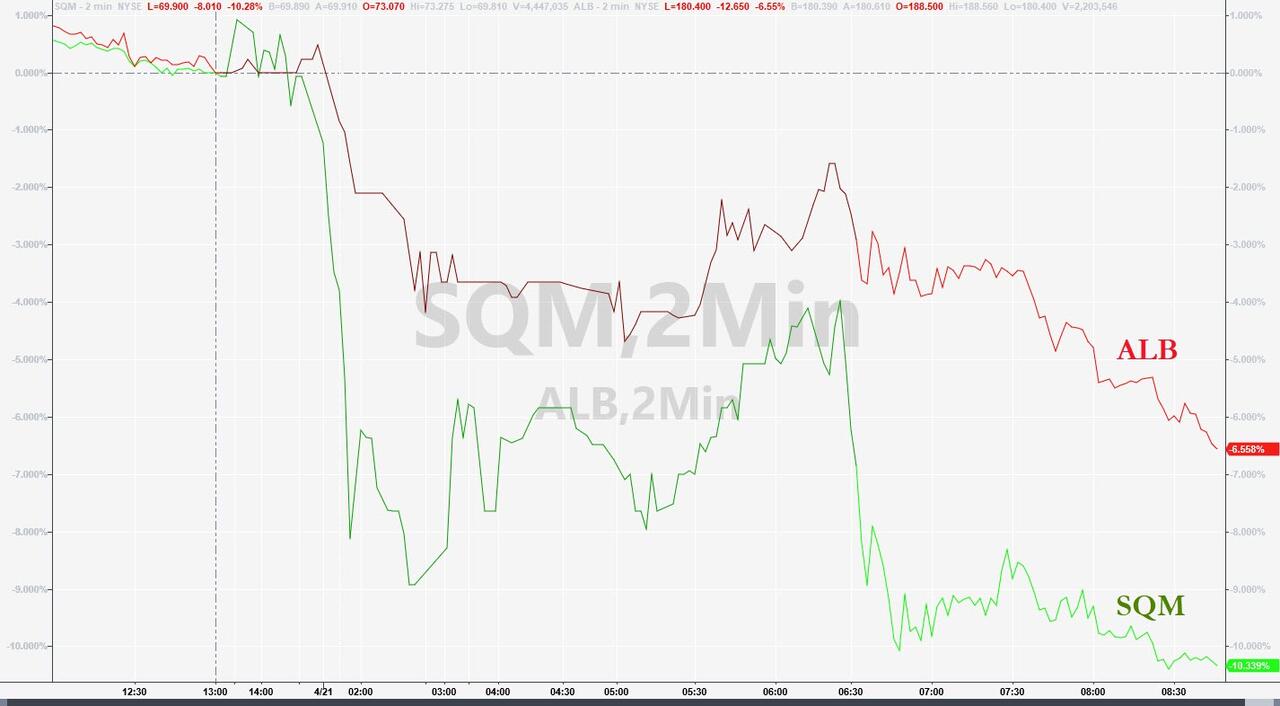
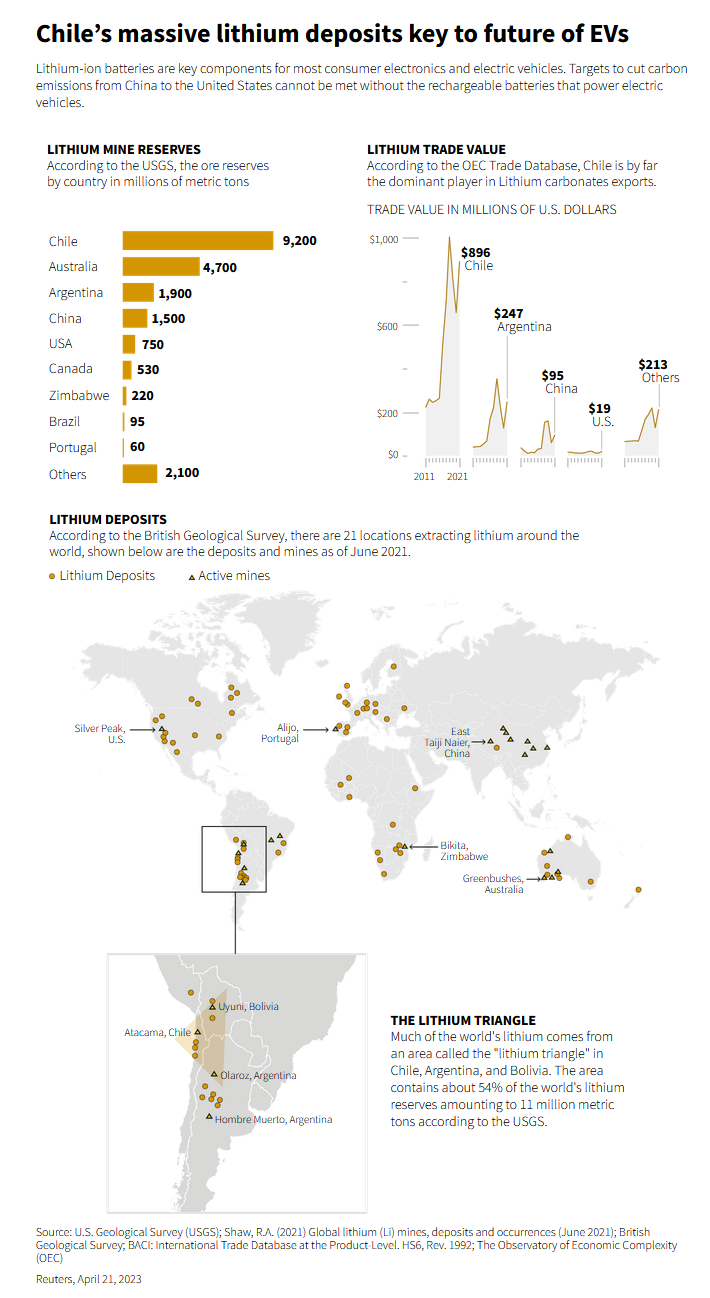
Chile's President Gabriel Boric stunned the world on Thursday when he said he would nationalize the country's lithium industry, the world's second largest producer of the metal essential in electric vehicle batteries, to boost its economy and protect its environment.

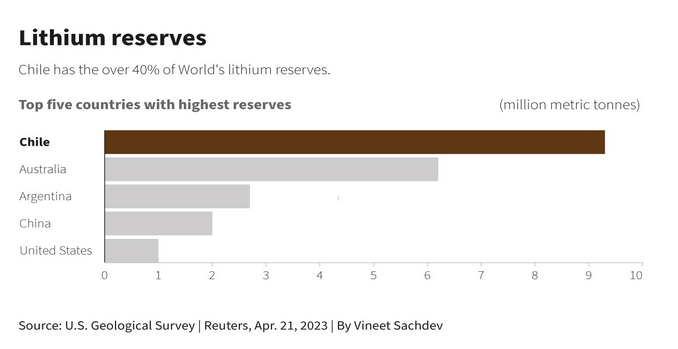
The shock move in the country with the world's largest lithium reserves would in time transfer control of Chile's vast lithium operations from industry giants SQM and Albemarle to a separate state-owned company.

The nationalization poses a fresh challenge to electric vehicle (EV) manufacturers scrambling to secure battery materials, as more countries look to protect their natural resources. Mexico nationalized its lithium deposits last year, and Indonesia banned exports of nickel ore, a key battery material, in 2020.

"This is the best chance we have at transitioning to a sustainable and developed economy. We can't afford to waste it," Boric said in an address televised nationwide.

Future lithium contracts would only be issued as public-private partnerships with state control, he said, hoping to extract far more profits from lithium demand by EV giants such as Tesla and well, everyone else these days.

The government would not terminate current contracts, but hoped companies would be open to state participation before they expire, he said, without naming Albemarle and SQM, the world's No.1 and No.2 lithium producers respectively. In other words, they can volunteer to hand over control of their assets. SQM's contract is set to expire in 2030 and Albemarle's in 2043.

SQM, formally called Sociedad Quimica Y Minera de Chile, and Albemarle supply Tesla Inc, LG Energy Solution Ltd and other EV and battery manufacturers.

Albemarle said the announcement would have "no material impact on our business" and it would continue talks on investing in further growth and using new technologies in Chile. SQM was not immediately available for comment.

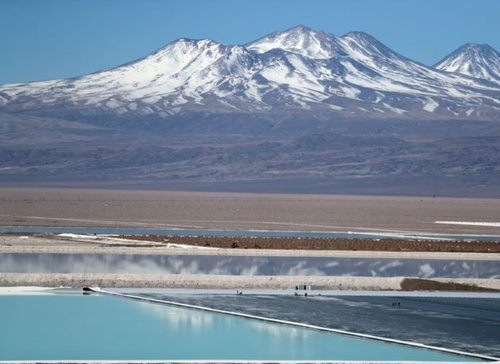
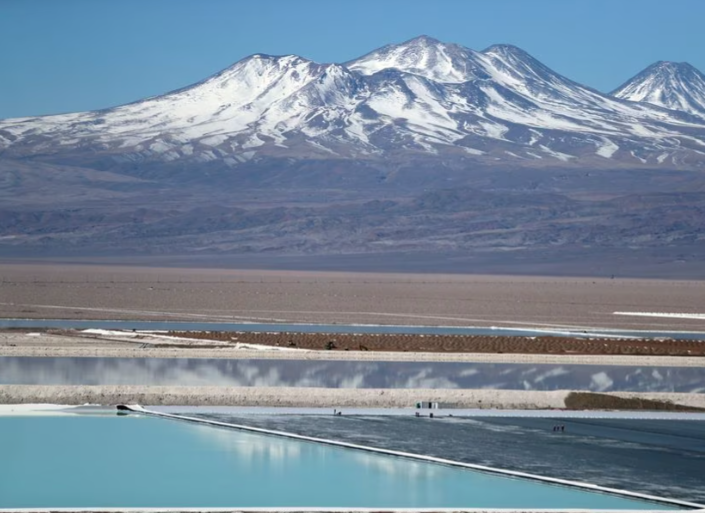
A view of a brine pool of a lithium mine on the Atacama salt flat in the Atacama desert, Chile, August 16, 2018.

South Korean battery maker SK On, which has a long-term supply contract with SQM, said it would monitor the development and respond with a long term view.

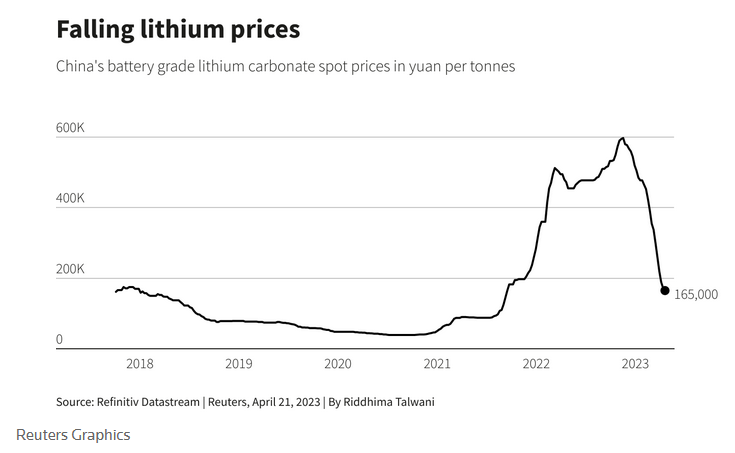
The announcement by Chile did not trigger a reversal in lithium prices which as we noted previously, have plunged more than 70% from a November peak due to weakening EV demand in China, the world's biggest auto market. The most-traded lithium carbonate futures on the Wuxi Stainless Steel Exchange in China fell 3.4%.

"When or if battery makers renew their contracts with lithium firms in Chile, contract conditions would likely become more difficult than what they saw in the past when there was no state involvement," said Cho Hyunryul, an analyst at Samsung Securities.

The move is likely to spur a shift in future investment in lithium to other countries including Australia, the world's biggest producer, analysts said.

"Policy stability is very important for any mining project ... Mining-friendly jurisdictions like Australia would be places where incremental funds get invested," said Harsh Bardia, an analyst at National Australia Bank's private wealth arm JBWere.

Boric said state-owned Codelco, the world's largest copper producer, will be tasked to find the best way forward for a state-owned lithium company and he would seek approval from Congress for the plan in the second half of the year. Congress has - or rather had - been a check on many of Boric's more ambitious proposals and shelved a proposed tax reform bill in early March.

Codelco and state miner Enami will be given exploration and extraction contracts in areas where there are now private projects before the national lithium company is formed.

A division will be dedicated to advancing technology to minimize environmental impacts, including favoring direct lithium extraction over evaporation ponds. Privately held Summit Nanotech Corp, which is developing direct lithium extraction technology, welcomed the announcement.

Boric said the country would look to protect biodiversity and share mining benefits with indigenous and surrounding communities.

"Today we present a national lithium strategy that's technically solid and ambitious," the president said, adding it would build "a Chile that distributes wealth we all generate in a more just way".

https://www.zerohedge.com/markets/chile-stuns-markets-and-ev-makers-nationalizing-lithium-industry-overnight

OmniAb started at Buy by Benchmark

 Target $8

https://finviz.com/quote.ashx?t=OABI&ty=c&ta=1&p=d

SciSparc and Clearmind Collaboration in the U.S. for Treatment of Depression

 SciSparc Ltd. (Nasdaq: SPRC) ("Company" or "SciSparc"), a specialty clinical-stage pharmaceutical company focusing on the development of therapies to treat disorders of the central nervous system, announced today that as part of its ongoing collaboration with Clearmind Medicine Inc. (Nasdaq: CMND) (CSE: CMND), (FSE: CWY) (“Clearmind”), a biotech company focused on discovery and development of novel psychedelic-derived therapeutics to solve major under-treated mental health problems, an additional provisional patent application was filed by Clearmind with the United States Patent and Trademark Office (“USPTO”).

The latest patent application refers to the protection of the unique combination of MEAI and SciSparc's Palmitoylethanolamide (“PEA”) for the treatment of depression.

Under this collaboration, three other patent applications have been filed by Clearmind with the USPTO for the combination of SciSparc’s PEA with Clearmind’s MEAI compound (5-methoxy-2-aminoindane) for the treatment of alcohol use disorder, treatment of cocaine addiction and treatment of obesity and its related metabolic disorders. An additional six patent applications have been filed for the combination of SciSparc's PEA and lysergic acid diethylamide (LSD), psilocybin, and N,N-dimethyltryptamine (DMT), 3,4 methylenedioxymethamphetamine (MDMA), ibogaine and ketamine.

https://finance.yahoo.com/news/scisparc-clearmind-collaboration-strengthens-ip-123000434.html

Shockwave Medical Draws Interest From Boston Scientific

  Shockwave Medical Inc. is attracting takeover interest from Boston Scientific Corp. as health-care dealmaking starts to rebound, people with knowledge of the matter said.

Boston Scientific has been exploring a potential deal for Shockwave to boost its portfolio of cardiovascular devices, the people said, asking not to be identified because the talks are private. Shares of Shockwave have gained 29% this year, giving the company a market value of about $9.6 billion.

Shockwave shares rose as much as 14% on the news while Boston Scientific stock fell as much as 3.8%.

A deal could rank as one of Boston Scientific’s largest ever acquisitions, potentially trailing only its 2006 purchase of Guidant Corp. for more than $27 billion. Bloomberg News reported last year that Shockwave was working with advisers to study mergers or partnerships with other health-care companies after receiving takeover interest.

Founded by serial medical technology entrepreneur Daniel Hawkins, Shockwave says it’s seeking to change how calcified cardiovascular disease is treated. The Santa Clara, California-based company has a device that uses sound waves to break up calcium deposits in arteries and expand vessels, a method the company says is safer than some currently used procedures.

Boston Scientific, which has a market value of about $76 billion, makes a number of devices and instruments used in cardiac care. Deliberations are ongoing, and there’s no certainty they will lead to a transaction, the people said.

https://finance.yahoo.com/news/shockwave-medical-draws-interest-boston-153931388.html