Search This Blog

Friday, April 21, 2023

Scientific Consensus - A Manufactured Construct

 by Maryanne Demasi via The Brownstone Institute,

In a recent interview, famed astrophysicist Neil deGrasse Tyson was challenged on his scientific views about COVID-19 and he said “I’m only interested in consensus” – words that would have Nicholas Copernicus and Galileo Galilei rolling in their graves.

The appeal to “scientific consensus” is fraught with problems, just like “The science is settled” and “Trust the science” and other authoritarian tropes that have dominated the pandemic.

A widely accepted theory, such as the theory of evolution, depends on a consensus being reached among the scientific community, but it must be achieved without censorship or reprisal.

As Aaron Kheriaty, a fellow at the Ethics and Public Policy Center, recently said:

Science is an ongoing search for truth & such truth has little to do with consensus. Every major scientific advance involves challenges to a consensus. Those who defend scientific consensus rather than specific experimental findings are not defending science but partisanship.

Consensus by Censorship

It’s not difficult to reach a scientific consensus when you squelch dissenting voices.

The origin of COVID is a classic example. Twenty-seven scientists published a letter in the Lancet condemning “conspiracy theories” that suggested the virus did not have a natural origin. Dissenting views were censored on social media and labelled “misinformation.”

It’s only now that the US Department of Energy and the FBI say the virus was likely the result of a lab leak in Wuhan, that it’s possible to have these discussions openly.

The Great Barrington Declaration is another example. Three eminent professors from Harvard, Stanford, and Oxford Universities, argued against lockdowns, which they said would disproportionately harm the underprivileged. 

But former NIH director Francis Collins dismissed them as “fringe epidemiologists” asking Anthony Fauci for “a quick and devastating take down” of the declaration.
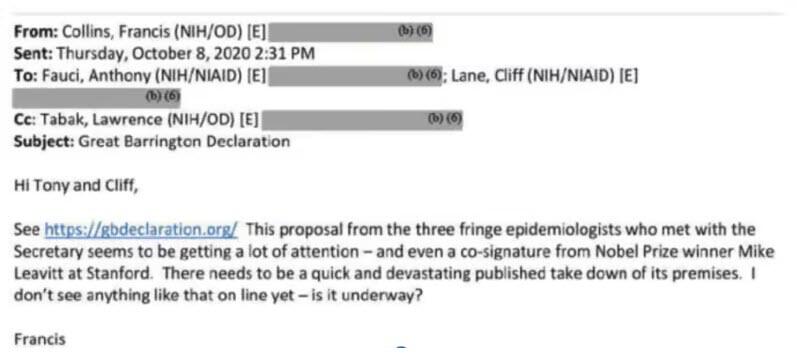
Scientific consensus has become a manufactured construct, dictated by politics and power.

The recent release of the ‘Twitter Files’ reveals how government agencies, Big Tech, media, and academia colluded in an effort to police online content, and censor dissenting voices to create a false perception of consensus.

One egregious example was Stanford University’s Virality Project that brought together elite academia, experts in artificial intelligence, and social media companies to censor “true” stories of vaccine injuries under the guise of fighting disinformation.

Robert Malone, physician and pioneer of mRNA technology summed up the situation accurately when he said;

The real problem here is the damn press and the internet giants. The press and these tech players act to manufacture and reinforce “consensus” around selected and approved narratives. And then this is being weaponized to attack dissenters including highly qualified physicians.”

The pandemic has made this insidious behaviour more visible, but the reality is, it has been happening for a long time – I would know – I was caught up in it.

Consensus in mainstream media

As a TV presenter on ABC’s top ranking science program Catalyst for over a decade, my role was to investigate science issues and, if necessary, challenge orthodoxy.

The ABC is not funded by private industry, but by the public purse, to avoid the bias which befalls the commercial networks.  Or so I thought.

Several years ago, my successful career at the ABC came to a grinding halt after defenders of “scientific consensus” criticised several documentaries I produced, which questioned various medical orthodoxies such as cholesterol-lowering drugs, nutritional guidelines, and the over-prescription of medicines. 

One documentary questioned the health impacts of prolonged exposure to wireless devices (such as iPads, laptops, and smartphones) which emit low frequency radiation – we did our due diligence and undertook an excruciating process of reviewing the program for legal, editorial, and factual integrity.

In the program, we questioned why the Australian government’s radiation safety authority (ARPANSA) had safety standards that were out-of-date, and excluded important evidence from multiple peer-reviewed papers by independent scientists.

It unleashed a firestorm of complaints from the Telco industry, the regulatory authority and ARPANSA, all of which had been preparing for the biggest wireless rollout the country had ever seen.

Industry experts emerged from the shadows, and the media obliged, uncritically reporting criticisms of the program, while ignoring those defending it. No attention was paid to industry’s influence over the science.

Critics complained that I’d given weight to a “fringe” position that was not supported by science. And by “fringe” they were referring to Devra Davis, professor of epidemiology at the University of Pittsburgh, with a distinguished career at the National Academy of Sciences, and the National Research Council.

The ABC caved to the relentless pressure and suspended me from on-air duties, concluding that I’d given prominence “to views challenging the scientific consensus.

And by “scientific consensus,” they meant the position taken by ARPANSA, the very organisation I had criticised for its lax regulations.

Eventually, the ABC banned the program and “restructured” the department by firing the staff. What the network believed would be a quick solution had serious and far-reaching consequences.

It would not only deter future journalists from questioning orthodoxy, but it sent a chilling message that the ABC would succumb to industry pressure and favour scientific consensus.

I think Michael Crichton – physician, producer, and writer – explained it best when he gave a lecture on science, politics, and consensus in 2003; 

I regard consensus science as an extremely pernicious development that ought to be stopped cold in its tracks. Historically, the claim of consensus has been the first refuge of scoundrels; it is a way to avoid debate by claiming that the matter is already settled. 

He continued:

Consensus is the business of politics….The greatest scientists in history are great precisely because they broke with the consensus. There is no such thing as consensus science. If it’s consensus, it isn’t science. If it’s science, it isn’t consensus. Period.

https://www.zerohedge.com/technology/scientific-consensus-manufactured-construct


TikTok's Democrat Lobbyists Visited Biden White House At Least 40 Times In Past Year

 A recent report may explain why there hasn't been much action against TikTok - which collects its users' browsing data and keystrokes - at the federal level.

According to the Washington Free BeaconTikTok lobbyists visited the Biden White House at least 40 times over the past year, according to official White House visitor records.

The Chinese social media platform and its parent company, ByteDance, are mounting a massive public relations blitz as lawmakers are seeking to ban the app due to national security, espionage, and data privacy concerns. ByteDance and TikTok have spent $13 million on federal lobbying since 2019 and hired heavyweight firms such as influential Democratic public relations shop SKDK.

Those hired guns have had the ear of the White House, the records show. Former Louisiana Democratic senator John Breaux, a TikTok lobbyist at Crossroads Strategies, visited the White House at least three times last year, most recently for an event on Dec. 21. Stephanie Leger Short, another TikTok lobbyist who works with Breaux, attended a June 23 meeting with White House adviser Mitch Landrieu. Breaux also met with White House official John Podesta last November. -Free Beacon

Other TikTok lobbyists include former Congressman Barton Gordon (D-TN), who attended two White House events (Dec. 1 and last September), and ByteDance lobbyist Lauren Aronson, who visited twice in September. 

Meanwhile, ex-congressman Joseph Crowley (D-NY) is listed at least four times in the 2022 visitor logs - meeting with presidential special assistant John McCarthy in August and White House adviser Mariana Adame in September. Crowley notably helped arrange meetings for TikTok on Capitol Hill last month.

Former Biden campaign spokesman Jamal Brown, another revolving door lobbyist hired by TikTok in November, visited the White House numerous times in June, August and December, while Paul Thornell - another ByteDance lobbyist, visited at least three times last year.

"If administration officials appear highly susceptible to TikTok's lobbying efforts, it's probably because they're highly dependent on the app for political reasons," said Michael Sobolik, a China expert at the American Foreign Policy Council. "The Biden administration claims to be serious about TikTok, but the facts suggest otherwise."

"Democratic operatives are already planning to push Biden's reelection agenda on the Chinese-controlled app," Sobolik added.

https://www.zerohedge.com/political/tiktoks-democrat-lobbyists-visited-biden-white-house-40-times

Time to address the unaffordability of affordable health care

 President Biden’s proposal to open Obamacare plans and Medicaid to Deferred Action for Childhood Arrivals (DACA) recipients marks the most recent effort to expand federally subsidized health insurance programs. These expansions, however, come with an inconvenient truth: They inflate prices for unsubsidized commercial patients and payers.

Our new study documents that between 2011 and 2021, after adjusting for medical price inflation, median unsubsidized premiums for individual market insurance plans (i.e., Obamacare plans) rose by 59 percent. And there is little reason to expect that health care unaffordability will slow as government subsidies continue to grow. Medicaid expansion in North Carolina and other states inflates commercial prices, as one of us explained in an analysis. Despite expanding insurance coverage, recent  life expectancy data suggest minimal impact for low-income Americans.

Subsidized health insurance programs make unsubsidized health care unaffordable because these programs require buy-in from powerful health care industry groups. To cover the cost of providing care and contribute to industry players’ bottom line, money is channeled from taxpayers’ pockets, both overtly and covertly. This process inevitably inflates health care costs and raises prices for unsubsidized patients and payers.

As the health care industry derives more and more revenue from government-subsidized programs, it has strong incentives to influence policymakers to expand these programs and enhance payments at taxpayers’ expense. This is a regressive game. Large players gain disproportionate advantages, which incentivizes further consolidation, less competition and higher prices for unsubsidized patients and payers.

Gradually, industry interests become more entrenched in subsidized health programs, as do the bureaucratic structures required to sustain them. Both forces create demand for further expansion of these programs, allowing politicians to push for incremental but continuous expansions and seek political gains.

By increasing prices for privately-funded health care and obfuscating the true cost of subsidized health care, public monies will crowd out private monies. This trend is already underway: Small employers are pushing workers to Obamacare plans. Ultimately, taxpayers get a double whammy — higher health care prices for themselves and heavier tax burdens to subsidize government programs.

Evidence suggests that politicians and industry players will exploit every opportunity to continue expanding subsidized health insurance programs. The American Rescue Plan extended eligibility for premium subsidies to people with income over 400 percent of the poverty level, and the Inflation Reduction Act extended this “temporary” provision through 2025.

The Biden administration’s current proposal is to extend Obamacare and Medicaid coverage to DACA recipients. It is not unreasonable to predict the next proposal will be expanding coverage to all undocumented immigrants and higher-income earners. The endgame? A single-payer system, funded by taxpayers and controlled by the government.

If politicians and industry players wish to pursue incremental steps towards a single-payer system, they have an obligation to be honest with the nation’s citizenry about this direction and the financial consequences involved. Health care price increases for private patients and payers should not be viewed as market failures but rather as intended consequences along the path toward a single-payer system. 

Ge Bai is a professor of accounting and health policy at Johns Hopkins University. Elizabeth Plummer is a professor of accounting and medical education at Texas Christian University.  

https://thehill.com/opinion/healthcare/3962117-its-time-to-address-the-unaffordability-of-affordable-health-care/

Americans bought almost 60 million guns during the pandemic

 One-fifth of U.S. households purchased guns during the pandemic, a national arming that exposed more than 15 million Americans to firearms in the home for the first time, academic studies show. 

Americans purchased nearly 60 million guns between 2020 and 2022, according to an analysis by The Trace, a nonprofit, nonpartisan news organization that tracks gun violence. Yearly gun sales are running at roughly twice the level of 15 or 20 years ago.  

All the new weapons may be fueling a historic surge in gun deaths, which reached record highs during the same period.  

“It’s a totally different type of gun ownership now,” said John Roman, a senior fellow in the Economics, Justice and Society Group at NORC, a research organization based at the University of Chicago.  

“It’s not a rifle stored away somewhere that you take out twice a year to go hunting. It’s a handgun, probably a semiautomatic handgun, that you keep in your bedside table or in your glove compartment, or that you maybe carry around with you.” 

The COVID-19 pandemic triggered a run on gun shops, part of a larger national spasm of panic-buying that gripped the country at a moment when many Americans thought society might collapse.  

“There was fear, and real concern, about what happens to the country during a global pandemic,” said Nick Suplina, senior vice president of law and policy at Everytown for Gun Safety, a gun-control nonprofit.  

The National Rifle Association fanned that fear, Suplina said, by tweeting out a video of a woman holding a rifle and pushing firearms as a pandemic safety measure.  

“You might be stockpiling up on food right now to get through this current crisis,” the woman says. “But if you aren’t preparing to defend your property when everything goes wrong, you’re really just stockpiling for somebody else.”  

Between March 2020 and March 2022, 18 percent of households bought guns, according to a NORC survey.  

Pandemic gun sales raised the share of Americans living in armed homes to 46 percent, up from 32 percent in 2010.  

“Five percent of Americans said they bought a gun for the first time during the pandemic, which is a huge number,” Roman said. “Those buyers were younger, they were more likely to be renters, they were more likely to be women, they were more likely to be people of color.” 

A scholarly study found that 7.5 million Americans became new gun owners between 2019 and 2021. Those purchases exposed 17 million Americans to household firearms for the first time, a figure that includes 5 million children.  

The study found that many Americans who already owned guns, nearly 20 million, bought more. 

“Most people say, ‘I bought the gun to protect myself and my family against home invasion,’” said Matthew Miller, professor of health sciences and epidemiology at Northeastern University and one of the report’s authors. “But that doesn’t explain why most of the guns that were bought during this time period were bought by people who already owned guns.” 

The pandemic accelerated a rise in gun ownership that began around 2005, the year Congress passed a law that largely shielded gun manufacturers from liability when their products are used in crimes. 

That law set off a new era of emboldened advertising by gun makers, who marketed firearms as an essential tool for defending the American home.  

“This is to protect yourself against your fellow humans,” Roman said, “with the implication being that your fellow humans are getting increasingly dangerous. Which is ironic, of course,” because violent crime stood at a low ebb after the turn of the millennium. 

Gun sales rose further with the 2008 election of former President Obama, partly from fears “that the government was going to shut down gun purchases,” said Eric Fleegler, an associate professor of pediatrics and emergency medicine at Harvard Medical School who studies gun violence. 

FBI background checks for firearm sales more than doubled in a decade, from 9 million in 2005 to 23 million in 2015. Five years later, in pandemic-scarred 2020, the bureau conducted nearly 40 million background checks.  

Gun sales have retreated since then. But the FBI logged 8 million background checks through March, presaging a yearend total of at least 30 million for 2023. 

Background checks are an imprecise measure of gun sales, because they include sales of multiple weapons and concealed-carry permits for guns already owned, among other complexities.  

Using background checks and other data, The Trace estimates that gun sales almost tripled between 2005 and 2020, from 7.8 million to 21.8 million. Firearm sales eased to 18.9 million in 2021 and 16.6 million in 2022. All three figures are larger than the gun-sale total for any other year in the new millennium.  

“Clearly, there has been a stark increase in gun purchases, and I think a lot of these folks are new,” said Christian Heyne, vice president of policy and programs at Brady, the gun-control nonprofit. 

“And I think it’s incumbent upon us to make sure that all gun owners make sure they understand the responsibility they have to safely store these weapons, and to understand the risk that is associated with having the firearm in the home in the first place.” 

With the nation awash in firearms, gun deaths are rising anew. Research by Fleegler and colleagues found that firearm fatality rates increased by nearly half between 2004 and 2021.  

More Americans died from gun violence in 2020 and 2021 than in any prior year on record. Gun-related homicides and suicides totaled 48,830 in 2021. Shootings of children nearly doubled during the pandemic.  

“There are no two years in recorded history that I’m familiar with, going back to the 1980s, that you see such a dramatic increase” in such a short span, Fleegler said. 

The nation also endured a record number of mass shootings in 2021: 690 incidents in which four or more people were shot. The Gun Violence Archive tallied 646 mass shootings in 2022.  

The link between rising gun ownership and rising gun violence is hard to prove. Yet, “gun ownership rates track very closely to gun fatalities,” Fleegler said. “If you want to know where people are dying by guns, look where the guns are.” 

Guns are most common in the South and least prevalent in the Northeast, a 2021 Pew analysis found. Firearms sit in around half of rural homes, two-fifths of suburban homes and 30 percent of urban dwellings, and in 40 percent of all American households.  

Researchers envision a return to an era when firearms sat in half of American homes. Five decades of NORC surveys show a peak of gun ownership in 1977, when exactly 50 percent of households held guns. 

Nearly one-third of Americans hunted in 1977. Hunting declined over the decades, and gun ownership reached a low ebb around 2010.  

Estimates vary on how many guns are circulating today in the United States, but most sources suggest guns outnumber Americans. 

“There’s enthusiasts, survivalists, collectors,” Heyne said. “I think somewhere around 3 percent of the U.S. population possesses more than half of the guns in the country.”

https://thehill.com/policy/national-security/3960527-americans-bought-almost-60-million-guns-during-the-pandemic/

These States Don't Tax Retirement Income

 States vary widely in the way they tax retirement income so location is an important consideration in financially planning for retirement. Some states don’t levy income states on any sort of retirement income, while others tax IRA and 401(k) distributions, pension payouts and even social security payments like ordinary income. Income taxes are just part of the story, however, as some states with low or no income taxes have high property, sales and other taxes. Consider working with a financial advisor when you are planning for retirement to make sure you avoid any unnecessary taxes.

Retirement Income Tax Basics

Most retirement income can be subject to federal income taxes. That includes Social Security benefits, pension payments and distributions from IRA and 401(k) plans. Exceptions include distributions from Roth IRA and Roth 401(k) plans. Federal income taxes on Roth contributions are paid before the contributions are made. These contributions as well as any investment gains can be withdrawn free of federal income taxes after five years if you have reached age 59 1/2.

The situation is more complex when it comes to how states will tax your income. Many states have no income tax at all, so all retirement income, as well as other income, is state tax-free. Most states specifically exclude Social Security benefits from taxation. Some others also exempt retirement account distributions and pensions. Most have a mix of approaches to taxing retirement income.

Now that you have a good baseline knowledge of how retirement taxes work at the state level, let’s dive into the states that won’t tax you at all.

Eight states have no state income tax. Those eight – Alaska, Florida, Nevada, South Dakota, Tennessee, Texas, Washington and Wyoming – don’t tax wages, salaries, dividends, interest or any sort of income.

No state income tax means these states also don’t tax Social Security retirement benefits, pension payments and distributions from retirement accounts. Even income from securities held in non-retirement brokerage accounts is free from any state income tax in these states. That means retired residents in these states have no worries about paying state income taxes on their income from any source.

Another state, New Hampshire, has no state income tax on wages, salaries, retirement account withdrawals or pension payments. But New Hampshire does currently tax dividends and interest, which are likely to be sources of income for some retirees with assets outside retirement accounts.

The rest of the states take a variety of approaches to taxing retirement income. Some tax all retirement income, including Social Security. Others exempt Social Security but tax sources such as pensions and retirement account income if retirees’ income exceeds a certain cap. But the following states levy no tax on retirement income of any sort.

11 States That Don’t Tax Retirement Income 1. Alaska No state income tax 2. Florida No state income tax 3. Illinois Retirement income exempt, including Social Security, pension, IRA, 401(k) 4. Mississippi Retirement income exempt, including Social Security, pension, IRA, 401(k) 5. Nevada No state income tax 6. Pennsylvania Retirement income exempt, including Social Security, pension, IRA, 401(k) 7. South Dakota No state income tax 8. Tennessee No state income tax 9. Texas No state income tax 10. Washington No state income tax 11. Wyoming No state income tax

States With Small Retirement Tax Requirements

Some states that don’t appear on this list of those that don’t tax retirement income at all are still relatively generous when it comes to letting retirees off the tax hook. For instance, Georgia does not tax Social Security retirement benefits and also provides a deduction of up $65,000 per person on all other types of retirement income.

Also, in Pennsylvania all Social Security benefits and IRA and 401(k) income is exempt. And the Keystone State does not levy income tax on pension payments for those over 60. Clearly, state taxation of retirement income is somewhat complicated. One of the biggest differences between states is the variety of income caps to qualify for exemptions.

In addition, state taxation of retirement benefits is a moving target. State tax laws change over time. For instance, New Hampshire’s 5% tax on dividends and interest is due to be phased out by January 2027. Until then, the tax rate on dividend and interest income in New Hampshire declines every year until it reaches zero.

Eleven states levy no income taxes on retirement income from any source. Others offer resident retirees varying degrees of exemptions from taxation on Social Security, retirement account distributions, pension payments and other types of retirement income. Some of the exemptions are generous enough that many retirees in those states won’t pay any income tax. Details such as the retiree’s income matter and vary by state, so it’s important to check with the state tax office for details before relocating to save on taxes.

https://finance.yahoo.com/news/states-dont-tax-retirement-income-150028847.html

Medicare Advantage is not an advantage for many seniors with cancer

 When America’s seniors enroll in Medicare, they enter the most medically vulnerable stretch of their lives. And if they are unfortunate enough to be among the 1.9 million Americans each year who hear the terrifying words “you have cancer,” it is imperative they have access to the support and care they need to survive. About 60 percent of cancers occur in people ages 65 or older, accounting for approximately 70 percent of all deaths caused by the disease.

But as recently diagnosed cancer patients embark on this unwanted, unexpected care journey, what many seniors do not realize is that their Medicare Advantage (MA) plan can often put them at a disadvantage by restricting access to the care they need and deserve.

Nearly half of all Medicare beneficiaries are enrolled in MA plans, which equates to an estimated 29 million Americans. Unlike traditional Medicare, which allows patients to visit any hospital or physician that accepts Medicare, MA beneficiaries are only able to use physicians and hospitals within their plan’s — and in some instances, their sub-contracted medical group’s — network and service area.  

While MA plans are ostensibly held accountable to maintain appropriate “network adequacy” to manage the primary and specialty care needs of their enrollees, many MA networks are woefully inadequate to ensure access to the latest advances most likely to help beneficiaries with cancer. This is because the industry has accepted, even encouraged, under the banner of affordability and, ironically, the catchphrase “value-based care,” plans to develop narrow networks. And for those developing these networks, the focus is on cost containment, and not the attributes most valued by cancer patients: survival, quality of life and additional years with friends and loved ones.

While this outcome may be unintended, it was not unforeseeable. Narrow networks can successfully provide coverage for less complex illnesses where expertise is abundantly available. But to understand why MA’s narrow networks negatively impact cancer patients, one must understand how cancer is different from other health concerns.

Cancer is not one disease but hundreds, and the expertise needed to treat each cancer is often unavailable through the narrow networks of MA. With our burgeoning knowledge driven by genomics and precision medicine, the oncology field no longer behaves as one specialty, but rather many sub-specialties defined by tumor origin and specific genetic blueprint. These advances are reflected in the 33 percent cancer death rate reduction in the last 30 years and more than 3.8 million cancer deaths that have been averted. But as new treatments emerge, the need for specialized expertise increases.

Breakthrough advances — such as cell-based and immuno-oncology therapies — are first and sometimes only available at academic medical centers (AMCs) or National Cancer Institute-designated comprehensive cancer centers (NCI-CCCs). But MA beneficiaries are far less likely than traditional Medicare beneficiaries to receive cancer care at a teaching hospital (23 percent with Medicare versus 8 percent with MA), Commission on Cancer-accredited hospital (57 percent versus 33 percent) or NCI-CCC (15 percent versus 3 percent).

Cancer surgery statistics provide sobering evidence of the impact a lack of appropriate expertise has on outcomes: Cancer patients with MA who had their stomach or liver removed were 1.5 times more likely to die within the first month after surgery compared to their peers with traditional Medicare. And MA beneficiaries who had oncologic surgery on the pancreas were two times as likely to die within the first month.  

To further illustrate the importance of access to academic centers, consider your potential journey if you were diagnosed with metastatic lung cancer 10 years ago — you would be likely to die in six to eight months. However, if you visited an AMC conducting a trial with a life-changing medication, you could have potentially extended your life by six years or longer. Today, there are complex or advanced cancer cases that can only be appropriately diagnosed and safely treated at academic centers that uniquely provide cell-based therapies or newer, emerging immune-based and targeted therapies.

Access to these specialized centers has impact beyond immediate care needs. The clinical research that takes place at these comprehensive cancer centers paves the road to launching the next generation of new, more effective medications. Products with narrow network designs restrict access, adding to the burden already posed by social determinants of health. The combination of these barriers also deepens the pattern of under representation of minorities in clinical trials particularly as minority representation is greater among MA beneficiaries.

Put another way, by accepting narrow networks that restrict beneficiaries from accessing the leading academic centers, we’re broadly depriving future generations of cures and perpetuating a system that results in unacceptable disparities in health outcomes.

By recognizing that cancer care is different, these unintended outcomes become foreseeable. We can avoid them by modernizing our definition of “network adequacy” to keep pace with the innovation, and by establishing a new oncology ecosystem where academic medical centers and community oncologists work in harmony. This would allow for patients to receive the right care at the right place at right the time. Some critics may argue that expanding access to these centers is too disruptive to manage care norms and a threat to affordability. But those arguments fall flat when you consider the layers of organizations involved and the profit they each make. At the end of the day, disruption that benefits the patient creates value. 

In this new paradigm of value-based care, MA administrators should require health plans and other risk-bearing entities to demonstrate they have processes and networks in place to ensure that timely and appropriate care will not be restricted to a cancer patient in need.

Government programs, such as MA, should reflect the best of society’s values and aim to democratize access to leading-edge cancer expertise so every cancer patient, regardless of race, socioeconomic status, geography or insurance product, has access to care that gives them the best chance of living.

Harlan Levine, M.D., is the president of health innovation and policy at City of Hope (COH), a National Cancer Institute-Designated Comprehensive Cancer Center dedicated to ensuring optimal cancer care through patient focused treatments. Levine also serves as the chair of the board of AccessHope™, a spinout company from COH that is focused on serving the employer market and making leading-edge cancer care available to all regardless of geographical location.

https://thehill.com/opinion/healthcare/3963071-medicare-advantage-is-not-an-advantage-for-many-seniors-with-cancer/

Lilly expects US Medicare to reverse course, fully cover Alzheimer's drugs


Eli Lilly and Co expects the U.S. Medicare health plan to back down from strict coverage limits on new Alzheimer's drugs as more evidence emerges in coming weeks showing that clearing amyloid brain plaques can help patients, a company executive told Reuters.

Lilly plans to release results from a trial of its experimental amyloid-targeting drug donanemab before the end of June. More study data on Leqembi, a rival drug from partners Eisai Co Ltd and Biogen Inc, is also expected in the coming months.

Leqembi received accelerated approval from the U.S. Food and Drug Administration earlier this year, and a decision on full approval is due by July.

"We believe that they (Medicare) will provide what we would call outright coverage like they do for every other FDA-approved medication," Derek Asay, Lilly's senior vice president of government strategy and federal accounts, said in an interview. Lilly has not previously discussed its Medicare coverage optimism publicly.

The U.S. Centers for Medicare & Medicaid Services (CMS) did not immediately respond to a request for comment. The agency told Reuters earlier this month that it is committed to being nimble when reconsidering its coverage in light of new evidence related to clinical benefit.

Currently, Medicare - the government health plan for Americans 65 and over - will only pay for anti-amyloid drugs approved under the FDA's less rigorous accelerated review if patients are enrolled in a clinical trial. Drugs in the class that receive traditional FDA approval - which may eventually include Leqembi and donanemab - would be covered contingent on their participation in a registry that would track patients and how they fare.

Such "coverage with evidence development" requirements are rare and historically used by Medicare to evaluate medical devices.

Industry groups and patient advocates, such as the Alzheimer's Association, say the envisioned policy would shut out patients and are pushing for less restrictive coverage.

Investors are watching closely for how restrictions could influence sales, as Medicare is estimated to insure 85% of Americans who would be eligible for the drugs. Leqembi costs $26,500 per year.

Asay said Medicare's current plan "potentially leads to some coverage, but coverage that's both delayed and inequitable," limiting access for many underserved patient populations, including minorities.

He said Medicare will soon have a "significant amount" of new data on donanemab as well as Eisai and Biogen's full data set on Leqembi.

Asay said he believes both Lilly and Eisai/Biogen would have ample evidence to address questions the agency has that could open the door to broader coverage. Lilly has also participated in discussions with CMS.

The severe Medicare restrictions were largely a response to a previous Alzheimer's treatment from Eisai and Biogen, Aduhelm, which won accelerated approval in 2021 with little evidence that it slowed cognitive decline.

THREE QUESTIONS

Under its coverage framework, CMS is looking for answers to three key questions: Do the drugs meaningfully improve health outcomes, such as slowing decline of cognition and function, for patients in a broad community practice? Do the benefits outweigh the risks? How do the benefits and harms change over time?

Eisai, which estimates that 100,000 U.S. patients would be eligible for Leqembi during its first three years on the market, has expressed confidence it will be able to provide those answers.

Lilly's Asay said: "We are very confident that we will be able to fully answer those three questions as well."

Other products facing similar CMS restrictions have languished.

Amyvid, Lilly's Alzheimer's imaging agent that can detect amyloid plaques on PET scans, has been subject to CMS' evidence development program for a decade.

Under the policy, the diagnostic is only available through enrollment in a Medicare-approved registry, and reimbursement is limited to one scan per lifetime.

A first registry failed to recruit enough minorities. In the second, started two years ago, there are still 18 states without a single site enrolled, Asay said.

"It shuts out many patients," said Dr. Maria Carrillo, chief science officer of the Alzheimer's Association, "especially minorities and rural patients."

https://www.marketscreener.com/quote/stock/BIOGEN-INC-4853/news/Exclusive-Lilly-expects-US-Medicare-to-reverse-course-fully-cover-Alzheimer-s-drugs-43599833/