Search This Blog

Wednesday, August 9, 2023

Azenta Up After Earnings Beat

 Azenta Inc (AZTA) reported upside earnings and revenues today.


Azenta Inc's earnings came in at an EPS of $0.13 per share, 750.00% higher than estimates for an EPS loss of $0.02 per share. The firm's earnings are up 8% since reporting $0.12 per share in the same period a year ago. Remember, earnings reported were on an adjusted basis, so they may not be comparable to prior reports and/or analyst estimates.

Analyst projections for Azenta Inc revenue came in at a consensus of $153.5 million. Third-Quarter revenues surpassed estimates for $165.9 million by $12.5 million (8%). The company achieved 25% growth year-over-year compared to the firm's revenue of $132.7 million from the year-ago quarter. The lower earnings growth relative to revenue signals Azenta Inc has not been able to improve its profit margin.


The firm's higher revenue growth to earnings signals that the firm has not been able to reduce costs and has seen its profit margin decrease.

Enanta cut to Underweight from Neutral by JPMorgan

 Target $14

https://finviz.com/quote.ashx?t=ENTA&p=d

Nature’s Proximal Origin Paper Was a Work of ‘Fraud and Scientific Misconduct'

 A growing number of people, including prominent scientists, are calling for a full retraction of a high-profile study published in the journal Nature in March 2020 that explored the origins of SARS-CoV-2.

The paper, whose authors included immunology and microbiology professor Kristian G. Andersen, declared that evidence clearly showed that SARS-CoV-2 did not originate from a laboratory.

“Our analyses clearly show that SARS-CoV-2 is not a laboratory construct or a purposefully manipulated virus,” the authors wrote in February. 

Yet a trove of recently published documents reveal that Andersen and his co-authors believed that the lab leak scenario was not just possible, but likely. 

“[The] main thing still in my mind is that the lab escape version of this is so friggin’ likely to have happened because they were already doing this type of work and the molecular data is fully consistent with that scenario,” Andersen said to his colleagues, according to a report from Public, which published a series of Slack messages between the authors. 

Anderson was not the only author who privately expressed doubts that the virus had natural origins. Public cataloged dozens of statements from Andersen and his co-authors—Andrew Rambaut, W. Ian Lipkin, Edward C. Holmes, and Robert F. Garry—between the dates January 31 and February 28, 2020 suggesting that SARS-CoV-2 may have been engineered.

” …the fact that we are discussing this shows how plausible it is,” Garry said of the lab-leak hypothesis.

“We unfortunately can’t refute the lab leak hypothesis,” Andersen said on Feb. 20, several days after the authors published their pre-print.

To complicate matters further, new reporting from The Intercept reveals that Anderson had an $8.9 million grant with NIH pending final approval from Dr. Anthony Fauci when the Proximal Origin paper was submitted. 

The findings have led several prominent figures to accuse the authors of outright deception.

Richard H. Ebright, the Board of Governors Professor of Chemistry and Chemical Biology at Rutgers University, called the paper “scientific fraud.” 

“The 2020 ‘Proximal Origin’ paper falsely claimed science showed COVID-19 did not have a lab origin,” tweeted Ebright. “Newly released messages from the authors show they did not believe the conclusions of the paper and show the paper is the product of scientific fraud and scientific misconduct.”

Ebright and Silver are among those pushing a petition urging Nature to retract the article in light of these findings.

Among those to sign the petition was Neil Harrison, a professor of anesthesiology and molecular pharmacology at Columbia University. 

“Virologists and their allies have produced a number of papers that purport to show that the virus was of natural origin and that the pandemic began at the Huanan seafood market,” Harrison told The Telegraph. “In fact there is no evidence for either of these conclusions, and the email and Slack messages among the authors show that they knew at the time that this was the case.”

Dr. Joao Monteiro, chief editor of Nature, has rebuffed calls for a retraction, The Telegraph notes, saying the authors were merely “expressing opinions.”

This claim is dubious at best. From the beginning, the Proximal Origin study was presented as authoritative and scientific. Jeremy Farrar, a British medical researcher and now the chief scientist at the World Health Organization (WHO), told USA Today that Proximal Origin was the “most important research on the genomic epidemiology of the origins of this virus to date.”

Dr. Anthony Fauci, speaking from the White House podium in April 2020, cited the study as evidence that the mutations of the virus were “totally consistent with a jump from a species of an animal to a human.” Fact-check organizations were soon citing the study as proof that COVID-19 “could not have been manipulated.” 

Far from being presented as a handful of scientists “expressing opinions,” the Proximal Origin study was treated as gospel, a dogma that could not even be questioned. This allowed social media companies (working hand-in-hand with government agencies) to censor people who publicly stated what Andersen and his colleagues were saying privately—that it seemed plausible that SARS-CoV-2 came from the laboratory in Wuhan that experimented on coronaviruses and had a checkered safety record.

Indeed, even as media and government officials used the Proximal Origin study to smear people as conspiracy theorists for speculating that COVID-19 might have emerged from the Wuhan lab, a Defense Intelligence Agency study commissioned by the government questioned the study’s scientific rigor.  

“The arguments that Andersen et al. use to support a natural-origin scenario for SARS CoV-2 are based not on scientific analysis, but on unwarranted assumptions,” the now-declassified paper concluded. “In fact, the features of SARS-CoV-2 noted by Andersen et al. are consistent with another scenario: that SARS-CoV-2 was developed in a laboratory…” 

Despite the many problems with the study’s findings, Monteiro continues to resist calls for retraction—perhaps because Monteiro himself publicly inferred that the lab leak hypothesis was a conspiracy theory in March, 2020. 

Whatever the case, it remains unclear how long Monteiro can resist calls for a retraction in face of overwhelming evidence of scientific misconduct.  

“There can be no doubt the Proximal Origin authors consciously and inappropriately downplayed the #COVID19 research-related origin hypothesis and coordinated efforts manipulating media coverage,” said Jamie Metzl, a former Clinton administration official and a WHO expert advisory committee on human genome editing appointee. 

Why there was such intense pressure to declare that SARS-CoV-2 was of natural origin is obvious today. 

The federal government was funding risky coronavirus research at Wuhan Institute of Virology, which would make officials complicit to some degree in a leak of a deadly virus. This is no doubt why the government had an interest in funding the study, which gave them a measure of control over its results.

“Jeremy Farrar and Francis Collins [then director of the National Institutes of Health] are very happy. Works for me,” Holmes Slacked his colleagues after the pre-print was submitted. 

The Proximal Origin paper increasingly looks like a whitewashing job, and some influential people have noticed. 

“This is a huge scandal,” said statistician and FiveThirtyEight founder Nate Silver. “Scientists like @K_G_Andersen believed a lab leak was extremely plausible, if not likely, they concocted a plan to deceive the public about it, and they’ve been caught red-handed.” 

Silver is not wrong; yet so far, no one has been held accountable. 

This lack of accountability is concerning, and to understand why it’s worth consulting age-old concepts of power and justice. As FEE’s Dan Sanchez has observed, power is not the mere exertion of unjust force. True power lies in the use of force and the absence of any accountability.  

“Systematically getting away with it—or impunity—is where power truly lies,” wrote Sanchez.

In his famous work Republic, Plato showed what raw power looked like. The legendary “Ring of Gyges” did not make one strong. It made one invisible. This did not mean the wearer could do anything he wanted, but it did mean he would never be held accountable for his acts of injustice. 

This is the most frightening part of raw state power. The greatest danger is not that people will act unethically. It’s not even that state actors will commit crimes to serve “a greater good.” The real danger begins when people are not held accountable—even when they are caught “red-handed.”

Jonathan Miltimore is the Editor at Large of FEE.org at the Foundation for Economic Education.

https://fee.org/articles/nature-s-proximal-origin-paper-was-a-work-of-fraud-and-scientific-misconduct-say-scientists-demanding-a-retraction/

Does Ozempic Cause Depression?

 “Thin” has been “in” across the United States for more than a century, but in this current age of social media, people’s obsession with achieving a rake-handle frame might be hitting a contemporary-times apex. And while, yes, excess body weight does cause serious health issues for some, the path many people are taking to get skinny today may require a concerning mental health toll.

Either directly or indirectly, you’ve probably heard the joyful refrains of folks who’ve lost considerable weight by taking the alleged wonder drug semaglutide, under the names of Ozempic, Wegovy or Rybelsus. Semaglutide was first developed to battle Type-2 diabetes, but then, two years ago, the FDA cleared its use for treatment of chronic obesity, as it effectively curbs the appetites of many who take it.

With dramatically shrunken waistlines, many praised semaglutide’s positive impact on their life. Demand increased, which generated barriers of cost and availability. That led to ethical questions over whether healthcare providers should prescribe semaglutide to those who take it for weight loss, which meant less access to it for people with diabetes, a disease that may create more immediate health emergencies if not treated.

Still, plenty of people who didn’t need the drug got their hands on the stuff — a number of wealthy celebrities, and others with more modest profiles but equal means. Some are choosing to deal with a range of well-documented unsavory side effects: Nausea, diarrhea, vomiting, abdominal pain, headache, fatigue, a boost in flatulence and other issues can crop up with semaglutide use. These issues have turned some people off to the drug, but there are other, more extreme possible semaglutide side effects that, for the most part, have fallen through cracks in media coverage. They include depression as well as suicidal thoughts and tendencies.

A number of purported semaglutide users have posted on social media that their mental health has suffered since beginning their treatment. Other people on semaglutide have reported to the media that they miss food and the ceremonial act of eating, which then darkens their mood.

Researchers and healthcare providers are enthused about the apparent growing number of applications for semaglutide. It’s not hyperbole to say the drug could transform the health landscape in a country like the United States, the most-obese of all the globe’s wealthy nations, and home to 30.7 million diabetics, the most of any country besides China and India. However, for some, the benefits of semaglutide have too great a cost to their mental health. The problem is widespread enough in the U.K. that the country’s medicine and healthcare regulatory body is launching a probe into semaglutide and its potentially harmful impact.

InsideHook spoke with a number of healthcare providers about the troubling issues many are facing. Based on their responses, consensus seems to be that semaglutide-prompted mental health woes are fairly uncommon and that the depressed turn in mood some people experience while on the drug would likely not be permanent or even long-lasting. It can even be addressed without having to cease dosing. 

“It’s not something that I’ve actually really had a patient complaint about,” says David Nazarian, M.D., a Beverly Hills-based internist who’s been prescribing semaglutide to patients as a weight-loss aid for several years, though like many other doctors he’s fielded a rise in requests for it over the past year or so. “I guess it’s all dependent on the dosage that one is taking. These medications start at a starting dose, and then you can increase it as needed to curb your appetite and have weight-loss effects. If you go higher on it, and it’s too much, you can have more side effects.”

He advises people on semaglutide, which he describes as a “powerful” medication, to take it only under strict guidance of a medical professional — multiple ones, actually. At Nazarian’s practice, internists partner with nutritionists to ensure clients continue eating properly. 

“I always tell patients that are on these medications, you want to make sure that your intake of protein is adequate enough so that you don’t have muscle breakdown and also some of these other side effects,” Nazarian says. “There’s nutrients that we need for optimal functions. So like the omega three fatty acids, they play a role with neurotransmitters, brain functions. If you’re completely cutting out certain things from your diet, then you’re going to have more of a side effect,” including possible mental health problems.

Sue Decotiis, M.D., a weight loss specialist in New York City, says people taking semaglutide also need to hydrate well. “You need to drink a gallon of water [a day] when you’re doing these drugs,” she says. “Because for every ounce of fat that you burn — and you will be burning fat rapidly — you’re gonna lose water.” From dehydration, Decotiis says, feelings of hunger, fatigue and dizziness may manifest, which is “not going to have a great impact on your mood, potentially.”

“Does Ozempic make anyone else feel depressed, unmotivated and sad?” asked one person in the subreddit r/OzempicForWeightLoss

“Anyone else start getting anxious/depressed?” posted another in r/Semaglutide.

“Has anyone else’s mental health plummeted while on Ozempic?” asked a third, among a number of other worried semaglutide-taking Redditors. 

While few, if any, of these posts have garnered huge upvote tallies, they’ve all gotten a number of responses in the affirmative. A couple comments read: “I have anxiety and Ozempic definitely makes my anxiety worse” and “I am becoming more and more depressed for reasons I don’t know.” One even says: “Yes, I had to go off it because it was intolerable. I never understood why anyone would commit suicide, now I understand. I’m on my third week not injecting but I can still feel the side affects [sic].”

“Kinda a numbness and a lot of fatigue,” one more Redditor posted in response to another’s question about increased depression coming with semaglutide use. “It creeps in slowly and before u know it u get quite depressed well me anyway [sic]. I’ve decided to go off.”

But these sensations and emotions, as well as that aforementioned feeling of “missing food” and the loss of a “zest for life,” that some people taking semaglutide have experienced should pass over time, Decotiis says. The current relatively high frequency of such reports could possibly be due to the fact that there are so many new users of the drug, who are still knee-deep in an expected adjustment period. When I ask Decotiis if there’s maybe a “mourning phase” over the decreased interest in some people’s favorite pastimes — dining out and drinking with friends, for example — she says, “Yeah, a little bit.”

However, she quickly adds: “But when people see that they’re down two pants sizes…” So she’s basically positing an unsettling paradox: “Yes, it might cause depression, but obviously you won’t be depressed if you’re skinny!” Still, Decotiis generally sees semaglutide having an effect on her patients that’s the opposite of those Redditors’ experiences.

She says when insulin levels — which are adversely affected by diabetes, excess fat and a lack of physical activity — are better maintained, so too are levels of cortisol, the body’s primary stress hormone that helps control mood. It’s not much of a surprise to Decotiis, then, that clients of hers on semaglutide say they’ve actually stopped taking antidepressants and anti-anxiety medications. She’s also heard remarks from her patients like, “My therapist says I’m doing so much better.”

Dr. Monica Vermani, a clinical psychologist and author of A Deeper Wellness: Conquering Stress, Mood, Anxiety, and Traumas, says seven out of the nine clients she sees who take semaglutide have experienced “positive effects” from it, including “faster progress in weight loss due to reduced cravings…and an inability to binge eat.” The other two patients continued their unhealthy eating habits, but in terms of their mental health, she says none of the nine reported “a loss of enthusiasm, joy or lust for life.” Instead, she says, “Most of them were very happy with their weight loss, after years of unsuccessful yo-yo dieting.”

Perhaps the best-case scenario for anyone who’s taking semaglutide is to one day be able to stop taking it and maintain a trim physique, which is not out of the realm of possibility for many who are on it. 

“I have a few patients who have discontinued using the medication for over a year and have not had significant weight gain,” says Vermani. “[They] have simply fluctuated between five to 10 pounds after a significant weight loss of 50 to 70 pounds.”

Because semaglutide is a peptide drug, and peptides are like messenger systems, Decotiis says the drug might be able to “rewire appetite over time,” giving people struggling with diabetes and weight loss a greater chance of improving their eating habits. In fact, some of her clients, after six months or so of semaglutide use, have told her that they’re craving healthy foods.

“And this is as we taper them off the medication, so I think that’s really exciting,” Decotiis says. “You’ve heard a lot in the press, ‘Oh, once you go off these drugs, you gain the weight back and you have to stay on them for life.’ I think if you go to the right physician who knows how to use the drugs, that is not necessarily the case.”

Vermani says the psychotherapy clients she has who are taking semaglutide and have lost significant weight tell her the challenges they face as they alter their lifestyles have been worth it. “My successful patients shared the motivation to change, and the willingness to engage in healthier eating habits, rather than continue their unhealthy patterns while taking the medication,” she says.

https://www.insidehook.com/article/health-and-fitness/ozempic-semaglutide-depression

Special Counsel Broke Into Trump's Twitter Account

 Back in January Special Counsel Jack Smith sought and obtained a search warrant for President Donald Trump's Twitter account. In the warrant, Smith demanded Twitter not tell Trump the Special Counsel was pursuing his account. 

"On January 17, 2023, the government applied for, and obtained, a search warrant that directed Twitter to produce data and records related to the '@realDonaldTrump"'Twitter account. At the same time, the government applied for, and obtained, a nondisclosure order, which prohibited Twitter from disclosing the existence or contents of the search warrant to any person. Based on ex parte affidavits, the district court found probable cause to search the Twitter account for evidence of criminal offenses. Moreover, the district court found that there were 'reasonable grounds to believe' that disclosing the warrant to former President Trump 'would seriously jeopardize the ongoing investigation' by giving him 'an opportunity to destroy evidence, change patterns of behavior, [or] notify confederates,'" court documents state. 

"The warrant required Twitter to tum over all requested information by January 27, 2023. The nondisclosure order was to remain in effect for 180 days after its issuance. The government faced difficulties when it first attempted to serve Twitter with the warrant and nondisclosure order," the documents continue. 

In response to the request for access to Trump's account and the warrant, Twitter argued the effort was a violation of the First Amendment. According to court documents the request was slow walked at the social media company, prompting a judge to hold the company in contempt and a levy a big fine. 

"The district court issued a search warrant in a criminal case, directing appellant Twitter, Inc. ("Twitter") to produce information to the government related to the Twitter account "@realDonaldTrump." The search warrant was served along with a nondisclosure order that prohibited Twitter from notifying anyone about the existence or contents of the warrant," court documents show. "Twitter initially delayed production of the materials required by the search warrant while it unsuccessfully litigated objections to the nondisclosure order. Although Twitter ultimately complied with the warrant, the company did not fully produce the requested information until three days after a court-ordered deadline. The district court thus held Twitter in contempt and imposed a $350,000 sanction for its delay."

"In this appeal, Twitter argues that the nondisclosure order violated the First Amendment and the Stored Communications Act; that the district court should have stayed its enforcement of the search warrant until after Twitter's objections to the nondisclosure order were resolved; and that the district court abused its discretion by holding Twitter in contempt and imposing the sanction," the documents continue.  

Billionaire Elon Musk purchased Twitter in October 2022 with a goal of protecting free speech rights and ending big tech censorship collusion with the federal government. President Donald Trump was banned from Twitter on January 8, 2021 and reinstated by Musk in November 2022. Twitter executives explained their decision to issue the ban in the aftermath of the events at the U.S. Capitol on January 6, 2021: 

After close review of recent Tweets from the @realDonaldTrump account and the context around them — specifically how they are being received and interpreted on and off Twitter — we have permanently suspended the account due to the risk of further incitement of violence. 

In the context of horrific events this week, we made it clear on Wednesday that additional violations of the Twitter Rules would potentially result in this very course of action. Our public interest framework exists to enable the public to hear from elected officials and world leaders directly. It is built on a principle that the people have a right to hold power to account in the open. 

However, we made it clear going back years that these accounts are not above our rules entirely and cannot use Twitter to incite violence, among other things. We will continue to be transparent around our policies and their enforcement. 

https://townhall.com/tipsheet/katiepavlich/2023/08/09/jack-smith-tried-to-break-into-trumps-twitter-feed-n2626816

Will Firefox’s “Pocket” Become The Bud Light Of Online News Curators?

 Among the battle of woke corporations, it appears one online news aggregator—Pocket, a news curator managed by Mozilla, creator of the web browser Firefox—is now aggressively vying for Bud Light’s crown.

Nearly a decade after Mozilla CEO Brendan Eich famously became one of the first victims of left-wing “cancel culture” and resigned after privately donating to an organization that opposed the legalization of gay marriage in California, Mozilla and its Pocket product are on the vanguard of pushing leftist propaganda on unsuspecting users worldwide.

While individual media outlets have experienced serious pushback in recent years over their blatant liberal bias, news aggregation platforms like Apple News and Yahoo News have received far less scrutiny into their editorial judgements. But as more Americans turn to these sites to get their news, it has become increasingly obvious that supposedly neutral aggregation sites are just another channel for Big Tech and media companies to impose their left-wing agenda on ordinary Americans.

One major example of this phenomenon is Pocket, which AMAC Newsline has examined in recent weeks. Pocket’s popular app and bookmarking service that allows users to save articles for later reading reports having more than 10 million active users.

But in addition to this core product, Pocket also powers the article recommendations that are featured on the “News Tab” of the wildly popular Firefox web browser, which is installed on hundreds of millions of computers around the world. A regular Firefox user could see those recommendations dozens or even hundreds of times per day.

Pocket says it prides itself on sharing “the best articles, news, stories and videos” and promises to promote content with a “diverse range of publications with a track record of trustworthy and accurate coverage” that marks a “refreshing change from other digital spaces.”

But after several weeks of monitoring, AMAC Newsline found that Pocket—rather than circulating the “best content on the web”—largely circulates the most culturally and politically charged left-wing hit pieces.

In the last week alone, the platform’s “suggested content” has included a Vanity Fair piece disparaging the “sheer stupidity of Republican politics,” an NPR piece speculating on how climate change will “cause a home insurance meltdown,” a BBC article praising what it describes as “the Communist leader who led an Indian state through Covid,” and a story insisting that it’s “actually common to indict leaders of democracies”—an apparent attempt to downplay or minimize Democrats’ relentless prosecution of President Donald Trump.

Additionally, the platform promoted blatantly political content like a Rolling Stone list hailing the “50 most inspirational LGBTQ songs of all time,” a Time puff piece on John Fetterman obsequiously titled “How John Fetterman Came Out of the Darkness,” and a “Pocket Collections” article on “how LGBTQ+ representation on film and TV is getting bolder.”

Other content in the last seven days has included a Los Angeles Times column lamenting the “far-right GOP” in New Mexico, a Politico piece warning of the effects of “conspiracy theories” (featuring photos of Donald Trump and Hungarian Prime Minister Viktor Orbán), an Atlantic essay predicting the imminent collapse of churches in America, and another Politico piece on how “college towns are decimating the GOP.”

Additional content recommended by Pocket in previous months has included a “letter of apology to mother Earth,” a Substack article on “fatphobia,” a piece on which countries are “making progress” toward electing more women leaders, and a Pocket-produced piece entitled “The Affirming, Life-Changing World of Amateur LGBTQ+ Sports.”

The content Pocket has highlighted in the last week would be better suited for an openly left-wing news curator seeking to elicit pageviews from committed liberals. But for such content to be elevated and shared by Firefox and framed as objective news that is “diverse,” “refreshing,” and the “best content on the web” is not only highly misleading, but also corrosive to the culture and is almost certainly further contributing to an already toxic political ecosystem.

In this, Pocket is hardly alone among news aggregation platforms. Apple News, which has 125 million monthly active users, also pushes left-wing content to users—in some cases with the express purpose of influencing political outcomes.

In 2019, for instance, The Guardian reported how millions of voters in Britain received a notification straight to their iPhone from Apple News encouraging them to watch three videos highlighting a “difficult start to election week for the Tories,” Britain’s conservative faction. The content was clearly intended to embarrass conservative politicians in Britain at a crucial time as voters cast their ballots.

Notably, the decision to send the notification directly to every iPhone in Britain was made by Apple News’s five-member U.K. editorial team—effectively making them one of the most powerful media entities in the country.

Companies like Apple, Google, and Mozilla often hide behind their algorithms as an excuse to continue their politically biased content curation, insisting that users see stories like ones that they have engaged with in the past, or that other users are sharing widely.

But as the incident in Britain shows, that is not always the case. On issues of great importance, a shadowy group of human editors has the ability and the propensity to step in and push content to users that favors their own liberal ideological convictions.

Though the left is of course represented in great numbers within the online media landscape, Pocket and similar news curators regularly fail to promote any content generated by massively popular conservative platforms like The FederalistThe Daily WireThe Washington ExaminerThe Washington Free Beacon, and Breitbart—each of which produce insightful content that can reliably be described as, in the words of Pocket, “refreshing change from other digital spaces.”

As this left-wing bias becomes more obvious, news aggregation services may soon find themselves facing the same collapse in trust now befalling traditional media outlets.

This year, several American companies have already seen what can happen when they embrace the creeds of wokeism with the expectation that consumers won’t notice. Bud Light, Target, Disney, and several other major companies have suffered massive blows to their public image and revenue after they publicly toed the line of left-wing extremism.

Though many liberal corporate actors often go out of their way to ignore it, the fact remains that Americans are paying attention—and when their values are under assault, they will fight back and ensure that woke companies pay the price.

https://amac.us/newsline/society/will-firefoxs-pocket-become-the-bud-light-of-online-news-curators/

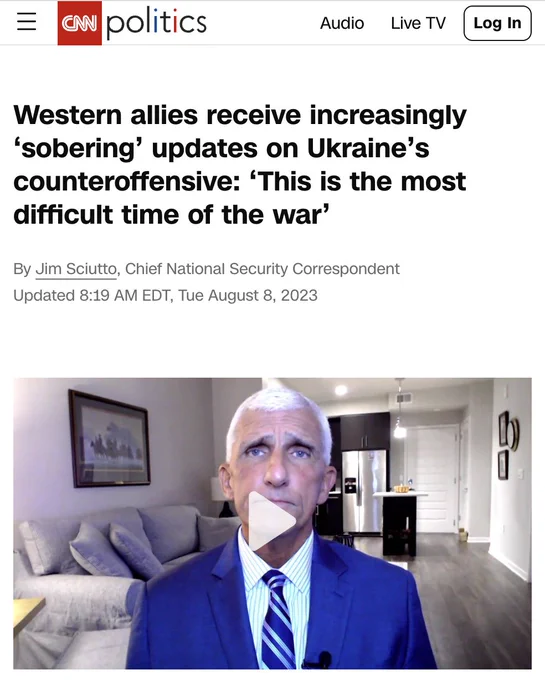
CNN Changes Tune On Ukraine's Counteroffensive: 'Extremely Unlikely' To Succeed

 by Dave DeCamp via AntiWar.com,

A Western official told CNN in an article published Tuesday that it’s "extremely" unlikely that Ukraine will make progress in its counteroffensive in the coming weeks that will alter the balance of the war with Russia.

"They’re still going to see, for the next couple of weeks, if there is a chance of making some progress. But for them to really make progress that would change the balance of this conflict, I think, it’s extremely, highly unlikely," an unnamed senior Western diplomat said.

Rep. Mike Quigley (D-IL) also spoke to CNN about the counteroffensive and said the briefings Congress has received on the assault are "sobering." He said the situation was the "most difficult time of the war."

Leading up to the counteroffensive, the Discord leaks and media reports revealed that the US did not believe Ukraine could regain much territory. 

The Wall Street Journal recently reported that Western officials did not think Ukraine had enough weapons or equipment to dislodge Russian forces. But the Biden administration pushed for the assault anyway, as it rejected the idea of a ceasefire.

Ukraine is struggling to break through multiple layers of Russian defense, most notably vast minefields. The Wall Street Journal quoted a Ukrainian platoon commander in an article published Tuesday who said the Ukrainians are "demining the fields with bodies," demonstrating the massive human cost.

"It’s awful," the platoon commander said. Another Western diplomat told CNN that Ukraine hasn’t even gotten through Russia’s first defensive line."

"Even if they would keep on fighting for the next several weeks, if they haven’t been able to make more breakthroughs throughout these last seven, eight weeks, what is the likelihood that they will suddenly, with more depleted forces, make them? Because the conditions are so hard," the diplomat said.

https://www.zerohedge.com/geopolitical/cnn-changes-tune-ukraines-counteroffensive-extremely-unlikely-succeed