Search This Blog

Wednesday, August 9, 2023

Guardant and Illumina bury the legal hatchet, ink cancer partnership

 What’s a little litigation between friends? After accusing Guardant Health and its founders of absconding with company secrets more than 10 years ago, Illumina has opted to drop its lawsuit in favor of a new commercial partnership deal.

The DNA sequencing giant filed claims in March 2022 saying that Guardant’s co-CEOs, Helmy Eltoukhy and AmirAli Talasaz, originally set up the cancer blood test developer in 2011 while still serving on Illumina’s payroll—and that they took tens of thousands of internal documents with them when they eventually made the jump.

The lawsuit also took issue with the provenance of as many as 35 different Guardant patents, including for detecting tumor mutations among cell-free DNA in the bloodstream—though many of these claims were dismissed (PDF) by a Delaware federal judge in January. 

For the claims that remained, the two companies have now agreed to settle all pending litigation and intellectual property allegations, Guardant announced last week.

In their place, Guardant has signed on to a three-year commitment to purchase Illumina’s DNA sequencing supplies, and the two have agreed to share specimens and blood samples for cancer research.

“This agreement supports getting our transformative technologies to even more patients globally while strengthening our long-standing and valued partnership with Illumina,” Guardant Chief Commercial Officer Chris Freeman said in the statement.

The lawsuit first came down as Illumina was embroiled in the ill-fated acquisition of its former spinout, Grail, one of Guardant’s competitors in cancer blood test development.

Indeed, at the time Guardant had publicly painted the suit as retaliation for its objections to Illumina’s multibillion-dollar deal: The company said that if the DNA sequencing provider were to own its own blood test developer, it could potentially throttle back the research of potential rivals.

Those concerns were ultimately shared by antitrust watchdogs in the U.S. and Europe, who both moved to block the acquisition—despite Illumina moving ahead to close the deal in August 2021 without official regulatory green lights. 

Illumina recently received a record fine from the European Union for jumping the gun, totaling about $476 million. The company has also been ordered to unravel its ownership of Grail by the U.S. Federal Trade Commission. 

Aside from nearly half-a-billion dollars, the failure to acquire Grail also saw the departures of Illumina’s CEO and its board chair, following a proxy battle led by activist investor Carl Icahn.

Board chair John Thompson was voted out of his seat by shareholders in May, to be replaced by one of Icahn’s hand-picked associates, while CEO Francis deSouza stepped down in June after about decade on the job.

https://www.fiercebiotech.com/medtech/guardant-and-illumina-bury-legal-hatchet-ink-cancer-partnership

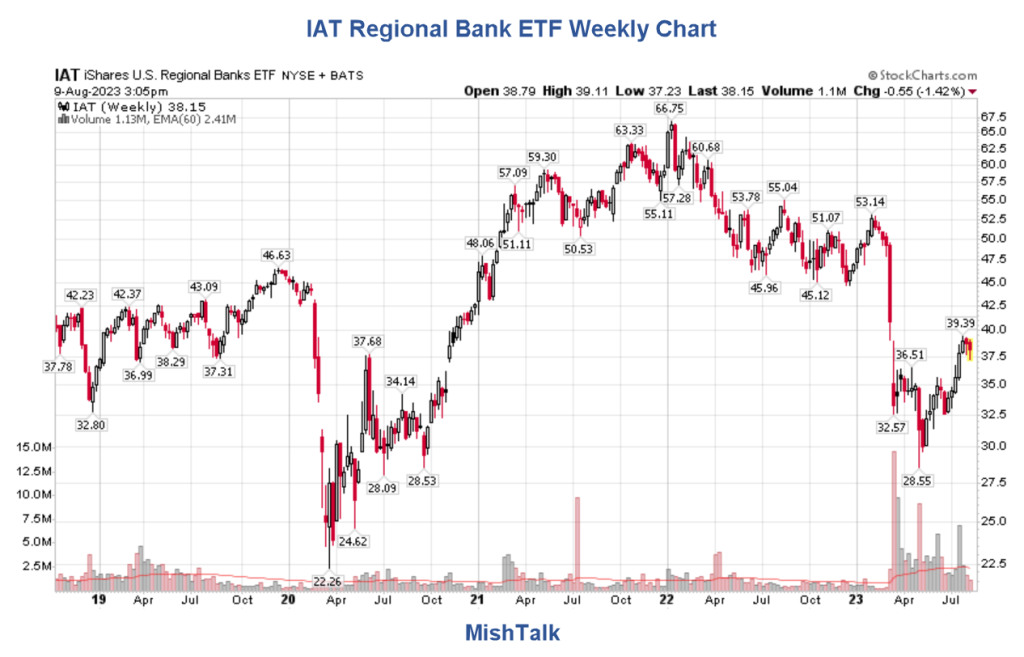
In Case You Too Were Wondering Which Banks Were Cited by Moody's

 Citing Commercial Real Estate (CRE) issues and interest rate risk, Moody’s downgraded 10 banks, with 6 more on review, and 11 with a negative outlook.

IAT chart courtesy of StockCharts.Com

CBS News reports Banks Get a Downgrade from Moody’s.

In its report, Moody’s highlighted that some of the issues that caused the banking crisis earlier this year haven’t disappeared; banks are still at risk for depositors to withdraw their funds, while the current higher-interest rate environment is knocking down the value of investments lenders made when rates were super low.

The rating agency added that asset risks are also rising for small- and mid-sized banks, especially those with large corporate real estate (CRE) holdings. 

“Elevated CRE exposures are a key risk given sustained high interest rates, structural declines in office demand due to remote work, and a reduction in the availability of CRE credit,” it noted.

Smaller banks are especially at risk, given that they have “sizable unrealized economic losses” that could cause investors to lose confidence, it stated in the Monday report.

Ten Downgrades

  • Commerce Bancshares
  • BOK Financial Corporation 
  • M&T Bank Corporation
  • Old National Bancorp 
  • Prosperity Bancshares
  • Amarillo National Bancorp
  • Webster Financial Corporation
  • Fulton Financial Corporation 
  • Pinnacle Financial Partners
  • Associated Banc-Corp 

Six Under Review

  • Bank of New York Mellon Corporation
  • Northern Trust Corporation
  • State Street Corporation
  • Cullen/Frost Bankers
  • Truist Financial Corporation 
  • U.S. Bancorp

Eleven Negative Outlooks

  • PNC Financial Services Group
  • Capital One Financial Corporation
  • Citizens Financial Group
  • Fifth Third Bancorp 
  • Huntington Bancshares 
  • Regions Financial Corporation 
  • Cadence Bank
  • F.N.B. Corporation
  • Simmons First National Corporation
  • Ally Financial 
  • Bank OZK

IAT Regional Bank ETF Monthly Chart

IAT chart courtesy of StockCharts.Com, annotations by Mish

Technically speaking, the chart looks like a disaster in waiting from an Elliott Wave perspective. A 5th wave seems due and possibly just started.

Support is at 22 level, That’s about a 42 percent drop from here.

Fundamentally Speaking

Every bank listed above will be fearful of new loans. They are all hoping to ride out the storm, praying for rate cuts that may be a long time away.

Meanwhile, the collective lot is tightening credit standards.

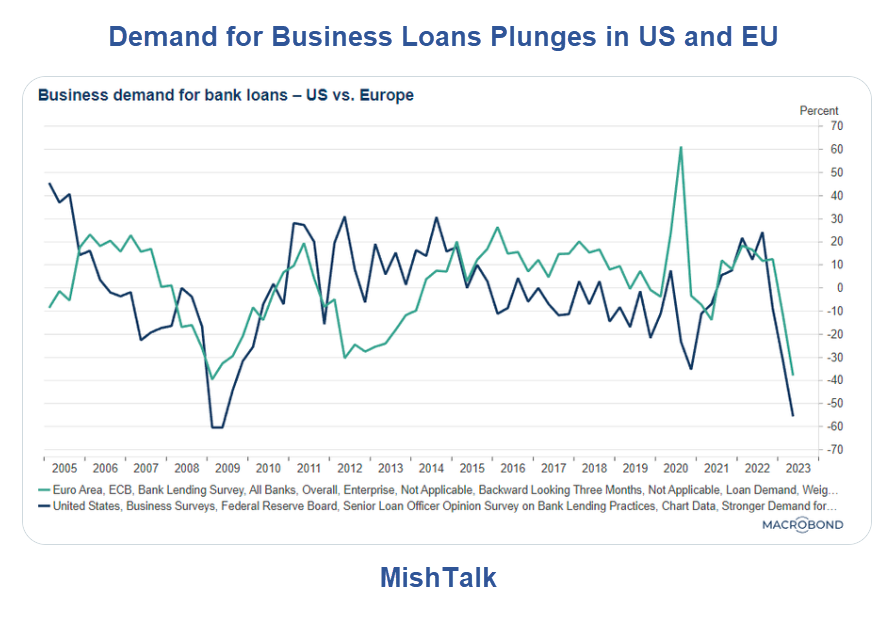
US and EU Corporations Slam the Brakes on Demand for Business Loans

Yesterday, I noted US and EU Corporations Slam the Brakes on Demand for Business Loans

Attitude Change

Q: Why are Companies Slamming the Brakes?
A: Recession risk and profit risk

It’s not just companies who are slamming the brakes. Tighter lending standards across the board shows banks are doing the same.

Large and small banks alike are getting clobbered on rising yields. This led to the collapse of Silicon Valley Bank (SVB).

Banks raise lending standards, the economy slows a bit, corporations get fearful of falling profits so they do not want to expand.

The cycle feeds on itself until something breaks. And it’s breaking now.

The Cycle Feeds On Itself

These downgrades will cause further tightening of lending standards, and not just by the banks cited by Moody’s.

Every bank will now be fearful of a rating downgrade.

Soft Landing?

A crashing demand for loans does not add up to the now widely believed soft landing thesis.

For further discussion, please see China Exports and Imports Collapse, Harbinger of the Global Economy?

https://mishtalk.com/economics/moodys-downgrades-10-small-to-mid-size-banks-6-more-under-review/

Surprise! FBI Lied About 'White Supremacist' Memo Targeting Catholics: New Document

 When the FBI was busted targeting Catholics in a now-retracted leaked document which said Roman Catholics were 'at risk of committing acts of extremist violence,' the agency downplayed it as the work of a 'rogue field office.'

Now, thanks to a less-redacted internal FBI document released Wednesday by the House Judiciary Committee, we learn that the effort was far more widespread than the agency acknowledged.


 Now, Chairman Jim Jordan (R-OH) wants more details.

In February, a whistleblower leaked a heavily redacted January report from the FBI's Richmond office: "Interest of Racially or Ethnically Motivated Violent Extremists in Radical-Traditionalist Catholic Ideology Almost Certainly Presents New Mitigation Opportunities."

The document defined "radical-traditionalist Catholics" as those who attend Latin Mass and, according to the FBI, adhere to "anti-Semitic, anti-immigrant, anti-LGBTQ, and white supremacist ideology," based on what the WSJ editorial board called half-baked "open-source" reporting from liberal news outlets to justify further investigation.

FBI headquarters quickly said the report didn’t meet its “exacting standards” and had been withdrawn. FBI Director Christopher Wray told the Judiciary Committee in July that the report was “a single product by a single field office.” He added that “as soon as I found out about it, I was aghast and ordered it withdrawn and removed from FBI systems,” and he said he began an internal probe.

On July 25 the FBI finally provided the committee with a less-redacted version of that Richmond document. The report says that its information on Catholics was “primarily derived” from an “FBI Richmond contact”; an “FBI Portland liaison contact” who informed on a subject who “gravitated to” traditionalist catholicism; and an “FBI Undercover Employee” who reported on a subject who attended a Catholic church in California. -WSJ

The FBI's Los Angeles field office, meanwhile, "initiated an investigation" into one subject, while the Richmond office "[c]oordinated with" the agency's Portland office to prepare the field report.

In other words - it wasn't just the product of a single field office as Wray had claimed, but was instead a widespread effort among several offices.

What's more, the Journal calls out the FBI's 'troubling decision' to redact the roles of the Los Angeles and Portland offices from the original version of the Richmond document it provided to Congress in March. The agency defended the earlier redactions due to "ongoing criminal investigations."

Yet, as the Journal asks:

What changed from March until July, other than a threat of contempt from the Judiciary Committee? It’s hard not to conclude that the bureau was trying to hide the breadth of its Catholics-as-radicals investigation.

In a Wednesday letter, Jordan asks Wray to amend his July testimony "to fully explain the nature and scope of the FBI’s assessment of traditional Catholics as potential domestic terrorists."

https://www.zerohedge.com/political/surprise-fbi-lied-about-white-supremacist-memo-targeting-catholics-new-document-reveals

Galera Gets CRL for Avasopasem Manganese

 The Company remains committed to its goal of bringing avasopasem to patients and intends to meet with FDA as soon as possible to discuss potential next steps

Galera will take actions to extend its cash runway and continue enrolling its rucosopasem clinical trials

Conference call tomorrow, August 10, 2023 at 8:30 a.m. ET

 Galera Therapeutics, Inc. (Nasdaq: GRTX), a clinical-stage biopharmaceutical company focused on developing and commercializing a pipeline of novel, proprietary therapeutics that have the potential to transform radiotherapy in cancer, today announced that it has received a Complete Response Letter (CRL) from the U.S. Food and Drug Administration (FDA) regarding the Company’s New Drug Application (NDA) for avasopasem manganese (avasopasem) for radiotherapy-induced severe oral mucositis (SOM) in patients with head and neck cancer undergoing standard-of-care treatment.

In the CRL, the FDA communicated that the results from the Phase 3 ROMAN trial together with the supporting data from the GT-201 trial are not sufficiently persuasive to establish substantial evidence of avasopasem’s effectiveness and safety for reducing severe oral mucositis in patients with head and neck cancer. FDA stated that results from an additional clinical trial will be required for resubmission.

The Company intends to request a Type A meeting with the FDA to understand the FDA’s rationale for its decision and discuss next steps to support an NDA resubmission seeking approval of avasopasem. The Company will also explore strategic alternatives, including partnering, for the continued development of avasopasem and rucosopasem.

Restructuring and Financial Update

“As we explore a potential approval path for avasopasem, we are taking decisive actions to extend our cash runway,” continued Dr. Sorensen. “Unfortunately, this necessitates reducing our workforce by approximately 70%. We are grateful for the many contributions our talented team has made over the years and their commitment to avasopasem.”

Galera’s restructuring plan includes a wind-down of commercial readiness efforts and headcount reductions across several departments. The Company will focus resources to define the path forward for avasopasem and to progress the ongoing clinical trials for rucosopasem. Rucosopasem is the Company’s second product candidate in development to augment the anti-cancer efficacy of stereotactic body radiation therapy (SBRT) for patients with non-small cell lung cancer and locally advanced pancreatic cancer.

“We will continue our focus on completing enrollment of our rucosopasem GRECO trials,” continued Dr. Sorensen. “Our GRECO-2 trial is a 220-patient trial in locally advanced pancreatic cancer intended to build upon the positive results observed in our placebo-controlled pilot trial, where we saw meaningful improvements in multiple endpoints including overall survival and tumor outcomes. There is an urgent need for novel therapies to extend survival in patients with pancreatic cancer, and we believe rucosopasem’s unique mechanism of action in combination with SBRT could offer a transformative treatment option.”

Galera estimates that its balance of cash, cash equivalents and marketable securities as of June 30, 2023 was $38.8 million. This figure is preliminary and is subject to completion of the Company’s financial closing procedures. The Company plans to file its Quarterly Report on Form 10-Q for the quarter ended June 30, 2023 on August 14, 2023. The Company now expects that its current cash will be sufficient to support operations into the second quarter of 2024.

The NDA submission for avasopasem included data from a total of 678 patients enrolled in two randomized, double-blind, placebo-controlled trials (Phase 3 ROMAN and Phase 2b GT-201). The FDA granted Fast Track and Breakthrough Therapy designations to avasopasem for the reduction of SOM induced by radiotherapy. The NDA was accepted for priority review, which is granted to applications for therapies that, if approved, would be significant improvements in the safety or effectiveness of the treatment, diagnosis, or prevention of serious conditions compared to available therapies.

Conference Call and Webcast
Galera will host a conference call and live audio webcast tomorrow, August 10, 2023 at 8:30 a.m. ET. The conference call dial-in numbers are (877) 869-3847 (domestic) or +1(201) 689-8261 (international). The live audio webcast of the event will be accessible from the Investors page of Galera’s website, investors.galeratx.com. The webcast replay will be available shortly after conclusion of the event for 90 days.

https://finance.yahoo.com/news/galera-receives-complete-response-letter-203100675.html

Daiichi Sankyo tipped to dominate antibody-drug conjugate market through 2029

 The antibody-drug conjugate (ADC) market is emerging as one of the most competitive areas in pharma, with companies such as AstraZeneca, Gilead and Pfizer investing billions into the space. Amid the vying for commercial position, analysts at GlobalData expect Daiichi Sankyo to dominate the space through 2029.

Japan’s Daiichi has helped to establish ADCs as a major modality after years in which the approach failed to fulfill its potential. Companies, including Pfizer and Roche, obtained approval for ADCs before Daiichi rolled out its first product, the AstraZeneca-partnered Enhertu. However, none of the older treatments had the same impact as Daiichi's breakthrough treatment.

With Enhertu, Daiichi and AstraZeneca have created a new class of breast cancer patients, HER2-low, and have been rewarded with surging sales. Daiichi cited (PDF) demand for its ADC as the driver of the 157% jump in sales at its oncology unit in the first quarter.

Analysts at GlobalData expect Daiichi to remain the dominant force in the ADC space, tipping its sales of the modality to top $10 billion by 2029. The forecast paints Daiichi is the runaway leader in the market, with Seagen and Roche following as distant second and third, respectively. GlobalData predicts that sales of their ADCs will reach $5.8 billion and $3.6 billion, respectively.

Daiichi recently tipped (PDF) its oncology sales to top ¥900 billion ($6.3 billion) in its 2025 financial year. Enhertu is the bedrock of the forecast but Daiichi also expects datopotamab deruxtecan (Dato-DXd) and, to a lesser extent, patritumab deruxtecan (HER3-DXd) to contribute to sales. Dato-DXd is partnered with AstraZeneca but Daiichi has HER3-DXd all to itself and plans to keep it that way. 

Seagen is next on the list. The biotech helped to birth the ADC space, picking up its first approval in 2011, but its days as an independent business may be coming to a close. If competition regulators sign off on the deal, Pfizer will buy Seagen for $43 billion to establish itself as a major player in ADCs. Roche, the manufacturer of the ADCs Kadcyla and Polivy, is third on the GlobalData list.

https://www.fiercepharma.com/marketing/daiichi-sankyo-tipped-dominate-antibody-drug-conjugate-market-through-2029

Novartis Scores Phase III Chronic Hives Wins as Sanofi Challenges

 With Xolair’s patents set to expire over the next year, Novartis has been looking to strengthen its grip on the chronic spontaneous urticaria market. Thursday, the Swiss pharma shared positive Phase III results for chronic hives with its BTK inhibitor and announced plans to submit for regulatory approval next year. 

In two late-stage studies, remibrutinib met the primary endpoint of change from baseline in a weekly urticaria activity score at week 12. While studies will continue for a full year, the BTK inhibitor demonstrated a rapid onset, improving patients’ symptoms in as little as two weeks. 

Patients with chronic spontaneous urticaria (CSU) deal with chronic hives that can last for six weeks or longer. The trigger is internal, as opposed to allergen exposure. While antihistamines are the first line of treatment, around 60% of patients’ symptoms are inadequately controlled with antihistamines alone.  

Oral drug remibrutinib, taken twice daily, successfully reduced the itchy hives and deep tissue swelling on the face, throat, hands and feet.  

“CSU is a distressing and unpredictable disease, and patients urgently need effective, convenient and well-tolerated treatments that can provide rapid and sustained relief from the relentless itching and deep tissue swelling that greatly impact their daily lives,” Novartis CMO Shreeram Aradhye said in a statement. 

Xolair, Novartis’ subcutaneous injection originally approved for asthma, has been one of the go-to treatments on the market for chronic hives since 2014. As the only injectable biologic indicated for the condition, it brought in $716 million in sales during the first half of 2023. 

However, the patent for Xolair is set to expire this month and 2024 in the U.S. and Europe, respectively. Novartis appears to have found its replacement. 

The company will present full data from the trials at an upcoming conference and submit it to global health regulating agencies beginning in 2024. The BTK inhibitor also shows potential across several immune-mediated conditions like hidradenitis suppurativa, Sjögren’s syndrome and food allergies, according to Novartis. Remibrutinib is also in a Phase III trial for multiple sclerosis, with a readout expected in 2026. 

Novartis won’t be without competition in the urticaria market, though. Sanofi announced in March 2023 it was submitting a supplemental BLA for its Dupixent to treat patients aged 12 and up with CSU that isn’t controlled by antihistamines.  

Sanofi’s subcutaneous injection is a monoclonal antibody currently approved for atopic dermatitis, asthma and other diseases with type 2 inflammation. The FDA has set a target action date of October 22, 2023. 

https://www.biospace.com/article/novartis-scores-phase-iii-chronic-hives-wins-as-sanofi-challenges-/

Precigen: Phase 1/2 Study of AdenoVerse Immunotherapy Will Be Pivotal Study to Support Accelerated Approval

 FDA confirmed that the ongoing Phase 1/2 single arm study will serve as pivotal and no additional randomized, placebo-controlled trial will be required to support submission of a BLA 

–   FDA agreed on the required efficacy and safety endpoints that will support filing an accelerated approval BLA for licensure 

–   Enrollment and dosing in the ongoing Phase 2 portion of the study is completed 

–   If approved, PRGN-2012 would potentially be the first therapeutic for the treatment of RRP, a serious and difficult-to-treat orphan indication for which the current standard-of-care is repeated surgeries   

https://finance.yahoo.com/news/precigen-announces-fda-confirmation-ongoing-110500434.html