Search This Blog

Wednesday, August 9, 2023

True Costs of Clinical Trials

 Hi, everyone. It's Dr Kathy Miller from Indiana University. In a few short weeks, we'll gather again in Chicago at the annual American Society of Clinical Oncology (ASCO) meeting. Undoubtedly, we will think about health equity and how we make certain that our advances are available to all the patients in need, both as they become standard of care and during clinical trials. We'll also think about the cost of clinical trials, and it's time for us to bring those together.

We need to think about the ways that participating in clinical trials results in increased out-of-pocket costs to our patients and how that limits the ability of marginalized groups to participate. That should be a problem for us.

There are many subtle and some egregious ways that participating in clinical trials can result in increased costs. We may ask patients to come to the clinic more frequently. That may mean costs for transportation, wear and tear on your car, and gas prices. It may also mean that if you work in a job where you don't have time off, and if you're not at work, you don't get paid. That's a major hit to your take home pay.

We also need to take a close and more honest look at our study budgets and what we consider standard of care. Now, this becomes a slippery slope because there are clear recommendations that we would all agree, but there are also differences of practice and differences of opinion.

How often should patients with advanced disease, who clinically are doing well, have scans to evaluate their disease status and look for subtle evidence of progression? Are laboratory studies part of the follow-up in patients in the adjuvant setting? Did you really need a urinalysis in somebody who's going to be starting chemotherapy? Do you need an EKG if you're going to be giving them a drug that doesn't have potential cardiac toxicity, for which QTc prolongation is not a problem?

Those are often included in our clinical trials. In some cases, they might be paid for by the trial. In other cases, they're billed to the insurance provider, which means they'll contribute to deductibles and copays will apply. It is very likely that they will cost your patient something out of pocket.

Now, this becomes important because many of our consent forms would specifically say that things that are only done for the study are paid for by the study. How we define standard of care becomes vitally important. These issues have not been linked in this way frequently. It is time for us to tackle this problem and think about how we financially support the additional costs of care that can be real barriers for patients to participate in clinical trials.

Clinical trials are how we make progress. The more patients who are able to participate in clinical trials, the better it is for all of us and all our future patients. I hope to see you all at ASCO. I really look forward to your thoughts on this important topic.

Kathy D. Miller, MD, is associate director of clinical research and co-director of the breast cancer program at the Melvin and Bren Simon Cancer Center at Indiana University. Her career has combined both laboratory and clinical research in breast cancer.


https://www.medscape.com/viewarticle/990749

How Groundbreaking ADCs Are Helping More Breast Cancer Patients

 Antibody-drug conjugates (ADCs), a class of potent biopharmaceutical agents that target specific cancer cells, are associated with relevant antitumor activity across breast cancer subtypes. Medscape recently spoke with experts in metastatic breast cancer (MBC) — Avan J. Armaghani, MD; Aditya Bardia, MD, MPH; and Paolo Tarantino, MD — about sequencing ADCs for patients with MBC. Read on for their insights.

What sequencing strategies do you follow at each step of therapy for patients with MBC?

Avan J. Armaghani, MD

Armaghani: Sequencing ADCs in patients with MBC requires consideration of many factors unique to the patient, including the presence or absence of brain metastasis, number of prior lines of therapy received, performance status of the patient and other comorbidities, and dosing schedule of the drug. These factors will determine not only how to sequence ADCs but also which to use. For example, in patients with HR+, HER2-low MBC with overall good performance status, trastuzumab deruxtecan (T-DXd) and sacituzumab govitecan are two therapies that can be considered. In a patient with overall good performance status, I would first recommend T-DXd as the next line of therapy following endocrine therapy per findings from the DESTINY- Breast04 study. Based on the TROPICS-2 study, sacituzumab govitecan can be considered in subsequent line of therapy (endocrine therapy and at least two additional systemic therapies). Trial data show that T-DXd and sacituzumab govitecan are excellent therapy options, ones that are more effective and better tolerated when compared with infusional chemotherapy.

Aditya Bardia, MD, MPH

Bardia: There are multiple ADCs in development to target antigens overexpressed in MBC. The composition of the ADC (ie, antigen selectivity, stability of linker, and type of toxic payload) are important considerations that could impact efficacy-toxicity ratio, therapeutic sequencing, and combination strategies. Determining resistance to antibody vs payload could help with optimal therapeutic sequencing of ADCs for patients with breast cancer. For example, if resistance is driven by the antibody portion, then switching the antibody portion could still have efficacy; for example, sacituzumab govitecan works after T-DXd in HR+/HER2-low MBC.

Paolo Tarantino, MD

Tarantino: There are currently three ADCs approved to treat MBC. Sequencing strategies for patients with MBC are generally dependent on the inclusion criteria from trials demonstrating the benefit of these ADCs and are also based on differences in toxicity profiles and patient preferences.

Patients with HER2 MBC generally receive T-DXd first, based on findings from the DESTINY-Breast03 trial showing significant overall survival improvement with T-DXd compared with trastuzumab emtansine (T-DM1). T-DM1 is often utilized at progression, although other options are sometimes preferred due to concerns with cross-resistance among anti-HER2 ADCs administered in immediate sequence.

In order to use T-DXd, HER2-low expression needs to be detected on the tumor cells. Approximately 70% of all HR+/HER2-negative tumors have HER2-low expression (most cases). T-DXd is generally utilized as a second-line chemotherapy after exhausting endocrine treatment options and one line of chemotherapy per findings from DESTINY-Breast04. Although sacituzumab govitecan is generally considered in the third- or fourth-line setting given that it was tested among more pretreated patients in the TROPiCS-02 trial, it may be considered earlier for patients with HER2-0 tumors, who are not eligible for T-DXd.

In patients with triple-negative breast cancer (TNBC) with HER2-low expression, studies (DESTINY-Breast04 and ASCENT) showed that T-DXd and sacituzumab govitecan outperformed conventional chemotherapy among patients with relapsed or refractory MBC ["outperformed" meaning that T-DXd and sacituzumab govitecan significantly increased progression-free survival and overall survival]. The decision of which of these ADCs to use as second-line treatment generally relies on an informed discussion with the patient, one that balances the activity and toxicity of each drug and considers key differences between their respective clinical trials. Sacituzumab govitecan, however, is currently the only ADC option for patients with HER2-0 TNBC.

How do you recognize and manage ADC toxicities?

Armaghani: The development of this therapeutic class of medications presents a new challenge in recognizing and managing associated toxicities. It is important that clinicians be well informed of the commonly reported adverse events (AEs) and the symptoms of ADC therapy, and understand the severity or grade of the AE to determine the appropriate action plan — eg, reduce dose, hold or discontinue the medication, and prescribe treatments to manage the side effects and symptoms. For example, interstitial lung disease (ILD)/pneumonitis, which can be life-threatening, is a well-known adverse reaction that can occur with T-DXd. Since early intervention is key, it is therefore imperative to closely monitor and educate patients on signs and symptoms of ILD such as new-onset shortness of breath, cough, etc., to ensure proper treatment and recovery for patients.

Bardia: Each ADC has different toxicities. The toxic payload is the major determinant of toxicity, though internalization efficiency, bystander effect, and payload metabolism are all important consideration that could impact toxicities associated with ADC. Toxicities associated with T-DXd include nausea, myelosuppression, and pneumonitis, while common AEs with sacituzumab govitecan include neutropenia, nausea, and diarrhea. Early recognition and management of toxicities are critical, particularly for serious AEs such as pneumonitis. ADC toxicity can usually be managed with supportive treatment and dose reductions.

Tarantino: The most common toxicities associated with ADCs correlate with their cytotoxic payload; thus, management does not differ substantially from conventional chemotherapies. Nonetheless, some important differences exist among the toxicity profiles of ADCs.

For instance, T-DXd is associated with a relatively high incidence of nausea. The establishment of guidelines on the prophylactic use of antiemetics has decreased the severity of this side effect. In addition to nausea, about 10%-15% of patients receiving T-DXd are expected to develop ILD, a potentially serious condition that requires prompt recognition, drug discontinuation, and corticosteroid treatment. Thanks to improvements in the detection and management of ILD, the mortality rate from ILD has dropped from 2.7% (as observed in the early DESTINY-Breast01 trial) to 0% (as observed in the DESTINY-Breast03 trial).

Sacituzumab govitecan can be associated with severe neutropenia and diarrhea, respectively requiring treatment with growth factors (granulocyte colony-stimulating factors and granulocyte-macrophage colony-stimulating factors) and antidiarrheal agents. Alopecia is more common with sacituzumab govitecan than with other ADCs. At Dana-Farber Cancer Institute, we are leading a study looking at the potential benefit of scalp cooling to prevent alopecia caused by sacituzumab govitecan and T-DXd, and hope to report the first results soon.

T-DM1 is more commonly associated with thrombocytopenia and elevated liver enzymes but is generally well tolerated.

Disclosures:

Avan J. Armaghani, MD

Assistant Member, Department of Breast Oncology, Moffitt Cancer Center, University of South Florida, Tampa, Florida

Avan J. Armaghani, MD, has disclosed no relevant financial relationships.

Aditya Bardia, MD, MPH

Director, Breast Cancer Research; Associate Professor, Harvard Medical School; Attending Physician, Massachusetts General Hospital, Boston, Massachusetts

Aditya Bardia, MD, MPH, has disclosed the following relevant financial relationships:
Serves in a consultant/advisory board role for: Pfizer; Novartis; Genentech; Merck; Radius Health; Immunomedics/Gilead; Sanofi; Daiichi Pharma/Astra Zeneca; Phillips; Eli Lilly; Foundation Medicine
Received contracted research/grant (to institution) from: Genentech; Novartis; Pfizer; Merck; Sanofi; Radius Health; Immunomedics/Gilead; Daiichi Pharma/Astra Zeneca; Eli Lilly

Paolo Tarantino, MD, PhD candidate

Advanced Research Fellow, Dana-Farber Cancer Institute and Harvard Medical School, Boston, Massachusetts

Paolo Tarantino, MD, has disclosed the following relevant financial relationships:
Serves in an advisory/consultant role for: AstraZeneca; Daiichi Sankyo; Gilead; Eli Lilly

https://www.medscape.com/viewarticle/995201

A New and Completely Different Pain Medicine

 Welcome to Impact Factor, your weekly dose of commentary on a new medical study. I'm Dr F. Perry Wilson of the Yale School of Medicine.

When you stub your toe or get a paper cut on your finger, you feel the pain in that part of your body. It feels like the pain is coming from that place. But, of course, that's not really what is happening. Pain doesn't really happen in your toe or your finger. It happens in your brain.

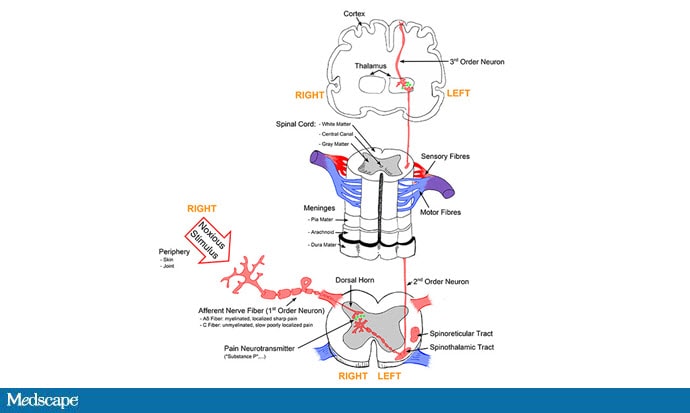
It's a game of telephone, really. The afferent nerve fiber detects the noxious stimulus, passing that signal to the second-order neuron in the dorsal root ganglia of the spinal cord, which runs it up to the thalamus to be passed to the third-order neuron which brings it to the cortex for localization and conscious perception. It's not even a very good game of telephone. It takes about 100 ms for a pain signal to get from the hand to the brain — longer from the feet, given the greater distance. You see your foot hit the corner of the coffee table and have just enough time to think Oh no! before the pain hits.

Given the Rube Goldberg nature of the process, it would seem like there are any number of places we could stop pain sensation. And sure, local anesthetics at the site of injury, or even spinal anesthetics, are powerful — if temporary and hard-to-administer — solutions to acute pain.

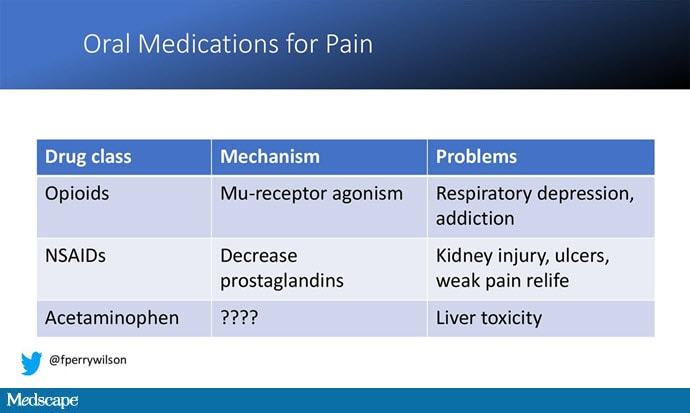
But in our everyday armamentarium, let's be honest — we essentially have three options: (1) opiates and opioids, which activate the mu-receptors in the brain to dull pain (and cause a host of other nasty side effects); (2) NSAIDs, which block prostaglandin synthesis and thus limit the ability for pain-conducting neurons to get excited; and (3) acetaminophen, which, despite being used for a century, is poorly understood.

But this week, we enter the prologue of what might be the next big story in pain control. Let's talk about VX-548.

If you were to zoom in on the connection between that first afferent pain fiber and the secondary nerve in the spinal cord dorsal root ganglion, you would see a receptor called Nav1.8, a voltage-gated sodium channel.

This receptor is a key part of the apparatus that passes information from nerve 1 to nerve 2, but only for fibers that transmit pain signals. In fact, humans with mutations in this receptor that leave it always in the "open" state have a severe pain syndrome. Blocking the receptor, therefore, might reduce pain.

In preclinical work, researchers identified VX-548, which doesn't have a brand name yet, as a potent blocker of that channel even in nanomolar concentrations. Importantly, the compound was highly selective for that particular channel — about 30,000 times more selective than it was for the other sodium channels in that family.

Of course, a highly selective and specific drug does not a blockbuster analgesic make. To determine how this drug would work on humans in pain, they turned to two populations: 303 individuals undergoing abdominoplasty and 274 undergoing bunionectomy, as reported in a new paper in The New England Journal of Medicine.

I know this seems a bit random, but abdominoplasty is quite painful and a good model for soft-tissue pain. Bunionectomy is also quite a painful procedure and a useful model of bone pain. After the surgeries, patients were randomized to several different doses of VX-548, hydrocodone plus acetaminophen, or placebo for 48 hours.

At 19 time points over that 48-hour period, participants were asked to rate their pain on a scale from 0 to 10. The primary outcome was the cumulative pain experienced over the 48 hours. So, higher pain would be worse here, but longer duration of pain would also be worse.

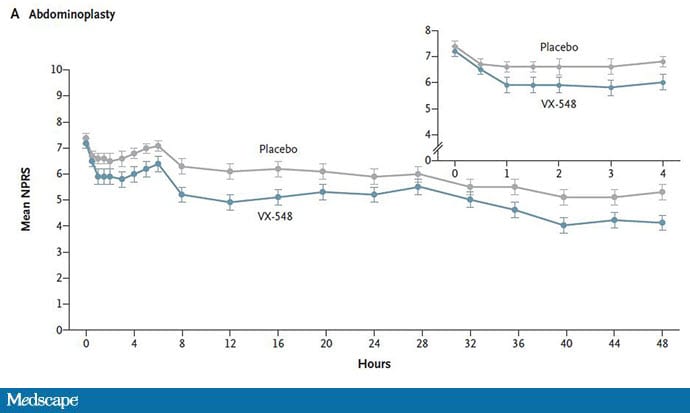
The story of the study is really told in this chart.

Yes, those assigned to the highest dose of VX-548 had a statistically significant lower cumulative amount of pain in the 48 hours after surgery. But the picture is really worth more than the stats here. You can see that the onset of pain relief was fairly quick, and that pain relief was sustained over time. You can also see that this is not a miracle drug. Pain scores were a bit better 48 hours out, but only by about a point and a half.

Placebo isn't really the fair comparison here; few of us treat our post-abdominoplasty patients with placebo, after all. The authors do not formally compare the effect of VX-548 to that of the opioid hydrocodone, for instance. But that doesn't stop us.

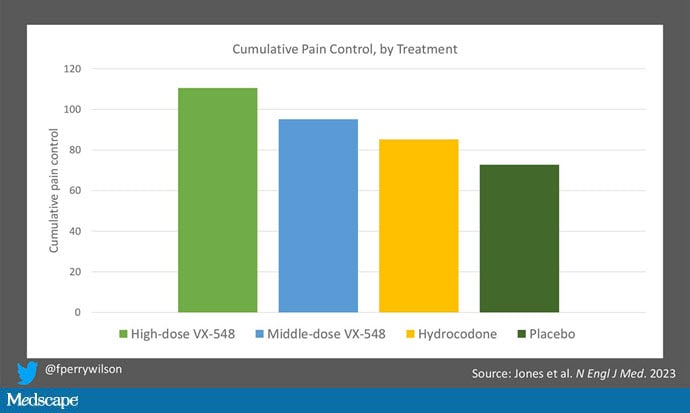
This graph, which I put together from data in the paper, shows pain control across the four randomization categories, with higher numbers indicating more (cumulative) control. While all the active agents do a bit better than placebo, VX-548 at the higher dose appears to do the best. But I should note that 5 mg of hydrocodone may not be an adequate dose for most people.

Yes, I would really have killed for an NSAID arm in this trial. Its absence, given that NSAIDs are a staple of postoperative care, is… well, let's just say, notable.

Although not a pain-destroying machine, VX-548 has some other things to recommend it. The receptor is really not found in the brain at all, which suggests that the drug should not carry much risk for dependency, though that has not been formally studied.

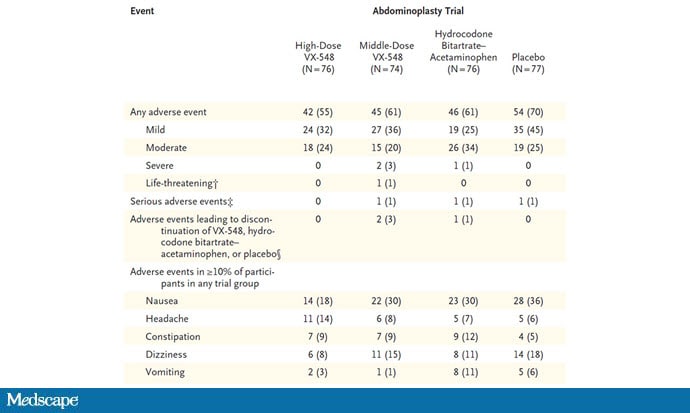
The side effects were generally mild — headache was the most common — and less prevalent than what you see even in the placebo arm.

Perhaps most notable is the fact that the rate of discontinuation of the study drug was lowest in the VX-548 arm. Patients could stop taking the pill they were assigned for any reason, ranging from perceived lack of efficacy to side effects. A low discontinuation rate indicates to me a sort of "voting with your feet" that suggests this might be a well-tolerated and reasonably effective drug.

VX-548 isn't on the market yet; phase 3 trials are ongoing. But whether it is this particular drug or another in this class, I'm happy to see researchers trying to find new ways to target that most primeval form of suffering: pain.

F. Perry Wilson, MD, MSCE, is an associate professor of medicine and public health and director of Yale's Clinical and Translational Research Accelerator. His science communication work can be found in the Huffington Post, on NPR, and here on Medscape. He tweets @fperrywilson and his new book, How Medicine Works and When It Doesn'tis available now.

https://www.medscape.com/viewarticle/994975

Isometric Exercise Optimal for Lowering Blood Pressure?

 Isometric exercise training emerged as the most effective mode to reduce blood pressure in a systematic review and meta-analysis of 270 randomized trials with close to 16,000 participants.

The findings support the development of new exercise guidelines for blood pressure control, the authors say.

Previous research, based on older data that excluded high-intensity interval training (HIIT) and isometric exercise training (IET), led to aerobic exercise training (AET) being recommended for managing blood pressure, according to the authors.

Although AET, HIIT, dynamic resistance training (RT) and combined training (CT) are also effective in reducing both systolic (SBP) and diastolic blood pressure (DBP), the new analysis suggests that IET does it best.

The analysis showed reductions in blood pressure of 8.24/4 mm Hg after IET, compared with 4.49/2.53 mm Hg after AET; 4.55/3.04 mm Hg after RT; 6.04/2.54 mm Hg after CT; and 4.08/2.50 mm Hg after HIIT.

"These findings mirror our smaller-scale trials, and therefore we anticipated that isometrics would be largely effective," Jamie O'Driscoll, PhD, of Canterbury Christ Church University, Kent, UK told theheart.org | Medscape Cardiology. However, "the magnitude of difference between isometrics and some other modes was surprising."

The study was published online July 25 in the British Journal of Sports Medicine.

All Modes Effective

The investigators analyzed data from 270 randomized controlled trials including 15,827 people published between 1990 and February of this year. For consistency, the protocol/intensity of each included paper was screened against the Exercise Prescription in Everyday Practice and Rehabilitative Training tool to be defined and categorized.

All protocols were then stratified as AET, RT, CT, HIIT or IET.

As appropriate, protocols were then further stratified into subgroups: AET included walking, running, and cycling; HIIT included sprint interval training and aerobic interval training; and IET included isometric leg extension and isometric wall squat.

Healthy resting blood pressure was defined as a reading below 130/85 mm Hg, pre-hypertension as 130–139/85–89 mm Hg, and hypertension as 140/90 mm Hg or higher.

All exercise modes led to statistically significant reductions in SBP in normal blood pressure cohorts; however, all reductions were substantially larger in individuals with hypertension.

Pairwise analyses showed significant reductions in resting SBP and DBP following AET (−4.49/–2.53 mm Hg); RT (–4.55/–3.04 mm Hg), CT (–6.04/–2.54 mm Hg), HIT (–4.08/–2.50 mm Hg); and IET (–8.24/–4.00 mm Hg).

In the network meta-analysis, the rank order of effectiveness for SBP based on surface under the cumulative ranking curve (SUCRA) values were IET (SUCRA: 98.3%), CT (75.7%), RT (46.1%), AET (40.5%), and HIIT (39.4%).

Secondary network meta-analyses showed that isometric wall squat was the most effective submode for reducing SBP (90.4%), followed by isometric leg extension, isometric handgrip, cycling, running, CT, sprint interval training, other aerobic, RT, aerobic interval training, and walking.

Running was the most effective submode for lowering DBP (91.3%), followed by isometric wall squat, isometric handgrip, isometric leg extension, cycling, sprint interval training, RT, AIT, other aerobic, CT, and walking.

The authors acknowledge limitations, including variability in exercise interventions, missing data, variable quality of exercise monitoring and analyses, lack of blinding to group allocation, varying participant populations, and publication bias.

Nevertheless, they conclude, "The results of this analysis should inform future exercise guideline recommendations for the prevention and treatment of arterial hypertension."

Guideline-Changing?

"There are numerous organizations involved in providing and communicating population exercise guidelines," including WHO, American and European exercise guidelines, and NICE, O'Driscoll said. "We are currently developing an international collaborative project with other world leaders in the area to develop this line of enquiry."

In addition, the team is exploring the prescription of IET within England's National Health Service and extending the study to wider clinical populations.

Commenting on the study for theheart.org | Medscape Cardiology, John A. Osborne, MD, PhD, founder and director of State of the Heart Cardiology in Southlake, Texas, said, "This study further lends credence that other forms of exercise, beyond the usually recommended aerobic exercise promulgated in prior guidelines, have significant value for blood pressure lowering, and, potentially, may offer even greater benefits for…controlling hypertension."

"This study should inform contemporary nonpharmacological approaches to blood pressure management and allows providers more flexibility in different strategies of exercise to combat high blood pressure," said Osborne, a volunteer spokesperson for the American Heart Association.  

That said, he added, "While this study by itself is extremely provocative, thoughtful, and rigorously performed, it should be used as hypothesis-generating and hopefully [will be followed by] head-to-head studies of aerobic exercise vs resistance training to confirm the findings."

The study received no funding. O'Driscoll and Osborne report no relevant financial relationships.

Br J Sports Med.  Published online July 25, 2023. Abstract

https://www.medscape.com/viewarticle/995324

'Triple G' Agonist Hits New Weight-Loss Heights

 A novel triple agonist to receptors for three nutrient-stimulated hormones led to weight loss as high as 24% among people with overweight or obesity but who did not have type 2 diabetes when used at the highest tested dose for 48 weeks. The results are from a phase 2 study of retatrutide that was published in The New England Journal of Medicine on August 9.

This level of weight loss is "unprecedented" for a medication administered for 48 weeks, commented Mary-Elizabeth Patti, MD in an editorial that accompanied the report.

The findings "offer further optimism...that effective pharmacologic management of obesity and related disorders is possible," writes Patti, a principal investigator at the Joslin Diabetes Center in Boston.

The study randomly assigned 338 adults with obesity or overweight ― a body mass index (BMI) of ≥27 kg/m2 ― and at least one weight-related complication to receive either weekly subcutaneous injections of retatrutide in any of six dose regimens or placebo over 48 weeks. The primary outcome was weight change from baseline after 24 weeks.

The highest dose of retatrutide safely produced an average 17.5% drop from baseline weight, compared with an average 1.6% reduction in the placebo group, after 24 weeks, a significant difference.

After 48 weeks, the highest retatrutide dose safely cut baseline weight by an average of 24.2%, compared with an average 2.1% drop among placebo control patients, Ania M. Jastreboff, MD, PhD, and her co-authors say in their report. Weight loss levels after 24 and 48 weeks of retatrutide treatment followed a clear dose-response pattern.

Weight Losses Never Before Seen

"I have never seen weight loss at this level" after nearly 1 year of treatment, said Jastreboff when she discussed these findings in a press conference at the American Diabetes Association (ADA) 83rd Scientific Sessions in San Diego in late June.

A separate presentation at the ADA meeting documented unprecedented weight loss levels in a study of 281 people with obesity or overweight and type 2 diabetes.

"No other medication has shown an average 17% reduction from baseline bodyweight after 36 weeks in people with type 2 diabetes," said Julio Rosenstock, MD, director of the Dallas Diabetes Research Center at Medical City, Texas, who formally presented the results from the study of retatrutide in people with type 2 diabetes at ADA.

The mechanism behind retatrutide's potent weight-loss effect seems likely tied to its action on three human receptors that naturally respond to three nutrient-stimulated hormones that control appetite, metabolism, fat mobilization, and related functions.

The three hormones that the retatrutide molecule simultaneously mimics are glucagon-like peptide-1 (GLP-1), such as agents in the class of GLP-1 agonists that includes liraglutide (Victoza/Saxenda) and semaglutide (Ozempic/Wegovy); the glucose-dependent insulinotropic polypeptide (GIP), the receptor that is also activated by tirzepatide (Mounjaro), a dual-incretin receptor agonist that mimics both GLP-1 and GIP; and glucagon. Survodutide is a dual GLP-1 and glucagon receptor agonist in phase 2 development.

Retatrutide is currently unique among agents with reported clinical results by having agonist effects on the receptors for all three of these hormones, a property that led Patti to call retatrutide a "triple G" hormone-receptor agonist in her editorial.

Triple Agonist Has Added Effect on Liver Fat Clearance

The glucagon-receptor agonism appears to give retatrutide added effects beyond those of the GLP-1 agonists or GLP-1/GIP dual agonist that are increasingly used in US practice.

A prespecified subgroup analysis of the no diabetes/Jastreboff study (but that was not included in the NEJM report) showed that at both 8-mg and 12-mg weekly doses, 24 weeks of retatrutide produced complete resolution of excess liver fat (hepatic steatosis) in about 80% of the people eligible for the analysis (those whose liver volume was at least 10% fat at study entry).

That percentage increased to about 90% of people receiving these doses after 48 weeks, Lee M. Kaplan, MD, reported during a separate presentation at the ADA meeting.

"When you add glucagon activity, liver-fat clearance goes up tremendously," observed Kaplan, who is director of the Obesity, Metabolism and Nutrition Institute at Massachusetts General Hospital in Boston.

The average age of the participants in the new study of the use of retatrutide for those with obesity/overweight but not diabetes was 48 years. By design, 52% were men. (The study sought to enroll roughly equal numbers of men and women.) Average BMI at study entry was 37 kg/m2.

Treatment with retatrutide was also significantly associated with improvements in several cardiometabolic measures in exploratory analyses, including systolic and diastolic blood pressure, A1c, fasting glucose, insulin, and some (but not all) lipids, reported Jastreboff, director of the Yale Obesity Research Center of Yale University in New Haven, Connecticut, and her co-authors in the NEJM article.

The safety profile of retatrutide was consistent with reported phase 1 findings for the agent among people with type 2 diabetes and resembled the safety profiles of other agents based on GLP-1 or GIP–GLP-1 mimicry for the treatment of type 2 diabetes or obesity.

The most frequently reported adverse events from retatrutide were transient, mostly mild to moderate gastrointestinal events. They occurred primarily during dose escalation. Discontinuation of retatrutide or placebo because of adverse events occurred in 6% to 16% of the participants who received retatrutide and in none of the participants who received placebo.

Lilly, the company developing retatrutide, previously announced the launch of four phase 3 trials to gather further data on retatrutide for use in a marketing-approval application to the US Food and Drug Administration.

The four trials ― TRIUMPH-1TRIUMPH-2TRIUMPH-3, and TRIUMPH-4 ― are evaluating the safety and efficacy of retatrutide for chronic weight management for those with obesity or overweight, including those who also have obstructive sleep apnea, knee osteoarthritis, type 2 diabetes, or cardiovascular disease.

The study was sponsored by Lilly, the company developing retatrutide. Patti has been a consultant to AstraZeneca, Dexcom, Hamni, and MBX. She has received funding from Dexcom and has been a monitor for a trial funded by Fractyl. Jastreboff, Kaplan, and Rosenstock have reported financial relationships with Lilly as well as other companies.

New Engl J Med. Published online August 8, 2023.

https://www.medscape.com/viewarticle/995316

AHA/ACC Issue Updated Chronic Coronary Disease Guidelines

 The latest clinical practice guideline for managing patients with chronic coronary disease (CCD) takes an evidence-based and patient-centered approach to care and includes key updates on revascularization, beta-blocker use, and routine functional and anatomic testing.

Developed by the American Heart Association (AHA), the American College of Cardiology (ACC), and other specialty societies, the 2023 guideline both updates and consolidates ACC/AHA guidelines previously published in 2012 and 2014 for the management of patients with stable ischemic heart disease.

It was published online July 20 in  Circulation and the Journal of the American College of Cardiology.

Among the key recommendations:

  • Long-term beta-blocker therapy is no longer recommended for improving outcomes for patients with CCD in the absence of myocardial infarction (MI) within the past year, left ventricular ejection fraction (LVEF) ≤50%, or another primary indication for beta-blocker therapy. Either a calcium channel blocker or a beta-blocker is recommended as first-line antianginal therapy.

  • Sodium glucose cotransporter 2 (SGLT2) inhibitors and glucagon-like peptide-1 (GLP-1) receptor agonists are recommended for select groups of patients with CCD, including individuals without diabetes, to improve outcomes.

  • Statins remain first-line therapy for lipid lowering for patients with CCD. Several adjunctive therapies, such as ezetimibe, proprotein convertase subtilisin/kexin type 9 (PCSK9) inhibitors, inclisiran, or bempedoic acid, may be used in select populations, although clinical outcomes data are not yet available for novel agents such as inclisiran and bempedoic acid.

  • Shorter durations of dual antiplatelet therapy are safe and effective in many circumstances, particularly when the risk of bleeding is high and the ischemic risk is not high.

  • The use of nonprescription or dietary supplements, including fish oil and omega-3 fatty acids or vitamins, is not recommended for patients with CCD, given the lack of benefit in reducing cardiovascular events.

  • Revascularization is recommended in two scenarios: (1) for patients with lifestyle-limiting angina despite guideline-directed medical therapy and with coronary stenoses amenable to revascularization, with the goal of improving symptoms; and (2) for patients with significant left main disease or multivessel disease with severe LV dysfunction (LVEF ≤35%), for whom coronary artery bypass grafting plus medical therapy is recommended over medical therapy alone, with the goal of improving survival.

  • Routine periodic anatomic or ischemic testing in the absence of a change in clinical or functional status is not recommended for risk stratification or to guide therapeutic decision-making for patients with CCD.

  • Nondrug therapies, including healthy dietary habits and exercise, are recommended for all patients with CCD. When possible, patients should participate in regular physical activity, including activities to reduce sitting time and to increase aerobic and resistance exercise.

  • Cardiac rehabilitation for eligible patients provides significant cardiovascular benefits, including decreased morbidity and mortality.

  • Electronic cigarettes increase the odds of successful smoking cessation, but they are not recommended as first-line therapy, owing to the lack of long-term safety data and risks associated with sustained use.

Living Document

The co-authors of a related editorial note that "CCD as defined in the 2023 guideline includes patients who may or may not have classic signs and symptoms of CAD.

"The 2023 guideline reflects this heterogeneity by including patients stabilized after acute coronary syndrome hospitalization, those with ischemic cardiomyopathy, stable angina or equivalent with or without a positive imaging test, vasospasm or microvascular disease, and positive noninvasive screening test leading to a clinician diagnosis of CAD," write Sunil V. Rao, MD, with NYU Langone Health System, and co-authors.

"The focus of the guideline is on extending life and improving quality of life for CCD patients, taking into account patient priorities, and the importance of equitable care. There is emphasis on shared decision making that involves the patient's preferences and values when considering treatment options," they point out.

"Importantly, the guidelines exist to provide guidance, and are meant to complement, not supplant, clinical judgment. As the evidence for the management of CCD continues to evolve, the guidelines will need to be a 'living document' to ensure that clinicians and patients can achieve their shared therapeutic goals of reducing mortality and improving quality of life," they add.

The 2023 guideline on management of patients with CCD was developed in collaboration with and was endorsed by the American College of Clinical Pharmacy, the American Society for Preventive Cardiology, the National Lipid Association, and the Preventive Cardiovascular Nurses Association. It has been endorsed by the Society for Cardiovascular Angiography and Interventions.

The research had no commercial funding. Disclosures for the writing group are available with the original articles.

Circulation. Published online July 20, 2023. AbstractEditorial

J Am Coll Cardiol. Published online July 20, 2023. Abstract

https://www.medscape.com/viewarticle/995320

Illumina stock falls, as 'cautious consumer backdrop' tempers outlook

 Shares of Illumina Inc. slid 6.6% after hours on Wednesday after the DNA-sequencing company tempered its full-year sales outlook, amid a cautious consumer backdrop and a wobbly economic recovery in China. The company, whose equipment helps with genome analysis, said it expected full-year sales growth of around 1%. That was down from an outlook of 7% to 10% given in April. "Despite additional placements, we expect our second-half revenue to be negatively impacted by customers remaining more cautious in their purchasing, a more protracted recovery in China, and a larger-than-expected temporary decline in high throughput consumables as customers transition to the NovaSeq X," the company said, referring to one of its sequencers. "In response, we are increasing customer support for the NovaSeq X and continue to manage our expense base in a disciplined way." For the second quarter, the company reported a net loss of $234 million, or $1.48 a share, which was narrower than the $535 million loss, or $3.40 a share, reported in the same quarter last year. Revenue crept higher, to $1.18 billion, compared with $1.16 billion in the prior-year quarter. Adjusted for costs related to sales, R&D and general and administrative expenses, Illumina earned 32 cents a share. Analysts polled by FactSet expected adjusted earnings per share of 2 cents, on revenue of $1.16 billion. The company also announced the departure of Chief Medical Officer Phil Febbo. And it said Steven Barnard will be its next Chief Technology Officer, as Alex Aravanis departs.

https://www.morningstar.com/news/marketwatch/20230809866/illumina-stock-falls-as-cautious-consumer-backdrop-tempers-outlook