China has been hit by devastating floods in recent weeks, inundating cities and causing deaths and infrastructural damage, as well as raising questions about the effectiveness of its 2015 "sponge city" initiative aimed at reducing urban flood risks.
The initiative was launched to boost flood resilience in major cities and make better use of rainwater through architectural, engineering and infrastructural tweaks.
But cities remain vulnerable to heavy rain. In July alone, floods and related geological disasters caused 142 deaths and disappearances, destroyed 2,300 homes and caused direct economic losses of 15.78 billion yuan ($2.19 billion), China's emergency ministry said on Monday.
Following is an explainer about the sponge city scheme.
WHY WAS THE INITIATIVE LAUNCHED?
China has long sought to improve the way it handles extreme weather, and make highly populated cities less vulnerable to flooding and drought.
The "sponge city" initiative was designed to make greater use of lower-impact "nature-based solutions" to better distribute water and improve drainage and storage.
Those solutions included the use of permeable asphalt, the construction of new canals and ponds and also the restoration of wetlands, which would not only ease waterlogging, but also improve the urban environment.
Breakneck urbanisation has encased vast stretches of land in impermeable concrete, often along banks of major rivers that traditionally served as flood plains. With wetlands paved over and nowhere for surplus water to settle, waterlogging and flooding was commonplace.
According to 2018 data, 641 out of 654 large- and medium-sized cities in China were vulnerable to flooding and waterlogging, with 180 facing flood risks every year.
WHAT HAS BEEN DONE SO FAR?
Studies show that many of the local pilot initiatives launched so far have had a positive effect, with low-impact projects like green roofs and rain gardens reducing run-offs.
But implementation has so far been patchy. A total of 30 pilot sponge cities were selected in 2015 and 2016. By last year, only 64 of China's 654 cities had produced legislation to implement sponge city guidelines, researchers said in January.
The researchers said the government had so far paid "minimum attention" to sponge city construction, and called for national legislation to be drawn up as soon as possible.
WHAT ARE THE LIMITATIONS OF SPONGE CITIES?
Even if sponge city measures had been implemented in full, they would have been unable to prevent this year's disasters.
Zhengzhou in Henan province was one of the most enthusiastic pioneers of sponge city construction, allocating nearly 60 billion yuan to the programme from 2016 to 2021. But it was unable to deal with its heaviest rainfall in history in 2021.
Experts believe sponge city infrastructure can only handle no more than 200 millimetres (7.9 inches) of rain per day. At the height of the rainstorms that lashed Beijing at the end of July, rainfall at one station reached 745 millimetres over three and a half days. In July 2021, Zhengzhou saw rainfall in excess of 200 mm in just one hour.
Authorities are also playing catch-up to climate change. This year's heavy rain hit cities in the normally arid north, where sponge city development is less advanced.
The first of four supporters of President Donald Trump to die on Jan. 6, 2021, received emergency medical care away from the fast-growing crowd on the U.S. Capitol’s west plaza—before any explosive munitions were used by police—new security video reveals.
Capitol Police closed-circuit-television (CCTV) footage obtained by The Epoch Times calls into question the popular narrative that Benjamin James Philips was struck by a police munition before he collapsed from a fatal cardiac event.
Mr. Philips, 50, of Bloomsburg, Pennsylvania, had organized a busload of area residents to travel to Washington for Mr. Trump’s speech at the Ellipse. He followed the bus in a van.
He got separated from the group when he drove away to search for parking. He got as far as the U.S. Capitol that day but never made it back home.
It has long been contended that Mr. Philips’s death was related to police riot munitions. A popular version of the story is that he was in the thick of the quickly expanding crowd on the west plaza beneath the inauguration stage when he was struck by an explosive munition tossed or shot by police.
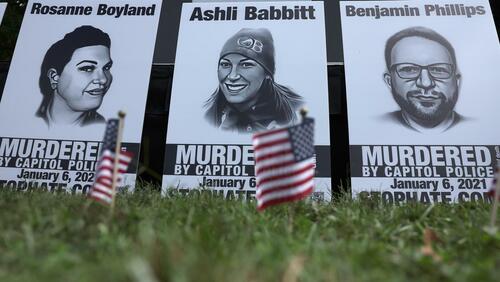
A large sign with an artist's sketch of Mr. Philips is often seen at Jan. 6 events contending that he was “murdered by Capitol Police.”
However, the previously unreleased CCTV video, which was obtained by The Epoch Times from a Capitol Police database, shows that an unconscious Mr. Philips was tended to by protesters behind the large scaffolding complex on the west side, away from the main crowd.
A west dome security camera shows the small area where Mr. Philips later collapsed was breached by the crowd at 12:58:52, shortly after a much larger crowd breached the iron fence protecting the west plaza. Several bike-rack barricades were pushed over as the crowd surged forward.
The camera isn't zoomed in, so distinguishing details is difficult, but the video appears to show someone stumbling and falling at 12:59:17 in the spot where Mr. Philips was later seen. Bystanders began to gather around the downed individual.
The zoomed-in video of Mr. Philips’s rescue attempt begins at 1:02:51 p.m. That's the time that the U.S. Capitol Police Command Center trained one of its security cameras on the area where he fell. While the closeup video doesn't show the moment Mr. Philips collapsed, it picks up shortly after bystanders rendered medical aid and started CPR.
The first Capitol Police radio call for help was broadcast at 1:04 p.m., according to Jan. 6, 2021, audio recordings obtained by The Epoch Times.
“Can you please have someone respond to my location with an AED [automated external defibrillator]? The bottom of the west front with an individual that’s down here, unconscious and not breathing,” a female officer broadcast on the main U.S. Capitol Police (USCP) radio channel.
Pictures of Rosanne Boyland, Ashli Babbitt, and Benjamin Philips, three of the four Donald Trump supporters who died on Jan. 6, 2021, are seen during a “January 6th Solidarity Truth Rally” near the U.S. Capitol on Sept. 24, 2022. (Alex Wong/Getty Images)
According to CCTV footage reviewed by The Epoch Times, the first police munitions on Jan. 6, 2021, weren't used on the west front crowd until 1:10 p.m., about 10 minutes after the first breach of police lines near the Peace Monument. This was moments before Mr. Trump finished his speech at the Ellipse, which is two miles from the Capitol.
Capitol Police Deputy Chief Eric Waldow ordered "less-than-lethal" force to be used on the crowd just prior to 1:06 p.m., according to police radio transmissions obtained by The Epoch Times. It wasn't until nearly five minutes later that force was actually used.
"I got a crowd fighting with officers, pushing, throwing projectiles," Deputy Chief Waldow broadcast. "I have given warnings about chemical munitions. I need the less-than-lethal team positioned above me to identify the agitators and start deploying. Launch, launch, launch!"
Security video shows that the iron railing and fence blocking access to the west plaza was breached by protesters at 12:58:41 p.m. Thousands of people quickly filled the plaza.
The first use of explosive force occurred on the south end of the plaza—the opposite side of the west front, where Mr. Philips went down.
Overhead CCTV video footage reviewed by The Epoch Times shows that there were no police munitions used on the north side of the plaza until 20 minutes after Mr. Philips collapsed. By this time, Mr. Philips was in a D.C. Fire and EMS Department ambulance.
The first munitions on that side of the plaza went off far back in the crowd at 1:21 p.m. At 1:25 p.m., two flashes were seen just north of the center of the plaza. Seconds later, two more powerful explosions cleared a circle around where the munitions dropped. This set off visible rage among the protesters.
Over the next hour, more than 40 munitions exploded in the crowd, most of them in the northern half of the west plaza, bodycam and security video footage shows.
A grenade tossed by D.C. police officer Daniel Thau explodes over the heads of protesters at the U.S. Capitol at 1:36 p.m. on Jan. 6, 2021. (Metropolitan Police Department/Screenshot via The Epoch Times)
A woman who appeared to have a medical kit took charge of performing CPR on Mr. Philips. She took turns doing chest compressions with a U.S. Capitol Police officer.
“Be advised that the person on the northwest side of the upper west terrace is now receiving CPR,” a male USCP officer told the police Command Center. “Have the ambulance come down the northwest sidewalk.”
A man in full camouflage tactical gear standing nearby extended his left hand in prayer and was joined by several others in the crowd.
A group of bystanders appeared to offer opinions on how best to provide advanced life support for Mr. Philips, the video footage shows.
A Capitol Police officer was concerned that the crowd was getting too agitated.
“We need this ambulance,” he said over the USCP radio at 1:13 p.m. “We’re about to lose control of this crowd down here.”
'Refusing to Come Down'
At about 1:15 p.m., an out-of-breath officer announced that the D.C. Fire and EMS Department rescue squad wouldn't come down to the scaffolding where Mr. Philips lay on the sidewalk.
“They are bringing the patient up to the ambulance right now,” he shouted on the radio. “They are refusing to come down.”
Another officer said, “The group is carrying the individual up to the ambulance up the northwest drive.”
A dozen or so bystanders and police officers laid a section of bicycle rack flat on the sidewalk. After placing Mr. Philips on it, the group lifted the rack and carried it like a battlefield stretcher.
A woman straddled Mr. Philips and continued CPR as the group carried them about 100 yards up the sidewalk to rescue Squad 18. They turned Mr. Philips over to paramedics at 1:19 p.m.
According to the District of Columbia Office of the Chief Medical Examiner, Mr. Philips died from a stroke. His manner of death was listed by the pathologist, Dr. Fernando Diaz, as "natural," and the cause was hypertensive atherosclerotic cardiovascular disease.
Mr. Philips was a self-employed computer programmer and toy inventor. He founded Trumparoo LLC, which marketed a line of Trump-inspired toys that went on sale in 2020.
The "Trumparoo" was a kangaroo bedecked with a swirling Trumpian coiffure. He developed a Trumparoo social-media-style website where owners of the toys could communicate.
Mr. Philips got the idea after seeing actress Alyssa Milano post on social media about Trumpy Bear, a stuffed toy with Trump's signature hairstyle and red tie.
"I thought a kangaroo would be even better than a bear," Mr. Philips told the local Press Enterprise newspaper in September 2020. "Kangaroos are fighters."
He developed other characters in the Trumparoo line, including "Fightin' Trumparoo the Heavyweight," "Fightin' Trumparoo the Hippo," and "Count Trumpula."
Mr. Philips organized a rally in Bloomsburg on Nov. 14, 2020, to protest election fraud. At about the same time, he established the website ScummyDemocrats.com, which carried his views about the 2020 presidential election. He called the site the Scummy Democrat Accountability Project. The home page headline read: "Remember What They Did."
On Jan. 6, 2021, he drove a van to Washington while other Trump supporters went on a motor coach. He told a Philadelphia newspaper that he was eager to hear what Mr. Trump had to say at the Ellipse.
"It seems like he called us there for a reason," Mr. Philips said. "I think something big's about to go down that no one's talking about yet. I think he has an ace up his sleeve."
He spoke openly about election fraud and the meaning of the forthcoming rally with Philadelphia Inquirer reporter Julia Terruso. In an interview with her during the ride to Washington on Jan. 6, 2021, he spoke what turned out to be prophetic words.
"It seems like the first day of the rest of our lives, to be honest," Mr. Philips said. "They should name this Year Zero because something will happen."
The Epoch Times was unable to reach members of Mr. Philips' family for comment.
German chemicals group Evonik IndustriesEVKn.DEsaid on Thursday its second-quarter core profit fell 38% from last year, although it came in at the upper end of itspreliminaryforecast range, as the economic environment remained difficult.
The company, whose products are used in goods from animal feed and diapers to Pfizer/BioNTech's COVID-19 vaccine, posted adjusted earnings before interest, taxes, depreciation and amortisation (EBITDA) of 450 million euros ($494 million) for the quarter. This is above analysts' forecast of 447.6 million euros provided by Vara Research.
Currently spreading COVID-19 variants such as EG.5, or Eris, do not represent a major shift and updated vaccines in September will offer protection, the director of the U.S. Centers for Disease Control and Prevention said on Wednesday.
"Right now, what we're seeing with the changes in the viruses, they're still susceptible to our vaccine, they're still susceptible to our medicines, they're still picked up by the tests," Director Dr. Mandy Cohen said in an interview on former Biden administration adviser Andy Slavitt's "In the Bubble" podcast. "We're seeing small changes that are what I would call subtypes of what we've seen before."
Updated vaccines should be available by mid- to late September, she said.
COVID-19 vaccine manufacturers have created new versions of their vaccine, which were updated to target the so-called XBB.1.5 subvariant that was dominant earlier this year in order to more closely resemble the circulating virus.
"We anticipate that they are going to be available for most folks by the third or fourth week of September," Cohen said. The vaccines still need to be authorized by the U.S. Food and Drug Administration and the CDC needs to make its recommendations, she said.
"We are likely to see this as a recommendation as an annual COVID shot just like we have an annual flu shot," she said.
Pfizer/BioNTech SE, Moderna and Novavax have all said they expect to have supplies of the updated vaccine ready for the roll out this autumn.
On Wednesday, the World Health Organization classified the EG.5 coronavirus strain, circulating in the United States and China, as a "variant of interest" but said it did not seem to pose more of a threat to public health than other variants. Eris is the fasting-growing COVID-19 subvariant in the U.S., estimated to be responsible for around 17% of current COVID cases, according to the CDC.
A federal appeals court on Wednesday ruled that a decades-old law prohibiting users of illegal drugs from owning firearms was unconstitutional as applied to the case of a marijuana user, the latest fallout from a U.S. Supreme Court ruling last year that expanded gun rights.
A three-judge panel of the New Orleans-based 5th U.S. Circuit Court of Appeals concluded that the federal law violated a Mississippi man's right to "keep and bear arms" under the U.S. Constitution's Second Amendment.
The man, Patrick Daniels, had been convicted under that law after law enforcement found a pistol and a semi-automatic rifle in his vehicle during a traffic stop along with marijuana cigarette butts.
The U.S. Drug Enforcement Administration did not administer a drug test, though Daniels admitted he sometimes smoked marijuana, which federal law prohibits. He was sentenced to nearly four years in prison.
While his case was pending, the conservative-majority Supreme Court in June 2022 declared for the first time that the Second Amendment protects an individual's right to carry a handgun in public for self-defense.
That decision, New York State Rifle & Pistol Association v. Bruen, also announced a new test for assessing firearms laws, saying restrictions must be "consistent with this nation's historical tradition of firearm regulation."
U.S. Circuit Judge Jerry Smith, an appointee of former Republican President Ronald Reagan, said that decision meant the statute was invalid as applied to Daniels.
"In short, our history and tradition may support some limits on an intoxicated person’s right to carry a weapon, but it does not justify disarming a sober citizen based exclusively on his past drug usage," he wrote.
U.S. Circuit Judge Stephen Higginson, an appointee of former Democratic President Barack Obama, in a concurring opinion agreed while noting that many other gun safety laws had likewise been struck down since the Supreme Court's ruling.
He urged the court to provide more guidance in a case it agreed to hear in its next term, saying last year's ruling could otherwise result in the "dismantling of the laws that have served to protect our country for generations."
A conservative legal group on Wednesday urged a U.S. anti-discrimination agency to investigate Kellogg Co over workplace diversity policies that it says are unlawful, and accused the cereal maker of sexualizing its products.
This is the second complaint filed this week against a company by America First Legal, a nonprofit run by Stephen Miller, who was an adviser to former President Donald Trump.
America First in a letter to the U.S. Equal Employment Opportunity Commission (EEOC) said Kellogg's hiring, training and promotion practices are designed to achieve a balance based on race and sex that violates the federal law banning workplace bias.
It also criticized marketing campaigns including boxes of Cheez-It crackers featuring drag queen RuPaul and cereal boxes celebrating LGBTQ Pride Month.
"Management has discarded the company's long-held family friendly marketing approach to politicize and sexualize its products," the group said.
The EEOC can sue companies if it finds that their employment practices amount to illegal discrimination.
Kellogg did not immediately respond to a request for comment.
Many legal experts expect an uptick in legal challenges to corporate diversity programs in the wake of a June U.S. Supreme Court ruling barring race-conscious admissions policies in higher education.
America First in the letter said Kellogg, for example, has said it wants to have "25% underrepresented talent at the management level" by 2025 and runs fellowship programs that are only open to racial minorities.
"Kellogg’s employment practices are unlawfully based on 'equity,' which is a euphemism for illegal discrimination," Reed Rubenstein, a lawyer with the group, wrote in the letter.
America First said it also had sent a letter to Kellogg's board of directors on Wednesday threatening shareholder litigation if the company maintains the allegedly illegal policies.
New data on the heart benefit of an obesity drug from Novo Nordisk increases the chances of a pay-off for it and rival Eli Lilly, which have spent a record amount on U.S. lobbying to win government backing for the drugs, analysts and experts said.
U.S. law classifies weight-loss treatments as lifestyle drugs and bars Medicare from paying for them. Novo and Eli Lilly have spent nearly $1.3 million this year lobbying the U.S. Congress on obesity and specifically on a bill reintroduced in July that would allow the Medicare health plan to reimburse these medicines.
Novo's treatment was shown to decrease heart attacks and strokes by 20% and the drugmaker has said it will seek regulatory approval for Wegovy as a cardiovascular treatment, which analysts and health policy experts said could also be a route to winning reimbursement from Medicare.
Vanderbilt University Professor Stacie Dusetzina said she thought the trial results might provide an avenue to coverage for people similar to those in the study in terms of having a prior heart attack or stroke.
"The drug ingredient semaglutide is already covered when used in lower doses for treatment of diabetes, so if the drug receives additional indications that are typically covered by Medicare, I'd expect those patients to have access to the drug," she said.
Wegovy and Eli Lilly's Mounjaro, a diabetes treatment similar to Wegovy that is expected to be approved for obesity this year, are two of the fastest growing drugs in the country, with a price tag of more than $1,000 per month. Wegovy prescriptions were up 300% at their peak, according to data from Barclays, before supply issues began to hamper sales.
Novo Nordisk and Eli Lilly did not respond to requests for comment.
A COMPELLING CASE
Analysts said the data made a compelling case for long-term health benefits of the drug.
"This 20% risk reduction in cardiovascular events, including death, will start to make a huge difference and a real push to get the law changed," said BMO analyst Evan Seigerman.