Search This Blog

Sunday, September 17, 2023

NY Ignores Contradiction of Trying To Electrify Everything While Also Eliminating Fossil Fuels

 The following post was written jointly by Jane Menton and Francis Menton:

In New York, politicians are selling the public a narrative that electricity is going to be the solution to climate change. We will eliminate all CO2 emissions by banning gasoline-powered cars, banning natural gas infrastructure, banning gas heat in buildings, and banning gas for cooking.  All of these are to be replaced with supposedly “green,” emissions-free, alternatives – which in practice consist of only one thing, electricity.  We’ve been told that this is how we are going to protect the planet for future generations.

But there is nothing emissions-free about the way electricity is currently generated in New York.  About half of our electricity comes now, as it traditionally has, from burning fossil fuels.  New York has announced plans to eliminate those from electricity generation by 2030, but as of now has no realistic plan to replace them.  Meanwhile, it is forcing its citizens to convert essential systems like heating to electricity, with no basis to believe that the electricity will be available to prevent people from freezing in the winter only a few years from now.  This is a glaring contradiction, that needs urgently to be addressed before we suffer a self-inflicted catastrophe.

At present, fossil fuels are critical to our generation of electricity.  According to the most recent data from the federal government’s Energy Information Administration, in 2021 New York got some 46% of its electricity from burning natural gas and another 1% from fuel oil, and almost all of the rest from either nuclear (25%) or hydropower (23%, most of which comes from Niagara Falls).  Non-hydro “renewables” (wood, wind and solar) provided only about 6% in total, and about 2% of that was from wood.  After decades of hype about their wondrous future, wind and solar provided only about 4%.  And in 2021, the state closed the Indian Point nuclear plant, replacing its output almost entirely with natural gas generation, meaning that the percent of our electricity supply coming from fossil fuels is now up near 50% today.

If more electricity is needed, the options are few. New nuclear plants face vociferous opposition from environmentalists, with almost no prospect that that can be overcome. A completely finished nuclear plant called Shoreham sits idle on Long Island, having never been approved for commercial operation in the face of vigorous environmental opposition. As to hydropower, we do not have another Niagara Falls. Wind and solar produce remarkably small amounts after decades of hype and massive subsidies; and what they do produce is intermittent and often unavailable when most needed on the hottest and coldest days. The last option, natural gas – the one that is available, scalable, and actually works – is the one our politicians are pledging to eliminate without anything to replace it.

In the face of this generation picture, the State and New York City are proceeding with proposed electricity mandates that will have the effect of greatly increasing demand for the power. This will either require scaling up our electric grid to match that need or else leaving people without functioning infrastructure.  Policies already in place in New York City require electrification of cars, heat, and cooking, aiming for widespread conversion by 2035, and continuing thereafter.  A piece in the Daily News on June 3 includes a projection from National Grid (one of our utilities) that the State will need to increase the capacity of the grid by 57% by 2035, and 100% by 2050.

In scenarios where people’s cars, heat, cooking and more are all entirely dependent on reliable electricity, ensuring that our electricity sources are adequate and reliable is critical to the functioning of everyday life. Yet, even as our government is rapidly rolling out electrification mandates, it is simultaneously closing the biggest piece of our reliable generation. 

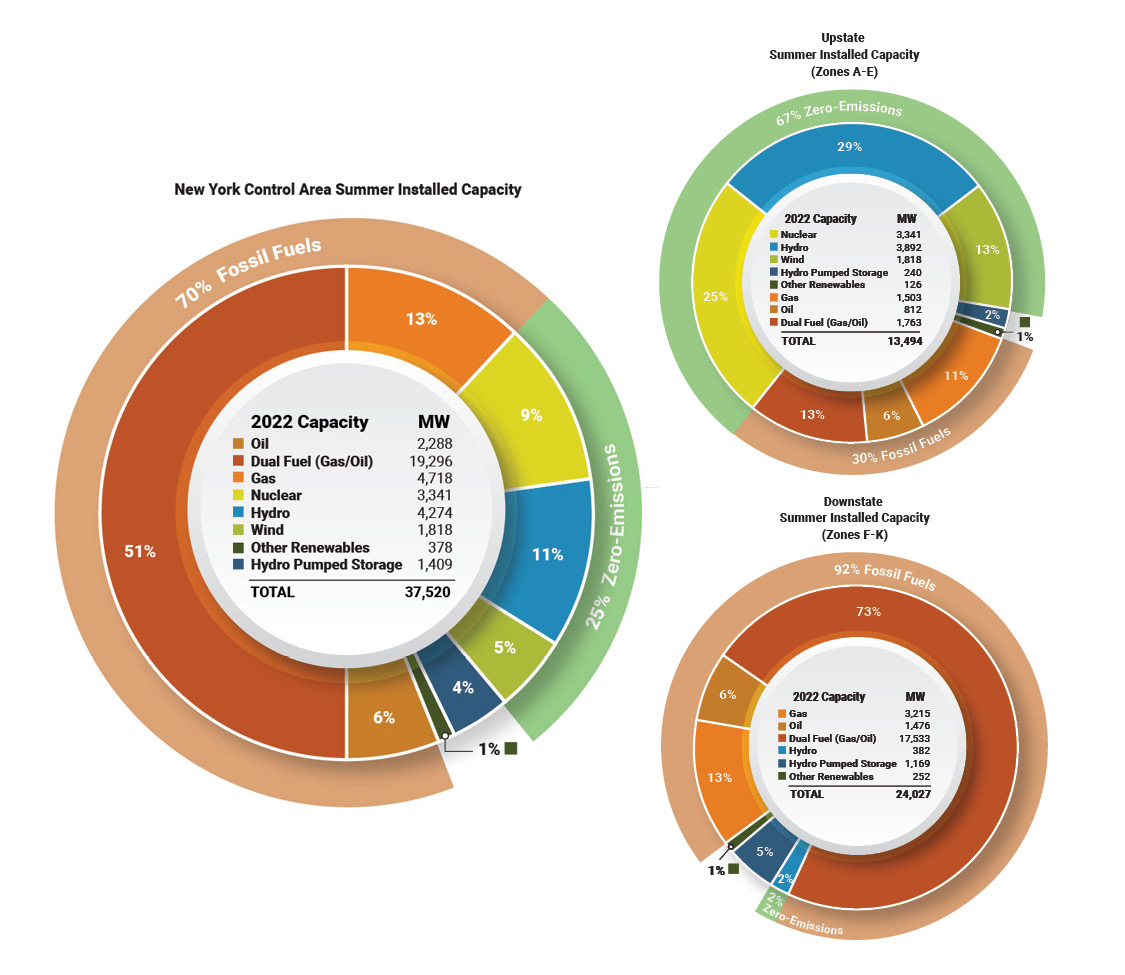
New York is Exhibit A of a current crisis-in-waiting. At the State level, Governor Hochul has committed to closing all of the State’s fossil fuel electricity plants by 2030.  Current  New York State summer installed capacity is 37,520 MW, or 37.5 GW.  Of that, about 60%, or more than 22 GW, consists of natural gas facilities, which are capable of running nearly all the time and ramping up to maximum output when most needed.  Based on National Grid’s projection of 57% increased demand by 2035, New York should be planning to have 37.5 GW x 1.57, or almost 59 GW of always-available capacity on hand by that year.  Yet the only significant plans for additional capacity by 2035 consist of about 9 GW of offshore wind, and another 1.25 GW to come from a transmission line to bring hydropower from Quebec.  (In recent weeks, all of the offshore wind developers have demanded major contract price increases of 50% and up, failing which they threaten to walk off the job.)    

Something here does not remotely add up.  If New York state succeeds by 2030 in closing its natural gas plants -- the plants that account for 60% of the State’s generation capacity -- that would bring our total installed capacity down from 37.5 GW to as little as 15 GW. But we need almost 60 GW to meet projected demand.  And that’s 60 GW that can be called on any time as needed to meet peak usage.  The 9 GW of projected offshore wind turbines wouldn’t make much of a dent even if they operated all the time and could be dispatched to meet peak demand, which they can’t.  Instead, they will operate only about a third of the time, and at their own whim.  At best they will provide about 3 GW on average, when what we need for this full electrification project is more like 45 GW of dispatchable power to add to our existing hydro and nuclear.    

The New York Independent System Operator, which is well aware of this gigantic contradiction, talks vaguely of something they call a “dispatchable emissions-free resource” to fill the enormous gap.  Other than nuclear, which is blocked, that is something that is a pure fantasy and does not exist.

Our State’s and City’s proposed plans are putting New Yorkers on a path to catastrophe, with greatly increased dependence on electricity, but without nearly enough of the stuff to function at even the current usage level.  New York City got a huge lesson on dependence on electricity from Hurricane Sandy a decade ago, when a week-long blackout left people in high-rises without elevator service and without water.  Now they plan to add all heat, cooking, and transportation to the things that absolutely require electricity.  In that world, insufficient electricity becomes a humanitarian crisis.

It is high time for the politicians writing electricity mandates to demonstrate that it is even possible to build and scale an emission-free grid, one that is dispatchable (meaning it will work when we need it), reliable, and resilient. In today’s world, no demonstration of such a grid exists anywhere in the world.

If these mandates are allowed to go forward unabated, the real cost of will be the impoverishment of communities and destruction of quality of life. It’s up to us to realize we’re being sold a false narrative and to stop playing along. 

https://www.manhattancontrarian.com/blog/2023-9-13-new-york-urgently-needs-to-confront-the-contradiction-of-trying-to-electrify-everything-while-also-eliminating-fossil-fuels

Medicare’s Price Regulations: How Government Determines What It Pays for Medical Care

 Abstract

Medicare’s rules specifying payments for covered services are among the most powerful levers in health care. Private insurers use the same codes and formulas as their starting points for payments to avoid reinventing the wheel even as they are forced to “plus up” the amounts to appease their affiliated providers. (Medicare’s size allows the government to adopt take-it-or-leave-it terms.) While the differential between what Medicare and commercial plans pay is said to validate the benefits of price regulation, the empirical bases for the government’s rates are not well understood. A partial review shows a pattern of combining dated, imprecise cost reports with idiosyncratic and opaque adjustments that were not constructed to guarantee the best outcomes for the dollars spent. Properly designed competitive pricing, with a focus on value and not just cost, could be used to tether more Medicare payments to the rates that will incentivize efficiency and innovation, leading to optimal patient care. As the debate over how to control health care costs without compromising quality continues, Medicare’s regulated prices should not be given unquestioned status as the best available options.

pdf-icon

Medicare’s Price Regulations: How the Government Determines What It Pays for Medical Care


By James C. Capretta | David N. Bernstein

https://www.aei.org/research-products/report/medicares-price-regulations-how-the-government-determines-what-it-pays-for-medical-care/

'Long Covid is a new name for an old syndrome'

 Long Covid goes by many names. Today, it is no longer a new public health enigma, but the outlook for sufferers is no better than when the condition was first recognized in early 2020. Although its prevalence has recently decreased to 6% of the U.S. adult population, there has been no significant progress in understanding its causes, prevention, or treatment. Long Covid still looms as the national health disaster many predictedEveryone — patients, support groups, clinicians, researchers, and health care systems — is frustrated by lack of meaningful progress in research and patient care.

On the research side, the U.S. government rapidly anticipated and tried to blunt the force of this national calamity by investing in basic and clinical research. Hopes were raised in December 2020 when Congress provided $1.15 billion over four years to the NIH to launch its long Covid research initiative called RECOVER. The Centers for Disease Control and Prevention additionally initiated its Innovative Support for Patients with Covid-19 Infections Registry (INSPIRE). Veterans Affairs also deployed the nation’s largest health care system in support of LC research.

Now, more than two years down this ambitious path, and with published results emerging, outraged experts and patient advocates say that there is “little to show for it.” The critique is that mostly observational studies have characterized risk factors, demographics, and attributes of the clinical syndrome, but little has emerged that directly contributes to prevention or patient care.

The view from the patient care side is no more optimistic. People with long Covid are subject to stigmatization and feel disempowered as they navigate a fragmented health care system not organized to deliver patient-centric care.

While long Covid’s causes and treatments remain elusive, its health, social, and economic toll is enormous and indisputable. A 2022 paper projected the total U.S. economic impact in quality of life, lost earnings, and medical care spending at $3.7 trillion. That’s $11,000 per capita or 17% of the 2019 gross domestic product. As the country has largely moved on from the acute phase of the pandemic, long Covid has left a trail of frustration, suffering, functional impairment, and disability.

The current grim reality is underscored by the unsatisfying National Institutes of Health guidance that “the best way to prevent long COVID is to avoid getting COVID-19.” Although true, this advice offers scant comfort to the large majority of Americans who have been infected by Covid-19 and to most who are still at risk for new or re-infections — especially now, when there are few societal efforts to prevent transmission.

The solution for this seemingly unsolvable puzzle is hiding in plain sight. Long Covid is a new term coined for an old syndrome that has long bedeviled the ecosystem of clinicians, researchers, patients, support groups, and health care systems. It’s a unifying hypothesis that explains most observed facts around the striking lack of inroads against long Covid.

Long Covid is really not new. It is virtually indistinguishable from the condition long known in the medical lexicon as post-infectious syndrome or myalgic encephalomyelitis/chronic fatigue syndrome (ME/CFS). Although some have recognized and studied their similarities, it seems no one has made the simplifying observation that they are essentially the same condition.

In the ME/CFS paradigm, long Covid is not a new condition. Logic and reason dictate that acute SARS-CoV-2 infection causes long Covid.

Or, more accurately, acute Covid-19 triggers ME/CFS in the same way many other infectious agents trigger ME/CFS. “Triggers” means a temporal association, but not “cause” in a mechanistic sense — at least not identifiable with currently available scientific tools. This hypothesis has major policy, research, and patient-care best practice implications. It’s our most direct path forward to reset society’s goals, strategies, and expectations for true progress against this public health catastrophe.

Although much about ME/CFS is still not well-understood, decades of experience and research into this condition could be productively and rapidly applied to long Covid. That approach could help avoid missteps, focus investment priorities, ground societal expectations regarding what is achievable, and improve patient welfare dramatically.

For example, basic research has focused on identifying long Covid laboratory markers and the pathogenesis (mechanism) linking the virus with the symptoms. Researchers are exploring biologically plausible hypotheses including viral persistence, microvascular clots, gut microbiome disruption, and immune system derangements as the mechanism behind long Covid symptoms.

But if long Covid is really a form of ME/CFS, this approach will likely be unrewarding. Decades of ME/CFS research exploring etiology and pathogenesis have been unproductive. The current research directed at finding mechanistic clues to long Covid is a resource-intensive and lengthy uncharted process. It is likely to produce further leads for more research, but with a low ultimate probability of success in helping patients.

There is an already extensive body of patient-care experience, guidance, and resources for best practice to build on in the clinical management of post-infection syndromes. This should be aggressively applied to the benefit of long Covid patients. This approach includes “coordinating clinical care and rehabilitation, reducing health care disparities, and addressing ongoing and complex medical and psychosocial needs.” Patient education and health care workforce training are an essential component in the dissemination of best practices and in setting realistic expectations for prognosis and treatment outcomes. The wheel does not need to be reinvented, only improved. A current consensus long Covid definition is that it is a disorder following acute Covid-19 infection “with symptoms not attributable to any other condition.” It can present with a myriad of more than 200 symptoms referable to any organ system. This is virtually identical to the Institute of Medicine’s 2015 case definition of ME/CFS.

For the sake of definitional clarity, there are a few well-documented consequences of acute Covid-19 that are caused by the SARS-CoV-2 virus. These are MIS-Cmyocarditis, and blood clots. Where there are clear objective signs of disease that are diagnosable outside the patient, the illness is excluded from the ME/CFS paradigm. Another exclusion is the post-intensive care syndrome (PICS). According to the CDC, “people experiencing any severe illness, hospitalization, or treatment may develop problems such as PICS. For people who experience PICS following a COVID-19 diagnosis, it is difficult to determine whether these health problems are caused by a severe illness, the virus itself, or a combination of both.”

Conditions similar to ME/CFS have been described in the medical literature for centuries. Although well-described symptom clusters similar to ME/CFS were reported as early as the 1930s, the term myalgic encephalomyelitis was first used to describe the condition in the 1950s, and ME was recognized by the World Health Organization as a disease entity in the 1960s. The term chronic fatigue syndrome was coined in the 1980s for cases simulating post-viral syndromes that were not found to have a viral etiology. In this unifying framework, fibromyalgia and postural orthostatic tachycardia syndrome (POTS) — other debilitating symptom clusters — are included as subsets of CFS.

Just as there was with ME/CFS, there is an ongoing, polarizing debate of whether long Covid is “real,” as in an organic disease with presumed identifiable physical or biochemical signs, or an “imagined” non-organic disorder with no discernible cause. However this is a false dichotomy. Scientific evidence shows that post-infectious fatigue syndromes (including long Covid) can have a spectrum of inseparable pathobiological and psychological components. Acknowledging this is culturally unifying and will generate more light than heat in helping chart society’s path forward. It allows for less contentious, more productive, and targeted patient care and research strategies; enlightened policies; and more cost-effective investments for addressing the long Covid crisis.

The enormous global toll of Covid-19-associated post-infectious syndrome is readily explained in the conventional epidemiologic paradigm. SARS-CoV-2 and its variants are among the most communicable human viruses in history and with extensive international movement, infected the vast majority of the initially completely immunologically-naive people on the planet. The broad range of the observed 7.5% to 41% of post-acute Covid symptoms is consistent with general post-viral CFS rates. As the virus keeps circulating, natural and vaccination-related population immunity continues to build, the gradual diminishing of CFS incidence is to be expected. This is the recent pattern we have observed in the U.S. With Covid-19 endemicity, an ongoing decrease in CFS rates is likely.

The recognition that long Covid is the latest emergence of an old syndrome and not a de novo new entity, while no panacea, augurs a fundamental reset of every aspect of societal response. It reframes but does not change the facts. It provides the foundation for better strategies and manages expectations around what is likely and unlikely to work in prevention, treatment, research and policy. It prioritizes care delivery over research in the expenditure of government funds.

A recent editorial has recommended that Congress fund the Health Resources and Services Administration to “competitively select centers of excellence in long COVID patient care … that were established as part of the RECOVER initiative.” A now vastly expanded and refocused effort on patient care for ME/CFS could help build bridges of understanding, collaboration, and empathy across the diverse constituencies of the long Covid ecosystem. It could serve as a more productive and accurate new paradigm for how we as a society face the challenge of long Covid.

Steven Phillips, M.D., M.P.H., is a Global Virus Network board member and vice president for science and strategy at the COVID Collaborative. Michelle A. Williams, Sc.D., is the former dean and is the Joan and Julius Jacobson professor of epidemiology and public health at the Harvard T.H. Chan School of Public Health.

https://www.statnews.com/2023/09/14/long-covid-me-cfs-myalgic-encephalomyelitis-chronic-fatigue/

Europe Must Cut Down on Its Dependence With China, Baerbock Says


  • The German foreign minister speaks in a Bloomberg TV interview
  • She said the EU must de-risk from China but not decouple

German Foreign Minister Annalena Baerbock said that the European Union must reduce its reliance on China and that she supports the EU’s investigation into the subsidies Beijing supplies its electric-vehicle industry.

“If you are bound too closely it can endanger yourself,” Baerbock said in a Bloomberg Television interview on Sunday. She added that “cutting down on our dependency” was necessary with a country like Russia that invaded Ukraine, “but also now with regard to China.”

https://www.bloomberg.com/news/articles/2023-09-17/baerbock-says-europe-must-cut-down-on-its-dependence-with-china

ChatGPT's Environmental Impact Ignored By Climate Warriors

 Climate alarmists have waged war on energy-intensive cryptocurrency mining operations but have yet to denounce large language models (LLMs) like Microsoft-backed OpenAI's ChatGPT that use 16 ounces of fresh water every time a user asks it a series of questions. 

Microsoft revealed in its latest environmental report that its global water consumption surged 34% from 2021-22 (to nearly 1.7 billion gallons), a massive increase versus the previous years primarily due to artificial intelligence research, according to AP News

"It's fair to say the majority of the growth is due to AI," including "its heavy investment in generative AI and partnership with OpenAI," said Shaolei Ren, a researcher at the University of California, Riverside who has been developing a new process to calculate the environmental impact of ChatGPT. 

Ren's team calculates that ChatGPT consumes 16 ounces of water for every 5 to 50 queries or prompts from a user. He noted, "Most people are not aware of the resource usage underlying ChatGPT." 

Ren added, "If you're not aware of the resource usage, then there's no way that we can help conserve the resources."

Given the chatbot's unprecedented popularity this year, environmental problems have emerged with LLMs as massive data centers that power the chatbot require huge amounts of water-based liquid cooling. 

Microsoft told AP in a statement last week that its AI research will soon have a measure on its energy and carbon footprint. The tech company said, "While working on ways to make large systems more efficient, in both training and application."

"We will continue to monitor our emissions, accelerate progress while increasing our use of clean energy to power data centers, purchasing renewable energy, and other efforts to meet our sustainability goals of being carbon negative, water positive and zero waste by 2030," it continued. 

OpenAI stated that it has given "considerable thought" to its computing power: "We recognize training large models can be energy and water-intensive" and work to improve efficiencies.

Despite significant energy and freshwater usage, ChatGPT and other LLMs have not faced the same scrutiny from environmental warriors as crypto mining has over the years.

https://www.zerohedge.com/technology/chatgpts-environmental-impact-ignored-climate-warriors

WHO chief pushes China for ‘full access’ to determine COVID’s origins, Financial Times reports

 The chief of the World Health Organization urged Beijing to offer more information on the origins of COVID-19 and is ready to send a second team to probe the matter, the Financial Times reported on Sunday.

"We're pressing China to give full access, and we are asking countries to raise it during their bilateral meetings — to urge Beijing to co-operate," WHO Director-General Tedros Adhanom Ghebreyesus told the newspaper.

The WHO chief's comments come as health authorities and pharmaceutical companies across the world have been racing to update vaccines to combat newer emerging coronavirus variants.

Ghebreyesus has for long been pressing China to share its information about the origins of COVID-19, saying that until that happened all hypotheses remained on the table.

The virus was first identified in the Chinese city of Wuhan in December 2019, with many suspecting it spread in a live animal market before fanning out around the world and killing nearly 7 million people.

https://news.yahoo.com/chief-pushes-china-full-access-092116178.html

U.S. envoy for Japan takes the spotlight with snarky China tweets

 When a Reuters reporter asked a U.S. State Department spokesperson this week about a sarcastic social media post by the U.S. ambassador to Japan concerning China's missing defense minister, the reply was appropriately diplomatic.

The ambassador, Rahm Emanuel, has always spoken in "a colorful manner," said Matthew Miller, restraining a smile, although he declined to say whether Emanuel's comments had been cleared by the State Department.

Emanuel, a legendary Washington political fighter who has served three Democratic presidents, had written on social media platform X, formerly known as Twitter, that the recent disappearances of top Chinese officials resembled Agatha Christie's best-selling crime novel "And Then There Were None," which follows the mysterious deaths of guests at a mansion in Britain.

"First, Foreign Minister Qin Gang goes missing, then the Rocket Force commanders go missing, and now Defense Minister Li Shangfu hasn't been seen in public for two weeks. Who's going to win this unemployment race? China's youth or Xi's cabinet?," Emanuel wrote.

On Thursday, he speculated in another post that Li might have been detained. "Might be getting crowded in there," he wrote.

Li has not been seen in public for more than two weeks. On Friday Reuters reported that the defense official, handpicked by Chinese President Xi Jinping, has been placed under investigation by Chinese authorities, according to 10 people familiar with the matter.

In July, Foreign Minister Qin Gang was replaced after not being seen in public for over a month. He had been appointed to the post only seven months previous.

POLICY OR OPINION?

Though common on social media, pointed sarcasm is almost unheard of in the buttoned-down world of diplomacy, where ambassadors' comments are carefully vetted and scrutinized for nuance.

So naturally, Emanuel's posts have raised questions about whether they reflect the views of the administration of Joe Biden, who Emanuel has known for years, dating back to the Obama White House.

"I would guess that the Chinese government views Ambassador Emanuel's remarks as authoritative and deliberate signaling. I doubt that's the case," said Bonnie Glaser, a China expert at the German Marshall Fund of the United States.

A Chinese embassy spokesperson said Beijing noted Emanuel's remarks. "We hope the U.S. side can stop smearing China and do more things that are conducive to enhancing understanding, trust and cooperation between the two countries," she said.

A source familiar with Biden administration dynamics said Emanuel's comments were likely not part of an agreed approach.

"Rahm is not subject to the rules that other ambassadors and senior officials follow," the source said. "I suspect that some of his public commentary makes the White House pretty uncomfortable, but his relationship with the President makes him effectively untouchable."

"There may be some who view his tweets and commentary as a useful foil, but there is no deliberate strategy that I am aware of," the source said.

On Friday, the State Department did not have immediate comment on whether Emanuel's tweets on Li reflected the knowledge and understanding of the U.S. government or whether they were his personal opinion. The U.S. embassy in Japan declined to comment.

ANTI-CHINA U.S. AMBASSADOR

Emanuel, 63, previously served as an aide to former President Bill Clinton and as former President Barack Obama's White House chief of staff, when he was known as an effective enforcer, nicknamed "Rahmbo."

In 2010, he successfully ran for mayor of Chicago but decided not to seek re-election in 2019 following controversy over his decision not to release footage of the shooting of a Black teen, Laquan McDonald.

The combative Democrat is known for his use of colorful and sometimes profane language. At the start of his time at the Obama White House, he had a name plate on his desk given to him by his brothers that read: "The Undersecretary for Go Fuck Yourself."

In Japan, his longstanding West Wing ties are seen as an advantage by the government of Prime Minister Fumio Kishida, which is eager to tighten bonds with Washington, a senior Japanese official told Reuters.

Within China, Emanuel has a reputation as an anti-China ambassador, said Yun Sun, director of the China Program at the Stimson Center, adding that Beijing believes his position as ambassador to Japan should not afford him a role on relations between the U.S. and China, which have been tense in recent years.

Emanuel has kept close ties with Biden, hosting him privately at the ambassador's residence in Tokyo, and is closely connected with members of Biden's inner circle, a rare direct line for an ambassador.

All of that suggests that the administration is unlikely to rein in its Japan ambassador.

"He's developed an extremely close relationship with the Japanese to advance the alliance and U.S. interests and is expressing his point of view," said an administration official.

https://news.yahoo.com/u-envoy-japan-rahm-emanuel-215013587.html