Search This Blog

Monday, November 6, 2023

"Concerning" Employment Losses At Nursing Homes Amid Biden Administration Staffing Push

 By Susanna Vogel of HealthcareDive

Summary:

  • Healthcare employment growth fell across the board during the COVID-19 pandemic. Some sectors have had more difficulty rebounding than others, according to a new study — especially skilled nursing facilities, which face a controversial federal push for more staffing.

  • Employment in hospitals increased 0.4% per quarter before the pandemic, but that growth rate shrunk to 0.03% during COVID-19, according to the study published in JAMA. By comparison, employment at skilled nursing facilities was already declining before COVID, dropping at a rate of 0.2% per quarter. During the pandemic, the rate of job losses accelerated to 1.1%.

  • The Biden administration is seeking to impose mandatory nursing staffing minimums at skilled nursing facilities, or SNFs. The nursing home industry largely opposes the rule, arguing there are not enough workers available to meet the staffing mandate.

The downward employment trend in SNFs is “concerning,” according to the study’s authors, who said it could be due to a variety of factors, including worker worries of contracting infectious diseases, lower wages and high turnover among long-term care occupations.

Regulators, healthcare industry leaders and workers unions disagree on how to make such roles more attractive to workers.

In September, the Biden administration proposed a rule that would require nursing homes to provide three hours of nursing care per resident per day. The proposed rule also stipulates that at least one registered nurse be on duty at long-term care facilities at all times.

Supporters of the rule, including top Biden administration officials, say that increasing staff is associated with higher-quality patient care and lower levels of provider burnout and turnover.

Critics, including nursing homes and lawmakers on both sides of the aisle, have asked the CMS to scrap the proposed rule, warning that requiring the industry to comply with staffing mandates would jeopardize patients’ access to care and cause facilities that can’t adequately staff to close. 

Over 80% of nursing homes in the country currently fall short of proposed staffing guidance, according to a September analysis from health policy nonprofit KFF.

Last month, Sens. Kevin Cramer, D-N.D., and Angus King Jr., I-Maine, sent a letter to CMS warning that the mandate would threaten veterans’ access to long-term care. A separate group of 28 senators also sent a letter pushing CMS to abandon the mandate.

The Biden administration is also facing pressure from stakeholders who want the staffing rule to be more robust. A group of 100 House Democrats plans to submit comments to the CMS today asking them to make the staffing requirements stricter, including raising the direct care requirement to 4.2 hours per patient per day, according to the Washington Post.

The comment period for the proposed rule ends today.

https://www.zerohedge.com/markets/research-flags-concerning-employment-losses-nursing-homes-amid-biden-administration

'Young, Bold, & Angry: The Youth-Led Revival Of The Palestinian Cause'

 by Mohamad Hasan Sweidan, op-ed via The Cradle,

Global youth are smashing Israeli propaganda constructs to champion justice and humanity as they throw their support behind the armed struggle for Palestinian national liberation.

For years, there's been a prevailing notion that the Palestinian cause is losing its grip on the younger generations. This perception stems from the belief that, as globalization tightens its hold, the youth in West Asia, particularly in occupied Palestine, might become more disconnected from their historical roots and national affiliations. 

With the spread of liberal ideas, many speculated that economic opportunities, technological advancements, and global exposure would shift their focus away from the Palestinian cause. Some even anticipated that the younger generation would turn against armed resistance to the Zionist occupation, owing to the small tide of Arab-Israeli normalization.

But recent events, especially the US-backed Israeli genocidal war against Gaza, have shown a different story. Three weeks of nonstop atrocities have rekindled the flame of Palestinian identity, ensuring that at least three generations stand united against the west's 'rules-based order' and in support of any resistance against the occupation state.

Youth in West Asia

Prior to the Hamas-led Al-Aqsa Flood military operation on 7 October, many believed that young Arabs were leaning more toward normalizing relations with Israel, prioritizing economic prosperity over solidarity with the oppressed Palestinians. 

However, the stark contrast between Iranian-aligned Arab states, which struggle with sanctions and insecurity, and those Arab countries that have normalized relations and enjoy a better quality of life has made the youth question the old assumptions about resistance.

The role played by Arab youth after the events of 7 October has reinforced the need to confront Israel. Tel Aviv's behaviors, rife with criminality, aggression, and lies, have embarrassed its Arab partners, and now challenge the narrative that sought to separate Hamas from the rest of the Palestinian population.

According to Pew Research Center's generational divisions based on age, today's younger generations can be categorized into two groups, and current children can be classified into a single category:

After the launch of Al-Aqsa Flood, the west attempted to frame the narrative around the specific event - leaving out historical context - sought to characterize Hamas as ISIS, and emphasized Israel's “right to self-defense” against "terrorism." Ironically, it has been Israel's brutal actions that countered these efforts, leading to the deaths of over 8,525 Palestinians, including 3,542 children and over 2,000 women. 

This devastating toll was enough to label Israel as the real perpetrator of terrorism, and the images of innocent martyrs, especially children, became a powerful symbol in the defense of Palestinian rights.

Agents of change 

What's truly remarkable is that the leaders of the new narratives are the youth of Generation Z, Y, and Alpha. Leveraging social media, and speaking directly to their peer groups, they conveyed the grievances of the Palestinian people to the world. Many had limited knowledge of Palestine, but their unfiltered sense of justice fueled their collective anger against Israel's ongoing ethnic cleansing of Palestine.

Social media has also given rise to a new form of journalism, known as citizen journalism. Ordinary individuals on the ground have become frontline reporters, sharing live audio and video updates that effectively sideline mainstream news reporting. When traditional media fails to provide the full picture, platforms like X and Instagram became invaluable sources of information. For instance, during the first two days of the Gaza offensive, over 50 million posts flooded the X platform and provided real-time coverage of events on the ground.

On social media, the younger generation is playing a crucial role in raising awareness about the Palestinian cause, galvanizing people across the globe to mirror their outrage. Today, in many countries, populations are taking to the streets in protest, boycotting companies supporting Israel, and expressing their solidarity across a wide variety of social media platforms. 

Videos advocating for Palestinian rights appear in dozens of languages, reaching millions. Weeks after the aggression, hashtags like #فلسطين and #إسرائيل had billions of views on TikTok, leading the US to pressure Meta to ban influential accounts supporting the Palestinian cause.

Crucially, the scenes of Israeli brutality on social media have led to widespread, unprecedented criticism of the US, a key partner in Tel Aviv's war plans, oddly, from Jewish American youth. Thousands of critical Jewish voices have emerged, condemning Washington's policies. Instead of fading, the Palestinian cause is regaining momentum worldwide, defying the intentions of both Washington and Tel Aviv.

Influence on western youth

According to a recent poll published by the Daily Mail, only 40 percent of respondents between the ages of 18 and 29 have a negative view of the Palestinian resistance group Hamas. Despite Israel's efforts to label Hamas as ISIS, more than half of young respondents do not share this view. The same poll indicates that 32 percent have a negative view of Israel instead, while only 24 percent have a positive outlook. Significantly, among young people, those with a negative view of Israel outnumber those with a positive view.

An Axios poll in the US reveals that less than half of young respondents (48 percent) believe that the country should support Israel. In contrast, this percentage rises significantly among older respondents, reaching 83 percent among those born between 1946 and 1964. Another poll by Generation Lab shows that 48 percent of US college students surveyed do not blame Hamas for the events of 7 October.

Quinnipiac poll shows that 51 percent of voters under the age of 35 do not support sending weapons and military equipment to Israel in response to the Hamas operation, compared to 77 percent for those aged 50 or older.

Additionally, Harvard University's Center for American Political Studies conducted a survey on the war in Palestine among respondents aged 18 to 24, with the following key findings:

  • 47 percent believe that Hamas targeted the occupation army during Operation Al-Aqsa Flood and not civilians.

  • 41 percent believe that Hamas fighters are military operatives and not terrorists.

  • 48 percent side with Hamas and not with Israel. (This rises to 91 percent for those aged 55-64)

  • Although 62 percent believe that Hamas' actions are criminal, 52 percent believe that Hamas ' killing of 1,200 Israeli civilians can be justified because of the injustice inflicted on Palestinians.

  • 46 percent believe that law firms should not refuse to hire law students who supported Hamas and attacks on Israeli civilians.

  • 48 percent oppose the Biden administration’s policies toward Israel.

  • 54 percent believe that Iran has nothing to do with the Hamas attack on 7 October.

  • 59 percent believe that it was wrong for Israel to cut off electricity, water, and food to the Gaza Strip in order to retrieve its prisoners.

  • Only 30 percent believe that the US should support Israel in the war on Gaza.

  • 45 percent believe that Israel bombed the Baptist Hospital in the Gaza Strip.

  • Only 24 percent believe that the US media reports events in Gaza in a fair manner.

  • 60 percent believe that the US should not intervene militarily if Iran strikes Israel.

Commenting on these figures, Mark Penn, CEO of Stagwell and president of the Harris-Ball Foundation, says that "the war between Israel and Hamas is not an issue divided along party lines, but on the basis of age." 

Rachel Janvaza, an expert on the political culture of the younger generation, suggests that "seniors are deeply traumatized by the generational divide, but this tension has been brewing on social media and in universities for a while – both of which play a very powerful role in how young people see the world." Others disparage this development - Brad Polombo, in an article for Newsweek, opines: "Gen Z is not okay." 

Recent events highlight the resilience of Palestinian youth in preserving their identity and defending their rights. They have leveraged innovative ways to keep the Palestinian narrative relevant globally, with youth solidarity in West Asia bringing Palestinian grievances to a worldwide audience via various social media platforms, in all languages. 

The impact of these events on the younger generation will likely continue to shape their views and influence future decisions, and today has the potential to affect international opinion and shift foreign policy. 

https://www.zerohedge.com/geopolitical/young-bold-angry-youth-led-revival-palestinian-cause

Slowing EV demand isn't just hurting automakers like GM and Tesla

 Stalling demand for electric vehicles isn't just hitting the automakers that sell them. It's also impacting companies along the supply chain including producers of lithium, the component used to make EV batteries.

Albemarle (ALB), the world's top lithium company, saw its stock tank as much as 7% on Monday after an analyst downgrade from UBS citing falling prices for the soft metal.

UBS analysts lowered their rating to Neutral from Buy and cut their share price target to $140 from $253.

"On UBS reduced EV forecasts, lithium demand growth declines from 30% Y/Y to 22% in 2024, and results in lithium over-supply sooner than expected," wrote analyst Joshua Spector and his team in a note to clients.

Albemarle recently cut its 2023 full-year guidance citing sliding lithium prices as demand in the US and Europe is expected to weaken.

“Our net sales were up 10% in the third quarter versus the same period last year. However, adjusted EBITDA was down due to softer lithium market pricing,” Kent Masters, CEO of Albemarle, said during the company’s latest earnings call.

"While the US and Europe make up only about one-third of total EV production in '23 and '24, near term we see potential challenges for EV growth in those regions related to economic softness and higher interest rates," added Masters.

Shares of lithium technology company Livent (LTHM) are also on a downward trend, down 24% year to date.

"On the demand side, we can see that customer buying activity for lithium in Q3 was weaker than what end market demand indicators would imply," Paul Graves, CEO of Livent, said during the company’s recent earnings call.

Unlike oil, gold, or any other major commodity, lithium is not actively traded on large international exchanges. The material is sold under contracts and the terms aren't generally publicized.

However China's spot market shows lithium prices are down around 50% from its June levels, recently moving below $20,000 per ton. The decline is a sharp contrast from a year ago, when prices for the critical metal coming out of China surpassed $70,000 per ton.

Albemarle says it has price floors on 80% of its contracts, which the company doesn't disclose. Those are intended to protect operations and help limit the downside of falling prices.

UBS analysts highlight "it isn't clear 1) where those floors kick in and 2) if they will hold in a prolonged downturn."

Lithium brine evaporation ponds at Albemarle's lithium mine in Silver Peak are seen in 2021. (Bizuayehu Tesfaye/Las Vegas Review-Journal/Tribune News Service via Getty Images)
Lithium brine evaporation ponds at Albemarle's lithium mine in Silver Peak in 2021. (Bizuayehu Tesfaye/Las Vegas Review-Journal/Tribune News Service via Getty Images) (Las Vegas Review-Journal via Getty Images)

Lithium prices are falling at the same time US legacy automakers Ford (F) and GM (GM) and Tesla (TSLA) are warning of softening demand in the EV space as the cost of financing is more expensive.

In October GM said it would push back its EV truck expansion, noting “evolving EV demand” as the main reason. Ford also said that US EV buyers were “unwilling to pay premiums for [EVs] over gas or hybrid vehicles, sharply compressing EV prices and profitability.”

Even Tesla hit the pause button on construction of its upcoming Gigafactory in Mexico due to concerns about global economic conditions crimping demand.

“I’m worried about the high interest rate environment we’re in,” Musk said during the company’s latest earnings call. “I just can’t emphasize enough how important cost is … We have to make our products more affordable so people can buy [them].”

A gloomy outlook for the sector is prompting battery manufacturers to buy smaller quantities of lithium and other materials for their EV batteries.

Tesla battery supplier Panasonic recently cut automotive battery production in Japan and lowered its annual profit forecast.

Not everyone is so bearish on the market. Morningstar analyst Seth Goldstein downplayed worries about a lithium oversupply and said Albemarle's stock is undervalued.

"We think the market is concerned that lithium spot prices will fall further to the end of 2023 and into 2024 due to oversupply concerns," wrote Goldstein."We disagree and expect prices will rise in 2024 as battery producer inventory destocking runs its course."

"As demand grows, we see lithium returning to structural undersupply in 2024, leading to higher prices," he added.

https://finance.yahoo.com/news/slowing-ev-demand-isnt-just-hurting-automakers-like-gm-and-tesla-193515181.html

Yuan De Facto Peg To The Dollar Looks Here To Stay

 By George Lei, Bloomberg Markets Live reporter and strategist

The US dollar suffered its worse selloff since mid-July last week, bringing some relief to China’s policymakers. With the world’s second-largest economy effectively pegging the yuan to the greenback, Beijing can ride the likely wave of dollar weakness that will also see the Chinese currency depreciate on a trade-weighted basis.

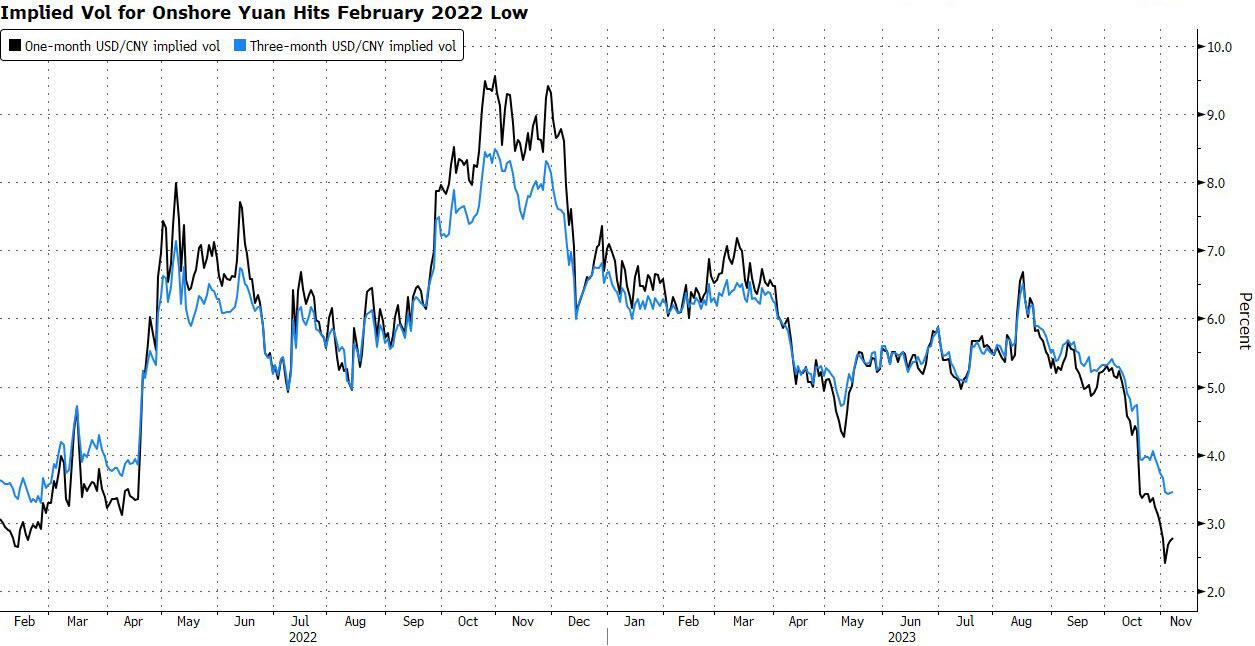
Dollar-yuan has traded around 7.30 since mid-August in both onshore and offshore markets: fluctuations, either upward or downward, have been less than 1%. The steady hand of PBOC helped suppress one-month implied volatility on the onshore yuan below 3%, to the lowest since February 2022. In offshore trading, where PBOC has relatively less clout, one-month implied vol is now lower than 4%, at levels last seen in April 2022.

PBOC’s favorite tool for stabilizing the dollar-yuan exchange rate is its daily fixing. The Chinese central bank has kept such a tight grip on the reference rate, sending its volatility to almost zero, something that last took place 13 years ago. From the onset of global financial crisis in 2008 to the middle of 2010, Chinese authorities essentially pegged their currency at 6.82 per dollar.

Suppressing swings in the dollar-yuan exchange rate is the main route on the road to financial stability. But with it comes side effects that can create headwinds for an economy struggling to recover.

Between mid-July and early-October, the Bloomberg dollar spot index rallied almost 7% from its 2023 low to high. While the yuan declined against the dollar over the same period, on a trade-weighted basis it advanced nearly 4%. That’s because the Chinese currency held up much better against the greenback than other currencies under the PBOC’s support.

Now, should the weakening dollar trend persist, the yuan will likely follow suit on a trade-weighted basis, helping boost the country’s competitiveness.

“It would be too early to declare victory in preserving RMB stability and PBOC will likely phase out its FX policy support gradually,” Ken Cheung, chief asian FX strategist at Mizuho Bank Ltd. said in a client email on Monday. While outflows from onshore equities have moderated recently, China’s property market is still not out of the woods yet and the growth outlook remains generally bearish, Cheung noted.

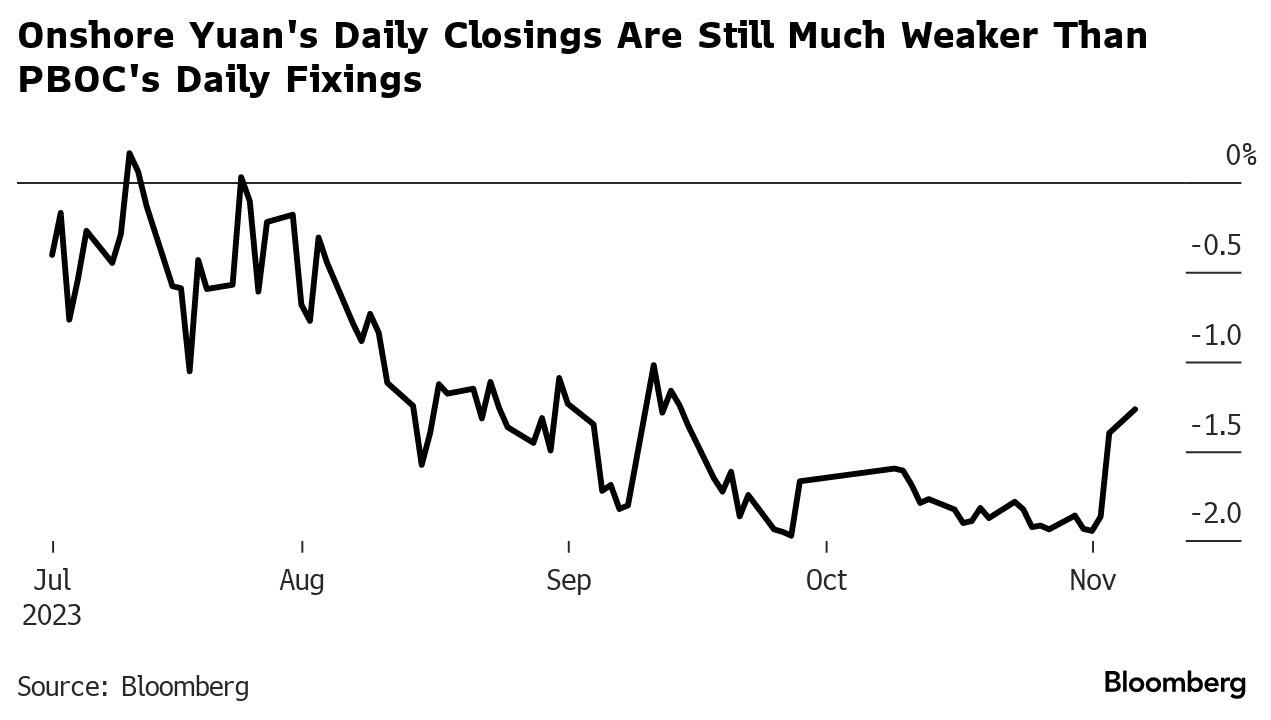
While the PBOC has practically left yuan’s daily fixings flat, the currency has kept trading on the weaker side over the past couple months, sometimes pushing the boundaries set by policymakers (yuan is only permitted to deviate a maximum 2% away from the reference rate in onshore trading). If the PBOC were to loosen its grip, market equilibrium will probably imply a much weaker Chinese currency despite a falling US dollar.

Bearish dollar moves are “likely to do much of the work” for the PBOC, which makes it less likely for policymakers to “give up on their defense of the currency,” according to a research report from JPMorgan on Friday. The US bank believes a large downside move in dollar-yuan is unlikely given the easing policy stance, and favors selling 3-month volatility for USD/CNH.

https://www.zerohedge.com/markets/yuan-de-facto-peg-dollar-looks-here-stay

Spike in attacks on US troops in Middle East as American forces surge to region

 American troops in Iraq and Syria were targeted in seven more attacks over the weekend as the US boosted its military presence in the region while the Israel-Hamas war rages.

“Since Oct. 17 Eastern Time, we’ve had 20 attacks in Iraq, 18 in Syria — a total of 38 of these, you know, essentially what are harassing attacks of drones and rockets,” Pentagon Press Secretary Patrick Ryder told reporters Monday.

The total of 38 attacks was up from Friday afternoon, when the figure was 31, according to the Pentagon.

While Ryder said no one was reported hurt in the weekend attacks, more troops have recently come forward with injuries from previous incidents.

The newly reported injured include five Americans diagnosed with traumatic brain injuries at Al-Tanf military base in Syria, the rep said, bringing the total there to 20 so far.

“We’ve also had an additional 10 personnel at Al-Tanf diagnosed with other minor injuries,” he said. “These could be things like shrapnel, headaches, perforated ear drums, tinnitus, rolled ankle, etc.”

The newly reported injuries bring the total number of forces hurt in attacks in the region to 45 since the first assault occurred Oct. 17.

It is not uncommon for injury rates to rise in the days and weeks after an attack “for a number of reasons,” Ryder explained.

“Individuals initially dismissing the severity of the injuries they’ve sustained either from a direct blast or non-direct blast can delay reporting or seeking of treatment, or symptoms presenting themselves after initial reporting can cause personnel to seek care at a later date,” he said.

“So the reporting data is highly dependent on self-reporting when individual injuries are not visually evident to medical personnel providing care directly following an incident,” he added.

At the Al-Asad military base in Iraq, there have been an additional nine troops who have reported “other minor injuries” but no increases in the number of traumutic brain injury cases, which remains at four total.

“There has been one other injury diagnosed – a minor injury at Erbil [military base in Iraq] – following an attack there on 26th October,” Ryder said.

The new attacks came as US Secretary of State Antony Blinken visited the war-torn Mideast region, making stops in the occupied West Bank, Iraq and Turkey on Sunday into Monday.

President Biden held an emergency call with Israeli Prime Minister Benjamin Netanyahu on Monday to drive home some of what Blinken was pushing for, including “humanitarian pauses” in Israel’s strikes against the Palestinian terror Group Hamas.

“[Biden and Netanyahu] discussed the possibility of tactical pauses to provide civilians with opportunities to safely depart from areas of ongoing fighting, to ensure assistance is reaching civilians in need, and to enable potential hostage releases,” the White House said in a statement afterward.

“The President also discussed the situation in the West Bank and the need to hold extremist settlers accountable for violent acts,” the Biden administration said.

Israel has balked at an pause in its attacks until all of the hostages taken by Hamas during its heinous Oct. 7 assault on the Jewish state are freed.

More than 1,400 Israelis died in the slaughter. Palestinian leaders have said more than 9,000 Palestinians have died since Israel’s retaliation.

The developments came the US increased its forces in the Middle East, notably sending a nuclear-capable Ohio-class submarine to the region Sunday, with US Central Command boldly announcing its presence there in a post to X that day.

The same day, CENTCOM also announced a bomber task force was sent to the Middle East, “demonstrating the ability of the U.S. military to respond to crises and contingencies across theaters,” it said in another post to X.

The Defense Department rarely reports on active or future movements by American submarines, as the underwarter force – dubbed “the silent service” – thrives on the platforms ability to maneuver without enemy detection.

The Navy also operated two aircraft carriers – the USS Gerald R. Ford and USS Dwight D. Eisenhower – and their strike groups in the eastern Mediterranean Sea over the weekend. Each aircraft carrier has crews of roughly 5,000 sailors.

The new deployments to the region were meant to “further support our deterrence efforts in the region,” Ryder said.

https://nypost.com/2023/11/06/news/spike-in-attacks-on-us-troops-in-middle-east-as-american-forces-surge-to-region/

Woman dies after taking Ozempic to slim down for daughter’s wedding

 An Australian woman who took Ozempic to shed a few pounds before her daughter’s wedding has died from gastrointestinal illness — now her husband is warning that the medication is “not worth it at all.”

Trish Webster, 56, was prescribed Ozempic to help her squeeze into her dream dress for her daughter’s nuptials.

Ozempic is a medication approved by the US Food and Drug Administration for people with Type 2 diabetes — it’s become widely used as a weight-loss drug around the world.

The drug works by mimicking a natural hormone, GLP-1, which slows down the passage of food through the stomach and intestines, making people feel full longer.

Problems arise if the drug slows down the stomach too much or blocks the intestines.

Intestinal blockage is called “ileus” — the FDA received 18 reports of it in people taking Ozempic as of late September.

For her part, Webster took Ozempic along with the prescription injection Saxenda, losing about 35 pounds in five months, according to local media reports.

While the medications helped Webster slim down quickly, they reportedly made her ill.

On Jan. 16, just a few months before her daughter’s wedding, Webster’s husband allegedly found her unconscious with a brown liquid seeping out of her mouth.

“She had a little bit of brown stuff coming out of her mouth, and I realized she wasn’t breathing and started doing CPR,” Roy Webster recounted to “60 Minutes Australia” last week.

“It was just pouring out, and I turned her onto the side because she couldn’t breathe.”

Webster died that night, with her cause of death listed as acute gastrointestinal illness.

“If I knew that could happen, she wouldn’t have been taking it,” the grieving husband insisted. “I never thought you could die from it.”

While Webster’s death has not been officially linked to her Ozempic and Saxenda usage, her husband is blaming the drugs.

“She shouldn’t be gone, you know,” Roy said. “It’s just not worth it, it’s not worth it at all.”

In a statement to “60 Minutes Australia,” the manufacturer of Ozempic, Novo Nordisk, said ileus was only reported after its “post-marketing setting,” suggesting the drugmaker only became aware of the problem after the drug was released.

Novo Nordisk and Eli Lilly and Company, which manufactures Mounjaro, are being sued in the US over claims that their popular weight-loss drugs can cause severe gastrointestinal problems, such as gastroparesis or “stomach paralysis,” which can lead to death.

Law firm Morgan & Morgan told The Post in August that it has received 500 similar inquiries from clients across 45 states, along with claims of injuries allegedly caused by other weight-loss drugs, including Wegovy, Rybelsus and Saxenda.

A rep for Novo Nordisk told The Post at the time, “Semaglutide has been extensively examined in robust clinical development programs, large real world evidence studies and has cumulatively over 9.5 million patient years of exposure.”

The company noted that “gastrointestinal (GI) events are well-known side effects of the GLP-1 class.”

“Patient safety is Lilly’s top priority, and we actively engage in monitoring, evaluating and reporting safety information for all our medicines,” Lilly told The Post in a statement.

The FDA in September updated the Ozempic label to acknowledge complaints of blocked intestines in some people who have taken the medication.

The update came after the federal agency received thousands of reports of gastrointestinal troubles from Ozempic users.

Gastroparesis is just one of many side effects that have been reported, including “Ozempic finger,” “Ozempic burp,” “Ozempic butt,” “Ozempic face” and weird dreams about celebrities.

Some experts have warned that Ozempic and similar medications have not been available long enough to study the long-term effects — including suicide concerns — and are likely being misused by some as a quick way to shed a few pounds.

https://nypost.com/2023/11/06/lifestyle/woman-dies-after-taking-ozempic-to-slim-down-for-wedding/

House lawmakers launch probe into FDA's response to nationwide drug shortages

 As shortages of drugs like amoxicillin, penicillin, Adderall and certain chemotherapies continue to confound doctors and patients in the U.S., two high-ranking Republican lawmakers are pressing the FDA for answers.

In a letter (PDF) to FDA Commissioner Robert Califf, M.D., the chairman of the House Committee on Oversight and Accountability, James Comer, R-Kentucky, and Lisa McClain, R-Michigan, chairwoman of the Subcommittee on Health Care and Financial Services, requested documents and a staff-level briefing to parse through the agency’s shortage mitigation strategies.

Drug shortages have been a persistent thorn in the FDA’s side for the last several years and “far pre-date the COVID-19 pandemic,” Comer and McClain argue in their letter.

At the time of writing, the FDA listed 128 drugs as being in shortage, according to the lawmakers. The medications treat a range of conditions such as infections, respiratory illnesses, heart failure and cancer.

To hear Comer and McClain tell it, the FDA is “failing” to ensure those critical drugs remain on pharmacy shelves.

They cite several reasons for the current spate of shortages, apart from pandemic-related supply chain delays. Key among those causes is an “over-reliance” on foreign manufacturing, plus “surging” demand and “diminishing” production of generic medicines. The lawmakers called for more domestic drug manufacturing as one possible remedy to the shortage conundrum.

In fact, 70% of some 4,000 facilities manufacturing drugs for the U.S. were located overseas in 2022, Comer and McClain wrote.

“Overseas pharmaceutical production is risky, especially when the FDA does not adequately inspect offshore facilities,” they said.

Tackling drug shortages in the U.S. has been a common theme this year.

Back in August, Califf opined on drug shortages during a presentation of the Alliance for a Stronger FDA, noting that the “fundamental problem” is that “we essentially have two drug industries in the U.S.”

He cited an “innovator industry” of branded drugs where “the prices are too high,” and the generics industry, where “a lot of the prices are too low.”

About a week after that, 11 Republican governors sent a letter to Congress demanding action on the protracted supply squeeze. Much like Comer and McClain, the governors blamed the issue in large part on the offshoring of drug manufacturing for U.S.-bound medicines.

“This limited supply chain creates a national security risk and leaves America competing with other nations for essential resources,” the joint letter read.

Meanwhile, the FDA itself has argued that it can’t stop the trend of medication supply shortfalls on its own. While the agency has a hand in mitigating cancer drug shortages, its abilities are limited, Richard Pazdur, M.D., the director of the FDA’s Oncology Center of Excellence, told The Cancer Letter in May. He flagged a failure by the industry to invest in building capacity as the root cause of shortages. As it stands, the FDA can’t require a company to manufacture a drug, nor can it make a manufacturer report spikes in demand that could fuel shortages, Pazdur explained. 

https://www.fiercepharma.com/pharma/republican-lawmakers-slap-fda-probe-drug-shortage-oversight