The House Freedom Caucus is issuing a series of conditions for considering funding to rebuild the Francis Scott Key Bridge in Baltimore, as Congress awaits a supplemental request from the Biden administration.
In an official position released Friday, the conservative group demanded that any funding for the bridge be “fully offset” and called on the Biden administration to first lift its pause on approvals for natural gas export projects before discussing a supplemental for the bridge.
“[T]he Biden Administration’s pause on approvals of liquified natural gas export terminals — which, like the Baltimore harbor closure, has severe implications for foreign trade — must be lifted before Congress considers appropriating any funding for the bridge reconstruction,” the group wrote.
The Freedom Caucus, comprised of roughly three dozen conservatives, is also asking authorities “seek maximum liability from the foreign shipping companies upfront” and that the Baltimore port “draws upon already available federal funds” before Congress considers any supplemental funding to rebuild the bridge.
The conservative group released its position shortly before President Biden was scheduled to travel to Baltimore to visit the site of the collapsed bridge, which fell last week after being struck by a cargo ship.
When delivering remarks about the bridge collapse last week, Biden said “it’s my intention that the federal government will pay for the entire cost of reconstructing that bridge, and I expect the Congress to support my effort.”
Shalanda Young, the director of the Office and Management and Budget, reiterated that position in a letter to top lawmakers Friday, asking that Congress authorize “a 100 percent Federal cost share for rebuilding the bridge.”
“This authorization would be consistent with past catastrophic bridge collapses,” Young added.
The administration has not yet disclosed how much the rebuilding effort will cost, but some estimates have put the number at $2 billion.
The White House’s vow, however, has run into some opposition from some conservatives, who have raised concerns about the ballooning deficit and argued that the company that owns the cargo ship that struck the bridge should pay for the reconstruction effort.
“The very thought of having the Federal Government pay for the Baltimore bridge is TOTALLY ABSURD!!” Rep. Ralph Norman (R-S.C.), a Freedom Caucus member, told The Hill by text message last week. “This exemplifies the old slogan ‘ROBBING PETER TO PAY PAUL!!’”
The Freedom Caucus also asked that various regulations “are waived to avoid all unnecessary delays and costs” and demanded that lawmakers do not tack other priorities on to the funding bill.
“[T]his funding must be limited to physical structure repairs with a federal nexus — this must not become a pork-filled bill loaded with unrelated projects and the House of Representatives must adhere to the ‘single subject’ rule,” the group said.
It remains unclear when Congress will begin consideration of funding to rebuild the bridge. Members who represent Maryland are asking that the request is quickly considered. The House and Senate reconvene next week.
The next two weeks, however, are packed with other priorities for the two chambers. Congress is facing an April 19 deadline to reauthorize the nation’s warrantless surveillance powers, which has sparked a bitter battle on Capitol Hill. And Speaker Mike Johnson (R-La.) has vowed to move forward with foreign aid legislation when the House returns to Washington, as lawmakers and officials sound the alarm about Ukraine’s standing in its war against Russia.
Multiple aftershocks shook the New York and New Jersey area following a 4.8 magnitudeearthquakeFriday morning, according to officials.
“New Jersey just experienced an aftershock,” New Jersey Gov. Phil Murphy said in a post on X, the platform formerly known as Twitter, on Friday evening around 6 p.m. “Please follow the emergency guidance below and avoid calling 911 unless you have an actual emergency.”
The United States Geological Survey (USGS) reported Friday evening that a New Jersey aftershock with a 4.0 magnitude happened at 5:59 p.m., with its epicenter a little over four miles southwest of Gladstone.
The sizeable evening aftershock followed smaller aftershocks that occurred earlier in the day.
“Following this morning’s 4.8 magnitude earthquake, 3 much smaller aftershocks hit our region: 1.8 magnitude at 12:31pm, 2.0 magnitude at 1:14pm, and 2.0 magnitude a few minutes ago,” New York Gov. Kathy Hochul (D) said in an X post earlier Friday afternoon.
“Aftershocks of these sizes are normal and are not expected to cause further damage,” Hochul continued.
The 4.8 morning quake was felt as far as Philadelphia and Boston and both Newark Liberty International and John F. Kennedy International Airports issued ground stops in its wake.
Earthquakes are unusual on the East Coast of the U.S. and are more common in the western part of the country due to its proximity to tectonic plates, whose movement often causes shaking in places like California and Washington state.
New York City Emergency Management said in a post on X following the Friday evening aftershock that it had “no major damage reports coming in.”
“Please call 911 for life safety issues & 311 for non-emergencies,” the agency said in its post. “Check in on your family & friends, esp. those who are vulnerable & have accessibility & functionality issues.”
New development pathway significantly expands addressable patient population for IV Choline Chloride
IV Choline Chloride has the potential to become the first FDA-approved IV formulation of choline for the 40,000 PN patients in the U.S.
Approximately 80% of PN patients are choline deficient, which can lead to liver damage and hepatic failure; ASPEN recommends choline replacement for PN patients
Company expects to start registrational trial to support FDA approval of IV Choline Chloride for PN patients in the first half of 2025
US intelligence is 'convinced' that Iran isreadying a retaliation response against Israel for the Monday attack on the Iranian embassy complex in Syria, US officials have toldCBS News, and that an attack could be imminent.
The officials say that the US "has picked up intelligence that Iran is planning a retaliatory attack that would include a swarm of Shaheed loitering drones and cruise missiles. Officials say the timing and target are unknown, but a proportional response to the Damascus attack would be to hit an Israeli diplomatic facility."
As for possible timing they believe it will come between now and the end of Ramadan next week. Israel has already issued firm warnings that any direct attack from Iranian soil will be met with a "stronger" response, taking the conflict to the next level.
CBS reports further that "A public funeral was held in Tehran on Friday for the seven IRGC members killed in the suspected Israeli strike in Damascus, including two generals."
One hawkish analyst from the Middle East Institute, Jason Brodsky, has noted on Friday:
There are reports Iran's regime may be eyeing hitting an Israel diplomatic compound in a third country via drones & missiles. Israel maintains embassies in Bahrain; UAE; Jordan; Egypt; Azerbaijan; & Turkey. I would keep an eye on Jordan.
This is a scenario that Iranian and regional leaders might deem 'proportionate'. The idea of a sovereign state intentionally attacking another country's embassy or consulate was pretty much unheard of prior to Israel's Monday attack.
Israel, however, has tried claim to the international community - which by and large condemned attacking embassies - that what was actually destroyed was a military building used by the Islamic Revolutionary Guard Corps (IRGC).
A handful of publications and pundits have pointed out that the Israeli attack, which killed eleven and took out a top IRGC Quds general, is in fact a declaration of war.
For example, Hamidreza Azizi of the German Institute for International and Security Affairs, immediately sought to underscore that the strikes which flattened a consulate next to the main embassy building "is viewed by some in Iran as a declaration of war by Israel against Iran."
He wrote further that "It represents a shift from previous engagements, directly hitting Iranian soil represented by its consulate in Syria—as opposed to targeting IRGC officers in Syrian sites."
Currently, Israel is bracing for an inevitable response, and is reportedly calling up extra reserve forces. Hezbollah could also open up a bigger war front:
The leader of Lebanon’s Hezbollah movement said on Friday that Iran would inevitably retaliate after a strike — widely blamed on Israel — destroyed its consulate in Damascus this week, killing two generals. “Be certain that Iran’s response to the targeting of its Damascus consulate is inevitable,” Hassan Nasrallah said in a televised speech marking Quds (Jerusalem) Day — an annual day of pro-Palestinian rallies held by Iran and its allies.
At least so far, the daily tit-for-tat fighting along Israel's northern border has remained contained, but perhaps just barely. Israeli leaders have warned that all of Lebanon could be bombed back to the 'stone age' if Hezbollah starts a full war.
President Joe Biden issued a rare primetime threat to the Supreme Court during his State of the Union address on March 7, warning the justices that they could cause political backlash for their 2022 decision to overturn Roe v. Wade.
“With all due respect, justices, women are not without electoral or political power,” President Biden said.
In doing so, the president amplified that mounting pressure on the Supreme Court, a pressure that seems to build each week as the election nears and the queue of cases related to former President Donald Trump gets longer.
The justices are taking up two major appeals related to President Trump, who is the presumptive GOP nominee and is leading President Biden in polling matchups, including in crucial battleground states.
President Trump’s former advisors are also facing multiple charges, raising the prospect that some may request the high court’s intervention, as former White House advisor Peter Navarro did on March 15. The court’s denial made Mr. Navarro the first Trump White House adviser to end up in prison.
“This is certainly a blockbuster year for the court,” Heritage Foundation Vice President John Malcolm told The Epoch Times.
“Several of the justices, most notably the Chief Justice, have been concerned about the public’s perception of the court’s ‘legitimacy,’ so it will be interesting to see how the justices respond, especially in an important election year.”
‘High Stakes’
The combination of several Trump-related cases, the potential for landmark changes to legal precedent, the vigorous calls for reform, and the coming elections have made 2024 a year of high impact decisions for the court.
One decision has already impacted the course of the 2024 presidential campaign.
In March, the justices rejected an effort that could have resulted in millions of President Trump’s supporters not having their preferred candidate on the ballot. During oral argument, Justice Amy Coney Barrett referenced the “very high stakes” surrounding the case, which has been described as the court’s most influential election-related matter since Bush v. Gore.
Its landmark opinion in Trump v. Anderson foreclosed the possibility that states like Colorado could, under their existing authority, remove federal candidates from ballots.
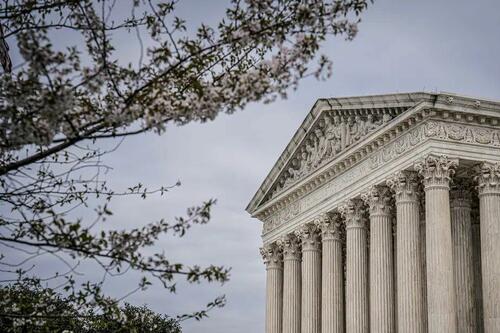
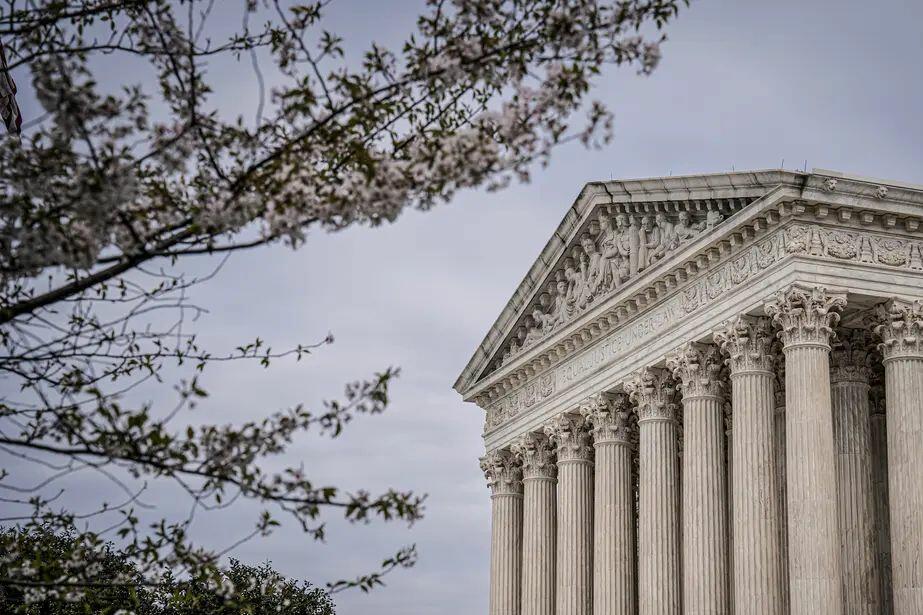
The Supreme Court in Washington on March 22, 2024. (Madalina Vasiliu/The Epoch Times)
The majority opinion, however, has been criticized for lacking clarity around how Congress should act. The decision emphasized the role of Congress in enforcing the 14th Amendment, while the three liberal justices and Justice Barrett favored a more limited approach that overruled state authority over federal candidates for office.
President Trump’s immunity appeal, scheduled for oral argument on April 25, could impact his Florida documents case and hush money trial, wherein he has requested a delay pending the Supreme Court’s decision on his D.C. immunity claims.
The stinging criticism that followed the court’s unanimous opinion in Trump v. Anderson indicates no matter how united the justices are, they will continue to face heavy scrutiny—especially when it comes to President Trump.
President Trump’s appeal, like Mr. Navarro’s, questions the separation of powers as well as the authority of the legislative and judiciary branches in challenging the executive.
In Trump v. Anderson, the court avoided wading into the specifics of President Trump’s alleged wrongdoing on Jan. 6 and will likely try to do the same with his immunity appeal. But their decisions in two other cases might impact the indictment in President Trump’s federal election case.
A challenge brought by Jan. 6 defendants against the DOJ’s use of an Enron-era obstruction charge in prosecutions will be heard before the high court on April 16.
In the federal election case, two of those charges were brought against President Trump. If the court rules in the defendants’ favor, as some legal experts predict, that could lessen the burden for President Trump in D.C. while also provoking scrutiny of the justices’ approach to Jan. 6.
The court’s decision in the presidential immunity appeal could similarly either upend or affirm the prosecution—likely sparking backlash from either side depending on the outcome.
Beyond Trump
Besides President Trump’s cases, the court is considering several major cases in administrative law—including potentially overturning the decades-old Chevron doctrine that gives deference to agencies in construing vague language in statutes. A reversal would significantly roll back the power of the administrative state.
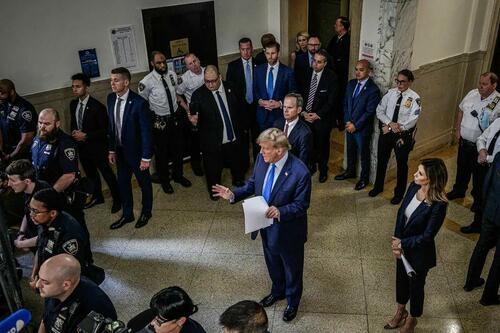
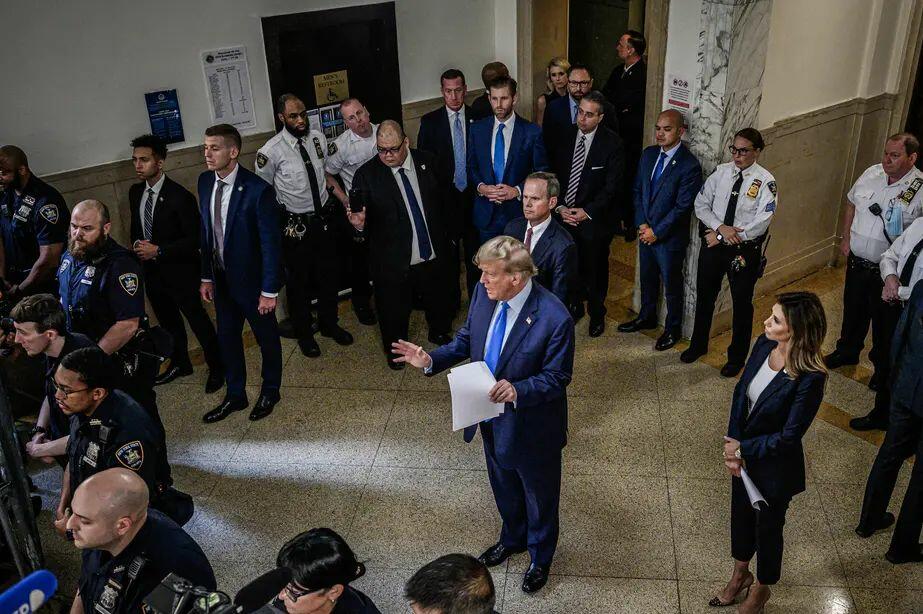
Former President Donald Trump talks to the press outside the courtroom at the New York State Supreme Court in New York City on Oct. 2, 2023. (Ed Jones/AFP via Getty Images)
In February, it considered whether the Justice Department legally restricted bump stocks. The case, Garland v. Cargill, was the second of three major gun-related cases announced for the term. Two—Cargill and Rahimi v. United States—could alter who owns guns and how they operate them. The third, NRA v. Vullo, could make it easier or more difficult for governments to pressure organizations like those promoting gun rights.
The justices also heard arguments over the constitutionality of two sweeping social media laws from Texas and Florida that, combined with similar cases this term, could dramatically change the landscape of online expression.
In striking those laws, the justices could prevent future state legislation aimed at how social media platforms moderate users’ content and the transparency they provide for censoring certain posts. If laws succeed, social media platforms could see a patchwork of rules for moderating users’ content across the United States and enjoy less discretion in how they do so.
“These are cases that touch upon separation of powers and important constitutional rights, in addition to involving ‘hot button’ issues that will have a major impact on the law now and in the future,” Mr. Malcolm told The Epoch Times.
Court’s Image
With such contentious issues before the court, it seems inevitable that the justices’ decisions will upset large swaths of the American public. The justices could also be weighing how the way they phrase rulings will impact public opinion during such a high-stakes year.
University of Michigan Law Professor Barbara McQuade previously told The Epoch Times she imagined that with Trump v. Anderson, Justice Roberts felt pressure to “maintain the credibility of the Court as an independent and apolitical institution.”
She said “a 9–0 decision would provide the country with far more confidence than would a 6–3 decision.”
Justice Barrett emphasized the importance of unanimity and language while appearing to offer a glimpse into the justices’ concerns. Her concurring opinion in Trump v. Anderson seemed to criticize her colleagues for lacking restraint in their opinion. She had joined the liberal justices in favoring a more limited approach but didn’t sign onto their concurrence, which had some strong words for the majority.
“In my judgment, this is not the time to amplify disagreement with stridency,” she wrote. “The Court has settled a politically charged issue in the volatile season of a Presidential election. Particularly in this circumstance, writings on the Court should turn the national temperature down, not up. For present purposes, our differences are far less important than our unanimity: All nine Justices agree on the outcome of this case. That is the message Americans should take home.”
The upcoming election will likely be less about changing voters’ minds and more about rousing the faithful and getting them to the polls.
America’s students, who according to an analysis by Tufts University helped elect Biden in key swing states in 2020, could prove to be pivotal in this regard, both as targets and as foot soldiers in the party’s get-out-the-vote drives.
Meanwhile, a lawsuit currently moving through Wisconsin courts appears to provide a case study for how these campaigns translate into election wins for the Democratic Party.
In February, Vice President Kamala Harris highlighted that the government is paying college students to register voters.
“We have been doing work to promote voter participation for students. And, for example we … now allow students to get paid through Federal Work Study to register people and to be nonpartisan poll workers,” she said.
Ms. Harris said the Biden administration has been able “to charge federal agencies with doing the work that they rightly can do to inform the American people of their right to vote.”
Paying students to canvass is the latest component of an initiative originated under former President Barack Obama to increase student voting. Initially this was carried out in conjunction with private nonprofit organizations such as Civic Nation.
Founded with the support of President Obama, his wife, and Joe Biden in 2015, and led by former Obama staffers, Civic Nation now boasts a partnership with 1,700 colleges and universities and a reported budget of more than $16 million in 2020.
Its stated goal is “fighting for gender equity, social justice, and more,” and it leads the “All In Campus Democracy Challenge” that engages with university administrators to get them to sign up student voters.
All In runs school get-out-the-vote competitions in all 50 states. According to its website, it has partnered with 994 institutions and signed up more than 10 million students. As part of the “challenge,” schools agree to share student voting data.
Civic Nation receives much of its funding from a network of progressive charitable funds managed by Arabella Advisors, which oversees a network of nonprofit vehicles that finance left-wing political campaigns.
Under the Biden administration, however, the student get-out-the-vote campaign is now being run with federal funds, spearheaded by the U.S. Department of Education.
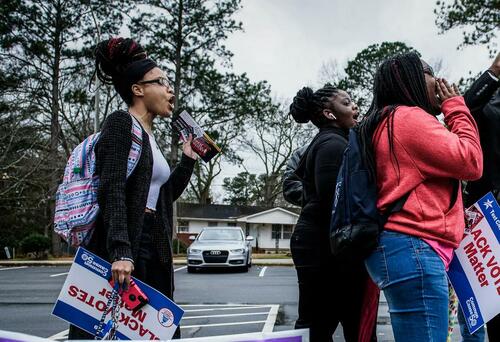
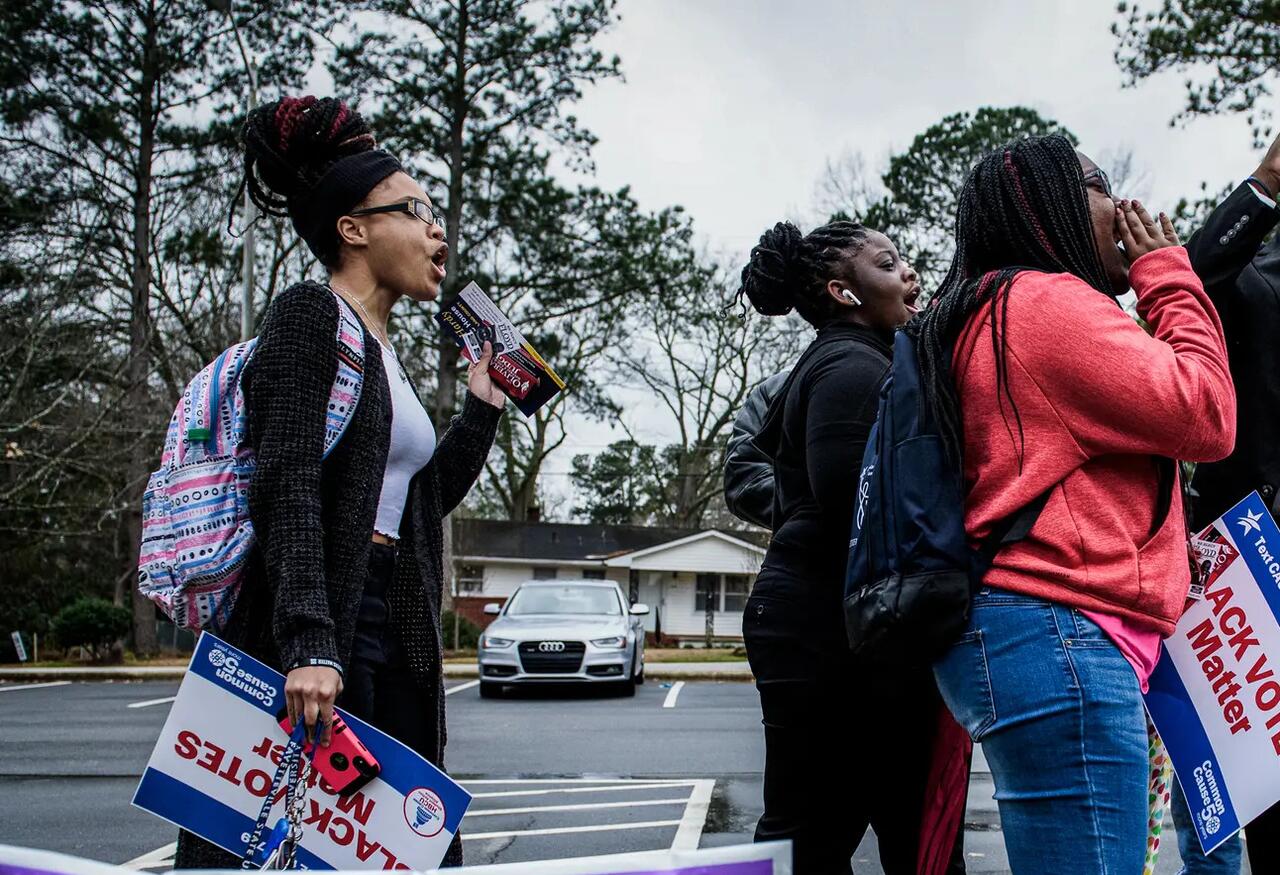
Fayetteville State University student NAACP chapter president Ty Hamer (R) leads a call as students walk to vote in Fayetteville, N.C., on March 3, 2020. (Melissa Sue Gerrits/Getty Images)
Executive Order Backed by Federal Funds
President Biden’s Executive Order 14019 compels all government agencies to take part in a nationwide effort to register voters and includes a program by the Department of Education (DOE) that pressures educational institutions to demonstrate that they have signed up students to vote.
Following the issuance of EO14019, the DOE sent schools a “Dear Colleague Letter” to “remind institutions of higher education of the federal requirements regarding voting that are tied to participation in federal student aid programs.”
The letter, according to the DOE, also clarifies when Federal Work Study dollars can be used “for nonpartisan civic engagement work.”
According to a 2022 report by Tufts University’s Center for Information and Research on Civic Learning and Engagement (CIRCLE), “youth ages 18–29 are the only age group in which a strong majority supported Democrats.”
Up until 2002, the youth vote was evenly split between the two parties, the report stated, but since that time young people have shifted sharply in favor Democrats by what is now a 28-point margin. The get-out-the-vote campaigns do not target all young voters equally, however. Instead, they focus their efforts on the most reliable Democrat voters—those who attend college.
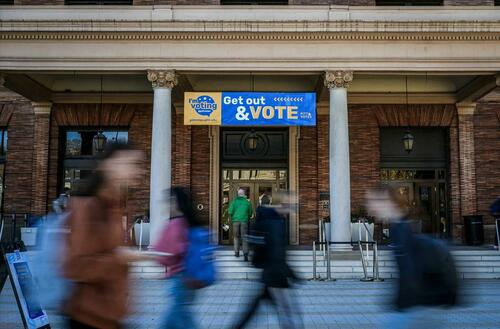
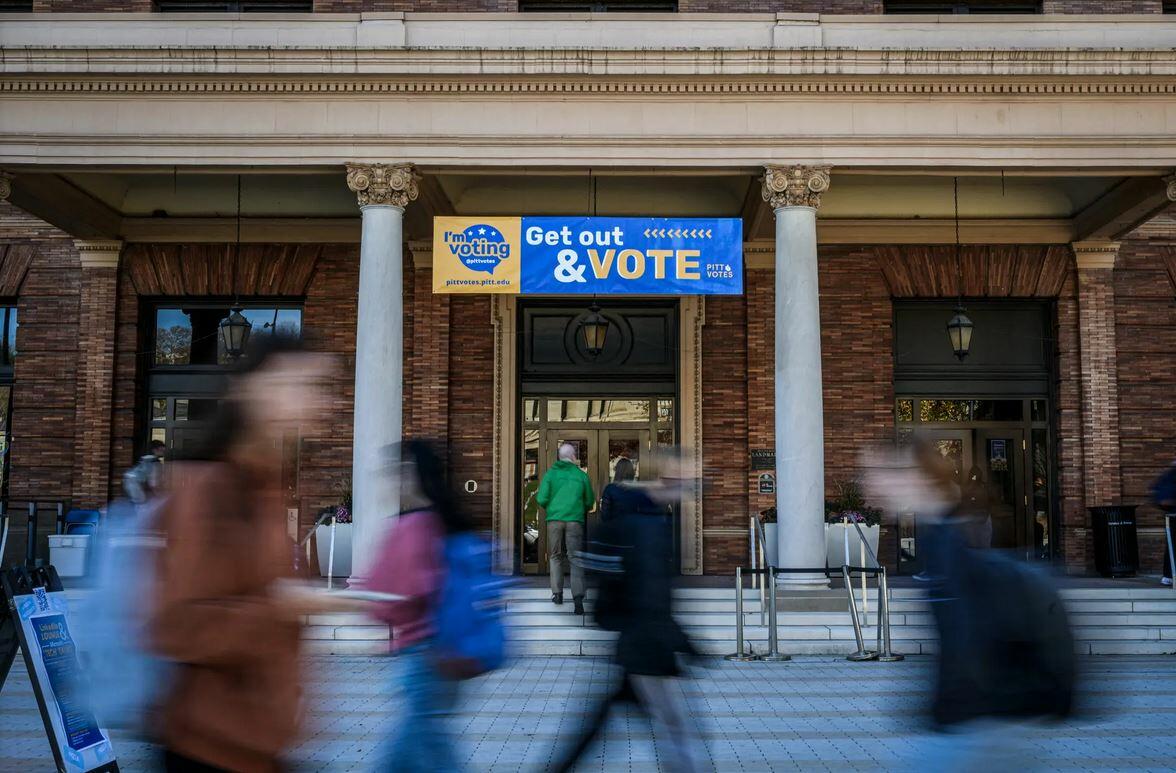
Students walk past a polling site at the University of Pittsburgh during the midterm election, in Pittsburgh, Pa., on Nov. 8, 2022. (Angela Weiss/AFP via Getty Images)
A 2020 survey by Pew Research found that the single largest voter gap in favor of Democrats was white college-educated women, of whom 62 percent voted Democrat versus 34 percent who voted Republican. Conversely, non-college white men favored the Republican Party by a margin of 32 points, with 62 percent for Republicans and 30 percent for Democrats.
“Democrats increasingly dominate in party identification among white college graduates,” the report states. “Republicans increasingly dominate in party affiliation among white non-college voters.”
Students Vote Like Their Teachers
A 2020 report by the National Association of Scholars found that Democrat-registered professors outnumbered Republican-registered professors by a ratio of 10-to-1, a gap that has widened from 4.5-to-1 in 1999.
“Research since World War II has consistently found overwhelmingly left-oriented political attitudes and ideological self-identification among college and university faculty,” the Association states. “It has also found overwhelming support for the Democratic Party.”
The other factor that makes the college vote so attractive to Democrats is the location of college students in key swing states, where a few thousand votes can deliver a win in a tight election. For this reason it may not be coincidental that the youth turnout rate has been much higher in swing states than non-swing states.
The CIRCLE report found that among the highest states for youth voter turnout were Michigan, Minnesota, Pennsylvania, Arizona, Colorado, Maine, Nevada, and Georgia. In Michigan and Pennsylvania, for example, 36.5 percent and 31.7 percent of residents under the age of 29 voted in 2022.
This contrasts sharply with neighboring non swing states such as West Virginia (14.2 percent), Delaware (18.7 percent), New Jersey (20.6 percent), Ohio (21.6 percent), Connecticut (21.4 percent), New York (20.7 percent), and Massachusetts (18.5 percent). Oregon, a reliable blue state, bucked this trend with 35.5 percent youth turnout.
The claim is outlined neatly by Josep Borrell, the EU’s foreign affair and security rep, in his mid-March bluster that“starvation is used as a weapon of war. Israel is provoking famine.”
But the data suggests that this, like so many other claims against Israel, is simply incorrect.
For starters, nearly 300,000 tons of food and beverages have been delivered to Gaza since the start of the war.
That alone, under parameters established by the United Nations Food and Agriculture Office, should be enough to secure approximately half of Gazans’ food needs on its own (assuming they get fully distributed).
Plus, the vast majority of Gaza’s greenhouse acreage was still available as of mid-February (per the latest UN survey) — and the Strip was exporting fruit and vegetables until Hamas broke the ceasefire with its Oct. 7 mass terror attack on Israel.
And all the fighting and bombing has focused on urban areas, where Hamas’ 600 miles of tunnels and bases are concentrated.
Note, too, that President Biden’s plan to build a pier off Gaza to provide some 2 million meals per day was first suggested by none other than Israeli Prime Minister Benjamin Netanyahu in the first weeks of the war.