Search This Blog

Saturday, April 6, 2024

How Much Treasury Issuance Does the US Add Every Month to Finance Debt?

 Let’s investigate US treasury debt issuance by month and year.

Data courtesy of SIFMA, chart by Mish

Chart Notes

  • Bills: Treasury bills are short term debt ranging from four weeks to 52 weeks. Bills are sold at a discount or at par (face value). When the bill matures, you are paid its face value.
  • Notes: Treasury Notes have terms of 2, 3, 5, 7, or 10 years. Notes pay a fixed rate of interest every six months until they mature.
  • Bonds: Treasury Bonds have a term of either 20 or 30 years. Bonds pay a fixed rate of interest every six months until they mature.
  • TIPS: Treasury Inflation Protected Securities (TIPS) are designed to protect against inflation. Unlike other Treasury securities, where the principal is fixed, the principal of a TIPS can go up or down over its term.
  • FRN: Floating Rate Notes (FRNs) are relatively short-term investments that mature in two years, pay interest four times each year, have an interest rate that may change or “float” over time.

The above descriptions from Treasury Direct.

Cumulative Issuance

  • From 2013-2019 the total amount of treasuries outstanding rose from $11.854 trillion to $16.663 trillion. That’s an increase of $4.809 trillion in six years.
  • From 2019-2023 the total amount of treasuries outstanding rose from $16.673 trillion to $26.366 trillion. That’s an increase of $9.693 trillion in four years.

Net Treasury Issuance Change From Year Ago

The years of under $1 trillion issuance have come and gone. One might have thought the pandemic surge was over, but thanks to Biden’s inflation reduction act another surge is underway.

Net Treasury Issuance Change From Month Ago

Over the last 12 months treasury issuance is at an average pace of $211 billion a month, a total of $2.536 trillion.

Most of the issuance is short-term Treasury Bills which will keep getting rolled over because we certainly are not paying down any debt.

There’s also steady steam of Treasury Bond issuance between $30 and $45 billion a month.

Pending in Congress

President Biden along with warmongers in both parties want to spend another $100 billion on Ukraine and Israel with no strings attached.

The Wall Street Journal constantly moans about deficit spending except for every warmongering project it sees.

I wrote about these Op-Eds this morning in Hoot of the Day: WSJ Complains of Biden’s Inability to Use the Bully Pulpit

Child Tax Credit Expansion

Amazingly, House Republicans got suckered into child tax care credit expansion.

On January 17, I asked How Much Will That GOP Deal on Child Tax Credits Really Cost?

The unfortunate answer is $1.5 trillion over ten years.

Transfer Receipts

Data from BEA’s personal Income and outlays report. Real means inflation adjusted. Chart by Mish.

What Are Transfer Receipts?

Transfer receipts are government payments for which no services were performed.

With every recession, transfer receipts as a percentage of real personal income rises.

For discussion, please see How Much Do Food Stamps, Social Security, and Medicare Support the Economy?

Some objected to my comment “Transfer receipts are government payments for which no services were performed.” Sorry, but that’s the definition.

Regardless of how anyone feels, Social Security and Medicare are about to explode.

Employment in Age Groups 60+ Will Drop by ~12.5 Million

Due to age demographics, I expect employment in age groups 60 and over to decline by about 12.5 million. Let’s go over the math to see how I arrived at that number.

Population stats are from the BLS. Expected Employment Loss is a Mish calculation based on the Employment Population Ratio (the percentage of people working in each age group).

For discussion, please see In the next 5 years employment in age groups 60+ will drop by ~12.5 million

12.5 million boomers will stop working and start collecting Social Security and Medicare.

US Treasury issuance is poised to soar. The Fed thinks inflation will be under control. I think otherwise.

https://mishtalk.com/economics/how-much-treasury-issuance-does-the-us-add-every-month-to-finance-debt/

Combating "Hate": The Trojan Horse For Precrime

 by Conor Gallagher via Naked Capitalism,

Philip K. Dick’s 1956 novella The Minority Report created “precrime,” the clairvoyant foreknowledge of criminal activity as forecast by mutant “precogs.” The book was a dystopian nightmare, but a 2015 Fox television series transforms the story into one in which a precog works with a cop and shows that data is actually effective at predicting future crime.

Canada is trying to enact a precrime law along the lines of the 2015 show, but it is being panned about as much as the television series. Ottawa’s online harms bill includes a provision to impose house arrest on someone who is feared to commit a hate crime in the future. From The Globe and Mail:

The person could be made to wear an electronic tag, if the attorney-general requests it, or ordered by a judge to remain at home, the bill says. Mr. Virani, who is Attorney-General as well as Justice Minister, said it is important that any peace bond be “calibrated carefully,” saying it would have to meet a high threshold to apply.

But he said the new power, which would require the attorney-general’s approval as well as a judge’s, could prove “very, very important” to restrain the behaviour of someone with a track record of hateful behaviour who may be targeting certain people or groups…

People found guilty of posting hate speech could have to pay victims up to $20,000 in compensation. But experts including internet law professor Michael Geist have said even a threat of a civil complaint – with a lower burden of proof than a court of law – and a fine could have a chilling effect on freedom of expression.

While this is a dangerous step in Canada, I also wonder if this is where burgeoning “anti-hate” programs across the US are headed. The Canadian bill would also allow “people to file complaints to the Canadian Human Rights Commission over what they perceive as hate speech online – including, for example, off-colour jokes by comedians.”

There are now programs in multiple US states to do just that –  encourage people to snitch on anyone doing anything perceived as “hateful.”

The 2021 federal COVID-19 Hate Crimes Act began to dole out money to states to help them respond to hate incidents. Oregon now has its Bias Response Hotline to track “bias incidents.”

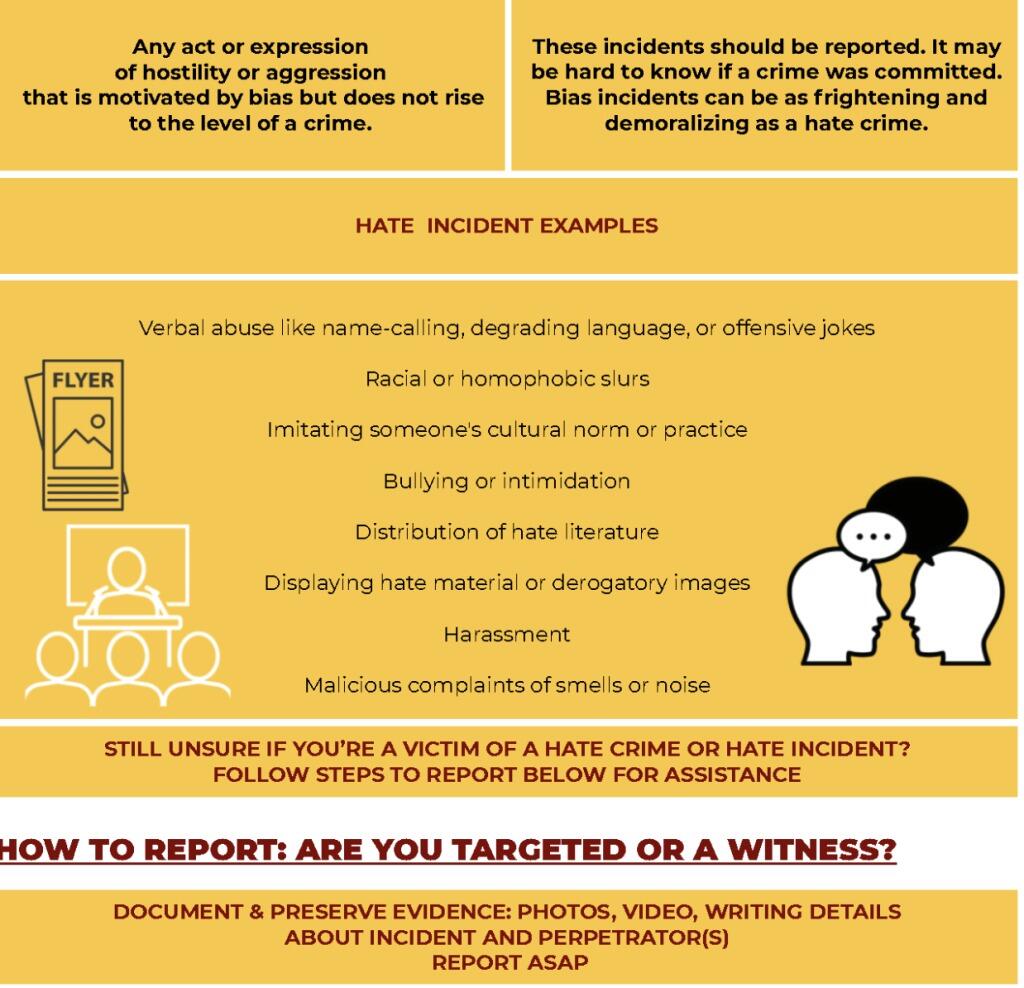
In December of 2022, New York launched its Hate and Bias Prevention Unit. Maryland, too, has its system – its hate incidents examples include “offensive jokes” and “malicious complaints of smell or noise.”
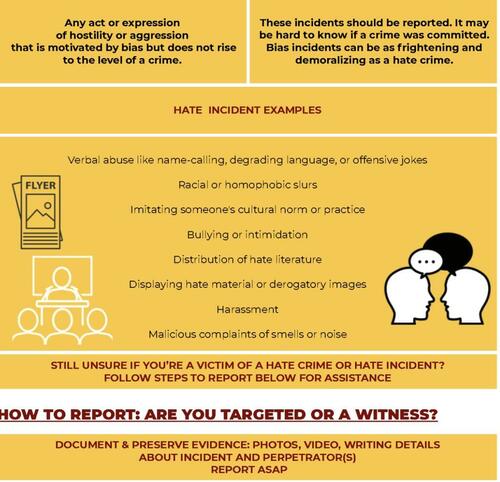
Maryland also has its Emmett Till Alert System that sends out three levels of alerts for specific acts of hate. For now, they only go to black lawmakers, civil rights activists, the media and other approved outlets, but expansion to the general populace is under consideration.

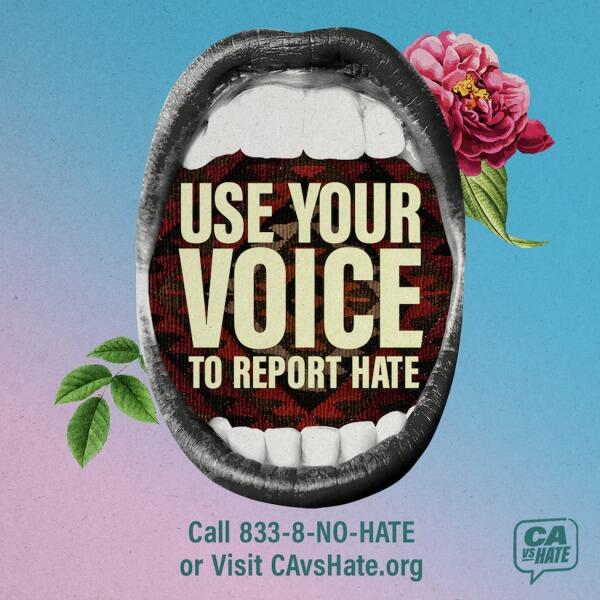
California vs. Hate, a multilingual statewide hotline and website that encourages people to report all acts of “hate,” is coming up on its one-year anniversary, reportedly receiving a mere 823 calls from 79% of California’s 58 counties during its first nine months of operation. It looks like the program is rolling out even more social media graphics in a bid to get more reports:
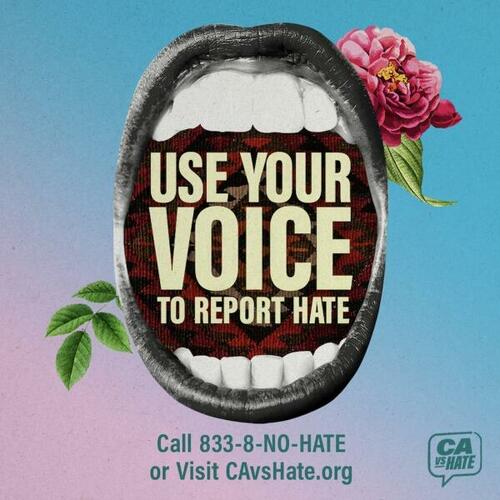
A key question is why states like California are rushing to expand the definition of hate. Officials in the Golden State like Governor Gavin Newsom claimed it was because of a rise in reported hate crimes – up 33 percent from 2020 to 2021. A deeper look at the data, however, shows that Newsom is guilty of cherry picking. From Public:

But convictions of hate crimes have been flat. In 2012 there were 107 hate crime convictions in California. In 2021, there were 109, according to the same data. It’s possible that hate crimes really did rise by 80%, and juries decided not to give prosecutors convictions. …But it’s also possible that convictions stayed the same because there was no increase in prosecutable hate crimes. And it may be that Californian prosecutors simply labeled more crimes as “hate” crimes because they were primed to do so by the media’s 700% – 1,000% increased focus on racism between 2011 and 2020.

I’m likely omitting other states with similar programs, but it’s clear that there is a push across the country. No doubt, these efforts to eliminate hate also have other benefits for the ruling class.

In a state like California or New York, there is the added bonus that the program ends up being a massive giveaway to a key part of the Democratic base – the nonprofit industrial complex that is helping to bring this system into existence.

These programs also help spread fear that hate is around every corner, which could allow for an erosion of rights under the guise of eradicating “hate.”

There’s also the issue of who is providing the definitions for hate that go beyond the laws already on the books for hate crimes. The California Senate Public Safety Committee analysis stated the following about the CA vs. Hate program:

A hate incident is an action or behavior motivated by hate but legally protected by the First Amendment right to freedom of expression.

That leads to the question of why the state is encouraging people to report and is collecting information on legally protected “behavior.” And where does the expanded definition come from? The committee stated the following:

Define hate incidents with language provided by the Anti-Defamation League.

The Anti-Defamation League (ADL) is a non-governmental organization based in the US, whose stated mission is “to stop the defamation of the Jewish people, and to secure justice and fair treatment to all.”

But there’s a little more to it than that. In May 2022, Jonathan Greenblatt, CEO of the ADL, announced that, “Anti-Zionism is anti-Semitism.” He also labeled groups that want equal rights for Palestinians in Israel as “extremists” and likened Israel critics to white supremacists. More from Boston Review:

…the ADL has consistently sought to undermine the left, leveling a charge akin to dual loyalty: that the American left’s calls for redistribution of power, its solidarity with global movements, and its prioritization of people over states threaten the very concept of the state. Indeed the ADL, in addition to its stated mission of shoring up U.S. support for Israel, is deeply loyal to the U.S. state. The second is that the ADL has waged a long, vigorous, and successful campaign, alongside AIPAC, specifically to characterize Arab American political organizing as dual loyalty.

Maybe this isn’t an organization that should be defining hate for US governments. We have the International Holocaust Remembrance Association (IHRA) for that.

In March South Dakota became the 35th state to codify the IHRA’s working definition of antisemitism. The law requires the consideration of the definition of antisemitism when investigating unfair or discriminatory practices.That definition includes the traditional elements of antisemitism but also inserts elements that could move the state of Israel under antisemitic protections. Consider the following from the IHRA’s definition:

  • Denying the Jewish people their right to self-determination, e.g., by claiming that the existence of a State of Israel is a racist endeavor.

  • Applying double standards by requiring of it a behavior not expected or demanded of any other democratic nation.

  • Drawing comparisons of contemporary Israeli policy to that of the Nazis.

A 2022 UK study published in Springer Nature found the following about the IHRA’s definition:

…pro-Israel activists can and have mobilised the IHRA document for political goals unrelated to tackling antisemitism, notably to stigmatise and silence critics of the Israeli government. This causes widespread self-censorship, has an adverse impact on freedom of speech, and impedes action against the unjust treatment of Palestinians. We also identify intrinsic problems in the way the definition refers to criticism of Israel similar ‘to that leveled against any other country’, ambiguous wording about ‘the power of Jews as a collective’, lack of clarity as to the Jewish people’s ‘right to self-determination’, and its denial of obvious racism.

Despite that effect, and despite the 2021 Hate Crimes Act, which provided more money and more programs to collect data on all “hate incidents,” there are still complaints that it all still isn’t enough because they don’t prevent “hate” but only address what takes place afterwards. To fix that, a precrime system will be necessary.

***

Predictive policing – which uses computer systems to help direct the deployment of police to crime hotspots – has been widely discredited as biased and worthless.

The Markup found that predictive policing does not work – at all. It took a look at efforts by Geolitica, known as PredPol until a 2021 rebrand, and its software that ingests data from crime incident reports and produces daily predictions on where and when crimes are most likely to occur. From The Markup:

We examined 23,631 predictions generated by Geolitica between Feb. 25 to Dec. 18, 2018 for the Plainfield Police Department (PD). Each prediction we analyzed from the company’s algorithm indicated that one type of crime was likely to occur in a location not patrolled by Plainfield PD. In the end, the success rate was less than half a percent.

It is also biased, despite efforts to make it less so. MIT Technology Review points out:

…many developers of predictive policing tools say that they have started using victim reports to get a more accurate picture of crime rates in different neighborhoods. In theory, victim reports should be less biased because they aren’t affected by police prejudice or feedback loops.

But a University of Texas study found this method still led to significant errors:

 For example, in a district where few crimes were reported, the tool predicted around 20% of the actual hot spots—locations with a high rate of crime. On the other hand, in a district with a high number of reports, the tool predicted 20% more hot spots than there really were.

While these predictive policing spatial models prove biased, what if to counter those criticisms you begin to roll out programs to “protect” minorities by preventing hate crimes? Could an approach that treats each individual as a collection of data points (including any “hate incidents”) be predictive of a future hate crime?

Efforts to do just that date back to at least the early 1970s. When UCLA tried to set up a center for the study of violence.The Center for the Long-Term Study of Life-Threatening Behavior was intended to re-think human functioning itself in terms of data and was going to compile behavioral data to understand crimes that were “in formation.”

The center never officially opened its doors, however, as it got caught in the backlash against psychosurgery when groups like the Black Panthers and Nader’s Raiders protested against it.

But the rethink of humans as a collection of data points that can predict crimes in formation never really went away, and is now inching closer to becoming a reality. What is Canada’s proposed law other than a method to use data to measure “dangerousness” and preemptively punish suspects?

As MIT Technology Review pointed out above, there are efforts underway to use victim reports to counteract bias, but the University of Texas study was still trying to use them to predict where a crime might occur and not who might commit the crime.

I should point out that it’s unclear what states are doing with all the info collected from reported hate incidents, particularly the details on the alleged perpetrators. I reached out to the California Civil Rights Division weeks ago to get an answer but have yet to receive a response.

There is a clear line of thinking that these hate incidents can be predictive of future crime, however. That’s what the Canadian bill claims. Back in 2019 NYU researchers claimed to use AI to show that “online hate” could be predictive of offline violence. Could all these efforts to gather data on hate “incidents” be laying the groundwork for precrime detention along the lines of what Canada is attempting?

For those who would like to see the adoption of a precrime system, one of the benefits of focusing on individuals and hate crimes is that it could help diffuse the bias criticism of predictive policing from groups typically suspicious of increased law enforcement powers. Indeed, many of the groups helping to implement the hate incident hotlines in US states are nonprofits focused on minority groups.

As the state efforts above show, the definition of what constitutes a bias or hate “incident” are slippery and many interested parties would like to shape that definition. Again, there are already hate crime laws on the books, and I have yet to encounter an explanation for why these laws are so ineffective that it’s necessary to encourage people to rat on one another in order to gather data on hate incidents.

Placed alongside burgeoning censorship efforts, it begins to make more sense. If we look at Canada’s effort to establish official pre-hate-crime law enforcement, it’s one that would mark the official end of free speech and lead to a dystopian society revolving around the fear of being targeted – either by an individual or AI.

Even without official precrime laws on the books, there are already ways that these efforts to combat “hate” are attempting to stifle speech. Naked Capitalism readers don’t have to look far for errors (or intentional targeting) in this system as Google’s AI targeted this site for “hateful content” among other alleged sins.

And there’s the issue with “hate.” It could mean a racist comment or action; it could also now refer to criticism of Israeli policy or a thought crime against the ruling class. It apparently does not refer to elite policy in California, for example, where the gap in life expectancy between the richest and poorest percentiles increased to 15.51 years in 2021 (which seems like the hateful result of hateful policies if you ask me). What happens if Californians begin to make hateful comments about that fact?

We don’t have to only look to fiction like Minority Report for answers. California’s own history provides a great example of the real use of these burgeoning programs to purportedly combat “hate.”

The California Criminal Syndicalism Act of 1919 prohibited speech that suggested the use of violence for political aims. It came at a time when workers were winning important battles in the class war raging across the state. California started locking up Wobblies en masse. As Malcolm Harris describes in his book Palo Alto:

Wobblies filled San Quentin, the Bay Area’s only prison, on bullshit charges that could hold them for up to 14 years. In Southern California, the police teamed with a resurgent KKK to bust the waterfront union, and the IWW was lucky if the cops decided to merely stand by and watch. …By the end of the decade, the state organization was jailed and beaten into submission.

https://www.zerohedge.com/political/combating-hate-trojan-horse-precrime

Biden Admin Installs New Rule Making It Harder To Fire Bureaucrats

 by Tom Ozimek via The Epoch Times (emphasis ours),

The Biden administration has issued a new rule that makes it harder to fire government employees in an apparent bid to thwart former President Donald Trump’s pledge to fire “rogue bureaucrats” and radically reshape the federal workforce.

The new rule, which bolsters job protections for career civil servants, was issued on April 4 by the U.S. Office of Personnel Management (OPM), which hinted in a statement that it’s targeting a promised move by a potential second Trump presidency to “drain the swamp and root out the deep state” by making it easier to fire government workers.

“In the first week of the Biden-Harris Administration, President Biden revoked an Executive Order issued by the previous Administration that risked altering our country’s long-standing merit-based civil service system, by creating new excepted service schedule, known as ‘Schedule F,’ and directing agencies to move potentially large swathes of career employees into this new excepted service status,” OPM said in the statement.

This is in reference to a Trump-era executive order issued in 2020 that allowed tens of thousands of the 2.2 million federal employees to be reclassified as political appointees, making it easier to fire them.

‘Root Out the Deep State’

Roughly 4,000 federal employees are now considered political appointees, who typically change with each administration, with the revival of a Schedule F potentially increasing that more than tenfold.

President Joe Biden nixed the Schedule F order when he took office, while President Trump said in mid-2022 that he would try to revive the concept in one form or another.

“We need to make it much easier to fire rogue bureaucrats who are deliberately undermining democracy or at a minimum just want to keep their jobs,” President Trump said in a speech at the America First Policy Institute on July 26, 2022, promising to “drain the swamp and root out the deep state.”

The former president went further in his speech, calling on Congress to pass laws that would give the commander-in-chief the authority to fire any government employee basically at will.

Congress should pass historic reforms empowering the president to ensure that any bureaucrat who is corrupt, incompetent, or unnecessary for the job can be told ‘you are fired, get out,’” he said, adding that, after such reforms, Washington would be an “entirely different place.”

Later on the campaign trail, President Trump repeatedly hinted at his intention to make good on this promise. His remarks dovetail with a long-standing desire on the part of many Republicans to prune what they say is a bloated, inefficient and, in many cases, counterproductive federal bureaucracy.

Many Democrats, on the other hand, see the potential revival of a Schedule F or similar initiative as a threat to the operations of government and a potential disruption to the provision of critical services.

“This final rule honors our 2.2 million career civil servants, helping ensure that people are hired and fired based on merit and that they can carry out their duties based on their expertise and not political loyalty,” OPM Director Kiran Ahuja said in a statement.

“The Biden-Harris Administration is deeply committed to the federal workforce, as these professionals are vital to our national security, our health, our economic prosperity, and much more.”

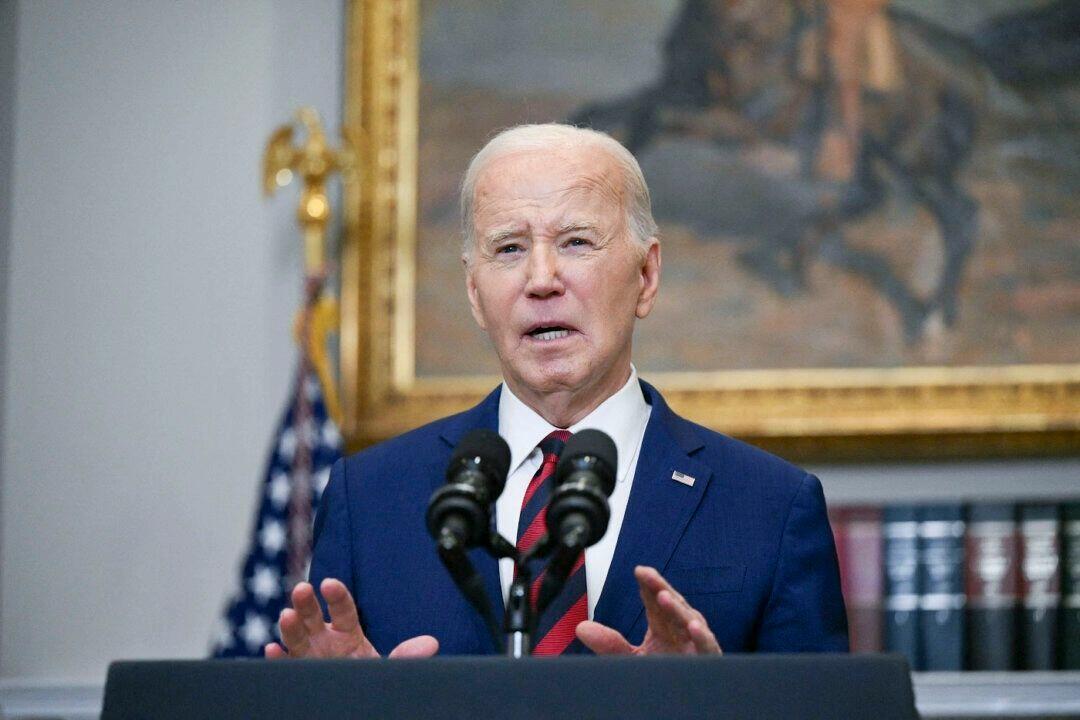
President Joe Biden addresses the Baltimore bridge collapse in the Roosevelt Room of the White House on March 26, 2024. (Pedro Ugarte/AFP via Getty Images)

The new rule, which is nearly 240 pages long, apparently seeks to put up a roadblock to prevent President Trump, or anyone else for that matter, from issuing another executive order that would reclassify civil servants.

The White House didn’t respond to a request for comment by press time.

Trump campaign spokesperson Karoline Leavitt pointed to President Trump’s Agenda 47 plan to “dismantle the deep state and return power to the American people,” which includes an explicit pledge to re-issue the 2020 executive order, “wield that power aggressively,” and “fire rogue bureaucrats.”

What’s in the New Rule?

The rule, which is being published in the federal registry and is set to take effect next month, is poised to counter a future Schedule F executive order by entrenching the status and civil service protections accrued by federal employees.

It stipulates that the job protections accrued by a government worker cannot be taken away by an involuntary move from the competitive service (appointments that are subject to OPM hiring rules and pay scales) to the excepted service (appointments that follow a separate, often more streamlined hiring process).

Similarly, moves from one excepted service schedule to another would not strip federal employees of those protections under the new rule.

“Once a career civil servant earns protections, that employee retains them unless waived voluntarily,” the OPM said in a statement.

The rule also makes clear that policymaking classifications apply to noncareer and political appointments and cannot be applied to career civil servants.

Specifically, the new rule stipulates that the phrase “confidential, policy determining, policymaking, or policy-advocating” positions (which describe positions lacking civil service protections) can be used to refer only to noncareer, political appointments and may not be applied to career civil servants to strip them of protections.

The final rule also establishes new procedural requirements for moving positions from the competitive service to the excepted service and within the excepted service. In particular, it creates an appeals process for federal employees when any such movement is involuntary and involves stripping workers of their civil service protections.

“This final rule builds on three years of the Biden-Harris Administration’s efforts to strengthen federal agencies and the federal workforce,” OPM Deputy Director Rob Shriver said in a statement.

The agency said it had reviewed more than 4,000 comments submitted during the public comment period as part of the rulemaking process.

https://www.zerohedge.com/political/biden-admin-installs-new-rule-making-it-harder-fire-bureaucrats

NATO Seeking To 'Trump Proof' Future Ukraine Funds

 When NATO Secretary-General Jens Stoltenberg this week unveiled a $100 billion, five-year fund for Ukraine which he pitched to alliance foreign ministers in preparation for the July annual summit, a number of pundits and publications immediately saw through it...

NATO leadership is ultimately seeking to "Trump-proof" support for the Ukraine war amid growing 'fears' the GOP frontrunner will take the White House after November, after which he's expected to pull the plug on Biden's billions for Ukraine.

Well-known career diplomat Chas Freeman told Responsible Statecraft that this scheme is "a case of throwing good money—in this case, borrowed money—after bad."

Freeman explained, "NATO has run out of Ukrainians to sacrifice on the battlefield as well as the armaments production needed to equip the existing, greatly depleted Ukrainian armed forces. A bond fund will neither create more Ukrainians nor produce more weapons to arm those who have so far survived."

Stoltenberg has been fairly transparent about his aims, with the Financial Times saying he's doing it as a means "to shield the mechanism against the winds of political change."

Freeman has commented further that what Ukraine and Europe really need "is peace, and this demands negotiations with Russia."

"This is a shameless attempt to use financial capitalism to avoid that reality, while further enriching munitions manufacturers. NATO is not a hedge fund and should not attempt to behave like one," he continued. "When alliances attempt to borrow money for lost causes, you would be right to judge that they know the jig is up."

As for Stoltenberg's words before NATO foreign ministers on Wednesday, he said Ukraine's government and military still has "urgent needs" and that "any delay in providing support has consequences on the battlefield as we speak."

"We must ensure reliable and predictable security assistance to Ukraine for the long haul so that we rely less on the voluntary contributions and more on NATO commitments, less on short-term offers and more on multiyear pledges," Stoltenberg said. "The reason why we do this is the situation on the battlefield in Ukraine. It is serious … We see how Russia is pushing, and we see how they try to win this war by just waiting us out."

But... as we reported previously, Hungary stands firmly in the way, having already announced its "opposition to increasing NATO’s coordination role in arms deliveries and training Ukrainian forces, refusing to participate in planning, operations, or funding," according to a foreign ministry statement.

https://www.zerohedge.com/geopolitical/nato-seeking-trump-proof-future-ukraine-funds

‘Misinformation’ Is the Censors’ Excuse

 The Supreme Court heard oral arguments last month in the momentous case of Murthy v. Missouri. At issue is the constitutionality of what government authorities did to censor speech that departed from preferred narratives.

Justice Ketanji Brown Jackson posed a hypothetical to Louisiana Solicitor General J. Benjamin Aguiñaga: “Suppose someone started posting about a new teen challenge that involved teens jumping out of windows at increasing elevations. . . . Kids all over the country start doing this. There is an epidemic. Children are seriously injuring or even killing themselves in situations. Is it your view that government authorities could not declare those circumstances a public emergency and encourage social media platforms to take down the information that is instigating this problem?”

Mr. Aguiñaga might have countered with a question of his own: What “information”? Whether government authorities would be justified in seeking to suppress such videos is an important question. But it isn’t a question about information, misinformation or disinformation.

What would be the correct information? If we rendered the video as a statement, it would be something like: It is valiant or cool to jump out of third-floor windows. That statement is foolish, wrongheaded, false. But “misinformation”? That is a category error.

What’s “cool” is no more a factual question than whether “Citizen Kane” or “Rear Window” is the better movie. What’s cool to confused kids is a matter of interpretation and judgment, which are far beyond mere information.

In Murthy, however, the government defends its actions in terms of combatting misinformation and disinformation. The administration and other practitioners and proponents of censorship thereby pretend that they are merely protecting the public from cut-and-dried falsehoods. In doing so, they misrepresent their actions and attempt to evade responsibility for arrogating to themselves the decision of what is safe and sound for people to see and hear.

In turn, they portray free-speech advocates as supporting falsehoods, even lies. The “misinformation” stratagem kneecaps them by trapping their objections in the limited dimension of information, forcing them to epistemologize to fight off censorship. Here we are, on the opinion page, talking about how information differs from interpretation and judgment.

The approach is attractive to censors because it flatters their vanity, frees them from accountability, and rigs the game against their opponents. Hubris built the Tower of Babel, and the result was semantic chaos. Today we see hubris and semantic chaos in censorship operations that claim to be combatting “misinformation.”

Knowledge can’t be flattened down to information. Once we appreciate the richness of knowledge, we see that anti-“misinformation” projects are miscarriages of civility, decency and the rule of law. We must rediscover the norms of openness, tolerance and free speech. Science, democracy, justice and everything else the censors purport to value depend on public confidence, and confidence depends on those liberal norms.

Mr. Klein is a professor of economics at George Mason University and author of “Misinformation Is a Word We Use to Shut You Up.”

https://www.wsj.com/articles/misinformation-is-the-censors-excuse-murthy-supreme-court-covid-social-media-27ccb7c8

Trump's Virtues Part II - Tom Klingenstein


TRUMP'S VIRTUES II TRANSCRIPT 

Now that former President Trump is the Republican nominee for President in 2024, it’s time for Republicans, including those who doubt him or even can’t stand him, to get behind him. The times demand it. 

We are in a war, fighting an enemy of revolutionaries that kick and spit on America. I call our enemy the “woke regime” or the “group quota regime.” This war is a contest between those who love America and those who hate it. But we do not have a commander-in-chief. You can’t win a war without one. 

We shouldn’t much care whether our commander-in-chief is a real conservative, whether he is a role model for children or says lots of silly things, or whether he is modest or dignified. What we should care about is whether he knows we are in a war, knows who the enemy is, and knows how to win. Trump does.

His policies are important, but not as important as the rest of him. Trump grasps the essential things. He understands that the group quota regime is evil and will not stop until it destroys America. He is a fighter—bold, brave, and decisive—who has confidence in himself and his country.

Trump never apologizes for America. He rightly believes America is the greatest country in history. Trump says, in effect, “We have our culture, it’s exceptional, and that’s the way we want to keep it. And we won’t keep it if we usher in millions of immigrants with cultures different from our own.” Trump knows his job is to protect Americans and just Americans. Protect them not just from enemies abroad but from the woke globalists within. He knows that America does not need more “diversity,” it needs more cohesion. 

The Woke radicals tell the Trump voters they are a threat to democracy. Think about that. They’re saying, “You Trumpsters are a threat to democracy.” The woke radicals also tell us ad nauseam that America is systemically racist. Trump knows this is deadly nonsense, and he says so. This charge of systemic racism bounces off Trump because he has no white guilt, or any guilt for that matter. Trump tells his supporters what they already know: They are not racist and they do not have white privilege. The woke radicals shut up those who disagree. Trump will not be shut up. If they manage to put him in jail, he will still roar like a lion. 

The woke radicals have the moral arrogance of fanatics. Trump—God bless him—knows we are all sinners. Trump rejects the utopian fanaticism of the woke radicals. He is a businessman who takes the world on its own terms and navigates by facts and common sense. 

Trump’s base knows first-hand the America that Trump wants to recover. They love him and they know he loves them. They will fight for him because they know he will fight for them.

Trump speaks to his supporters as fellow citizens without any condescension or poll-tested BS. Despite his billions, he is one of them, an outsider looking in, a man who takes ketchup on his steak; and is as disgusted as they are with the anti-America elite.

This natural appeal has created everyday patriotic Americans into an army. We cannot stop the Left’s revolution and retake the nation without these men and women. Unlike most conservatives, they will actually fight for America. But they follow Trump. Without him, they stay home. With him, they are united and determined.

At his rallies his audience invariably breaks into chants of “USA! USA!” In these moments Trump and his audience mutually pledge to each other their fidelity and their sacred honor.

His enemies hate him with an indescribable fierceness. “Another Hitler,” they say, “elect him and he will be a dictator.” We should take this hysteria as reason for hope. The America-haters rightly fear that he and his party are on the threshold of a successful counterrevolution.

Trump hates his enemies every bit as much as they hate him. His enemies are America’s enemies.

Trump is the most towering figure of our time. He has changed politics, not just in America but in the West. If we are to take back America, we need someone who is unmovable, who has proven that he can stand up against the immensely powerful army of woke modernity that will attack him with all its might, someone who will go after the deep state without pity or compassion and someone who has the conviction that America is still the last best hope of earth. That someone is Trump. 

Trump the politician came out of the blue. An unconventional commander against an unconventional enemy. Almost inconceivable as President at any other time, Trump fits this turbulent moment to a tee. Is it too much to wonder whether the appearance of this most unconventional man is providential? Lincoln spoke of Americans as the “almost chosen” people. Trump gives us hope that the God who has never forsaken his “almost chosen” people will not do so now.

Thank you.

Tom Klingenstein

https://tomklingenstein.com/video/trumps-virtues-part-ii/